And So It Begins
Once August is here the summer is basically over. Any marketer will tell you August isn’t the summer — it’s “August.” And that means contending with the likes of Must Love Dogs, Red Eye, The Dukes of Hazzard, Deuce Bigalow: European Gigolo, Four Brothers, Pretty Persuasion and The 40 Year-Old Virgin already.
And this means that out of lethargy or some kind of psychological avoidance pattern people like myself are shifting into a September frame of mind (Toronto Film Festival!), which will quickly feed into October and the dawning of Oscar season. And none too soon.
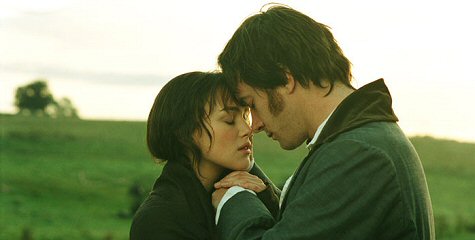
Matthew Macfadyen, Keira Knightley in Joe Wright’s Pride & Prejudice
I’ve seen 23 films so far this year that I’d call somewhere between very good and exceptional, and out of these I’d say six or seven (The Constant Gardener, Crash, Hustle & Flow, Mad Hot Ballroom, Grizzly Man, Match Point, A History of Violence) may penetrate in terms of screenwriting, acting or best feature doc nominations.
There are about another 30 or so films opening between now and December 31st that may qualify also, so figure 35 or so films and their creators competing for everyone’s consideration, and out of these maybe 10 or 12 will wind up in the final lap.
< ?php include ('/home/hollyw9/public_html/wired'); ?>
There’s very little I know right now but I’ve “heard” stuff, read some scripts, poked around and come up with some powerful hunches (Peter Jackson’s King Kong will only be up for only tech awards…heard that one?).
Let’s just jump into this and challenge some of those long-throw early-bird assumptions we’ve all been hearing from Dave Karger and David Poland and the like…prognosticators who, one gathers, are voicing some kind of assimilated community view. Let’s see about that.
Slap-Downs
Shakiest Presumed Best Picture Contender of All: Steven Spielberg’s Munich (Universal, 12.23) — I’m saying this because Spielberg isn’t a hardballer. He’s mushy at heart, and sentiment can swing either way at the drop of a hat, and is often a close relation of equivocation and accommodation. I’m seriously wondering if Spielberg has the cojones to handle this story about Mossad’s revenge upon the Palestinians behind the 1972 Munich killing of Israeli athletes without giving in to emotion or kowtowing to pro-Israeli sentiments by depicting the Palestinians as evil and subhuman.

Famous shot of Palestinian kidnapper during 1972 Munich Olympic Games standoff, almost certain to be used or recreated in some fashion in Steven Spielberg’s currently-rolling Munich (Universal, 12.23)
Munich costar Daniel Craig expressed the theme of this film as having something to do with the futility of revenge, but the hairs on the back of my neck are telling me Spielberg will finally go with a theme that says “revenge leaves a bitter aftertaste but when you’re eliminating some really wretched people who killed innocent Israeli athletes, it’s also kind of righteous.” If he doesn’t go this way and makes a film that, say, Costa-Gavras might have made in his late ’60s heyday, a lot of us will be delighted and amazed.
Jarhead isn’t Platoon — It’s More Like Full Metal Jacket . This was my guarded opinion after reading William Broyles, Jr.’s script last year. It may be something else entirely, its own thing, whatever…but I felt more of a dispassionate life-of-a-soldier thing than an emotional ride of any kind. I guess I’m just not feeling it quite yet, except for the reassuring notions of Sam Mendes (Road to Perdition, American Beauty) directing and Peter Sarsgaard costarring. (Universal, 11.11)
Second Shakiest Best Picture Contender: The Producers: The Movie Musical (Universal, 12.23). I say this because Susan Stroman, an obsequious Mel Brooks associate, is the director. If she follows Mel’s handbook to the letter the film will most likely wind up playing a little too something or other…broad, shameless, etc. (Mel Brooks was never Luis Bunuel.) Okay, there’s the Broadway and Tony Award momentum and yes, everyone loved the stage show and big brassy uppers sometimes do well with the Academy but c’mon….Susan Stroman?

Ziyi Zhang in Rob Marshall’s Memoirs of a Geisha
Heading For a Fall?: Memoirs of a Geisha (Columbia, 12.9) — This is one big-budget prestige movie that’s just waiting to get picked off because of the advance fatigue factor that I can sense all the way back here in Brooklyn. Ziyi Zhang as a woman from a Japanese fishing village who moves from one patron to the next and gradually becomes one of Japan’s most celebrated geishas…? See what I mean? Your eyelids are drooping as you read this.
There’s a premonition going around (I’m not the only one saying this) that it’s not going to play all that strongly with the public. And Rob Marshall having directed it is another grenade waiting to go off. The memory of Marshall’s Chicago having won the Best Picture Oscar over The Pianist two years ago still makes some of us twitch, and — honestly? — there would probably be a twinge of satisfaction in this corner if Memoirs of a Geisha were to fail, as a kind of payback-for-Chicago thing. An irrational, back-biting attitude? Sure, but unless Memoirs of a Geisha is some kind of masterwork such symmetrical notions may come into play.
Upticks
Has Cameron Crowe’s Time Arrived? — Neither Walter Parkes nor any Walter Parkes-minded uber-executive will have anything to say about the final shape of Elizabethtown (Paramount, 10.14) so maybe things will turn out this time for director-writer Cameron Crowe…better than they did with Almost Famous, I mean, which wasn’t fully appreciated until it came out on DVD as Untitled.
I read Elizabethtown way back when and I’m telling you it’s a peach, but I guess I shouldn’t be trusted, being a Crowe loyalist and all. This sad-funny story of a suicidal shoe designer (Orlando Bloom) getting in touch with his down-home Kentucky side during his father’s funeral and falling in love with Jean Arthur-like airline stewardess (Kirsten Dunst) definitely has the stuff. Crowe’s films dance to their own clock and work for their own reasons and they always pay off (except for Vanilla Sky), so I’m wondering why it even matters if the Academy gets on the bandwagon or not.
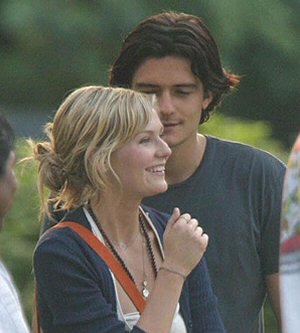
Orlando Bloom, Kirsten Dunst during filming of Cameron Crowe’s Elizabethtown (Paramount, 10.14)
Word is Just Starting on Pride & Prejudice, and While It May Not Be The Second Coming…: “I think when it comes to your Oscar forecasting you can’t ignore this one,” a New York journo told me this morning. “Focus has pushed it back to November so it will get more attention, and it deserves a look. It’s quite good with has a top-notch cast. I think Matthew Macfadyen is gonna get lots of attention as Mr. Darcy, and Brenda Blethyn looks like Supporting Actress material as Mrs. Bennet. Falco is handling.” Hey, Falco…can I see it? (Focus Features, 11.18)
Conceivables
* Terrence Malick’s The New World (New Line, 11.9) The script has heart and says all the right things. The trailer promises wonderful photography with that great pastoral particularity Malick is known for. Colin Farrell as Cpt. John Smith and what looks like a strong supporting turn by Christopher Plummer — these and other indicators are quite heartening.
* James Mangold’s Walk The Line (20th Century Fox, 11.18) Great performances, okay, but will Academy types feel a little funny about the notion of handing nominations to another period music bio one year after Ray? Is it fair to even bring this up? If a film works, it works.
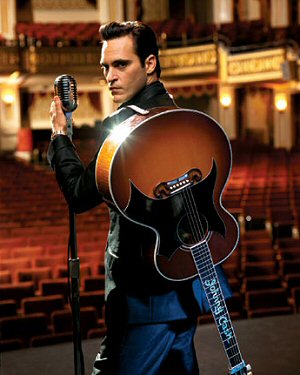
Joaquin Pheonix as Johnny Cash in Walk the Line (20th Century Fox, 11.18)
* All The King’s Men (Columbia, 12.16) Don’t know a damn thing about this except it’s apparently a modern take on the Robert Penn Warren novel about the rise and all of a Huey Long-like southern politician. Sean Penn has to be fantastic in the lead role, but why after every acting job does he always say he’s taking two years off because he’s burned out? (I’m burned out myself, but I can’t afford to take even a week off. Guess that’s the difference between being a big-time actor and a journalist, huh?)
Buckshot
I could spend another several hours on this thing, but it’s almost 2 pm in New York and I can’t…
* Ask The Dust (Paramount Classics, December) — Labor of love and devotion for many years for director-writer Robert Towne. Can’t wait to see Colin Farrell play a quiet, internal character; ditto those South African visions of 1930s Los Angeles.
* The Constant Gardener (Focus Features, late August) — I’ll say it again: this is the best feature-length adaptation of a John Le Carre novel since The Spy Who Came In From The Cold. Well written, superbly photographed, and basically sublime all the way around the track. Perhaps a bit too subtle in some respects for some, but definitely not me. If only director Fernando Meirelles (City of God) hadn’t cast Danny Huston as the heavy…
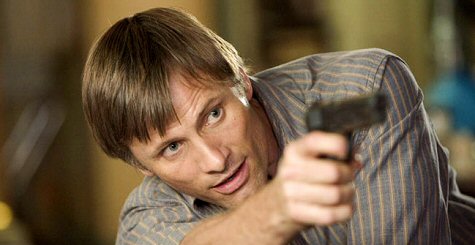
Viggo Mortensen in David Cronenberg’s A History of Violence (New Line, 9.30)
* A History Of Violence (New Line, 9.30) — Cronenberg’s best film in a long time, but even the best Cronenbergs don’t tend to register as award-level films. Except for the acting, I mean. Viggo Mortensen, Bill Hurt, Maria Bello….each performance burns deep.
* Brokeback Mountain (Focus Features, 12.9) — Ang Lee’s gay cowboy drama… bend over, grab that hitching post and get ready to feel the heartbreak. Jake Gyllenhaal (who popped up on Defamer this morning re Ted Casablanca) and Heath Ledger…I don’t know. I’m an old cowhand from the Rio Grande.
* Syriana (Warner Bros., 12.9) — Feels kinda particular, political, subdued, male-ish. What do I actually know? What have I heard? Nothing.
* The Three Burials Of Melquiades Estrada (still no distributor, presumably opening later this year) — A likely Best Actor nomination for director Tommy Lee Jones, if nothing else. And lots of critical support if and when it opens later this year.
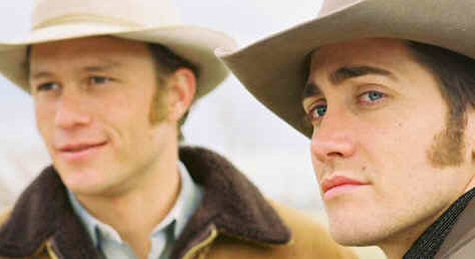
Heath Ledger, Stephen Gyllenhaal in Ang Lee’s Brokeback Mountain (Focus Features, 12.9)
* Crash (Lions Gate) — This punchy thoughtful little indie that made it big with the paying public deserves all the accolades it can get, especially for the script (Paul Haggis, Bobby Moresco) and for Don Cheadle’s performance.
* North Country (Warner Bros., 10.7) — The new film from Whale Rider‘s Niki Caro, about an actual sexual harassment case from the mid ’80s that involved a female miner. Charlize Theron, Frances McDormand, Woody Harrelson, Sissy Spacek.
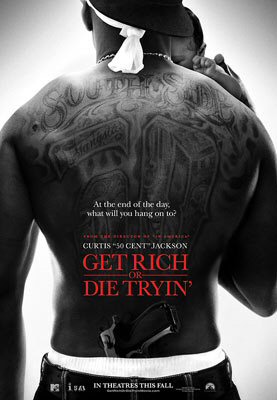
* Get Rich or Die Tryin’ (Paramount, 11.11) — Something hit when I realized this biopic about 50 Cent’s life in the criminal lane would be out in November after wrapping in early July. And you can feel the energy from the trailer. Doesn’t 50 Cent have a video game coming out in November, and didn’t I hear him say something about wanting to have the #1 song, the #1 movie and the #1 video game out at the same time?
I can’t do any more. I’ll have to jump into Part Two next Wednesday, which will include potential acting, directing and screenwriting nominees.
Rent Defense
“So let me get this straight: because there’s an effective treatment for HIV, the movie musical of Rent is out of date?
“Why can’t it be appreciated for its music and for highlighting a period in American history when people were dying from a virus that had no effective treatment? (And by the way, most of the world still doesn’t have access to these drug cocktails that treat it.)
“I’m sorry but David Karger and David Poland’s reasoning for dissing the coming of Rent are totally absurd.
“I’m not sure how Chris Columbus, the director of the film version, has handled the ending but it was an odd ending to begin with by having Mimi come back from what appears to be septic coma. If you have a medical background you would know eventually within a year that a person like Mimi would have been dead due to her continued weakened immune system and no effective treatment to fight off the virus that killed off her CD4 count.
“On top of which Rent is not just about AIDS but about the plight of anyone looking at their mortality faced with a terminal illness. Get a clue.” — Nick Good
Wells to Good: I would add, Nick, that the story of anyone facing any life-threatening situation works as a metaphor for terms we all face, which is that life is short and very dear, and continued health is not something any of us can entirely count on. In other words, treasure life as much as you can while you’re here…right?
Grabs
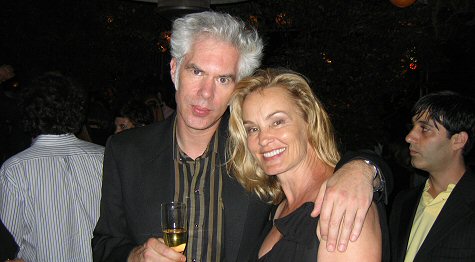
Broken Flowers director Jim Jarmusch, costar Jessica Lange at Maritime Hotel party following premiere at Chelsea Cinemas — Wednesday, 7.7, 10:48 pm.
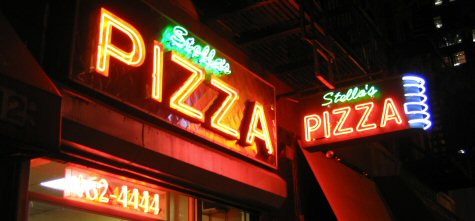
Stella’s Pizza, 110 Ninth Avenue between 17th and 18th Streets…excellent!
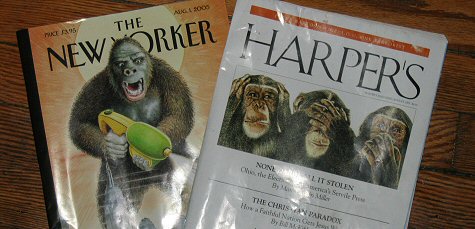
All those turn-the-other-cheek Christians who wrote in to complain about my disdain of this and that aspect of their trip should check out Bill McKibben’s thoughtful and very sincere look at their skewed spiritual attitudes in a piece called “The Christian Paradox: How a Faithful Nation Gets Jesus Wrong,” found on page 31 in the August issue of Harper’s. There’s another terrific piece in the same issue by Mark Crispin Miller called “None Dare Call It Stolen: Ohio, The Election and America’s Servile Press.”
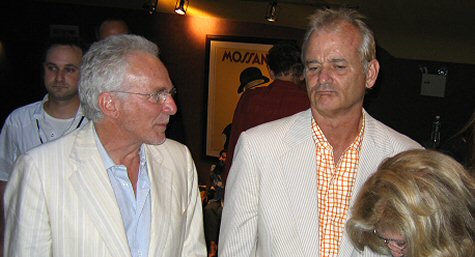
Harry Winston-level jeweler David Yurman, Broken Flowers star Bill Murray in lobby of Clearview Cinema’s Chelsea West just prior to premiere showing of Jim Jarmusch film — Wednesday, 7.27, 7:05 pm.
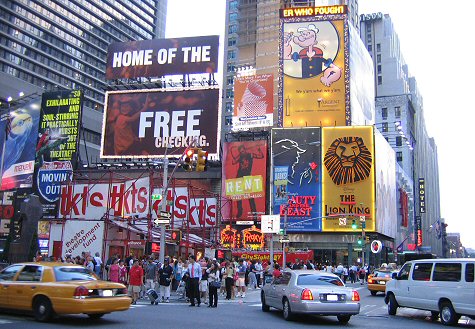
There are more slow-walking tourist pudgeballs shuffling around in groups of four and five near this intersection than in any other part of town. Shot taken Wednesday, 7.27, 6:35 pm.
Saturday, 7.25, 12:25 am.
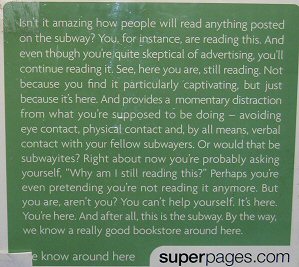
For what it’s worth, the most succinct, persuasive and elegantly written subway ad I’ve seen all summer.
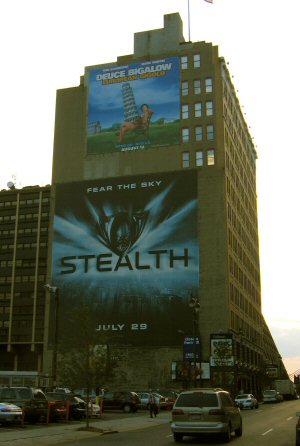
Way over on 33rd Street, a block or two from the home of the New York Daily News. I don’t know why I’m even running shots like this. Movie art on a big building….so what?