Revival

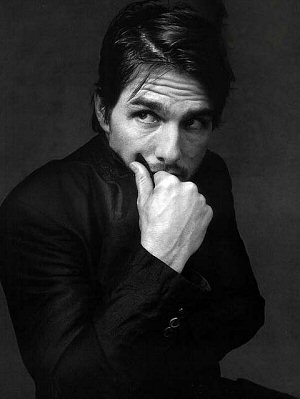
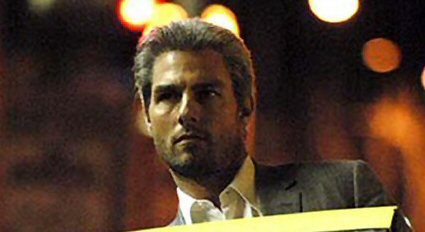
Vincent, Tom Cruise’s hit-man character in Collateral, is diamond-like — hard and sharp and full of glints and reflections. For me it’s a hot-cold thing…acting that burns through not because of some forced intensity, but an artful hold-back, cold-steel strategy.
Cruise, never much for passivity, wants a Best Actor nomination for this tour de force. He’s not out of line. His Vincent is a monster and a cripple, but at the same time a kind of tough-love therapist. By the end of the film he’s saved the life of Jamie Foxx’s procrastinating Max as surely as if he’d taken a bullet for him. (Which he does, in a way.)
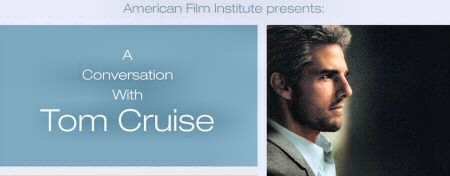
The more you think about Tom/Vincent, the more the ironies accumulate. Deftly played by a guy known for his own hard-wired intensity, this gray-suited assassin seeps through as a fairly sad figure despite Cruise barely revealing his emotional cards. Sad but oddly charitable, almost evangelical.

Cruise won’t win. The top contenders are Jamie Foxx’s Ray Charles performance in Ray and Paul Giamatti’s touchingly morose wine connoisseur and failed novelist in Sideways. But he deserves to be one of the five finalists, along with Javier Bardem in The Sea Inside and Liam Neeson in Kinsey.

This, in any event, is why Cruise showed up at UCLA’s Royce Hall on Monday evening. To goose his Oscar chances…without appearing to be precisely doing that.

It was billed as an American Film Institute event called “An Evening with Tom Cruise.” MTV personality and journalist Chris Connelly was the moderator. There were two soft leather chairs at center stage, and a huge screen just behind them for showing film clips. The tickets were $20 bucks a pop. The auditorium was just about filled, but not quite.

There was a lavishly catered press reception before the event. Dressed entirely in dark brown (his sister-publicist LeAnn Devett swore that his close-cropped hair hadn’t been dyed that color, but it looked that way to me) and wearing a two or three-day stubble, Cruise stood near the main entrance and talked to anyone who had the patience and the moxie to wait 15 to 20 minutes to push through and wait their turn.

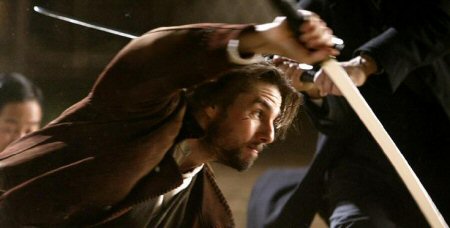
I’m too aloof for that kind of grovelling. What would I say if I got to the guy? I guess we could talk about our mutual friendships with Cameron Crowe and Robert Towne. And I could ask why his Last Samurai character managed to survive that samurai-on-horseback charge straight into a hailstorm of machine-gun bullets. And I guess I could float my pet theory that Cruise’s character was actually a werewolf — i.e., killable only with silver bullets.
A journalist friend who’d interviewed Cruise at press junkets was complaining that “he doesn’t give you anything.” A lot of journos feel that Cruise’s patter is too much about precision, exactitude, presentation. He never relaxes, never lets his guard down.
His fans see things differently. It’s one thing to look at the big grosses for Cruise’s films in the pages of Variety, and another to actually feel the ardor. The fans at Royce Hall were squealing, whooping…it felt almost Beatle-esque when Cruise walked on stage just after 8 pm. “We love you!,” cried a group of college-age girls to my left. “We love you too!” said another group to the right.

Cruise was obviously “on,” but he seemed fairly open to the give and take. He didn’t act or sound like an especially icy type. He seemed more in the realm of being intense, focused….not so much a controller as an uber-regulator. He showed an obvious liveliness of spirit and seemed eager to really listen to people, although perhaps a bit too eager to laugh at times. I forgave him for that.

The show lasted just under two and a half hours. Every 20 minutes or so, the house went dark and Cruise clips were shown. And yet no clips from All The Right Moves or The Outsiders or Curtis Hanson’s Losin’ It. And no acknowledgements than any of these films might have been letdowns for the audience, or for Cruise, which of course happens from time to time.

I couldn’t hear any groans when they ran clips from Days of Thunder (i.e., Top Car) and Far and Away, but then the sound levels were high.
Connelly was crisp, polished and TV pitchman-like. Always going for the jovial chummy tone. Cruise said at one point that he used to imitate Donald Duck as a youth, and Connelly urged him to do it for the crowd. Cruise gave it a shot and made a sound like a duck farting. Connelly to crowd: “What about that? Not bad!”

Cruise is a pretty good mimic though. He did an excellent Jack Nicholson a while later (i.e., acting the bar-rage scene from The Last Detail). I read somewhere he’s great at doing an Al Pacino/Tony Montana. He did a first-rate imitation of Jon Heder doing his Napoleon Dynamite voice.

The place went wild when they showed the famous clip of Cruise dancing in his underwear in Risky Business. The crowd was clapping in time to that Bob Seger beat. “I’ve never done anything like this in which they show clips,” Cruise said later on. “This is pretty amazing.”
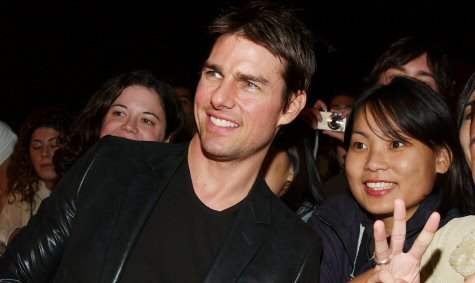

Cruise posing for photos with fans after Monday’s AFI Royce Hall event

Cruise recalled that when he first got to Los Angeles and hadn’t worked anywhere, he went to an open audition and read some lines. The casting director asked him, “New to California?” Cruise said yes. “Staying long?” Depends, Cruise answered. The casting director said, “Get a tan.”

He was also told during this stage, “Do movies. You’re too intense for television.”
Connelly asked him about always being recognized and dealing with the fame game. He quoted a line from Bob Dylan’s recently released book: “Privacy is something you can sell, but you can never buy it back.”

The clips reminded me that Cruise was on the physically chunky side in the early to mid `80s, and that he suddenly slimmed down when he appeared in Rain Man in ’88. Cruise said he became a Scientologist right around (or was it right after?) doing Martin Scorsese’s The Color of Money in ’86. I guess he went on some kind of Scientology diet.

“Before making The Color of Money, I had seen Raging Bull five times,” he said at one point. “If I like a movie I see it over and over. Now with DVD I sometimes just sit and re-watch scenes.”

He recalled that when he started shooting Taps and didn’t know how well he or the film would perform, he said to himself, “If this is it, then this is it…enjoy it for what it is.”

“I was always the kid who climbed to the top of the tree in a rainstorm,” he said later. “I’ve always wanted to risk it all.”

Cruise said more than once that “money doesn’t matter” to him as much as going for the challenge and the creative excitement. He said he only wants “a fair exchange in regard to what I’m worth.” Monetarily, he declared, “I’m doing okay.”

“I’ve never met a normal person,” he said toward the end of the chat. “Every person is unique. Every person has a story to tell. Films are personal, character is personal…”

When he was younger he always used to call people “sir.” His publicist Andrea Jaffe finally told him, “Look, you’re freaking people out. Stop saying ‘sir’ and ‘yes sir.'”
He told an amusing story about the months-long shooting of Stanley Kubrick’s Eyes Wide Shut, and how long it took his costar Sydney Pollack (who’d directed him in The Firm) to understand that sometimes Kubrick was more into blocking and thinking things through than actually filming. But EWS only cost $250,000 per week to shoot, or $1 million a month, he said. (That’s relatively cheap for a big-studio film.)
After many, many months of shooting, Cruise went up to Kubrick and said, “I gotta go, Stanley.” Kubrick said okay “and I left,” said Cruise. “And the movie was done.”
He said his goal is to climb Mount Everest. He said he was open to doing a musical. He said he was also willing in doing a straight play, although he seemed a little hesitant about this. His most emphatic statement of the night was, “I was born to make movies,”

Right now he’s doing final pre-production work on Steven Spielberg’s War of the Worlds, which starts shooting in early November and will be out next June. Then he’ll start work on Mission Impossible 3. During the q & a portion near the end I wanted to ask Cruise about the creative conflicts that resulted in Narc director Joe Carnahan’s leaving that project, but I wasn’t chosen.

An agent friend said to me later that evening, a couple of hours after the show was over, that the fans love him because Cruise projects regular-guy vibes — “He’s someone they feel they can relax with over a drink” — and because women think he’s cute and guys want to be like him.

“But he’s not that guy,” my friend argued. “He’s royalty and acts like royalty. He always gets the biggest perk packages when he shoots a film. He lives in a royal realm. He’s not an average type of guy at all.”

Okay, I said, but isn’t that what made him a star in the first place? Not being average?
And don’t people like worshipping royalty? Isn’t that built in to our genes? The urge to show obeisance before power?

“I’m just saying he’s not the guy he presents himself to be,” she said.

To the Wolves?

It’s no secret that I really like Charles Shyer’s Alfie. I don’t think it plays well; I know it does. It may not have the jolt or punch that the original Michael Caine version had in `66, but it’s a believably acted, exquisitely edited, richly scored character piece. It’s not quite Rules of the Game, but it’s a long way from a burn.
I especially liked that Alfie has the character and intelligence not to go all mushy at the end and deliver a conventionally happy turnaround ending. This despite the fact that one of Paramount’s Alfie trailers seems to suggest that Jude Law’s lead character, a hard-core hound who casually hurts women’s feelings through the film, hooks up with costar Marisa Tomei at the end and makes like a father to her young son, etc.
The problem is this: I was told earlier this week that Alfie is “not tracking.” This means it isn’t showing up in moviegoer surveys as something that a good-sized percentage of the audience wants to see. Apparently Law’s name isn’t enough of a draw on this score. He’s seen as more of an “industry star” than a public one.
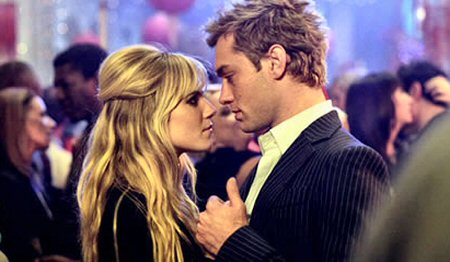
The standard way to raise awareness and create want-to-see with an upcoming film is to show nationwide “sneaks” the weekend before it opens so people will see it, like it and spread the word. The only reason you don’t do this is if distribution execs are concerned that the word of mouth may not be so hot, which could result in the opening weekend tally coming in lower.
Paramount is apparently not planning any Alfie sneaks this weekend, so draw your own conclusions. I understand why, and at the same time I don’t. This movie sells itself and doesn’t screw anyone over. Law gives his most movie-star-ish performance ever. He really leaves that character-actor attitude in the dust.
I think distribution should be like parenting. Your love should always be absolute and bountiful. Especially when it’s time for your child to meet the world and fend for himself. You shouldn’t raise, bathe, feed, nurture and teach your little boy only to push him out the front door on his very first day of school and say, “Okay, buddy…the bus is down the street….see ya later!” You have to stand by your child, hold his hand, show support and keep showing it.
It’s not just that deceptive trailer. The Alfie one-sheet is also a bit lame. By emphasizing only the fact that Jude Law is good looking and not indicating there are all kinds of layers to this film (which there are), they make it look like lightweight fluff.
Alfie isn’t that. It’s a far better film than what Paramount marketers are trying to suggest, and I just can’t imagine average filmgoers seeing this en masse and going “eh.”

Courage

“Dude, you have to calm down about the election. Kerry is going to win this thing and win it big. When you see these poll numbers that don’t look good for Kerry, take a look at the internals. They invariably oversample GOP voters (assuming more Republicans will turn out to vote than Democrats).

“That’s not the case. It wasn’t the case in 2000, when all the polls had Bush winning by 6-8% and he wound up *losing* the popular vote. And it certainly isn’t the case this year, when Democrats are more fired up than they’ve ever been and millions of first-time voters will pick Kerry. Hang in there.” — Clay Clifton

Last Lap

I ran into the mythical producer’s rep Jeff Dowd (a.k.a. “the Dude”) Tuesday night at the Grove. He told me he was on his way to Ohio today to do some kind of get-out-the-vote work for the Kerry campaign. Dowd’s positivism about what he’s certain will happen next Tuesday is almost a contact high.
Dowd also told me that George Butler’s Going Upriver: The Long War of John Kerry is now viewable for free online. The URL is www.thekerrymovie.com.
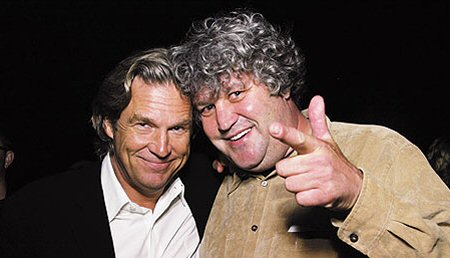

Big Lebowski star Jeff Bridges (l), original “Dude” and one-man Kerry vote-driver Jeff Dowd

Dowd had nothing do with the following, but here’s a well-reasoned endorsement from the pages of The New Yorker:
“[John] Kerry’s performance on the stump has been uneven, and his public groping for a firm explanation of his position on Iraq was discouraging to behold. He can be cautious to a fault, overeager to acknowledge every angle of an issue; and his reluctance to expose the Administration’s appalling record bluntly and relentlessly until very late in the race was a missed opportunity.
“But when his foes sought to destroy him rather than to debate him they found no scandals and no evidence of bad faith in his past. In the face of infuriating and scurrilous calumnies, he kept the sort of cool that the thin-skinned and painfully insecure incumbent cannot even feign during the unprogrammed give-and-take of an electoral debate.
“Kerry’s mettle has been tested under fire — the fire of real bullets and the political fire that will surely not abate but, rather, intensify if he is elected — and he has shown himself to be tough, resilient, and possessed of a properly Presidential dose of dignified authority. While Bush has pandered relentlessly to the narrowest urges of his base, Kerry has sought to appeal broadly to the American center.
“In a time of primitive partisanship, Kerry has exhibited a fundamentally undogmatic temperament. In campaigning for America’s mainstream restoration, Kerry has insisted that this election ought to be decided on the urgent issues of our moment, the issues that will define American life for the coming half century.
“That insistence is a measure of his character. He is plainly the better choice. As observers, reporters, and commentators we will hold him to the highest standards of honesty and performance. For now, as citizens, we hope for his victory” — New Yorker editors.
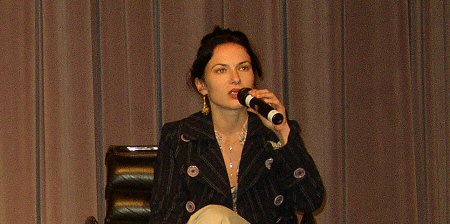

Xan Cassevettes, director of Z Channel: A Magnificent Obsession, after last Monday’s Movie City News screening at the Pacific Design Center. MCN is holding a series of weekly screenings of possible/likely Oscar-worthy films and they’re open to all awards voters including AMPAS, SAG, WGA and BFCA members. I have a problem with the seating (there’s not enough leg room) at the PDC auditiorium, but it’s otherwise a very agreeable amtosphere for seeing films.
“Rubber Tire” or Michelin?

Some day, somehow, major-publication editors are going to give up and start spelling the word “internet” without that fucking capital “I.” However you want to define the worldwide web — an environment, a digital information delivery system, an intergalactic atmosphere — “internet” is a generic term like “highway” or “radio” or “television.” I got into the same kind of idiotic dispute with a writer at the Hollywood Reporter in the early ’80s who insisted that every time a mention was made of CDs that they be referred to as “Compact Disks.” (Or was it “Discs”?) I argued that this was like insisting that anyone writing an article about Michelin or Goodyear be required to write “Rubber Tire.”

Finally, a good critic

New York magazine critic Peter Rainer√ɬ≠s review of Alexander Payne’s Sideways is, to me, really quite beautiful. An exquisitely cut stone. Fully in tune with the film itself. I√ɬ≠d like to see Ken Tucker, Rainer√ɬ≠s recently-hired replacement, write something as good. Perhaps he will. Here’s hoping Rainer finds a new berth sometime soon…hopefully a berth with an editor who will respect his talents more than New York editor Adam Moss apparently does.

Perhaps the invitation got lost in the mail

I haven’t been invited to see The Polar Express (Warner Bros., 11.10), the $200 million-plus, digitally groundbreaking, Christmas storybook flick made by director Bob Zemeckis and star-producer Tom Hanks, despite being invited to the product-reel, dog-and-pony show at the Warner lot a few weeks ago. I suppose there’s a reason for some concern now that Variety‘s David Rooney has called it The Bi-Polar Express and complained that the story doesn’t pay off particularly well. Along with an emerging view that the digitally-composed kids are “dead-eyed” and resemble the alien tykes from Village of the Damned. Plus David Poland declaring that “this thing is one of the most expensive films ever made, and it will not gross [back] its cost at the domestic box office.” All contributing to the basic consensus that November’s big animated feature isn’t The Polar Express but….drum roll….

The Incredibles

Brad Bird’s The Incredibles (Disney/Pixar, 11.5)!! This animated comedy about a family of gone-to-seed superhero parents and their two kids, ducking their enemies under the Witness Protection Program but looking to get those old juices flowing again, is looking like a monster hit with all ages. A friend who went to an Academy screening on Monday, 10.25, said, “I loved it…it’s funny…people applauded the especially good parts…it runs about 115 minutes but feels like 80 or 90…and it’s a crowd-pleaser, a blockbuster…it’ll make $200 or $300 million.” I could’ve gone, but I went to the Tom Cruise tribute thing instead. Choices, choices.

Have you ever been this man?

New Yorker critic David Denby on Paul Giamatti’s sublime performance in Sideways, from a 10.18 posting : “Giamatti has no chin to speak of, a round-shouldered physique, an adenoidal snarl, and the nervous grin of a craven dog. He√ɬ≠s the national anti-ideal, and he√ɬ≠s making a brilliant career out of it. In American Splendor, as the cartoonist Harvey Pekar, he dragged his miseries around the deserted lots and slag heaps of Cleveland [and was] a genuine oddball. Miles is closer to common dreams and chagrins, and in this role Giamatti gives his bravest, most generously humane performance yet. Women may be repelled, but men will know this man, because, at one time or another, many of us have been this man.”

Two words

There are two words that describe the reported thinking among certain undecided voters out there, as relayed in a New York Times story out today (10.25), and those words are “staggeringly ignorant.” Perhaps the better adjective for ignorant is “willfully,” since the only way to support Bush in the face of all the damning indicators is to invest in massive levels of denial. The bad guys seem to be inching up, up, up…polls say Kerry is slightly behind in Hawaii, Florida, et. al. The New York Times says support for Bush among black voters is higher than it was in ’00….what?? Even the www.electoral-vote.com guy is sounding dispirited. The last hope is in the preferences of the newly registered and the under-30s, whom pollsters supposedly aren’t talking to.

Upsetting

Closer is, I suppose, a Carnal Knowledge for 2004,” cinematographer Stephen Goldblatt has told San Francisco Chronicle columnist Hugh Hart. “It’s obsessed with sexual politics. It’s a quite upsetting, very adult drama, and [director] Mike Nichols is a fanatic about reality.” Glamour was not a concern. “When it worked dramatically, I wanted Julia Roberts not to look good,” he informs. “She was game. For one scene with Clive Owen that was very emotionally raw, she didn’t wash her hair, she wore no makeup at all. It was very much about the drama involved, so everything worked from the rehearsals and from the play.”

Multiple choices

The unfolding Paramount Classics situation boils down to this: (a) as run by co-presidents Ruth Vitale and David Dinerstein over the last six years, the division has been steadily profitable but not overwelmingly so, mainly due to financial-strategy restrictions placed upon Vitale-Dinerstein by former Paramount COO Jonathan Dolgen; (b) with Dolgen out as of last June, Viacom co-prexy Tom Freston has said he wants Par Classics to become a more dynamic, Fox Searchlight-resembling operation, and (c) in line with this, Paramount vice-chairman Rob Friedman is thinking about hiring John Sloss (the New York-based indie sales vet and producerís rep), former UA topper Bingham Ray or maybe distrib-marketing vet Danny Rossett to run a new, re-jiggered Paramount Classics, the basic idea being to focus more on production and building relationships with filmmakers. Great, but I donít get why Vitale-Dinerstein are being painted with the Dolgen brush. Hitting only bunts and singles wasnít their idea, and they know the ins and outs of the acquisitions game as well as Sloss, Ray or Rossett.

Just good entertainment

It was clear from an early John Logan draft of The Aviator, subsequently shot by director Martin Scorsese and the film now awaiting a Warner Bros. release on 12.17, that the resounding love affair in the piece isn’t between Howard Hughes and a woman (Cate Blanchett’s Katharine Hepburn, Kate Beckinsdale’s Ava Gardner, et. al.) but between Hughes and his flying machines. The longish film (a recent cut ran around 165 minutes) is also, apparently, buoyantly free of glumness or heavy-osity. “I know enough about it to say it is escapism, certainly for Scorsese,” says industry tipster Pete Hammond. “That doesn’t mean it’s comedy, but it doesn’t have the heavier feel of some of his other stuff. It’s all about Hollywood, aviation and the larger-than-life persona of the young Howard Hughes.” A publicist who’s seen the film told Hammond late last week this was a good way to describe the film, agreeing it’s “just good entertainment.” Blanchett is said to be quite robust as Hepburn, but wouldn’t that be a hard one to miss?

The challenge that inspired

“The challenge of taking on esteemed material has evidently inspired Alfie director [Charles] Shyer to shake off the bland and bloodless polish of his ultra-mainstream Hollywood pictures to inject this remake with welcome vitality,” writes Variety critic Todd McCarthy. “Shyer employs a jumpy, quick-cutting style he’s never used before. He also gets the dynamics among the characters right, is generous to his actors (all the actresses come off very nicely indeed) and guides Jude Law to an entirely engaging performance that does not so much compete with Caine’s as comfortably co-exist alongside it at a nearly four-decade remove. Many men meeting an Alfie in real life would no doubt be put off by his impossibly good looks and luck with women, but Law makes him entirely palatable company.”

Maybe Baby

Maybe Baby

Take this with a very small grain, but remarks from a couple of actresses have upped my interest in Clint Eastwood’s Million Dollar Baby (Warner Bros., 12.15).
Paul Haggis’s script is a surrogate father-surrogate daughter relationship piece. It’s about an aged ex-prize fighter (Eastwood) who decides to train a young woman (Hilary Swank) who’s determined to box. Morgan Freeman plays Eastwood’s longtime pal and confidante…the character with the pithy sayings and sage ringside commentary.
Haggis’s script is said to be based upon two short stories from the novel “Rope Burns,” by F.X. Toole. The plot has always sounded to me like a riff on Karyn Kusama’s Girlfight, with maybe a tad less emphasis on the girl boxer and a bit more on her trainer.
< ?php include ('/home/hollyw9/public_html/wired'); ?>


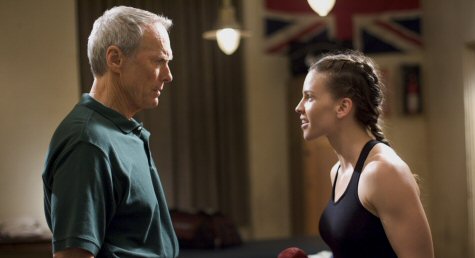
Clint Eastwood, Hilary Swank in Million Dollar Baby

Laura Linney, whom I interviewed last Monday regarding her just-opened film P.S. (Newmarket, 10.15) and who played a blue-collar Lady Macbeth in Eastwood’s Mystic River, has told me Million Dollar Baby is “really good.”
Linney said this with a certain conviction. Not in some deadly earnest, you-must-believe-me way, but in a tone of voice that said, “Well, yeah…of course…what else would you expect?”
An agent friend who sat down with Hilary Swank the other day says Swank is starting to think Eastwood might snag a Best Actor nomination for his portrayal of the haggard ex-boxer. Her remark wasn’t intended for journalistic absorption, so maybe she meant it.
This is all just talk, of course, but hearing these comments in the same week made me go, “Hmmm…maybe.”
You know going in that an Eastwood film will have a planted focused quality… that down-to-it, no-funny-stuff sensibility he brings to all his films. Maybe this will have a bit more.
The 12.15 Million Dollar Baby opening will be platformed — New York, L.A., Chicago, Toronto. It’ll break wide in January `05.

Ethnic Impurities

Easily, without question, Maria Full of Grace (Fine Line) is one of the best films released this year, one of the finest foreign-language movies I’ve ever seen, and a great woman’s film bar none.
Maria is one of those deserving indie flicks — quiet, character-driven, no stars, Spanish-speaking — that needs all the help it can get. A few Oscar noms in January would help.
The story’s about a poor, independent-minded 17-year-old girl from rural Colombia (Catalina Sandino Moreno) who accepts a gig as a drug mule in order to escape a dead-end life. Being a mule involves swallowing 60 or so sealed pellets of cocaine just before flying off to an American city (New York City, in this instance), and then crapping them out when she arrives. For this she gets $5000, minus expenses.
The film shifts into second gear when Maria embarks on her maiden voyage. On the same trip is Lucy (Giulied Lopez), an experienced mule whom Maria has befriended. Things get tense and then tenser, then somebody dies and tough calls have to be made.


(l. to r.) Maria costars Guilied Lopez, Catalina Sandino Moreno, director Joshua Marston, costar Yenny Paola Vega at Sundance Film Festival Fine Line party, January ’04

Joshua Marston, the film’s director-writer, wrote a totally solid script, and got superb performances out of each and every player, Moreno in particular. It seems especially remarkable that the U.S.-based Marston made Maria feel like an organic, hand-made Colombian right down to the bone.
His story is about Colombian characters, and wholly believable ones at that. 99% of it was acted in Spanish by a mostly Colombian cast, with slightly more than half of it filmed in Bogota, Colombia, and in Amaguacha, Ecuador. (A bit less than half was shot in Queens, New York, in the Colombian section of town, and on a set simulating a Manhattan-bound jet.) It’s a movie that looks brown, talks brown, thinks brown.
But it’s ineligible for a Best Foreign Language Film Oscar because the money and the behind-the-camera talent was too white.
This was essentially conveyed yesterday when the Academy of Motion Picture Arts and Sciences released their list of submitted foreign-language-feature entries.
Marston is a California Anglo (he went to the same high school as Angelina Jolie, Nic Cage, Lenny Kravitz, et.al.), a lot of the crew members were American, and four out of five companies that put up production cash were U.S.-based.
The Academy’s rejection of Maria Full of Grace as a Colombian film is “just technical,” says Fine Line marketing vp Marian Koltai-Levine. “It’s truly a technicality.”
The country of Colombia “supported it” and “wanted to submit it,” she adds.
Fine Line is unbowed, says Koltai-Levine. “We’re still running Academy campaigns on Catalina as Best Actress and Josh as Best Director, and Best Original Screenplay…we’re going for it.”

Foreigners

Which of the 49 films submitted for the Best Foreign Language Film Oscar have the most heat? I asked around yesterday, picked up some hints.
The two films most likely to be nominated are Alejandro Amenabar’s The Sea Inside (Fine Line), a Spanish-produced right-to-die drama with an Oscar-calibre lead performance by Javier Bardem, and Yimou Zhang’s House of Flying Daggers (Sony Pictures Classics), a visually operatic actioner from the Chinese director of Hero.
After these two it gets dicey.
Jan Hrebejk’s Up and Down, submitted by the Czech Republic, is said to be “a humanist cycle-of life” movie that “may play a bit too familiar…it’s good but has been done and seen before.”
Jorgen Leth and Lars von Trier’s The Five Obstructions, a Danish entry and a critical favorite at film festivals over the past year or so, is being dissed as too much of an elitist, smarty-pants exercise to draw any kind of groundswell support.

Bernd Eichinger’s Downfall, a German feature about the last days of Hitler (played by Bruno Ganz) in the Berlin bunker, is said to depict the Nazi leader in a way that may seem overly sympathetic (i.e., too vulnerably human) to industry mainstreamers, which, if true, means it’s toast.
The general Hollywood Jewish community rule is that Hitler can be portrayed only as a warhead of pure evil, straight from the molten caverns of hell. Downfall is based on the documentary Blind Spot: Hitler’s Secretary, based solely on the recollections of Traudl Junge, a Hitler assistant who was with him right to the end.
Nimrob Antal’s Kontroll, a Thinkfilm release from Hungary, ought to be one of the five. It’s a strong, stylistically nervy thing with a richly developed theme…except that Academy handicappers think it’s too strong and nervy, and they apparently feel the murky underground-subway milieu is a bit much. Go figure.
Brazil’s Olga, a true-life tale with a Holocaust undercurrent, is said to be shamelessly cornball, so it may have a chance. (HE’s Pablo Villaca wrote about this in his “Burden of Dreams” column two or three weeks ago — he said it was embarassing that the Brazilians bigwigs had submitted it.)
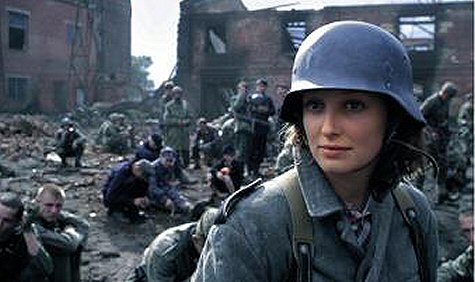
Timur Bekmambetov’sNight Watch, a big-budget submission from Russia, is kind of a Hollywood-style special effects fantasy thriller. A publicist tells me it’s set in present-day Moscow and is about “aliens who come down.” The IMDB says it’s about “forces that control daytime and nighttime doing battle.”
Night Watch has been a big hit in Russia, but will the Academy’s foreign branch want to salute a non-nativist Russian film trying to ape Big Hollywood? Fox Searchlight is releasing it sometime in ’05 — they couldn’t say when.

Blue Dog

I was finishing up the column this morning (10.22) and having a perfectly miserable time FTP-ing the photos when a Fed Ex guy came by with a package from Universal — a VHS of the new Meet the Fockers trailer. So I stopped working and popped it in.
Uh-huh, uhm-hmm, funny, funny, uh-huh…yeah, yeah, okay…whoa, FUNNY! A mix of toilet water and pet cruelty, and I was laughing for 15 or 20 seconds after the spot ended. I ran the tape three more times just to replay this one bit.
Except now it’s out there (I guess the trailer will be online before too long) and everyone will know about it going in, and so the movie won’t be quite as funny now.

That’s the trailer business for you — give away the money material in hopes that the audience will pay to see the film in order to get more. One hopes.
The invisible subtitle of this film is “Meet the Jews, Accept Them Into Your Family, and Sacrifice the Purity of Your Wonderbread Bloodline.”
The premise has been drilled into everyone’s head, but maybe someone’s been napping.
Having given their blessing to their daughter Pam’s (Teri Polo) wedding to neurotic male nurse Greg Focker (Ben Stiller), ex-CIA wacko Jack Byrnes (Robert De Niro) and wife Dina (Blythe Danner) travel to Detroit to meet the Greg’s touchy-feely liberal wacko parents, Bernie and Roz Focker (Dustin Hoffman, Barbra Streisand).
Meet the Fockers (Universal) opens on 12.22.

North, Part 2

Here I am finally writing about the entirely agreeable, smoothly run Mill Valley Film Festival, which I visited last weekend. It began on 10.7 and wrapped on 10.17…the usual ten days of screenings, q & a’s, parties, etc.
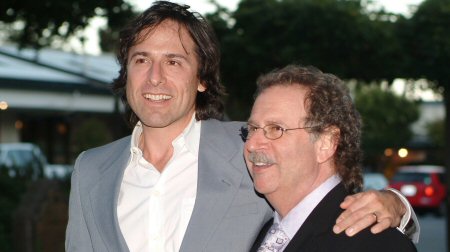
Mark Fishkin, the festival’s founder and executive director, picked up the phone last Sunday morning to suss things out a bit. The main subject was how Fishkin and his team managed to keep the festival going despite the collapse of the roof of one of the theatres inside the festival’s prime venue, Mill Valley’s Sequoia Theatre, in mid August.
The Sequoia’s owner, Century Cinemas, “was extremely optimistic that they could have it repaired before the festival began,” says Fishkin, “and the optimism was so great that there was no hint that it might not happen in time. As it was, we were told this about two hours before the press conference began.”
Century partly made up for this by providing two screens at the Century Northgate in northern San Rafael.

The rest of the festival schedule played at the first-rate San Rafael Film Center, which is owned and operated by the Film Institute of Northern California (also the parent org of the annual MVFF). The theatre is located on 4th Street in downtown San Rafael, and is know for its top-notch projection and sound quality. (I can attest to these personally.)
Switching everything around at the last-minute cost the festival an extra $20,000, says Fishkin.
I Heart Huckabees director David O. Russell showed up on opening night. Mike Leigh and likely Best Actress Oscar nominee Imelda Staunton dropped by to talk about Vera Drake. Alfred Maysles visited and gave a “master class” on documentary filmmaking. Laura Linney flew in for a day to talk about P.S.. Gena Rowlands stopped by, and so did Kinsey director Bill Condon.
Fishkin founded the MVFF in 1977. The festival has twelve regular staffers based in Mill Valley. The work force goes up to 27 or so in June, and then up to 100 during the festival run, along with the efforts of some 300 volunteers.

“It’s like making a movie every year, but you don’t end up with a negative,” Fishkin says.
Tom Luddy’s semi-secluded, non-competitive Telluride Film Festival was Fishkin’s inspiration when he started the MVFF in ’77. “Our atmosphere is still like that of a destination festival, but the numbers are more like an urban festival,” he says. The attendance this year was 40,000. The highest ever tally was 43,000.
Fishkin acknowledges the obvious fact that film festivals have exploded across the American landscape over the last decade. “First everyone wanted to write the Great American Novel, and then direct their own Hollywood movie,” he says. “Now everyone wants to manage their own film festival.”

Hell You Say

I nominate Tom Cruise to play the part of Lars Von Trier’s spiritually anguished American biologist in Antikrist,, which the provocative Danish helmer plans to shoot after finishing Manderlay, the second part of his Amerika trilogy.
In fact, I insist on this happening…even if Cruise can’t fit it into his schedule.
Peter Aalbek Jensen, von Trier’s producer, said earlier this week (I popped this into the WIRED column on Thursday morning) than the plan is to finish Antikrist in time to show it at the 2006 Cannes Film Festival.
This means Cruise probably can’t do it, since he’ll be making Steven Spielberg’s War of the Worlds and then Mission Impossible 3 through most of ’05. Because he’ll need to do something solemn and arty after these two, and a good von Trier would be just what the doctor ordered.

The Cruise idea is just a floater from Sweden, but von Trier is looking for a major American actor for the lead, and he went with Nicole Kidman for Dogville, so why wouldn’t he try for Cruise?
Jensen called Antikrist a “horror film.” Knowing von Trier, I’m guessing the horror will be more of a philosophical than a hair-raising thing.
Jensen told a Swedish reporter that Antikrist will “put an end to the big lie that God created the world,” and explore the more compelling view is that “it was Satan who created the human race and the world.”
There’s no script yet apparently, but according to a story in the Danish daily Berlingske Tidende , the plot will be about an American biologist who develops a fear of nature, finding it to be a place of evil, and starts seeking therapeutic help.
As Antikrist develops, von Trier’s theory of Satan being the true father and creator will be explored.
There’s a more detailed piece about this in the Swedish newspaper daily Dagens Nyheter .

Aristotle and Alexander

“Your question about whether Oliver Stone’s Alexander might capture “the bedrock faiths and realities of the time and culture in which he lived is a good one. But is Aristotle a significant player in the film? He should be. The `father of rational thinking’ certainly had a hand in creating the world conqueror, as he was Alexander’s personal tutor during his early teen years.
Aristotle believed in the City State idea, and this thinking was diametrically opposed to the philosophy Alexander later adopted. Aristotle believed that the Greek citizen was superior to others, and he held a condescending attitude towards other cultures, particularly Persians. Alexander came to embrace other cultures, albeit through conquest.
“When Alexander, in the name of cultural harmony, ordered several thousand of his Greek soldiers to take Persian wives, and to consummate their marriages by fornicating on the side of a hill, Aristotle must have come unglued. (I’ll bet that scene isn’t in the film).” — Ron Cossey, Studio City.

Distant Drum

“I’m not surprised that Charles Taylor hated Sideways I went to college with the guy (Connecticut College, class of ’83) and in those days he pretty much despised all contemporary filmmakers except Brian De Palma. (He put Dressed to Kill and blow out in the same category as The Godfather and Nashville.)
“I like Charlie and I think he’s a good writer, but calling Alexander Payne `a pretentious wiseass’ is like calling David O. Russell `formulaic.’ It makes him look stupid.” — C. Hashagen
Wells to Hashagen: DePalma acolytes are a weird bunch. They’re like born-again Christians. They’ve seen the light and you haven’t.