

In a 7.17 WIRED item [see below] I ran a list of the year’s best films so far (the total came to 22), but I should have included one more: Jon Gunn, Brian Herzlinger and Brett Winn’s My Date With Drew (DEJ, 8.5), a spritzy, surprisingly spiritual doc about Herzlinger, a struggling schlub in a one-bedroom apartment when the film was shot, trying to somehow arrange a date with Drew Barrymore. I first saw it at the Vail Film Festival in April ’04 and wrote about it as follows: “This hand-held camcorder movie plays like a frothy distraction…at first. Then it surprises the hell out of you. A disarmingly optimistic docu-romance, initially shot for roughly $1100, it manages to pay off — emotionally, metaphorically, mythically — in ways that are unexpected and curiously shrewd. It’s a little-engine-that-could movie that sends you out shaking your head with amazement, and wearing a big dumb grin.”
No question that Vanessa Grigoriadis’
No question that Vanessa Grigoriadis’ excellent piece in the current New York magazine about unbalanced, seemingly unhinged celebrity behavior (“Celebrity and Its Discontents: A Diagnosis”) is going to sell a lot of copies and get talked about all over…especially due to that hilarious cover showing Tomkat in straightjackets. But somewhere in the piece, shouldn’t Grigoriadis have acknowledged Andrew Breitbart and Mark Ebner’s Hollywood Interrupted, which was the first published diatribe about the trend of celebrities melting down and wacking out? Published in the spring of ’04, the book was lively and punchy, but also taken to task here and there for being too vitriolic and right-wingish…but it was still the first attention-getting diagnosis of this trend. Breitbart is back working for Matt Drudge after serving as the web guy/editor for the launch of www.huffingtonpost.com, and Ebner works for Bonnie Fuller out of L.A. I’m not saying Vanessa or New York were obliged to tip their hat to Breitbart and Ebner, but it would have been good manners…no? I mean, especially since she seems to have more or less “borrowed” a portion of a paragraph taken from an online promotional book description written by Ebner/Breitbart and provided to the press by their publisher (“…celebrities somehow believe that it’s their god-given right to inflict their pathology on the rest of us. Hollywood, Interrupted illustrates how these dysfunctional dilettantes are mad as hell…and we’re not going to take it any more”), and used it for her lead paragraph.
Kelefa Sanneh has written a
Kelefa Sanneh has written a dissection of Jessica Simpson’s “These Boots Are Made For Walkin'” video in a New York Times piece (“These Musical Genres Are Made for Mashing”). The verdict is that this musical Dukes of Hazzard promo is an “odd” collision of musical genres and performers with country fiddles “sawing away over that electronic beat [and a] honky-tonk chorus giving way to a rap section that evokes Gwen Stefani.” Sanneh compares Simpson’s cut to the Nancy Sinatra/Lee Hazelwood hit single from ’65 or thereabouts, and notes that Simpson’s “has new verses that turn a scorned woman’s vow into something not quite so dire: now the song is about how to beat a speeding ticket. ‘You believe you stopped me for a reason,’ she sings, ‘and I’m pretending my bending’s just for fun.'” I guess I’m used to seeing links to stuff within the body of a story, which is why I didn’t spot the link to the Simpson video next to the online version of Sanneh’s story on the Times website. Ah, well….
Serious DVD fanatics with the
Serious DVD fanatics with the ability to write concisely and with style should drop a line to HE’s Discland editor Jonathan Doyle at jd@storefrontdemme.com. My apologies to Jon for not getting this announcement up sooner.
Kurt’s Eclipse
Kurt’s Eclipse
It took me a while, but I’ve finally come to see that Gus Van Sant’s Last Days (Picturehouse, 7.22) is some kind of great film, and maybe even a masterpiece.
About five weeks before I first saw Last Days at the Cannes Film Festival, I showed Michelangelo Antonioni’s L’eclisse (The Eclipse), a stylishly profound piece about alienation and spiritual drainage among the aspiring classes in 1962 Rome, to some UCLA students in a class I was teaching.
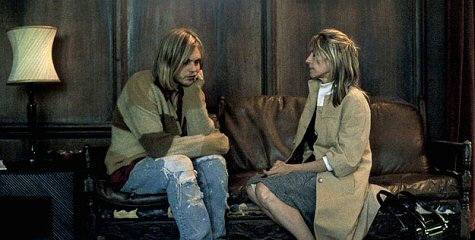
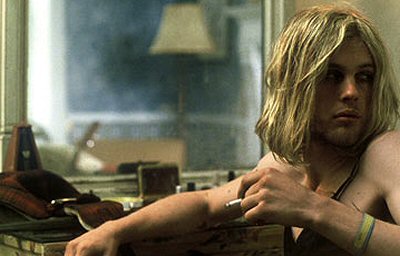
Michael Pitt (l.) as the Kurt Cobain-like Blake, with Kim Gordon (wife-partner of Sonic Youth’s Thurston Moore) in Gus Van Sant’s Last Days.
I told the students this was a movie in which almost nothing happens, and that they may feel bored or frustrated by it initially. But I promised them they would never forget it, and that if they didn’t stop being film buffs (i.e., really paying attention to movies) they would eventually understand its greatness, although probably, in most of their cases, not until they hit their 30s or 40s.
I acknowledged that it’s essentially a movie about, in a manner of speaking, “nothing”…about a couple of attractive people toying and flirting with each other and having a bit of sex here and there, but otherwise doing and saying relatively little, without anything resembling a story between them and certainly without any pronounced conflicts or resolutions of same in the third act.
But it has an emotional seep-through effect. There’s a torrent of small things in L’ecclise that stay with you — dispirited looks, hints of eros and emotional voids, meditative moments, intimations of ennui and pointlessness. It doesn’t “say” anything but there are echoes all through it.
< ?php include ('/home/hollyw9/public_html/wired'); ?>
Anyway, I showed L’eclisse because I know it’s one of the most sophisticated art films of the 20th Century, and because the students would probably never see it on their own (it had recently come out on a spiffy new Criterion DVD) and because, as I said to them before showing it, no one in the commercial or semi-commercial realm is making films like this any more.
And then, super-observant guy that I am, I went to Cannes and saw a direct descendant of L’eclisse in Last Days, which has a lot of similar chops and attributes. And I didn’t even see it.
Even without the Antonioni analogy, Last Days deserves your obeisance and then some.
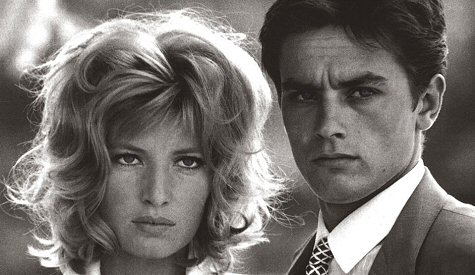
L’eclisse costars Monica Vitti, Alain Delon
The idea of it being masterful has been kind of sneaking up on me since my second viewing about three weeks ago here in Manhattan. I don’t expect most of the readership to agree. Some will hate it or find it frustrating, and others will be half-and-halfers. But that’s the usual drill with bold-ass art of any kind.
After the Cannes screening I knew it deserved respect for the way it was shot and cut, for going once again with that story-free verite thing that Van Sant used on Gerry and Elephant .
I wrote that “ten or fifty years from now people will watch [Last Days] and say, “Weird movie… what was that? But you know something? It’s got something.”
I also said that “compared to Shane Black’s Kiss Kiss Bang Bang and Atom Egoyan’s Where the Truth Lies [which I had seen the same day], Last Days is the least formulaic and the most out-there. Unlike the other two, it feels like it was made in the 21st Century.”
So I respected it but at the same felt a bit underwhelmed. I wrote, “Nice chops but the emotional content is zilch.”
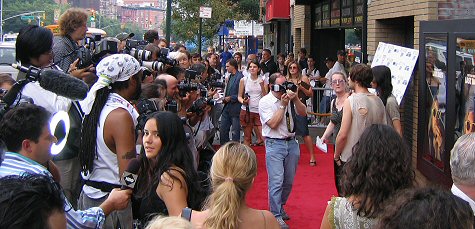
A hot and sticky crowd in front of the Sunshine theatre on East Houston Street for the New York premiere of Last Days — Tuesday, 7.19, 7:20 pm. That’s Maria Full of Grace star Catalina Sandino Moreno being interviewed at lower left, Michael Pitt
(wearing T-shirt with hole in the back) standing to right, Gus Van Sant (in blue) closer to theatre entrance.
That was my inner middle-class suburban guy who used to get B’s and C’s in high school talking. I like movies that make me feel something that I want to feel — shoot me. What this means is that when a film makes me feel something I don’t want to feel, I recoil and complain.
I also thought Van Sant had pushed his deconstuctionist aesthetic a bit too far this time.
Watching Michael Pitt, in his performance as a Kurt Cobain-ish junkie musician called Blake, mumble and shuffle around and occasionally nod out didn’t seem as involving to me as the happenings in Van Sant’s Elephant, about some banal activities among kids at a high school on the day of a Columbine-like massacre. That film, at least, had a kind of ticking-clock suspense element.
My basic beef, in short, was that not enough happens in Last Days that’s worth caring about…unless, that is, you’re a big Cobain/Nirvana fan and any movie that sheds even a shard or two of light about Cobain’s 1994 suicide is therefore worth the price of admission.
Last Days should really be called Last Hours. The use of “days” in a title implies at least three 24-hour cycles, and it didn’t seem to me as if what happens in the film takes place over more than two days. It could be occurring in a 36-hour period…not that this matters a whole lot.
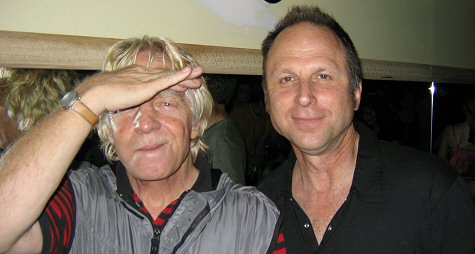
Screenwriter-producer L.M. Kit Carson and Picturehouse chief Bob Berney at Last Days after-party at Piano’s — Tuesday, 7.19, 10:40 pm.
Pitt (last in The Dreamers and Murder by Numbers ) gives a much better performance as Blake than you might appreciate at first. He’s very into the stupor, the lack of anything emotive…the heroin-fog personality. He convinced me he’s really into the same nihilistic space that Cobain was apparently caught up in just before the end.
Remember those long unbroken shots of kids walking through school hallways in Elephant? Same deal here, except this time the subjects are spaced-out, half-articulate heroin users hanging out inside an unheated home and doing stoned musician-type stuff…talking about music, cooking up macaroni-and-cheese in the grungy kitchen, having sex, listening to the Velvet Underground in their living room, etc.
The film is mostly about Blake, of course, who plays a tune at one point and is shown taking an overnight camping trip through the woods early on. Mostly, however, he avoids the phone and runs away whenever someone knocks on a door and spends a lot of time sitting around like a zombie and nodding out, even when a Yellow Pages salesman comes to visit.
Cobain had a heroin problem near the end of his life and it’s obvious Blake is using big-time in the film, but Van Sant chooses not to show him hitting up. I thought at first this was a tad dishonest, like a film about a man dying of cancer in a hospital that doesn’t show any scenes with doctors or nurses or chemotherapy.
But now I don’t know. Without syringes and tying off and blackened spoons, there’s a metaphor to consider. Don’t ask me what it might be because I’m still toying around with ideas. But it has something to do with showing us what’s being missed and slept through and thrown away. It’s about the sin of not being able to see beyond your own shit.
The more I think about it, the more of a really effective anti-drug movie this seems to be. It isn’t just life-like, but life-affirming.
After the Cannes screening I wrote that the juiciest scene in Last Days is when one of Blake’s bandmates (amusingly played by Scott Green) goes into the living room and puts on the Velvet Underground’s “Venus in Furs”– that plodding, screechy, oddly hypnotic cut from their 1967 banana album in which Lou Reed sings, “I am tired, I am weary, I could sleep for a thousand years.”
I was rocking in my seat last night when this scene played — it’s a great musical moment — but I wasn’t focused on it as much as before. Instead I was getting off on almost everything in the film in different ways.
This isn’t just a movie about states of mind. It’s about “wow, man…whew….the world out there…keep it out, don’t let it in.”
I really like the dispassionate artified way that Van Sant and his cinematographer, Harris Savides, capture the squalor. Everything they show is painterly, perfectly framed…almost serene. And I love the drugginess of it. There hasn’t been a film that has felt this exotic and ultra-believable about a fairly familiar subject (the star of a rock band having difficulties) in a long time.
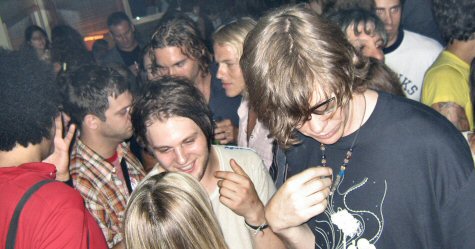
Michael Pitt, Last Days music consultant Thurston Moore during latter stages of after-party at Piano’s — Tuesday, 7.19, 11:55 pm.
For what it’s worth, Last Days really knows the heroin-user mentality. I used to hang with guys who were into smack when I was living in Boston in my early 20s, and the way they sat around and talked and basically did very little…that’s this movie, all right.
It’s no small thing for a film to be observationally fascinating (the third viewing was just as watchable for me as the first two) but at the same time relatively banal-seeming and tension-less in terms of story. Last Days isn’t playing the precise same tune that L’ecclise did, but it’s certainly playing with a lot of the same instruments and a vaguely similar attitude.
Do it right — rent L’eclisse this weekend and see it before going to Last Days, or vice versa. I’d really like to hear some reactions by Sunday night.
What Happened Was…
I didn’t know (i.e., nobody told me) I needed to renew ownership of the domain name of “Hollywood Elsewhere” on or before 7.19 so the site came to a sudden grinding halt Wednesday morning. I fixed the error at 8 a.m. but it took about twelve hours for the renewal of the domain to promulgate around the world. I don’t know about anyone else, but I love spending time on this shit. Talk about fulfilling.
“You Can’t?”
This isn’t hard to identify. Shall we let it go at that?
Hustle & Flow
“It’s too bad that Hustle & Flow‘s trailer seems to be turning more people off than on. This, at least, is what a couple pals said after the Saturday sneak preview. They said it’s not very good at portraying the real rhythm of the movie. I’ve seen it myself and agree wholeheartedly.
“Hustle & Flow is going to make a whole lot of money, whether in theatres or on DVD. Sneaking it was the smartest thing Paramount Classics could have done, to dispel some bad vibes people have, thanks either to the trailer or the attachment of MTV’s name to the piece.
“Whether or not Terrence Howard gets a big awards push for this role, it’s going to take him to the A-list for sure. DJ Qualls finally gets a decent part to work with, along with Anthony Anderson and the rest of the cast.
“A genuine, smooth-flowing script and a note-perfect cast makes this one more worthy of your six to twelve dollars than most films of the last few years.” – Moises Chiullan
Redneck Supreme
“I enjoyed your piece on The Last American Hero. Odd that it isn’t available on DVD because I’d always heard great things about the movie. Odder still that your Fox contact didn’t realize the movie was one of ‘ours’? The film has been shown a number of times on FXM (Fox Movie Channel) over the past six months. I’ve caught it twice, I think. Are all the p.r. guys at the big home video distributors this knowledgeable and on top of it?” — Darth Presley
Wells to Presley: I think they’re just over-burdened…too many balls in the air, too much on the plate.
Grabs
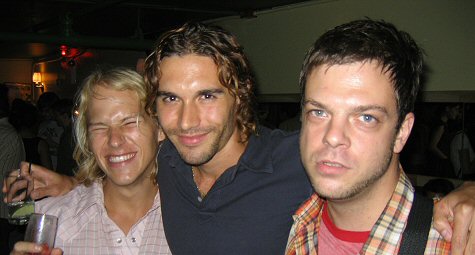
Tarnation director-producer Jonathan Caouette and two pals whose names I didn’t get (sorry) at Last Days after-party at Piano’s — Tuesday, 7.19, 11:10 pm.
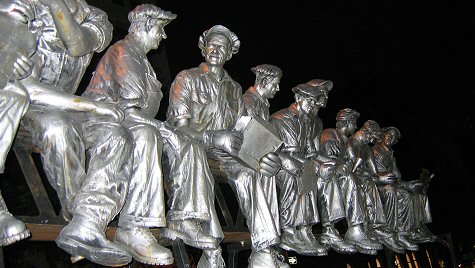
Sculpture
based upon famous “Lunch on a Skyscraper, New York City 1932” photo, sitting on some kind of towable platform in Soho — Saturday, 7.16, 10:10 pm.
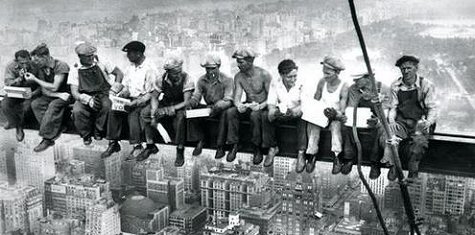
Original “Lunch on a Skyscraper, New York City 1932” photo, shot roughly 55 stories above Rockefeller Center.

New York City photographer-painter-clothing designer Sequoia Emmanuelle (www.sequoiaemmanuelle.com ) posing for Hollywood Elsewhere photographer while waiting for Brooklyn-bound L train last Saturday afternoon, 7.16. Rainbow-rasta hair styling by Dana Ferrullo (www.goddessmaker.com) who says she’s created this hair style to roughly 30 or 40 people so far on both coasts.
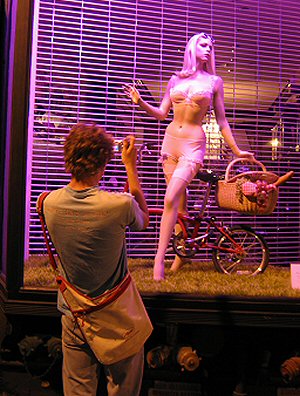
Young man
with a Canon A95 digital camera — Saturday, 7.16, 1:25 pm.

Greene Street near Broome Street — Saturday, 7.16, 11:20 pm.
Christians
“For fuck’s sake, Wells — stop it already with the attack against Christians.
“Don’t you realize that this vehement anti-Christian rhetoric you’ve been spewing all these years is now coming dangerously close to hate speech? How is it possible that you don’t understand that you’re exhibiting the same kind of (closed-minded) behavior towards Christians that you claim ‘95%’ of them exhibit towards others?” — Mark from Boston
Wells to Mark: I just took issue with the notion of “cool hip Christians,” which I believe to be an oxymoron. The things I wrote about the Christian socio-political agenda drew on impressions that are pretty widely shared, I think.
Mark-from-Boston replies: “This anti-Christian stuff has become an obsession with big-city, left-leaning hipster types (I see it in Boston daily), and it’s got to stop. I’ve never met a single Christian who was anything but honest and kind and genuinely well-meaning. They’re responsible for a great deal of the good that’s being done in the world on day-to-day, ground-level basis (feeding the poor, housing the homeless, etc.). You see a few of them on TV spouting anti-gay rhetoric and you think that’s representative of the entire culture? That’s called prejudice.”
Wells to Mark: My impression — the civilized world’s impression — is that a fair number of Christians out there — the vaguely wacko kind — seem to be xenophobic homophobes who, in their heart of hearts, want to smite the wicked and roll back the clock.
Mark-from-Boston replies: “And so what if a good deal of them seem to support Bush? You’re welcome to disagree with them. Just please stop hating everyone that disagrees with you for moral reasons. This kind of crap makes you look juvenile. Christians aren’t the evil empire you’d like them to be. They’re individuals, just like you and me.”
Wells to Mark-from-Boston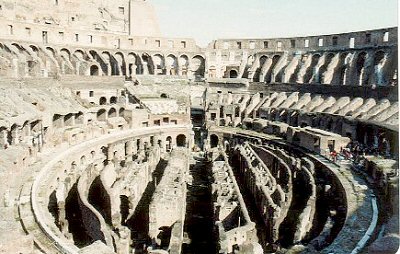
Ruins of Roman collisseum, called the Flavian amphitheatre in its day.
“And since many of these guys see abortion as a civil-rights issue (i.e., the civil right of the unborn child not to be terminated), there’s no way they’ll vote for people like Gore and Kerry regardless of their positions on deficit reduction, etc.
“And your comment that Christians can’t dress and all smile strangely? Come on, Jeff. You would never say that about any other religious group.” — D. Tucker
Wells to Tucker: But c’mon….middle-American Christians do dress horribly for the most part and some do smile like pod people. Shouldn’t the truth count for something?
“So Mark-from-Boston sez, ‘I’ve never met a single Christian who was anything but honest and kind and genuinely well-meaning.’ Is this guy kidding?? Give me a fucking break!!
“Apparently he’s not willing to acknowledge how the Christian right-wingers are in our current U.S. political landscape are really overstepping their well-meaning boundaries…it’s driving me absolutely CRAZY! Keep stickin’ it to ’em, Jeff, and if guys (and gals) like Mark don’t like to read it, they can go elsewhere…just not Hollywood Elsewhere.” — Bryan from L.A.
Charlie Plummet
“Those 6.9 million copies of the new Harry Potter book being sold last weekend is probably the main reason why Charlie and the Chocolate Factory experienced that Friday-to-Saturday 8% falloff.
“Say a million of those kids were interested in seeing Charlie last weekend. At an average kid ticket price of $7 (and I think you’ll agree the price is low), that adds an additional $7 million to Warner’s coffers for the weekend, sending Charlie over the $60 million mark for the weekend.
“At the music festival where I work, it seemed like four out of five kids entering the park were carrying around a copy of the book last weekend while exactly half the mostly college-aged employees in the accounting room were reading it as well.
“The Potter effect is very real. That’s not to say you’re wrong about kids about kids not reading much these days. There’s a ton of kids my age (I’m 19) who couldn’t tell you who Truman Capote, John Steinbeck or Nathaniel Hawthorne were, but they’ve read each of the Potter books five times. This isn’t so much a literary phenomenon as a cultural one that sits alongside the iPod and the Xbox joystick.” — Kyle Dickinson
More Grabs

Big celebration at Fanelli’s (neighborhood bar at Prince and Mercer) following bridal-shower party — Saturday, 7.16, 10:40 pm. (It’s been my experience that women who are very close to getting married are more approachable and even seducible than when they were single and unattached. I’ve gotten lucky in this respect twice, and the reason, I’ve concluded, is because the women said to themselves, “This is my last shot before tying the knot — I don’t want to break my marriage vows so if I’m going to bed some guy I’m attracted to, now’s the time.” The reason I’ve mentioned this is because the expression of the woman with the veil seems to be expressing…vaguely suggesting?…this attitude on some level.)

L train to Brooklyn — Saturday, 7.16, 12:25 pm.

Two girls and a guy looking for tickets to a show at the B.B. King Blues Club on 42nd Street — Tuesday, 7.20, 6:50 pm.
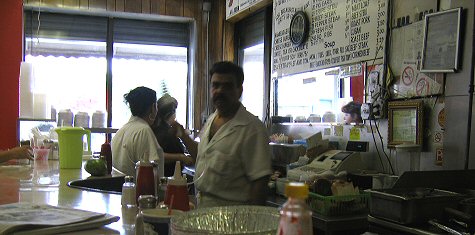
Breakfast at El Brilliante on Montrose Avenue in East Williamsburg — Sunday, 7.17, 9:25 am. Check out those prices…$6.50 for a skirt steak?
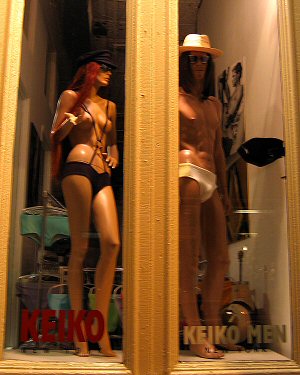
Bathing suit designs by Keiko (“…by far the most innovative bathing suits in the American market,” according to fashion-icon.com) at 62 Greene Street.
It’s strange that an eagle-eyed
It’s strange that an eagle-eyed New York Times writer like Caryn James would write a piece about how it’s totally common these days for journalists to be depicted as slimeballs in movies these days (Cronicas, Paparazzi, Cinderella Man). And note that the last time journalists were shown as heroic or even respectable was nearly 30 years ago in All The President’s Men. And yet fail to mention that a fairly major film called Good Night. And, Good Luck (Warner Bros.), due in November, will tell a stirring story of a very noble and moralistic journalist by the name of Edward R. Murrow (David Straitharn). And in so doing observe that this film will probably underline or reiterate by example the blemished reputation that today’s journalists are grappling with. How could James and her editors not take note of this? It obviously would have fit right into her story.
Johnny Depp is saying he
Johnny Depp is saying he didn’t base his Willy Wonka character on Michael Jackson. “It never entered my mind,” Depp allegedly told an interviewer. “Michael Jackson loves children but Willy Wonka doesn’t.” The actual inspirations, he said, were kiddie TV hosts Captain Kangaroo, Mr. Rogers and Uncle Al. To which I say, trust the art but never the artist.
Check out this Hustle &
Check out this Hustle & Flow pay-attention promo thing. Not a trailer — it just lays out what Craig Brewer’s film (Paramount Classics, 7.22) is from an inward thematic perspective. Sums it up, gets it all. But Anthony Anderson, man…cat’s gotta get on that treadmill and cut down on whatever he’s eatin’ ’cause there’s a surplus.
Here’s Lewis Beale’s assessment in
Here’s Lewis Beale’s assessment in today’s issue of Newsday about the summer slump. He agrees that admissions have been down since ’02 (how can he not agree to a fact?) and acknowledges that exhibitors are getting hurt the most, but he also explains how moneybags Hollywood is doing fine. I’m quoted saying the following: “The issue isn’t that movie attendance is soft this summer. The issue is that the fundamental idea of ‘going out to the movies’ is losing its hold on the moviegoing public. Seeing movies in theaters is being slowly depopularized and retired by different groups for different reasons.”
In the 7.18 New York
In the 7.18 New York Times, reporter Sharon Waxman has an interesting piece about Hollywood trying to tailor its movie content and adapt selling techniques to reach the thriving Christian demo — i.e., the audience primarily responsibly for turning The Passion of the Christ into a gargantuan hit last year. In paragraph #2, she quotes Mr. and Mrs. Smith director Doug Liman using the term “hip, young cool Christians.” Whoa…stop right there. It’s all well and good for Hollywood to try and make money any way it can, but can there be such a thing as Christians who are truly “hip and cool”? In a socio-political context — especially if you define “hip and cool” as sympathizing with liberal, neo-bohemian, anti-bourgeois attitudes, being into ars gratia artis, understanding the term “cosmic flow” and trying to roll with this, and respecting other cultures and lifestyles — Liman’s statement sounds like a sick joke. Is there anyone who would argue that an awful lot of Christians seem to be into rolling back the clock and restoring the authority of Christ by destroying or severely reducing the influence of Godless liberal-heathen cliques (especially gays) in the big cities? The reason Hollywood leftie types find 21st Century Christian culture so appalling isn’t the religious convictions of the devoted (i.e., saying they worship and respect and try to follow the teachings of Jesus Christ…we all could use a little of that). It’s the fact that 95% of Christians seem to be unrepentant xenophobes. It’s the impression that most of them seem to embrace radical-right beliefs (Terry Schiavo was mentally alert and just sleeping…women shouldn’t have the right to choose over abortion). It’s their unqualified knee-jerk patriotism (our sons and daughters are dying in Iraq so our presence over there is therefore righteous, and those bald-faced lies used to justify invading in the first place aren’t worth worrying about). And it’s their electoral support of the unregenerately pro-corporate, anti-environmental, deficit-expanding Bushies. On top of the fact that Christians have no fashion sense (walk around any midwestern airport and you’ll see what I mean) and they all tend to smile in such a way that recalls the grinning of the pod people in Don Siegel’s Invasion of the Body Snatchers.
Warner Bros. is “fine” with
Warner Bros. is “fine” with the $55 million earned by Charlie and the Chocolate Factory, David Poland wrote today on The Hot Blog, but “they are probably a little put off by a $20 million take on a Friday and not getting to triple that with a family movie.” A “little” put off? Then Poland rhetorically inquires, “Will Charlie get a whole new wave of kids who spend the [coming] week talking about the film and from parents of younger kids who hear that the darkness has a strong positive message?” What…he’s serious?
Okay, I was a bit
Okay, I was a bit off. Charlie and the Choclate Factory didn’t make $60 million this weekend — it only hit $55.4 million. Whoa, wait a minute…isn’t an 8% Friday-to-Saturday business falloff a tad unusual for a kid-friendly film? I hear thunder clouds. I see Charlie stepping into…good God, quicksand! Oh, and Wedding Crashers hit $32.2 million…excellent start.