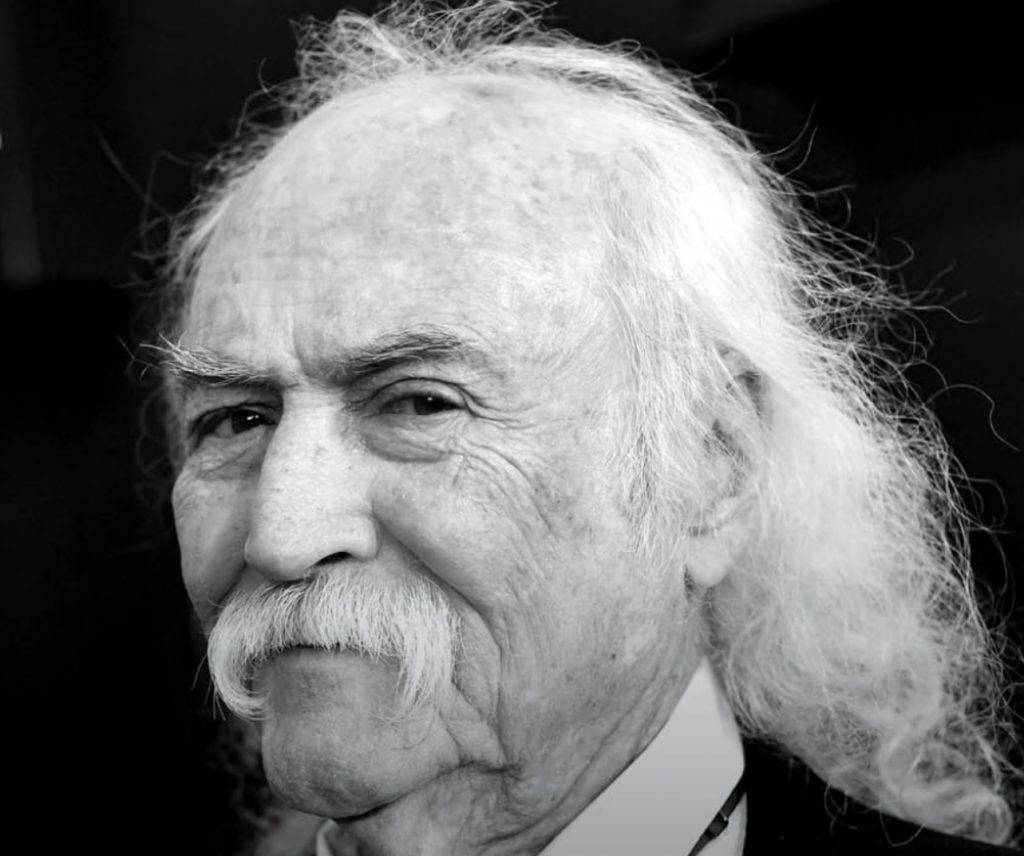
“Cinema Has Been Devalued”

“…not necessarily on the business side but certainly [in terms of] the art.” — Martin Scorsese speaking last night at the 60th New York Film Festival.

Marty didn’t point the finger of blame, but if he had who would have been the recipient? You know who. We all know who.

Not any one group of filmmakers or producers or distributors, but the under-40 couch potatoes…Millennials, Zoomers…the easy-streaming content generation. The ones most responsible for the abandoning and closing of movie theatres. Be honest…who else can be blamed as squarely?

Glenn Ford Was A Hound

Glenn Ford is one of those classic-studio-era movie stars whom nobody seems to care much for today. Even I don’t care much for the guy.

My favorite Ford films are not So Ends Our Night, Gilda, The Big Heat, Teahouse of the August Moon or The Blackboard Jungle. My favorites are actually Cowboy, Cimarron and especially Experiment In Terror.

Ford’s career peaked in the ’40s and ’50s; he seemed to fall off a cliff in the mid ’60s. He died at age 90 on 8.30.06.

What I honestly didn’t know until an hour ago was that off-screen Ford’s life was, to borrow a Quentin Tarantino-ism, largely about dick dick dick dick dick dick dick dick dick dick dick dick dick dick dick dick dick dick.

According to “Glenn Ford: A Life,” a 2001 bio by his son Peter, the allegedly well-endowed Ford put the high hard one to no fewer than 146 actresses during his heyday, and that’s not counting the little side affairs that are never written about.

The biggest extra-marital love of Ford’s life was Rita Hayworth; their off-and-on, 40-year affair began during the filming of Gilda and lasted until the ’80s.

Ford also “knew” Maria Schell, Geraldine Brooks, Stella Stevens, Gloria Grahame, Gene Tierney, Eva Gabor, Judy Garland, Connie Stevens, Suzanne Pleshette, Rhonda Fleming, Roberta Collins, Hope Lange, Susie Lund, Terry Moore, Angie Dickinson, Debbie Reynolds, Jill St. John, Brigitte Bardot, Loretta Young and Barbara Stanwyck.

He allegedly had a one-nighter with Marilyn Monroe in ’62, and did a duh-doo-ron-ron with Joan Crawford in the early 1940s. Ford’s affair with stripper and cult actress Liz Renay was mentioned in her 1991 book “My First 2,000 Men.”

Instant Brody Dismissal

Early in his review of Todd Field‘s Tar, New Yorker critic Richard Brody reveals a clear, nonsensical bias against the anti-wokester crowd (i.e., people like me).

He does so by using the expression “so-called” twice in a single sentence: “Tar is a regressive film,” he writes, “that takes bitter aim at so-called cancel culture and lampoons so-called identity politics.”

In short, Brody’s use of “so-called” means he’s highly suspicious of even the existence of wokeism and cancel culture, which of course completely invalidates his review of Tar.

A good portion of Field’s film deals with wokester investigations of improper sexual behavior on the part of Lydia Tar (Cate Blanchett), and so Brody being highly skeptical of even the presence of woke terror is like a critic reviewing a James Bond film while holding a view that there are no such things as guns.

Tar, says Brody, “presents Lydia as an artist who fails to separate her private life from her professional one, who allows her sexual desires and personal relationships to influence her artistic judgment — which is, in turn, confirmed and even improved under that influence.

“[Tar] presents the efforts to expand the world of classical music to become more inclusive, by way of commissioning and presenting new music by a wider range of composers, as somewhere between a self-sacrificing gesture of charity and utterly pointless. It mocks the concept of the blind audition (intended to prevent gatekeeping conductors, musicians, and administrators from making decisions on the basis of appearance). It sneers at the presumption of an orchestra to self-govern (which the one that Lydia unmistakably conducts in the film, the Berlin Philharmonic, does in real life). It derisively portrays a young American conducting student named Max (Zethphan Smith-Gneist), who identifies as ‘a bipoc pangender person,’ and who says that he can’t take Bach seriously because he was a misogynist. The film looks at any social station and way of life besides the money-padded and the pristinely luxurious as cruddy, filthy, pathetic.”

The slightly puzzling fact is that Tar doesn’t portray Lydia as a pure victim (although she is certainly pounced upon and destroyed by woke-deferring officials within the Berlin and New York orchestras) but also as a catalyst. So Tar is simultaneously saying the wokesters are beasts of prey but also that Lydia made her own bed.

Brody: “The film seems to want it both ways: it sustains Lydia’s perspective regarding music, her professional relationships, and her daily aesthetic, while carefully cultivating ambiguity regarding what Lydia is charged with, in order to wag a finger at characters who rush to judgment on the basis of what’s shown (or, what isn’t).

“By eliminating the accusations, Field shows which narrative he finds significant enough to put onscreen. By filtering Lydia’s cinematic subjectivity to include disturbing dreams but not disturbing memories, he shows what aspect of her character truly interests him. By allowing her past to be defined by her résumé, he shows that he, too, is wowed by it and has little interest in seeing past it.”

Like the film, Brody himself seems to want it both ways.

Read more

Furry Litter Boxes?

Nine months ago The New York TimesIsabella Grullón Paz reported that a rumor about school-age furries using litter boxes in a Midland, Michigan, elementary school was apparently bullshit, at least according to Midland Public Schools superintendent Michael Sharrow.

I don’t know if this is the same rumor that Joe Rogan mentioned yesterday…or not. Further investigation is required.

Respect For Austin Stoker

Austin Stoker, the star of John Carpenter‘s Rio Bravo-ish action thriller Assault on Precinct 13, passed last Friday (10.7) on his 92nd birthday. HE has long admired Stoker’s performance as Lt. Ethan Bishop, the steely, fair-minded L.A. cop in charge of an about-to-be-abandoned police station in some hellish South Central region of Los Angeles.

Stoker was around 45 when Assault was shot — he looked a good ten years younger.

I first saw John Carpenter’s Howard Hawks-inspired film at the Museum of Modern Art in ’78 or ’79. I’ve re-watched it at least nine or ten times since.

In my book Stoker and costars Darwin Joston (who played the allegedly fearsome but essentially honorable Napoleon Wilson) and Laurie Zimmer (who played a brave Hawksian woman named Leigh) were a much more compelling trio than John Wayne, Dean Martin and Ricky Nelson in Rio Bravo.

Honest Reactions, Please

In a 10.11 interview with A.V. Club‘s William Hughes, legendary horror helmer John Carpenter allows readers see the proverbial man behind the curtain, and that man, it turns out, is a lot more into video games than keeping up with must-see films.

And therefore — here’s a real forehead-smacker — Carpenter doesn’t even know what elevated horror is, for heaven’s sake.

C’mon, bruh…being 74 (which is oldish but not that old) doesn’t give you license to just live in your own little world and ignore the here-and-now. You have to watch what other directors are doing, and maybe let some of what they’re doing and saying…maybe let a little bit of that in.

Hughes: Shifting gears slightly: Are you familiar with the phrase ‘elevated horror’?

Carpenter: I don’t know what that means. I mean, I can guess what it means, but I don’t really know.

Hughes: People usually use it to refer to A24’s movies…horror that’s very heavy on the metaphorical. Hereditary, Midsommar, movies like that.

Carpenter: I have no idea what you’re talking about.

Things Were Different Then

Will you listen to this Pauline Kael interview with Woody Allen, which happened in early 1974? They’re mainly talking about Sleeper (12.17.73), Allen’s most recent film at the time, and Kael is offering sincere praise here and there but she’s also telling Allen, politely, what she feels is lacking in his films or about aspects of his films that don’t quite work for her

Does Allen stiffen or bristle or get a tad defensive? No, he’s totally fine with this (or pretending to be fine with it), half-agreeing or breaking into a discussion of some point she’s made or just listening.

Can you imagine any big-time critic or columnist conducting such an interview with a major filmmaker today? Saying nice things but also sharing discreet criticisms from time to time? It would never, ever happen.

Allen later told Roger Ebert that he admired Kael, but that during their interview “she had everything but judgment.”

Repeating: “Woman King” Is Dishonest History

Everyone presumably understands by now that Gina Prince-Bythewood‘s The Woman King lies about the slave-trading history of Dahomey and particularly that of the Agojie, the all-female warrior unit that protected Dahomey during the 18th and 19th Centuries.

Here’s the concise truth of it, laid out in an 10.5 Project Syndicate essay titled “Women, Life, Freedom and the Left.” The author is Slovenian philosopher and scholar Slavoj Žižek:

The Woman King is an historical epic about the Agojie, an all-female warrior unit that protected the West African kingdom of Dahomey from the seventeenth to the nineteenth centuries.

“It stars Viola Davis as the fictional General Nanisca. She is subordinated only to King Ghezo (John Boyega), a real-life figure who ruled Dahomey from 1818 to 1859, and who engaged in the Atlantic slave trade until the end of his reign.

“In the film, the Agojie’s enemies include slave traders led by the fictional Santo Ferreira (Hero Fiennes Tiffin), a character loosely inspired by Francisco Félix de Sousa, a Brazilian slave trader who actually helped Ghezo gain power.

“Dahomey was a kingdom that conquered other African states and sold their people into the slave trade. While Nanisca is depicted protesting to King Ghezio against the slave trade, the real Agojie served him.

The Woman King thus promotes a form of feminism favored by the Western liberal middle class.

“Like today’s #MeToo feminists, the Amazon warriors from Dahomey will ruthlessly condemn all forms of binary logic, patriarchy, and traces of racism in everyday language; but they will be very careful not to disturb the deeper forms of exploitation that underpin modern global capitalism and the persistence of racism.

“This stance involves downplaying two basic facts about slavery. First, white slave traders barely had to set foot on African soil, because privileged Africans (like the kingdom of Dahomey) furnished them with an ample supply of fresh slaves.”

For Me, Fetterman’s Stroke Issue Is Nothingburger

I don’t see John Fetterman‘s stroke issue (i.e., using closed-captioning) as a campaign problem, although obviously it’s become one. Recent Pennsylvania Senate race polls had Fetterman, the Democratic candidate, ahead but now he’s neck-and-neck with the Republican candidate, Mehmet Oz. I tend to see Fetterman’s temporary disability (which I presume is temporary) as a character-building thing, or somewhat analogous to FDR’s disability. I think it’s cruel to attack Fetterman over a medical issue. The idea of Oz winning is appalling.

Murray’s Great Gift

Damn few actors have the innate ability to make this kind of dialogue — “Put down the magazine before you hurt yourself…okay, Harold?” — land as well. This plus a just-right expression of world-weary “God help me.” Bill Murray owns this attitude. He coined it. If you insist on beating him with birch branches along with a time-out, fine. We all understand that paying just over $100K to the Being Mortal production assistant was just for openers, and that the real punishment starts now. But don’t excommunicate him. He’s Bill Murray, for chrissake. He understands everything, has been everywhere, carries the whole equation in his head, etc.