A Guy Who Knew From Cricket Bats
November 30, 2025
When "The Indian Fighter" Opened at Mayfair in 1955...
November 29, 2025
Persistence of 42 Year Old "Betrayal"
November 17, 2025
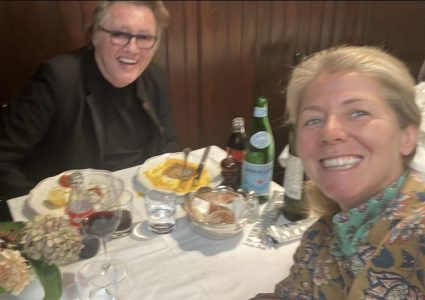
…that producers of Criterion Closet videos have traditionally kept the hands and arms of assistants or friends or whomever this woman might be…friendly hands and arms aren’t allowed to intrude upon Criterion Closet videos…period and finito.
Secondly, Cavett’s praise of Criterion’s OnlyAngelsHaveWings Bluray is mistaken or under-informed or something, as I pointed out nine years ago in an HE riff called “‘Angels’ Shadowed to Death.”
It’s the darkest, inkiest rendering of this 1939 classic ever created. The mine-shaft blacks and haunted-house shadows are thoroughly noirish and gloom-ridden. Somewhere in heaven Gordon Willis is quaking with envy.
Except for two irksome elements, Mariska Hargitay‘s My Mom Jayne (Max) is an emotionally affecting doc about identity — both suppressed (Mariska’s) and misunderstood (in the case of Mariska’s late mom, Jayne Mansfield) — and emotional closure by way of family ties and genetics.
It’s a little too weepy and whiney here and here. There is always an urge among modern women to turn women of the past into victims. But the doc settles in and touches bottom by the end.
In plainer terms, it’s about (a) the 61 year-old Mariska delving into who her famous blonde bombshell mom (who died in a horribly violent car crash at age 34) really was deep down, and (b) how Mariska came to discover that her biological dad wasn’t Mickey Hargitay, her putative father who was married to Mansfield between 1958 and 1964 and who raised Mariska after Mansfield’s death.
Mariska’s actual dad is a Brazilian-Italian lounge singer named Nelson Sardelli, whom Mansfield had an extra-marital affair with in mid ’63 and early ’64.
Mariska didn’t get around to facing the truth about Sardelli until the early 1990s, a year or so before she turned 30. For structural and dramatic reasons the doc holds his information back until the final 25 minutes or so.
Irksome element #1 is that as a young child Mariska (aka Maria) appeared to have been adopted, as her eyes and hair were much darker than those of her siblings. Any stranger would have taken one look at young Mariska and presumed she wasn’t from the same gene pool as her two brothers, Miklos and Zoltan, whose natural father was Mickey Hargitay; ditto her much older sister, JayneMarieMansfield, from her mom’s first marriage.
Mariska’s biological dad, the Neapolitan-featured Sardelli, was born in Brazil and is of Italian descent. Hence Mariska looked vaguely like a daughter of southern Italy or Sicily. She certainly bore no resemblance to her Hungarian body-builder caregiver “dad”, who was born in Budapest. It’s odd how this obvious biological fact was ignored or denied for as long as it was. Which just goes to show that if there’s a strong enough will, denial can be a very powerful force in people’s lives.
Irksome element #2 occurs when Mariska interviews actor Tony Cimber (born in ‘65), the son of Jayne and her third husband, Matt Cimber, a film director and promoter.
Mariska confronts Tony with stories about some ugly behavior that happened between Jayne and Matt, mostly a result of Matt’s provocation (presumably domestic violence and bruisings). She seems to be asking Tony to atone for these incidents or perhaps even accept responsibility for his father having struck Jane — a bizarre idea, to say the least. Tony says he’s not going to “own” his father’s behavior, as he doesn’t see how this could lead to anything that would heal or cleanse. Mariska’s non-verbal but emotionally readable response is one of seeming disapproval or disappointment.
HE to God: In what realm do you look at the son or daughter of an acknowledged shithead and say, “You need to face the fact that your parent was an abusive person, and so perhaps you need to apologize for this.” WHAT?
Rather than deifying Superman/Clark Kent as a true-blue heartland innocent who believes (or once believed back in Chris Reeve‘s day) in truth, justice and the American way, Gunn is trying to “woke” up this decades-old tentpole franchise.
Superman is an immigrant…wokey-wokey! Just like some guy from Nicaragua swimming across the Rio Grande in the dead of night. Just like young Vito Corleone arriving at Ellis Island at the turn of the century. Just like Elon Musk arriving in Canada from South Africa in 1989.
Cut the shit…Superman has never been and never will be “an immigrant.” He’s a saintly, goody-two-shoes, all-powerful alien from another planet…a visitor with powers well beyond those known to mortal men. He isn’t an Eastern European Jew fleeing from hate and oppression.. He isn’t a Gaza Palestinian looking to escape Israel’s wrath. He hasn’t crossed the Mexican border while listening to Tejano music. He’s a musclebound, axe-blade handsome, red-cape-wearing whiteboy who zips around and wows the womenfolk.
Seriously: When immigrants arrive in this country, legally or illegally, they start at the bottom of the social totem pole. They take the shittiest, grubbiest jobs that pay the least. Superman, by contrast, was way ahead of the eight ball when he on.arrived from Krypton. So he’s no “immigrant”. He’s a solid, square-shouldered, good-looking guy with a big, swinging Krypton dick….flyin’ faster than a speeding bullet, more powerful than a locomotive, an ability to leap tall buildings with a single bound.
“Superman is the story of America,” Gunn has toldThe Hollywood Reporter. “An immigrant that came from other places and populated the country”….bullshit!
Gunn has explicitly framed Superman “as an immigrant, emphasizing that he is not from Earth and must navigate a new world and culture“….bullshit, James! This allows Superman “to explore themes relevant to the immigrant experience, such as adapting to a new environment, dealing with prejudice, and finding a sense of belonging”….you’re full of it!
Gunn: “For me it is mostly a story that says basic human kindness is a value and is something we have lost.” Agreed but so what? This world is rough, and if a man’s gonna make it he’s gotta be tough.
I’m Jeffrey Wells of Hollywood Elsewhere, and a friend of the late George Hickenlooper. I saw the 4K Hearts of Darkness earlier today at the Film Forum, and it looked absolutely wonderful. I know this restoration required a lot of hard work. Congrats to each of you, and especially to Eleanor Coppola in absentia.
But the “directed by” credit should be shared between Fax and poor George, rest his soul.
Here’s what people are reading on the HOD credit block on the HOD one-sheet and during HOD’s closing credits:
George said more than once to me, in fact, that he did the lion’s share of the editing work on HOD. And yet the credit block has always read “written & directed by Fax Bahr with George Hickenlooper.”
“With”? Was George Fax’s helper or assistant? Did he go out for coffee, make copies, run errands?
This is a very strange credit block assertion.
I’m only going by what George told me repeatedly, of course, but I don’t believe he lied or that he was delusional or anything in that realm.
Given the current credit block assertion that Fax was the senior creative force in the directing and writing (and also, one presumes, the editing and shaping) of HOD, is this what I should believe? Should I discount George’s personal testimony? Was George some kind of eccentric with an over-sized ego? I’m asking.
How should I report this?? I’m honestly perplexed. This really doesn’t seem right. — cheers, Jeffrey Wells, HE
With a dynamically enhanced, 4K-scanned and generally restored Hearts of Darknessopening at the Film Forum tomorrow, it’s an opportune time to remind the HE readership that while this 1991 doc about the making of Apocalypse Now uses the late Eleanor Coppola‘s footage and narration, the heavy lifting in the post-principal photography sense of the term was done by the late George Hickenlooper, whom I regarded as a friend, and Fax Bahr.
“I think the more appropriate way to look at it is that Hearts of Darkness is Eleanor Coppola‘s story, but it’s not her film. Hardly. It’s her story. But that’s because I decided to make it her story.
“When I got involved with this project 20 years ago, Showtime was going to make it a one-hour TV special called Apocalypse Now Revisited. It was going to be basically an hour-long special about how they did the war pyrotechnics. It was going to be dull and stupid.
“At the time I told Steve Hewitt and my partner Fax Bahr. ‘Nobody cares about a making-of movie, especially one that is 14 years old.’ (Most of AN was shot in ‘76.) I argued that the film had to have an emotional component. At the time, no one was familiar with Eleanor’s diary ‘Notes.’ My father had purchased it for me on my 16th birthday [in 1979]. I devoured it up.
“When I got involved with Hearts of Darkness, I advocated using her diary as the narrative thread. I got incredible resistance from Showtime, and I fielded initial resistance from Eleanor. Not much, but some.
“Once I was able to convince everyone that the film would best be told through her narrative voice, it was then and only then it became HER STORY.
“Eleanor did shoot the footage in the Philippines back in 1976, of course, but she only stepped twice into our cutting room on the back lot of Universal. Twice. For a total of eight hours.
“I was there for a year, 15-18 hours a day. So it’s not a film by Eleanor, but I guess it’s sexier from a marketing angle to make it look that way.”
In an 8.27.10 HE followup Hickenlooper stated that “the reality is that Fax Bahr hardly had anything to do with HOD. He was writing for the show In Living Color at the time. He spent a total of about three weeks out of the entire year in the editing room. Eleanor spent two days. It was me and the two editors (Michael Greer, Jay Miracle) for an entire year.”
James Mockowski, Film Archivist and Restoration Supervisor at American Zoetrope: “For the past 30 years, Eleanor’s 16mm behind-the-scenes footage has been three to four generations removed from the original elements. For this new release and restoration of the documentary, Francis decided to scan the original sources in 4K. The extensive excerpts from the feature are now presented in their original 2.39:1 aspect ratio, rather than being letterboxed into a 4×3 frame.”
Hickenlooper (Picture This: The Times of Peter Bogdanovich in Archer City, Texas, Some Folks Call It a Sling Blade (short), Dogtown, The Man from Elysian Fields, The Mayor of Sunset Strip, Factory Girl, Casino Jack) died in his sleep on October 29, 2010, at age 47.
“The problem is that saving 200 pounds a month for a deposit on your first property makes very little sense when the price of that property grows by tens of thousands every year.
“This sense of the things you actually want speeding away from you on a train you’ll never catch…this is the real driving force behind the popularity of politicians like Mamdani.”
I still think Mamdani’s assured victory in the forthcoming New York mayoral election is a one-off.
Originally posted on 3.4.10: The Warner Bros. logo fanfare music that begins Lewis Milestone‘s Ocean’s 11 (1960) is the most enjoyable part of the film, hands down.
The second best part is Saul Bass‘s animated casino-attitude title sequence. Obviously old-school by today’s standards, but you can sense the smooth cocky mentality of late ’50s showbiz culture — the hold-the-clyde, chickie-baby attitude of Frank Sinatra and those those godawful orange sweaters he used to wear as he lounged around with Dean Martin and Sammy Davis, Jr. The mob guys who used to run things in Las Vegas would cater to the Rat Pack’s every whim, and there were always accommodating broads to hand out back rubs and…uhm, whatever else.
HE never even came close to a whiff of this kind of life (way before my time), but I can imagine.
If there’s one ’90s movie I’m determined to never, ever watch again, it’s Adrien Lyne‘s Indecent Proposal (’93). It was bad enough sitting through it the first time.
I lost it early on when Demi Moore‘s narration track used the term “dream house”. (Anyone who says those two words in that sequence deserves an instant, life-long demerit.)
Robert Redford‘s John Gage was supposed to be an odious millionaire, but there was no believing that because Redford can’t do odious, much less icky — it’s not in him. No matter the role (and I’m not counting Little Fauss and Big Halsy), he always played fair-minded straight-shooters.
As a testament to its own cynicism, Indecent Proposal uses a two-headed coin in the exact opposite way that Only Angels Have Wings uses one, which is interesting.
Just before his million-dollar night with Moore is about to commence on a yacht, Redford/Gage offers to forget the whole deal based on a coin toss — heads she submits, tails she walks.
Redford flips a half-dollar coin and it comes up heads, and so Moore stays and fulfills the deal by “doing” him every which way. At the finale he gives the coin to Moore for good luck. She flips it over and realizes it has heads on both sides. Redford/Gage therefore confirms that he’s a dishonest, manipulative shit.
Posted in 2018: The realm of Only Angels Have Wings is all-male, all the time. Feelings run quite strong (the pilots who are “good enough” love each other like brothers) but nobody lays their emotional cards on the table face-up.
Particularly Cary Grant‘s Geoff, a brusque, hard-headed type who never has a match on him. He gradually falls in love with Jean Arthur but refuses to say so or even show it very much.
But he does subtly reveal his feelings at the end with the help of a two-headed coin. It’s not what any woman or poet would call a profound declaration of love, but it’s as close to profound as it’s going to get in this 1939 Howard Hawks film. If Angels were remade today with Jennifer Lawrence in the Arthur role she’d probably say “to hell with it” and catch the boat, but in ’39 the coin was enough. Easily one of the greatest finales in Hollywood history.
Bosley Crowther’s reaction to Alfred Hitchcock’s Psycho in his 6.16.60N.Y. Timesreview is mostly one of distaste for the grisly stuff, which he regards as low-rent. He then masks his snooty prejudice by feigning boredom.
At age 54 the veteran critic was entering his harumphy, fuddy-duddy phase, I suppose, but how could this sophisticated movie maven…how could he have just sat in his seat like a heap of mashed potatoes during the startling, jittery editing of the shower-murder scene, compounded by Bernard Herrmann’s screechy violin score, neither of which he even mentions? Was he on painkillers?
And yet in the wake of Psycho’s striking popularity and financial success, Crowther’s opinion evolved. On 12.25.60 or six months later, he announced that Psycho was among his ten best of the year.
Andrew Sarris’s highly adniring VillageVoicereview didn’t appear until the August11thissue — almost twofullmonths after the Crowther verdict. Why would it have taken this long for the Voice to register an opinion? The downtown paper couldn’t even publish a review sometime in July?
HE to friendo who’s seen JamesGunn’s Superman: “How can you even stand to watch another DC Superman film? How can you let that shit into your soul? The endless reliance upon DC formula, remaking and remaking and remaking it all over again, is poison in the bloodstream.”
Friendo: “If I had a magic wand and could eliminate the blockbuster culture of the last 45 years, I would. But the poison didn’t start with comic-book movies. It started in the early ‘80s. And yet the bottom line is that some comic-book movies are good. That said, I’ve no doubt Superman will be trashed into the ground.”