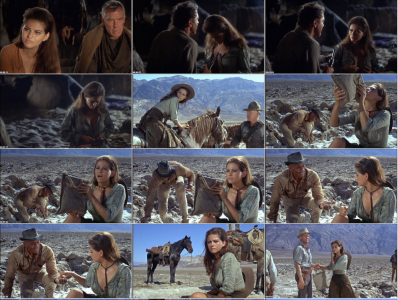
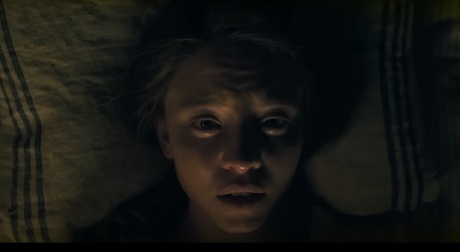
Richard Brooks‘ The Professionals (’66) deepens and souls-up during the final half-hour, agreed, and the only elements that don’t quite work, due respect, are the flagrantly inauthentic, un-Mexican Jack Palance and Claudia Cardinale. Good performances but there’s no believing them deep down.
Brooks, who adapted the script from “A Mule for the Marquesa”, gave Lee Marvin a difficult first-act line. Regarding an old photo of Marvin’s Henry “Rico” Fardan, Ralph Bellamy‘s J.W. Grant says “your hair was darker then.” On the page Marvin’s reply — “My heart was lighter then” — sounds too pat, too written. But Marvin makes it work by muttering the line in a semi-embarassed, self-amused way. This is where good acting and good directing come into play.
Let no one dispute that Jaglom was a world-class gabber and bullshitter (I interviewed him at length in the front seat of a car when he was filming Can She Bake a Cherry Pie? in Manhattan, and we could’ve easily yakked for another two or three hours). Plus he fancied himself as a soulful ladies man (his hottest girlfriend was Andrea Marcovicci), and he was a longtime friend and ally of Orson Welles.
He was always cushioned to some extent by family money, although I don’t know the particulars. “Risk is my middle name” was one of his better lines, but family wealth mitigates this.
A freckly, fair-skinned, auburn-haired guy who was shaped by ’60s experimentation and was always the agile, whipsmart social hustler, Jaglom’s run began with 1971’s A Safe Place, and continued five years later with Tracks (Dennis Hopper as a traumatized vet). Neither of these, to my fullest recollection, was all that great.
Jaglom found his groove and arguably peaked with four films released between the early to mid ’80s — Sitting Ducks (his only real financial hit) and Can She Bake A Cherry Pie? (’83), Always and Someone to Love (’87 — his only Marcovicci film).
That said, I’ve always had a thing for Jaglom’s Venice/Venice (’92):
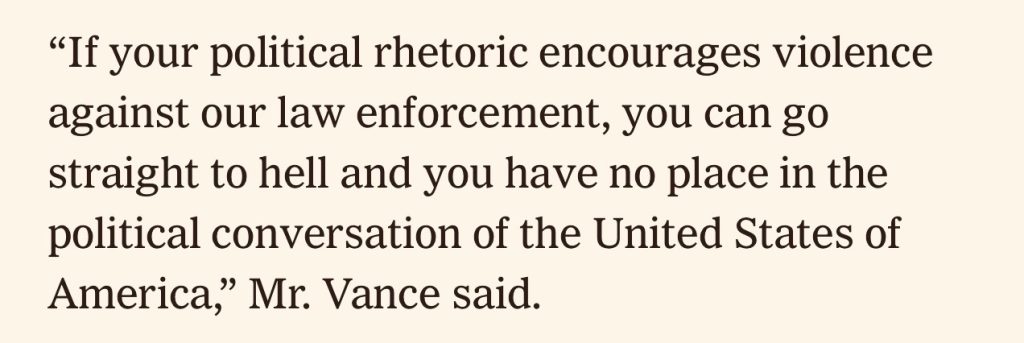
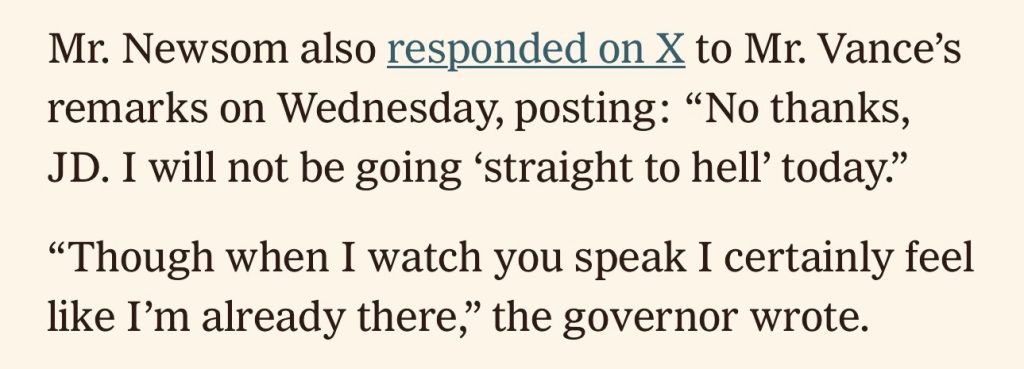
Instant analysis of yesterday’s ICE shooting in Dallas** led to verbal sniping between JD Vance, Gavin Newsom and PodSaveAmerica’s Jon Favreau. The following is from Jesse McKinley‘s 9.24 N.Y. Timesstory about same.
** The 29 year-old shooter, Joshua Jahn, was an overweight videogame enthusiast (what else?) who shot himself when the fuzz closed in. One of Jahn’s shell casings had been engraved with the phrase “ANTI-ICE.”
Watching Ron Howard‘s Eden prompted me to wonder about what visiting Floreana (600 miles west of Ecuador) would be like today, and what it might have been like 93 years ago (i.e., 1932), which is when the original German settlers tried to establish a small community there.
If I were to visit Puerto Velazco Ibarra, the one and only Floreana village, located on the island’s west coast — my first question would be “how’s the wifi?” How many bars would I get on the iPhone? Or would I be dependent on the hotel wifi? Any kind of cable or satellite TV? And how’s the water supply?
The movie made me cringe, if you wanna know. My imagination had a difficult time with the grim facts of primitive Florean life.
The cabin-sized homes in the film had tons of amber-tinted candles, so how many wax candles did they bring with them?
What was the situation with ships from the mainland delivering much-needed stuff (canned foods, sugar, flour, rubbing alcohol, fresh underwear, rubber sandals)? Imagine what a freighter would charge for soap bars, for example, if it had to travel 600 miles from Guayaquil, the Ecuador coastal port.
As soon as Sydney Sweeney and whatsisname moved in with their stuff, urgent questions arose. Water being so precious they couldn’t possibly take baths, so they had to bathe in the surf, but how clean can you get without hot water? How many bars of lava soap did they bring with them, and how long would those bars last? Where or how did they take a dump?, and did they bring toilet paper with them, and if so how many rolls? Did they have toothpaste, toothbrushes, deodorant, moisturizer, cologne, scissors, toenail clippers, wipes, dental floss, Aqua Velva, etc.? There was no dentist so if any kind of tooth infection manifested, they were on their own.
It couldn’t have been very comfortable. It might have been agonizing.
Friendo: “One Battle After Another is a beautifully orchestrated film, no doubt, but the sympathetic emotional boost, at least among the big-city critics, comes from the women-of-color costars…Anderson is married to a woman of color, and critics, political animals and certainly no fools, understand the deal or, if you will, the sociological signage…they have to be down with Leo, Benicio and the sisters.
“Now flip the coin and imagine a similar story in which the revolutionaries in question are white militia types…imagine the reviews! Not so friendly!”
Paul Thomas Anderson‘s One Battle After Another is a high-torque drama set in an agitated culture that’s markedly similar to what’s going on today. The good guys, the film tells us, are people of a rebellious nature…anti-government activists and insurrectionists (or, in the case of Leonardo DiCaprio‘s Bob Ferguson, a former anti-government activist) while the bad guys, so to speak, are ICE-like military guys in starched fatigues as well as an elite cabal of white nationalists called “the Christmas Adventurers.”
The current political atmosphere in this country is not what anyone would call an opportune time to release a “hooray for the good-guy insurrectionists!” action drama.
Within the last two weeks, after all, we’ve had two anti-rightist, anti-government-affiliated shootings by nihilist, insurrectionist, left-leaning types.
On Wednesday, 9.10, the hate-deploring, trans-boyfriend-supporting Tyler Robinson murdered Charlie Kirk, with one of his bullet casings etched with at least one anti-fascist slogan (“hey, fascist…CATCH!“).
Last week I wrote the following: “In the wake of the Charley Kirk tragedy Warner Bros, is releasing a hooray-for-the-left, defy-the-malevolent-whiteys film? A movie that says almost all white people and especially guys in starched military fatigues with close-cropped hair are bad…we get that, this is what Hollywood always does…whitey bad, POCs good…whitey baddie-waddie, POCs are spirit angels and God’s chosen. But the Kirk tragedy has changed the political landscape.”
I also said in my 9.17 rave review that Battle “might run into some trouble commercially as it’s strictly a blue-cities flick from a political-ideological standpoint.
“Form-wise it’s a total homer — a knockout masterwork from a gifted director who knows exactly what he’s doing and how to deliver the right stuff — while the content is so absurdly woked-up in a POC-favoring, insurrectionist-identifying, over-the-waterfall-in-a-barrel way that it’s sure to be hated or certainly hooted at outside the big cities, especially in the wake of the Kirk shooting.
“Average Joes and Janes will say ‘yeah, a really good movie but what’s with the leftist guerilla-revolution jazz?'”
Jimmy Kimmel, starting at 6:37 mark: “It was never my intention to make light [voice cracks, chokes] of the murder of a young man. I posted a message on Instagram on the day [Charlie Kirk] was killed, sending love to his family and asking for compassion, and I meant it and I still do. Nor was it my intention to blame any specific group for the actions of a deeply disturbed individual. That was really the opposite of the point I was trying to make. But I understand those who felt it was either ill-timed or unclear or maybe both.”
Kamala Harris‘s chances of scoring the 2028 Democratic presidential nomination are zero. Nobody wants her around. She’s done.
During the ’24 race she didn’t have the elemental political smarts to recognize that the only way to win was to (a) clearly distance herself from Joe Biden, to (b) explain that Vice Presidents are ceremonial figureheads with no agency of their own, and (c) state that if elected she would going her own way. The fact that she flubbed this by saying she would continue Biden-ism in a rote, rubber-stamped way…that in itself showed she wasn’t smart or tough enough for the Presidency. She’s toast.
Scott Galloway: “I actually think Mayor Pete would do pretty well on the national stage [in ’28] — he just has to get through the Democratic primary, in which the Black caucus carries a lot of weight.” Translation: “Intransigent black homophobia is still Pete’s primary impediment to a fair shot at the nomination.”
I’ve always thought of this 1957 lifeboat drama, directed and adapted by Richard Sale, as Abandon Ship!, but the British title is Seven Waves Away. Without going into a big song-and-dance about it, it’s a better-than-decent serving of a high-stakes moral tale –a story that teeters on the question of “who lives and who dies, and is there any fair way for a captain to choose?”
David Kittredge‘s Boorman and the Devil was honored earlier this month with a debut screening at the Venice Film Festival. A followup booking should have happened at the Toronto Film Festival, and it damn well ought to be booked for the about-to-begin New York Film Festival. And perhaps at AFI Fest.
I’m basically saying that it’s way too good — too rich, too fully considered, too thoughtfiul and high-end — to be screening at the upcoming Brooklyn Horror Film Festival on 10.22. It’s much, much better than what this booking implies.
All hail the late, great Claudia Cardinale, who flourished in the late ’50s, ’60s, ’70s and early ’80s….Big Deal on Madonna Street, Il bell’Antonio, Rocco and His Brothers, Girl with a Suitcase, 8 1/2,, The Leopard, The Professionals, Once Upon a Time in the West, Blood Brothers, A Common Sense of Modesty, Escape to Athena, The Salamander, The Skin, Fitzcarraldo.
What do we think of first when thoughts of Cardinale come to mind? Be honest. But even in her youth she had a lot more going on than just a great rack.
I finally saw Ron Howard‘s Eden last night, and yeah, I get it — it’s not much fun to watch. This doesn’t make it a “bad” film — just an unpleasant one. It’s basically a grubby, sandy, hand-to-mouth survival story, set in the early 1930s, about a few German settlers of Floreana, one of the Gallapagos Islands…a gnarly, rocky, non-tropical, water-poor place roughly 600 miles off the coast of Ecuador…dogs, cows, lizards, steep paths, scrub brush, etc.
I like Owen Gleiberman’s capsule description — “a misanthropic survivalist Robinson Crusoe meets Who’s Afraid of Virginia Woolf? with deranged footnotes by Friedrich Nietzsche.”
It’s not Howard’s fault that all but two of the characters are generally foul, perverse types. Well, okay…Howard chose to re-tell this calamitious true story but he’s just passing along what happened…just sticking to the facts.
All I knew last night was that it felt like a real drag to hang with three of the characters — Jude Law‘s Dr. Friedrich Ritter, a chilly, judgmental misanthrope…Vanessa Kirby‘s Dore Strauch, Ritter’s significant other and a chilly, malevolent blonde in her own right…and Ana de Armas‘s haughty Austrian bitch, Baroness Eloise Bosquet de Wagner Wehrhorn, who has an entitled attitude from hell.
There’s also a half-grown son (Jonathan Tittel), a pair of boy-toy types (Toby Wallace, Felix Kammerer) and a well-educated fellow with a movie camera who briefly visits the island (Richard Roxburgh).
The two decent settlers are Sydney Sweeney‘s Margret Wittmer, who lived on Floreana from 1932 until her death at age 95 in 2000, and Margret’s husband Heinz (Daniel Brühl).
Sweeney’s performance has nothing to do with her big boobs, and everything to do with real-deal, dug-in acting that feels genuine and un-“performed”. Zero makeup, her convincing German accent, Margret’s no-nonsense dialogue…Sweeney is the clear standout. Yes, viewers will talk about her baby-birthing scene while dogs are growling and snapping at her, but I believed each and every line and gesture. In every one of her scenes Margret touches the bottom of the pool.
For the last seven years or so Sweeney has struck me as a somewhat breezy lightweight with bodacious ta-tas…Under the Silver Lake, Once Upon a Time in Hollywood, Reality, Americana, Anyone but You, Madame Web, Christy, the sure-to-be-trashy The Housemaid. Now I respect her. Now I’ve seen through the facade.