
WARNING: CONTAINS A POOR THINGS SPOILER OR TWO:
Telluride friendo (after reading my brief Poor Things review): “You seriously thought this movie was better than Lanthimos’s The Favourite? Yeah, I guess Poor Things is ‘wild’ but in its undeniably interesting and audacious way I found it to be an ungainly, overlong didactic art thing.
“It’s like Barbie directed by the Marquis de Sade.
“Emma Stone is excellent, but she’s playing the only interesting character (apart from Dafoe’s scarred freak). Mark Ruffalo seems interesting at first, but grows duller as the movie goes on. He becomes one more oppressive male in a movie that’s programmatically full of them.
“How can you object to Barbie being an anti-male jeremiad and not object to this one?”
HE to friendo: “Every festival film, it seems, is misandrist except for Alexander Payne’s The Holdovers. Filmmakers are generally not allowed to not hate white guys. Then again Scarface Dafoe and his loyal assistant weren’t depicted as ugly diseased males. In any event I felt that the mad nutso Terry Gilliam paintbrush aspect overwhelmed my reservations about anti-male portraiture. Oh, and I wasn’t knocked out by The Favorite.”
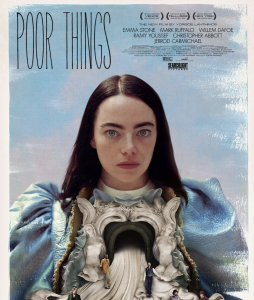
Telluride friendo: “Poor Things is visually entrancing, no doubt, but once Stone’s character gets out into the world (and becomes a less and less interesting character as she grows more intelligent and just becomes…a normal Englishwoman!), the storytelling becomes very basic and kind of stilted. It’a a drag that Ruffalo’s character turns out to be such a run-of-the-mill asshole. How much better it would have been had there really been something to their relationship, or to Stone’s relationship to anyone else in the film.
“I had no moral objection to Stone’s descent into prostitution, but what’s the point? You’re right that Dafoe and his assistant weren’t depicted as ugly diseased males, but by the end of the movie, every other male in the film is. That’s the whole point. That’s why that shot of her husband [redacted] is such a money shot. It’s sealing the deal on the movie’s misandry.
“My real objection isn’t that I found it so offensive — it’s that it’s so thin. The movie is the fairy tale as (woke) allegory, and I really wish that it could’ve been more of a greater fairy tale and less allegory. After a while, I was almost bored by it. Seemed like it would never end. This is not a movie that needed to be 140 fucking minutes.
“But I guess the machine has already decided that it’s this year’s woke/eccentric/Off-Hollywood Best Picture winner…”
HE to friendo: “It did become less interesting when Stone became a professional woman of diminished virtue. And yes, it does feel increasingly thin. And yes, it’s lamentable that Ruffalo’s louche wastrel character is written as such a vain and pathetic figure.
“My absolute favorite sequence was the dance number that Stone and Ruffalo perform.”
Telluride friendo: “That was a great scene, but not as great as Jenny Ortega‘s dance sequence in the streaming series Wednesday.
“What I don’t get is how this film — thinner as it goes along, Barbie by a Greek postmodern Tim Burton, a perverse Terry Gilliam-esque takedown of the patriarchy — is being hailed as the new Citizen Kane. I guess we’ve living in a post-Jeanne Dielman-as-greatest-film-of-all-time universe.”