“Apocalypto” Later?

Apocalypto Later

The Mel Gibson mess seems to be getting heavier all around, like fog. People will eventually get sick of it, but they’ll never forget about it. I’ve gotten used to the idea of news stories flaring brightly for a week or two and then going away, but there’s something deeper and skunkier about this one. Fame lasts 15 minutes; memories of racial hatred tend to linger a bit longer.
And that probably means that Gibson’s Apocalypto (Disney, 12.8) may have to push back its release date. April ’07, I’m thinking. Maybe. I don’t know. I’d like to hear opinions. But I’m starting to think that bumping it makes sense.
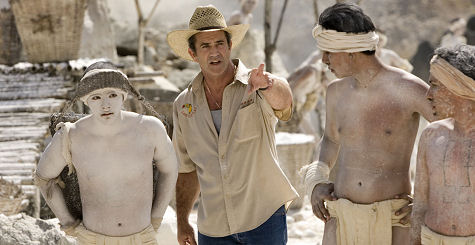

Mel Gibson giving direction during shooting of Apocalypto (Touchstone, 12.8)

There are lots of indications out there about how deep-seated the public’s anger at Gibson may be over his reported anti-Semitic blurtings, but the thing that got me was a story about Gibson’s troubles (“Mel to Pay?”) in the News & Notes section of this week’s Entertainment Weekly.
I don’t remember any story in this section ever drawing a hard moral line in the sand. Views and attitudes are hinted at left and right every week, but never in a declarative, plain-spoken way. But right after saying that attempts at rehabbing Gibson’s image (including “the Official Talk Show Contrition Tour””) are probably in the works, writer Daniel Fierman concludes with these words: “We’re here to tell you it’s not going to work — at least right now. The violence of Gibson’s [anti-Semitic] words won’t allow it.”
< ?php include ('/home/hollyw9/public_html/wired'); ?>
The words “we’re here to tell you” tells me something is going on. Anything that goads EW editors into growing a pair and actually allowing something to be said in their magazine is a significant seismic indicator. And I’m starting to think there’s no way Disney’s Touchstone division can put Apocalypto (12.8) into theatres only four months from now.
The pre-release p.r. campaign would obviously have to begin sometime around mid October, and no matter how many Larry King and Diane Sawyer confessionals Gibson does on the tube (and he’ll probably have to wait until late September or early October to do these or he’ll look too craven), any Apocalypto interview he gives will turn into a referendum on racism.
I strongly doubt that the Gibson moral rehab effort can work if it’s hurried along. And I doubt it can be managed successfully (if it can be managed at all) over the next two months.

The public needs to chill about this, and the media needs to get sick of writing about it. We all know that as long as editors and reporters think there’s any juice in this story, they’ll keep hammering. Everyone has to get completely bored of dissing Mel-the-bigot — it’s the only way — and that can only be achieved through endless repetition.
The Gibson thing will cool down naturally by the end of this month, but it’ll spark up again like a wounded panther if and when the Apocalypto campaign starts up in the mid fall.
I have an idea that if Touchstone pushes Apocalypto back and lets the boiling water cool down, it’ll be less difficult to release it in early April, or possibly late March. Or maybe a bit earlier. I’m not sure. People are going to bring up anti- Semitism no matter when Apocalypto comes out, but they’ll probably be a bit more tired of it six or seven or eight months from now.
I’m leaving film fanatics like myself out of the equation. I’d much rather see Apocalypto sooner than later. Gibson is a nervy hard-core filmmaker, and I’ve been reading all along that he’s got something to say about parallels between ancient Mayan culture and our own. My vote, personally, is open it sooner, not later. But I’m from Mars.
I was talking with some guys in a video store last night about Apocalypto‘s release, and one guy in his early 40s said he thinks the Malibu racism thing will increase interest in people wanting to see it, and that nobody will give that much of a damn in four months’ time.
I suspect this may be a minority view, but what does everyone think?
“Wicker” screening policy

I guess Warner Bros. really doesn’t want any advance word on The Wicker Man (9.1). Critic Steve Murray of the Atlanta Constitution says “they’re not screening it for critics. At least in Atlanta. Got the word here Friday from the local publicist that the screening will be 10 p.m. on Thursday, 8.31 — the night before it opens.”

I can’t believe this is a quality issue, not with director-writer Neil LaBute at the helm. He’s a shrewd writer, a pro-level director and no schlockhound. It must be about WB not wanting any kind of hint passed along about the Wicker plot, particularly the ending.

“Snakes” screening policy

The last time I checked New Line Cinema was planning on doing the same thing with Snakes on a Plane — no screenings until 10 pm on Thursday, 8.17, the night before it opens. I’m guessing New Line publicity is going to arrange gratis passes for critics. It should be a rockin’ experience, especially getting home at midnight and having to write the review so it’s up the next morning.

Brando estate

This story by London Times correspondent John Harlow says that executors of Brando’s estate “including [Pheonix Pictures honcho] Mike Medavoy…are raising money by licensing Brando products including…a semi-fictional documentary called Citizen Brando.” The semi-doc, formerly called Brando and Brando, is about a Tunisian “boy” who traveled to the U.S. to meet Brando. Directed by Ridha Behi, it is said to be a partly fictionalized doc about Behi’s friendship with Brando.
Hold on….what about that series of acting-class videos called Lying for a Living, which Brando and director Tony Kaye partnered on roughly four years ago? It’s basically shows Brando giving acting lessons to an audience of mostly non-pros with drop-by’s (according to this and that news account) from Robin Williams, Michael Jackson, Nick Nolte, Leonardo DiCaprio and Sean Penn. Surely all the tapes that were shot of the Lying sessions (one of which I almost gained admittance to) can be asembled into some kind of shape? Two or three calls to Medavoy last week and two chats with his personal publicist Howard Brandy provided no answers.

Mimic or transcend?

N.Y. Times Ed Leibowitz asks if it’s “better to mimic or transcend” famous figures you’re playing in a movie? Uhmm…the best way is try and do both, no? All I know is, any piece using a photo of Kirsten Dunst as Marie-Antoinette (as she appears in Sofia Coppola‘s film) is an automatic turn-off. It doesn’t open until 10.20, but Marie-Antoinette is already fixed in people’s heads as this year’s Memoirs of a Geisha…if that. It may do some business with young women who aren’t that deep, and it’ll probably pick up some tech nomninations (costumes, production, design, makeup).

“Vice” aftermath

I didn’t mention the sad 63% drop suffered by Miami Vice this weekend, but obviously not enough people agreed with critics that the dense aroma of that film — the visual “fumes,” as I put it two or three weeks ago — more than made up for a not-that-great story and an emotional current that could have been stronger. It’ll be a push for Vice to reach $60 million domestic, which won’t cover prints and marketing. The Vice shortfall may not prove as much of a bath for Universal as Poseidon was for Warner Bros., but it’s in that vicinity. I don’t know what this means as far as Mann’s next film is concerned, but having to work with less money is never a bad thing creatively. Look at what Scorsese did with After Hours and The Last Temptation of Christ during his late ’80s down period.

Whipp on “United 93”

Three days before World Trade Center opens and here‘s L.A. Daily News critic Glenn Whipp raising the United 93 Oscar flag. Go, Glenn! Oliver Stone‘s film is a thoroughly decent 7.8 on the HE scale, but Paul Greengrass‘s film is far superior and deserves all the salute pieces it can get.
The only thing “off” is that Whipp quotes David Poland as saying that United 93 “was not a powerful emotional experience for most people, and, as the academy goes, emotion leads intellect every time.” Of course, United 93 was nothing but emotional. The very idea of seeing it, in fact, was so emotionally threatening that a lot of people didn’t. What Poland tried to say but couldn’t quite articulate is that United 93 wasn’t sufficently emotional in the right way.
In other words, Academy members wanted a warm and reassuring 9/11 flick and Greengrass didn’t provide their idea of that. The irony is that “warm and reassuring” is precisely what United 93 provides by reminding us that Joe Schmoe Americans are made of very tough stuff indeed, and because of this courage what happened on that flight was one of this country’s absolute finest hours.

Carlyle Nicholson

This Peter Howell piece about inside jokes is pretty good, but just because I blanked on “Hey 19” — I don’t know the titles of any Steely Dan songs — doesn’t mean I missed it. Walter Becker and Donald Fagen may have written that letter-to-Owen with a jocular tone, but You, Me and Dupree did rip their song off, and they were definitely half-pissed. A person talking in a flip or cavalier way about something doesn’t mean they’re 100% joking.
What’s “inside” anyway? One of my first big-star interviews was with Jack Nicholson back in ’82, and during our chat I mentioned that aspects of his Shining performance were, to me, an inside joke. Nicholson disputed this. He didn’t say this in so many words but his response was basically who was I, a mere journalist, to assume I had an inside view of things? He wasn’t agitated — he was relaxed and grinning — but I remember him saying, “I’m inside,” meaning somebody else wasn’t.
Our interview took place on a brutally cold day at the Hotel Carlyle, around 10:30 or 10:45 am. When I first arived at the high-up suite I was greeted by publicist Bobby Zarem in the foyer. Nicholson was sitting down the hall and around the corner, but in earshot. “How are ya, Jeff?” Zarem asked. Manhattan had been going through a long frigid spell and I wasn’t wearing a warm-enough jacket that day to cope with 15 degree weather, so the first thing that came to mind was, “Cold as usual.” And a split second later I heard Nicholson doing an imitation of me, saying “cold as usual.”
Like a lot of X-factor guys, Nicholson has a way of jumping the track in terms of conversational threads. We got to talking about cold-weather jackets and he mentioned he expected to head downtown later that day to buy himself a nice warm one. “What are you looking for?”, I asked, meaning what kind of jacket (goose down, motorcyle jacket, retro). And Nicholson answered, “I don’t know. I haven’t known for quite some time.”
I remember he began sipping a Miller High Life in the middle of the interview, and my deciding to drink one also as a gesture of solidarity.
My deepest apologies to anyone who may be thinking I’ve waited too long (48 hours) to riff on Howell’s piece.

“Talladega” drops

Even though Sony is apparently projecting a $47 millon weekend tally for Talladega Nights, a rival studio is projecting $49,002,000. The Will Ferrell-Adam McKay comedy dropped 12% from Friday to Saturday. My guess it that it’s probably a bellwether of some kind.

Freshly Perverse

Freshly Perverse

In anticipation of Neil LaBute‘s The Wicker Man (Warner Bros., 9.1), yesterday I rented a DVD of Robin Hardy‘s ’73 classic of the same name. (The extended version, of course.) Sharply written by playwright Anthony Shaffer (Sleuth), it has a reputation of being an exceptionally creepy piece. Which it is, although it contains only one big jaw-dropper at the finale. Which there’s no forgetting. And yet it’s far from a horror film.
Boiled down, Shaffer and Hardy’s Wicker Man is a correctly mannered, somewhat dry parlor drama with an undercurrent of female eroticism and faint malice. It’s pretty much all talk and inference, but in the service of something quite strange.


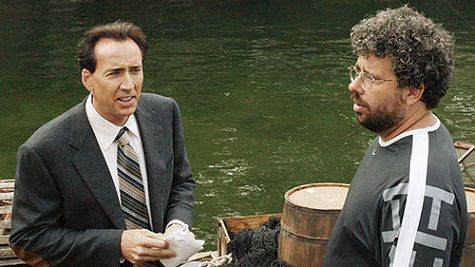
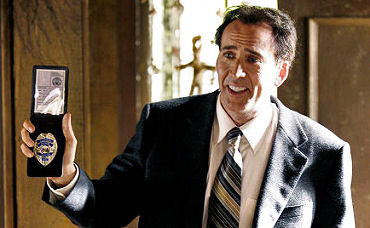
Nicolas Cage, director-writer Neil LaBute during filming of The Wicker Man (Warner Bros., 9.1)

It’s about a rigid, devout, clearly uptight Christian policeman (Edward Woodward) visiting a pagan society on an island off the Scottish coast in search of a missing girl, and his being constantly deceived by the locals in a strangely uniform way. Every last islander is either blank-faced or oddly cheerful, which seems especially weird in view of what they’re all planning. Lo, how righteousness spirals upward to the heavens, contained in a twisting plume.
The Wicker Man wouldn’t work nearly as well without the hammer-like energy and fierce conviction that Woodward brings to his role of Sgt. Howie. There’s no ques- tioning this cop’s intense Christian convictions — he’s all about discipline, rectitude and butt-plug righteousness. And, of course, sexual repression.
< ?php include ('/home/hollyw9/public_html/wired'); ?>
What happens to Howie at the end is what The Wicker man is all about — a metaphor about the fast-eroding influence of traditional Christianity in the face of the newborn spiritual currents of the late ’60s and early ’70s (LSD mysticism, Bhagavad Gita, Tom Wolfe‘s “third great awakening”) and the general shirking of tradition.
What will the metaphor of the new Wicker Man be? Labute wrote the script (naturally), and one of his changes is that the remote island society is now matriarchal instead of patriarchal, as it was in the ’73 film. (In this light, Ellen Burstyn is the new Christopher Lee.) LaBute said at Comic-Con a couple of weeks ago that the film is at least partly about the fact that “women scare me more than men,” or words to that effect.
With men’s social dominance eroding over the last 35 or 40 years, their powers increasingly diluted and on the downswing and guys feeling less and less vital, it seems reasonable to assume that LaBute has made tthe growing stength and independence of women (and the way this has made some guys feel) the focus of his film.

What’s for sure is that LaBute hasn’t made a standard-issue Lionsgate shocker. More assaultive than the ’73 film, but relatively restrained by the standards of 21st Century jolts and gore. And however it turns out, something his and is alone.
In a piece by Charles Lyons in today’s , LaBute says, “Even if there are a few people who are pushing you in saying, `We would love it if this movie was Saw for the first weekend, and it was The Sixth Sense for the next five weeks, you ultimately have just one film that you can create.”
The Wicker Man “probably has a number of scenes that are bloodier than anything in the original,” Lyons reports, adding that LaBute “deliberately exercised restraint in using special effects that, as he put it, provide only a ‘moment’s pleasure.'”
LaBute’s film, says Lyons, “will echo its forebear’s intelligence, even if that means making the contemporary audience work a little harder than usual. ‘If The Wicker Man is a thinking person’s horror film,” says LaBute, ‘that’s great.'”
Like Sgt. Howie, Cage’s cop — called Edward Maulis in Labute’s film — is conservative-minded but more “suave” than Woodward’s character, or so Lyons reports.


This lewd and leering shot is from a scene always mentioned in any discussion of the ’73 Wicker Man — a musical number (yes, a musical number) featuring Britt Eklund, whose singing voice was dubbed by either Annie Ross or Rachel Verney.

One curious thing: Lyon’s article devotes five paragraphs to the fragile ego of Hardy, the original Wicker Man‘s director, specifically his conviction that he was slighted by the producers of the new version when they failed to show him a copy of LaBute’s script and/or declined to let him see the film. Five paragraphs out of 22 — more than 20% of the piece.
The point, I guess, isn’t that Hardy’s feelings are hurt as much as the Wicker Man team doesn’t want anyone knowing what they’re up to.
This seems to be so. The Warner Bros. marketing plan doesn’t seem to include letting guys like me see The Wicker Man early and possibly writing about it. I’ve been trying to get an early peek since early July, but the word all along has been, “We know that you’re a Labute fan but not yet…we’ll let you know.”