Paris Je’taime

Paris, Je t’aime, which screened in Cannes three months ago and will show again at the Toronto Film Festival, is a lot more than interesting. It’s an anthology film with serious rhyme, reason, poetry and nocturnal fairy dust. It drags only once or twice, and is otherwise a cut or two above anything I’ve ever seen in this vein. It moves right along and is well-sprung and yet, surprisingly, it found no distributor out of Cannes. (John Sloss‘s Cinetic Media was handling sales before and will do so again in Toronto.)
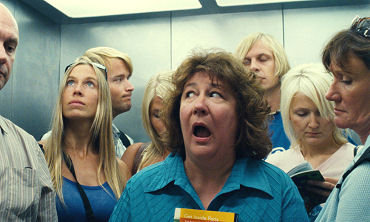

Margo Martindale in Alexander Payne’s “14th arronsidment” segment in ,em>Paris Je’taime; and an exuberant Paris metro moment from Tom Tykwer’s “Faubourg Saint-Denis” segment with Natalie Portman.

The idea is that each arrondisement in Paris gets its own short film, so there are 20 altogether. And the very best short, titled “14th arrondisement”, is directed by Alexander Payne (Sideways). It’s about an American tourist (Margo Martindale) visiting Paris all alone, and not having the greatest time with her poor command of French and tedious American accent and no one to talk to. But her Parisian sojourn suddenly kicks in at the end while she’s sitting in a park — suddenly she “gets it” — and we’re left with one of the more affecting spiritual residues that any film has shared in recent memory.
The other 19 directors are Olivier Assayas (“Quartier des Enfants Rouges”), Frederic Auburtin (“Quartier Latin”), Gurinder Chadha (“Quais de Seine”), Sylvain Chomet (“Tour Eiffel”), Joel and Ethan Coen (“Tuileries”), Isabel Coixet (“Bastille”), Wes Craven (“Pere-Lachaise”), Alfonso Cuaron (“Parc Monceau”), Gerard Depardieu (“Quartier Latin”), Christopher Doyle (“Porte de Choisy”), Richard LaGravenese (“Pigalle”), Vincenzo Natali (“Quartier de la Madeleine”), Bruno Podalydes (“Montmartre”), Walter Salles (“Loin du 16eme”), Oliver Schmitz (“Place des Fetes”), Nobuhiro Suwa (“Place des Victoires”), Daniel Thomas (“Loin du 16eme”) and Tom Tykwer (“Faubourg Saint-Denis”).
The second and third best shorts, I feel, are Tom Tykwer’s “Faubourg Saint-Denis” with Natalie Portman and Kathy Li’s “Porte de Choisy” with director Barbet Schroeder. A guy in Cannes told me that the Coen brothers segment is one of the best also but I don’t agree — it’s just okay. And watch for Mr. Payne’s cameo performance in Wes Craven‘s short. (I won’t say who or what he plays.)

New “Departed’ site

A newly expanded site for Martin Scorsese‘s The Departed (Warner Bros., 10.6) launched last week , and here it is. I still don’t understand this film not showing at Toronto, even if it’s more or less a straight genre crime flick. How can it not be at least some kind of medium- grade festival-level thing with the once-masterful Scorsese at the helm? There’s absolutely nothing disreputable about a good genre film if it’s good.

Ridley Lite in trouble?

Ding-ding-ding-ding-ding-ding-ding-ding! The judgments of two seasoned pros are producing another Toronto Film Festival trouble alarm, this one concerning Ridley Scott‘s A Good Year. It’s been described all along as a Ridley Lite flick about a London financial shark (Russell Crowe) growing a soul and falling in love as a result of owning, visiting and working on a vineyard in the south of France.
Lightly spirited and whimsical doesn’t seem to be Crowe’s forte, agreed, but one plugged-in journo says the problem is with the film itself. Another disagrees, saying that A Good Year is “a painfully obvious (and failing) attempt by Crowe to show he’s funny after a year of looking weird and hostile.”
I don’t like hearing this and I’m trying to figure some way to deny it or somehow brush it aside. I like Ridley Lite moves (Matchstick Men, Someone to Watch Over Me) and there’s no question about Scott being an immaculate craftsman so I don’t get it.

Knud Rasmussen blows

And there are also expressions of concern being voiced over the Toronto Film Festival’s opening night film, the Journals of Knud Rasmussen. Based, as you might presume, on the journals of 1920s Danish ethnographer Knud Rasmussen and directed by Norman Cohn and Zacharias Kunuk , it’s been described as a portrayal an Innuit shaman and his daughter and about the ravages of change. A Canadian know-it-all is calling it “possibly the most incomprehensible show opener in the history of TIFF…the hix in the stix are gonna hate it.”

What does a star do?

Eduardo Porter and Geraldine Fabrikant have written a N.Y. Times piece titled called “A Big Star May Not a Profitable Movie Make.” And we all know that to be true, but what is the ultimate bottom-line rule of thumb that any producer needs to accept when he/she pays big bucks for a star to play the lead role in a film?
Here’s what you get, and I swear to Krishna this is as much of a basic and fundamental rule as William Goldman‘s “nobody knows anything.” Pay for a big star or two and you’ll get people to pay attention to your movie when they first hear about it for ten seconds or less. During which time they will perk up and say to themselves, “Oh…what’s this one about?” And that’s all you’ll get. Six, seven or eight seconds worth of attention.
Without a big star’s name, chances are the average would-be moviegoer won’t pay attention at all. It would be nice if detections of stellar quality in a film (as initially confirmed by general advance buzz or film-festival consensus) mattered to people but it doesn’t seem to, for the most part. But a star’s name will get you those ten seconds or less with Joe Schmoe. I think that’s a completely reliable assessment.
And then the movie will pretty much sink or swim on its own. If people want to see it based on their own criteria (and not Kenneth Turan‘s or Hollywood Elsewhere’s or Scott Rudin‘s or anyone else’s…the ticket buyer decides solely according to his or her wits and gut instincts), and if they like the teasers or trailers and if there’s any kind of buzz in the air about it, they might give it a shot. Maybe.
So to underline this one more time, I think it’s fair to say that spending $10 or $12 or $15 million for a name-level star or two will persuade many millions of people to consider the idea of seeing your film for seven or eight or nine seconds.
But don’t kid yourself into thinking it means that they’ll show up. Because people really don’t give that much of a damn about you or your movie or what you spent to put it together and have it sold. A certain portion of the online generation will absorb the buzz about a film (and then pass the word along to their friends via text messaging). A microscopic portion of the public will re-consider seeing your film when the opening-day reviews are published.
But most people out there, I believe, are indifferent and/or don’t give a shit. This isn’t 1939 and they’re not movie loyalists, and they’re not your family or your childhood friends, and they don’t really care if you live or die or suffer a heart attack on the street. What they care about is doing the thing that they want to do on the spur of the moment when Friday night rolls around, and that’s all.

Is Cruise Flap Theatre?

“The mudslinging between Sumner Redstone and CAA [over last week’s Tom Cruise dismissal from the Paramount lot] may be largely a show for each side’s power base. Their interdependence is underscored by the dozen movie projects involving CAA clients pending at Paramount. The studio can ill afford to be feuding with CAA when it is only now getting back on track after a year of management turmoil and box-office disappointments. And it would be next to impossible today for any agency — even one as powerful as CAA — to boycott Paramount, which accounts for as much as 20% of the movie business.” — from Claire Hoffman‘s 8.28 L.A. Times piece titled “Cruise Flap a Set Piece?”

Mirren’s double derby

Now that the great Helen Mirren has won a Best Actress (in a Miniseries or Movie) Emmy for her performance as the Queen Elizabeth of yore in HBO’s Elizabeth I, does this affect in any way her chances of being considered as a Best Actress contender for her performance as the current Queen Elizabeth in Stephen Frears’ The Queen (Miramax, 10.6)? Or does it matter not at all?
There’s no denying that Mirren delivering two award-calibre perfs as a pair of English queens named Elizabeth in films presented the same year is a fairly striking coincidence. And I’m just sorta wondering if people are going to say (a) “Well, sure…she’s a great actress all around so the Elizabeth coincidence aside it’s right and fair that it’s double-derby time“, (b) “I don’t know…she was excellent in the HBO film and exquisite in the Frears film, but wasn’t her Best Actress Emmy sufficient? Worthy as it is, do we need to toast her other Elizabeth now that she’s already been covered?” or (c) “This is silly…if she’s excellent in the Frears film she deserves an Oscar nom and that’s that…the Emmy doesn’t mean diddly.”

Thomson on ratings

The MPAA’s rating system “is a racket, a way of saving face and assuaging public morality while making as much money as possible by showing sex and violence to cinema audiences,” writes David Thomson in the 8.27 Independent. It’s a piece worth reading because Thomson sums it all up very neatly.
“In practice, the MPPA has viewing panels that see a film, make their suggestion and then ‘negotiate’ with the filmmakers over what can and cannot be included. To this extent, the system is rigged. An NC-17 rating is still a killer because in the sedated and religious parts of America, an NC-17 film will not be shown, or even advertised. In other words, the provision for adult entertainment — and I don’t mean pornography, I mean material and ideas only for adults — is denied by the censoriousness of certain communities.
“In short, an NC-17 cannot make money, and so most production contracts require the director to deliver an R-rated picture. [And] independent films — in their nature,more dangerous, more subversive and less viable — do not get the same kind of treatment” — i.e., liberal and/or extended negotiations. “So the racket is that the ratings have ended up re-enforcing the commercial mainstream.”

Helen Mirren is coming

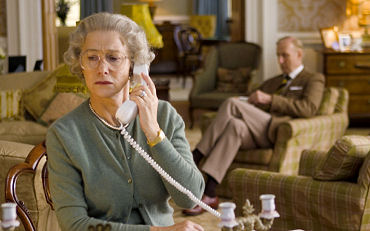
Here’s a taste of Stephen FrearsThe Queen (Miramax, 10.6), which will open the New York Film Festival in late September. The big selling point is Helen Mirren‘s performance as Queen Elizabeth, which will probably put her into the Best Actress derby. She’s sublime in the role. Mirren is obviously inhabiting Queen Elizabeth in ways that feel true and well-observed. Her performance is necessarily dry, restrained and reserved, as befits the subject, but she acquaints us with a woman who feels a lot more human than anything I’ve ever detected from the real McCoy.

The film is set in September 1997 and deals with various responses (governmental, royal, personal) to the death of Diana, former Princess of Wales. The Queen is about how the devastation that the British people were feeling about this tragedy finally, after days of disdain and indifference (and with the proddings of Prime Minister Tony Blair), got through to Queen Elizabeth, who heretofore believed that her role was to maintain dignity and decorum at all times and never expose the woman within. No longer!

Three Toronto problems

I leave for the Toronto Film Festival in five days (I like getting there early), and I’ve just done a re-scan and there are at least five high-profile festival selections that are putting out mild distress signals. No torpedo holes, no manning the lifeboats, but expressions of concern on the captain’s face. It means dredging up old material and I hate that, but I can at least re-review the situation with three of them:
(a) Steven Zallian‘s All The King’s Men (Columbia, 9.22) — This Mike Medavoy– produced period political drama has been giving off sputtering noises since it was yanked almost a year ago from Sony’s late ’05 release schedule. I’m not implying it’s a bad or even half-bad film — it might be half-decent or even good — but Sony won’t pre-screen it and Medavoy won’t even pick up the phone which tells you there are feelings of uncertainty behind the palace gates. And Sean Penn‘s delivery of his Willie Stark speeches, shouted and bellowed with that cracker-barrel hick accent, exudes a kind of profound anti-charm. And Sony’s decision to open Men in late September rather than October or November hints at something also. Any way you cut it, Men is coming into the festival with a wounded rep;
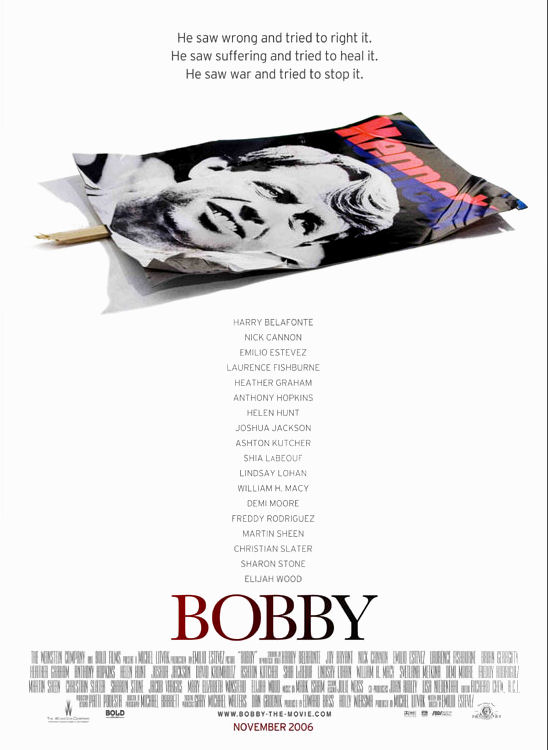
(b) Emilio Estevez‘s Bobby (Weinstein Co., 11.17) — Estevez is a director who has demonstrated his chops three times before (Wisdom, Men at Work, Rated X), and I just don’t see this one working out all that well, especially with all the problems he had during production. That really funny Bobby story written last year for Esquire by screenplay polisher John Ridley includes a crew-member judgment that the script reads like “an episode of Love Boat ’68.” And then there’s that Bobby one-sheet, which uses three lines that Sen. Ted Kennedy spoke in his eulogy speech for his slain brother during the funeral service at St. Patrick’s Cathedral: “He saw wrong and tried to right it. He saw suffering and tried to heal it. He saw war and tried to stop it.” Bobby is not a biopic, and this ad copy therefore reeks of dishonesty. And there’s also that initial announcement that Bobby is going to be screened as a “work in progress”.
(c) Anthony Minghella‘s Breaking and Entering (Weinstein Co., 12.8) — The campfire talk a few weeks ago was that Harvey Weinstein was on the fence about Minghella’s film coming out this year. (Harvey changes his mind all the time, but still…) And an Oscar campaign stategist not employed by the Weinstein Co, told me a while back that the word on B & E was that it wasn’t quite Oscar-calibre. It now has a 12.8 platform release plan, but Weinstein has mulled bumping it into the winter or spring of ’07. Smell the air, do the math.

Read more

End of the summer

Every so often but especially at the close of summer, a Variety reporter or two will write a story about how the formulas or genres that seemed to be working a year or two ago don’t seem to be working any more. Trying to calibrate the willingness of ticket-buyers to line up for this or that kind of film based on apparent trends or sociological currents is horseshit, of course. Movie-making is about inspiration, talent and gambling, and either you get that and run with it or you don’t.
Most producers and studio execs don’t, of course. Most are afraid to even go in the water, much less take a dive off the high board.
The underlying theme of these boring-ass articles is that producers and studio execs are terrified down to their knuckles at the idea of getting behind a film (in an idea or script form) or making a decision to greenlight a film based on a love of what the film could be and a deep desire to see this potential realized. Almost nobody thinks or operates like this, of course — they all want insurance and safety and rules they can depend on. In my book, that makes them cowards, milquetoasts, dilletantes.
These end of-the-summer Variety pieces — this latest one is written by Ian Mohr — also tend to conclude that stars seem to be less and less of an assurance that audiences will show up in force. Only Adam Sandler delivers! And only when he’s in a typical Sandler-brand comedy. Which means (and you don’t have to tell Jeff Blake this) that Reign O’er Me, good as it is (with a truly fine Sandler performance at the heart of it), is no slam-dunk.

Oar slaves, water-skiing

Here’s a good Ben-Hur joke that I never heard until today. The oar slaves on the warship that Ben-Hur (Charlton Heston) has been condemned to serve on (the one commanded by Quintus Arrius, the senior Roman officer played by Jack Hawkins) are told to listen up by a galley commander. “I have good news and bad news,” he announces. “The good news is that we won’t be going into battle today against the Macedonians.” And the oar slaves all whoop and cheer. “The bad news is that Arrius wants to go water-skiing.”