Cheatin’ Hearts

Cheatin’ Hearts

Two movies about issues of trust, truth-telling and fidelity between loving couples played during the Toronto Film Festival, and the lessons of both — Tony Goldwyn’s The Last Kiss (which opened Friday) and Bob Goldwaith’s Sleeping Dogs Lie (Samuel Goldwyn, 9.29) — are pretty much the same but told from different gender perspectives.
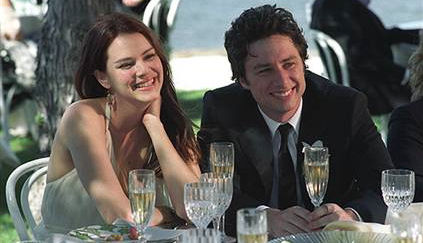
They both say don’t lie to your partner about anything — lies are poison– but at the same time don’t tell them the absolute 100% truth, which can be worse than lying.
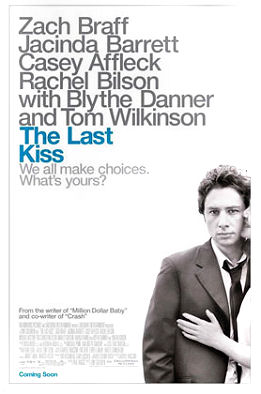
The Last Kiss is about 30 year-old architect Zach Braff freaking about girlfriend Jacinda Barrett suddenly being pregnant and deciding to go on a hot date with a pretty college sophomore he meets at a party (Rachel Bilson), and the very same night getting busted by Barrett when one of his good buddies fails to lie for him. Braff begs for forgiveness, telling Barrett that nothing happened (which is true) but she makes him leave their home anyway. Naturally, he goes right over to Bilson’s place and plays hide the python.
< ?php include ('/home/hollyw9/public_html/wired'); ?>
The next day Barrett has begun to relent and is thinking about taking him back, but Braff has been given fatally bad advice by her dad (Tom Wilkinson), to wit: “Unless you’re completely honest with her, you’ll lose her.” So a little later on when Barrett says to Braff, “You really didn’t sleep with her?”, he spills the beans….and their relationship is all but toast. Hello? Total candor can be ruinous.
Sleeping Dogs Lie, directed and written by Goldwaith, is about another relationship ruptured by truth. Sweet, emotionally adjusted Amy (Melinda Page Hamilton) is persuaded by her nice-guy finance John (Bryce Johnson) to share every last little truth about her past. Encouraged, once again, by an idiotic parent (her mother) as well as a friend at work, both of whom urge complete honesty, she tells John her kinkiest sexual secret, which is that she once gave her dog a blowjob.
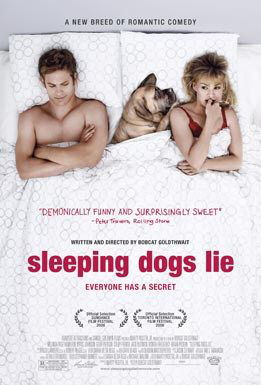
Does John take it like a man? Of course not. He freaks. He’s repelled. Lesson repeated: there are some things you should never share. Whole hog truth-telling is a recipe for disaster.
Obviously The Last Kiss has more to say about guys lying or not lying to their wives or girlfriends, and Sleeping Dogs Lie addresses just how honest women should be with their boyfriends or husbands.
From a guy’s POV, one of the worst things you can do to a girlfriend is to say, “I fucked somebody else.” Or to let her find this out if you did. Knowledge of infidelity hurts like a sword-stabbing. It breaks the other person’s heart and pretty much destroys whatever trust you had with them before. It’s a terrible thing to do to anyone you care for and respect.
I’m basically saying that the important thing is to never let your partner feel the pain of knowing what you’ve done if you’ve done it. If, I say. The important thing for a cheater (a one-timer or a serial) is to be an astonishingly good liar, and that means covering your tracks like a CIA agent in East Germany in the early ’60s, and making absolutely dead sure that she never finds out, even accidentally.
Cheating is obviously not a good thing for any relationship, but if you ever wade into those waters do so with the utmost caution and take it very, very seriously. That’s all I’m saying.
People are going to do what they’re going to do. Nobody’s perfect. Fidelity is the best policy but how many of us can say we’ve never sniffed around and maybe let something happen once or twice? Down cycles and odd episodes and tomcat compulsions come and go. I’m not advocating cheating, but if it happens — if — go there with the utmost consideration for your partner’s feelings, which means you need to keep them totally, totally in the dark.
Guys always tell their girlfriends or wives that their past relationships with other guys means nothing. They’re lying. They do mean something, and they will judge the shit out of you if you tell them too much. There is nothing to be gained by spilling every last detail about an ex-boyfriend, or boyfriends. You can only lose by doing so.

No Times critiques of NYFF flix?

MCN’s Len Klady has written that the New York Times “has decided it won’t print reviews of selections playing at the upcoming New York Film Festival. Though the exact reasons behind the decision are a bit sketchy, it appears the publication was persuaded by a film industry emissary that a potential blot on a [NYFF entry] was neither good for it or them.” What the hell does that mean? Exactly which “film industry emissary” said what to which person or persons at the Times? Nobody’s gonna bully me into not writing about The Queen on the day it opens the NYFF, which is Friday, 9.29.

Larry King knows

When in doubt, when something in your chest tells you those sourpuss Toronto Film Festival critics can’t be trusted, consider the jottings of Larry King.

De Palma’s Slices

When I think of the respectable and rewarding things about the films of Brian De Palma, I always think of those visual arias that are his well-known specialty — those searing displays of virtuoso camerawork and choreography that are worked out just so.
My right-off-the-top-of-my-head favorites: (a) a fantasizing Angie Dickinson being mauled in the shower in Dressed to Kill, (b) Sissy Spacek‘s freckled hand reaching out of the grave to grab a horrified Amy Irving, (c) Al Pacino lying on a Grand Central Station escalator in Carlito’s Way, (d) Tim Robbins meeting instant death when his face plate is removed during a space walk in Mission to Mars, and (e) Irving using her telekinetic powers in The Fury to make bad guy John Casse- vetes explode into pieces.
But I almost never think of De Palma’s movies being good as entire creations because they really and truly stopped being that a long time ago. The last entirely decent De Palma film — by which I mean a De Palma that didn’t once make me squirm or groan or shake my head in sadness — was Mission Impossible, although I did squirm here and there. Scarface was the last one before that. The last beginning-to-end 100% enjoyable De Palma film was The Phantom of the Paradise.
But I’ll always admire De Palma for those little slices of cake. There’s one of two of them in his latest, The Black Dahlia. Problem is, you have to sit through the whole film to enjoy them, and by that time they come along you’re so numbed and despondent over the turgid, impossible-to-follow plot and florid acting and the general over-ladled quality of the damn thing that nothing seems so enjoyable as the thought of getting up and jamming.

Power of Silence

“Silence is hugely important. I use silence to fight against the tyranny of noise, the fucking noise of TV and even movies. In silence, the seeds of profound things can grow.” — Alejandro Gonzalez Innaritu to the Toronto Globe & Mail sometime late last week.

McDougal on Nicholson

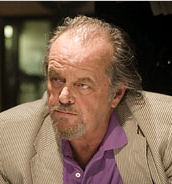
“Will Martin Scorsese‘s The Departed becomes a question-mark film?” asks Dennis McDougal in a 9.17 N.Y. Times piece. “Will it reintroduce Jack Nicholson to a new generation, as Batman once did? Or will his Frank Costello [character] smack of geriatric retread: The Last Detail‘s Badass Buddusky meets The Shining‘s Jack Torrance, only more debauched?”


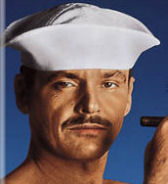
(l.) Jack Nicholson in The Departed; (r.) in The Last Detail

I won’t see The Departed for another couple of days, but of all the characters Nicholson has played, Badass Buddusky is by far the the most kind-hearted, sentimental and childish, which he covers up with standard enlisted-man macho bluster. Jack Torrance is a little more in the realm of the Costello character, whom McDougal describes as a character who is “losing his mind” and who is allegedly seen in the flm “eating an insect, wielding sex toys, bathed in blood and more or less personifying evil.” But Torrance, of course, is a fuckup — a would-be amateur who can’t write, can’t kill and gets spooked by old-crone ghosts.
Will The Departed “even the score for Mr. Scorsese?” McDougal asks. “Or will it simply provoke nostalgia for an era when Nicholson and Scorsese together would have been a sure thing?
“In any case no one can accuse these two old pros of lacking self-awareness. According to a scene included in a trailer for the film, The Departed has Costello asking after an acquaintance’s sick mother. Sadly the man tells him, ‘She’s on her way out.’ And Nicholson replies, ‘We all are. Act accordingly.'”
Oh, and I love this other McDougal graph, which opens the piece…
“There was a time, not so very long ago, when the first-ever pairing of tMartin Scorsese with Jack Nicholson would have been a guaranteed hit. But that was before DVD’s, MySpace, YouTube and, most recently, the decline and falter of Tom Cruise. When Viacom’s chairman, Sumner Redstone, evicted Mr. Cruise from Paramount last month, citing his ‘erratic behavior,’ it signaled a new era when no amount of star power could assure that a picture would be seen as an event.”

Russell “Ghosted” Tombstone

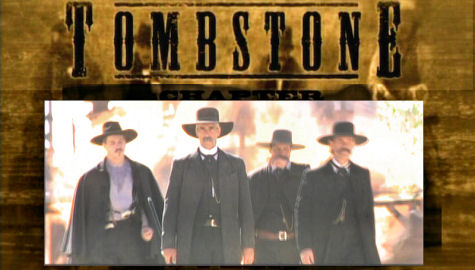
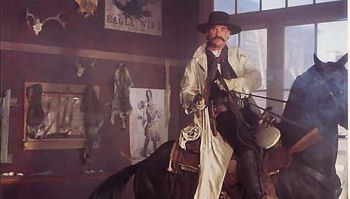
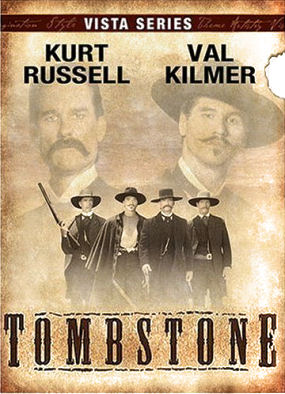
Everyone loves or at least greatly respects Tombstone, the 1993 cult western with Kurt Russell, Val Kilmer, Bill Paxton and Sam Elliott. And many of the more ardent fans have probably watched the Disney Home Video Director’s Cut DVD, which came out in January ’02. Now it turns out there’s an ironic element contained on that nearly five-year-old disc — ironic bordering on comedic, I’d say — by way of the commentary track by director George V. Cosmatos, who died in April 2005.

The Cosmatos rap will seem like a mild hoot to anyone reading this recent piece by Henry Cabot Beck in the October edition of True West magazine. That’s because it reveals/contends/proposes that the guy who ghost-directed Tombstone, who deserves the lion’s share of the credit for this much-loved western, and who certainly should have recorded the DVD commentary nearly five years ago is none other than Kurt Russell.
Cosmatos, no offense, was never anything but an amiable hack — a guy who did the shots, got the lighting right, etc. This is more or less acknowledged in the article by Russell, who swore to Cosmatos he would never tell the truth about their deal behind the making of Tombstone while he was alive.
< ?php include ('/home/hollyw9/public_html/wired'); ?>
Boiled down, Russell tells Beck that (a) it was he, Russell, who went out and raised the production dough through biking pal Andy Vajna, (b) that after Tombstone‘s original director Kevin Jarre was canned Russell decided to “ghost” direct Tombstone by hiring Cosmatos to shoot it like he was told to and nothing beyond that.
It also explains (c) how Kevin Costner, who was working with Larry Kasdan on Wyatt Earp at the time, pulled strings all over town to keep Tombstone from getting a distribution deal with anyone with Disney, (d) how Vajna wanted Richard Gere to play moustachioed lawman Wyatt Earp and (e) how Jarre wanted Willem Dafoe to play Doc Holliday but was forced to accept Val Kilmer in the role — which turned out to be a good thing because Kilmer was exceptional.

Beck got the goods from Russell while speaking with him at a Beverly Hills Poseidon junket four or five months ago.
“I mentioned to him that I write for True West and suggested we talk about Tombstone sometime,” Beck relates, “and then Russell went straight into it, pulling the lid off the can of worms and giving me an extra 20 interview minutes of unheard skinny — how he put the project together, how he ghost-directed the picture, Costner’s involvement, Jarre’s firing, casting issues…really loaded with good material.
Beck thereafter sent two messages to Russell through CAA agent Rick Nicita “thanking [Russell], letting him know I intended using the stuff, and requesting follow-ups, but when I heard nothing back I ran with what I had, especially since none of it was off the record and because the 125th anniversary of the Gunfight at The OK Corral is coming at the end of October and all the scholars and academics and buffs are converging in Tombstone and this was hot poop.
“When CAA finally noticed I was running a story, they called Russell, literally one week before the True West issue hit the stands (8.28 or 8.29) and the next thing I knew I had Russell calling me from the set of Quentin Tarantino‘s “Death Proof” short (which is part of Grind House) in Austin. He wasn’t all that happy, although he did admit he would have likely done the same thing in my shoes. I had some copies sent and called his hotel but I’ve heard nothing — I’m guessing he’s steamed for several reasons.

“There are two stories here — the story of Tombstone, and the story of the story. Things I think are most fun are Russell admitting he directed the picture but promising he’d keep mum for Cosmatos, Costner’s hardball, and the Gere/Dafoe casting business.
“Pity, really, that Russell was kept in the dark and then got pissed, because I really wanted to follow up, and I still think there’s a book here.”