Greer on feisy broads

Luis Bunuel‘s Belle de Jour (1967) “has a reputation for being one of the sexiest films ever made, simply because Catherine Deneuve behaves throughout like a pre-adolescent girl. Through the prism of the 21st century, the film seems oddly contrived; what is now a cliche — the child who, subjected to the sexual advances of an adult, then becomes a frigid woman who is only turned on by squalor — is coyly exploited as a series of fetishistic images that juxtapose her fantasy life with her actual life.

“As Severine Serizy, Deneuve moves through the imagery of what are meant to be her own fantasies like a sleepwalker. By her own account, Bunuel could not relate to her at all and never told her what he wanted. Unconsciously, she gave him what he wanted, which was as little as possible. The fantasies were his, after all.
“The decision to have her dressed by Yves Saint-Laurent adds a bizarre dimension to the nonexistent plot; we seem to be living within the pages of a glossy magazine, with product placement everywhere. Everywhere Severine goes, she is conspicuous by her catwalk presence, from her shiny patent leather pumps to the helmet that holds in her mane of Barbie-doll hair.
“The sex scenes in the brothel consist of her stripping to the full armour of suspender-belt, knickers, stockings and padded brassiere, and allowing ugly men to kiss her. In one extraordinarily unsexy sequence, she is required to process through the rooms of a ducal chateau dressed in nothing but a cloak of black georgette and a crown of white roses. She trots ahead of the camera like a lamb to the slaughter. She should have used a body double; it is typical of her passive obedience that she didn’t.
Lauren Bacall would never have done that for anyone, would never have stripped and had them shoot her bare arse from the back as she trotted through take after take. The Hawksian woman would have decked any man who asked her.” — from a thoughtful, somewhat revisionist Guardian piece by Germaine Greer, the subject being the decline of the feisty broad.

New numbers

The projected holiday weekend numbers have been slightly revised. Night at the Museum is now expected to hit $46,497,000. The Pursuit of Happyness is looking at $25,529,000 by tomorrow night, and Dreamgirls should earn close to $18,284,000. Charlotte’s Web is looking at $14,943, The Good Shepherd $14,517,000, Rocky Balboa $14,265,000, Eragon $10,806,000, We Are Marshall $10411, Happy Feet $9,696,000 and The Holiday $8,526,000.

Alpha Dog returns

It’s been almost two years since I ran a review of Alpha Dog out of the ’05 Sundance Film Festival, so I’m figuring it can’t hurt to re-post with the film finally opening on 1.12, or less than two weeks hence:
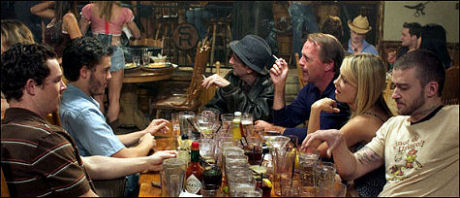

Shawn Hatosy, Emile Hirsch, Harry Dean Stanton, Bruce Willis, Olivia Wilde and Justin Timberlake in Alpha Dog.

Directed and written by Nick Cassevettes, Alpha Dog isn’t a great film but it’s quite provocative and even agitating (in a good way). It’s certainly thought-provoking, and it boasts more than a few live-wire performances, including a serious stand-out one by Justin Timberlake
Dog is more than a cautionary tale about amoral kids gone wild. It’s a condemnation of liberal anything-goes values, of absentee parents, of a society lacking in moral fibre. In short, it’s a film that social conservatives will point to and say, “See? This is what we’re trying to prevent.” And it’ll be hard to argue with them.
The impression is that Dog has fashioned its own particular vibe and attitude, but it will certainly be seen as following in the tradition of Tim Hunter‘s River’s Edge, Jacob Aaron EstesMean Creek and Larry Clark‘s Bully.
The film also stars Shawn Hatosy, Harry Dean Stanton, a bewigged Bruce Willis, Olivia Wilde, Sharon Stone, Dominique Swain and Ben Foster (another provider of an exceptional performance).
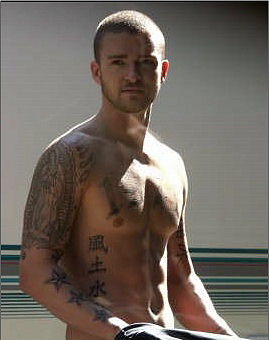

Justin Timberlake

Based on a true story that happened about six years ago, Dog is about a 20 year-old known as Jesse James Hollywood (called Johnny Truelove in the movie, and portrayed by Lords of Dogtown‘s Emile Hirsch), a pot dealer from a well-to-do San Fernando Valley suburb who obviously saw himself as a minor-league Tony Montana.
This plus the general lower-end-of-the-gene-pool idiocy that is not unknown to suburban youth culture led to Jimmy making a fatal error: he and some pals kidnapped the 15 year-old younger brother of a guy who owed him $1200 as a way of applying pressure, and when he later realized he and his cronies would be looking at big-time jail terms he told a flunkie to kill the boy (Nicholas Markowitz in actuality– called Zack Mazursky in the film and played by Anton Yelchin) to keep him from testifying.
When the boy’s body was found Jimmy eventually left the country and, with his father’s help, wound up living incognito in Brazil. But last March he was punched by Interpol agents and brought back to the U.S. to face murder charges.
Universal acquired distribution rights from New Line Cinema, which had originally planned to release it on 2.24.06. New Line bailed over a legal tangle regarding a threatened injunction. The beef was from Hollywood’s attorney James Blatt, who’s saying that prosecuting attorney Rod Zonen was guilty of misconduct by providing inside information about the murder case to Cassevetes during the film’s preparation phase. Blatt’s argument was that the release of this information in a dramatic fashion in Alpha Dog would prejudice matters against his client.


Emile Hirsch

Cassevetes was subpoenaed by Blatt in the summer of ’04 as part of an attempt to have Zonen removed from the case for giving Cassavetes access to nonpublic records. The ploy failed. In late ’04 a judge ordered Cassavetes’s researcher, Michael Mehas, who is writing a book about the case, to turn over notes and tapes from his interviews to the defense.
Sundance honcho Geoff Gilmore declared in the ’05 program notes that Cassavetes’ film “captures the driving energy and sordid anomie of contemporary youth culture,” adding that it end “in a tragedy that would be shocking if we weren’t so aware of the kind of world we live in, a place with kids who live without mores, parents who don’t have a clue, and ongoing conflict between the lingering inno- cence of youth and moral disintegration and dissolution.”
A Cassevetes quote in a N.Y. Times piece about absentee-parenting struck home:
“I’m guilty of it — of being too busy with your everyday life to properly spend enough time with your children to figure out what’s going on with them.
“You can check in, and you say, ‘Are you all right?’ But it’s not like being on a farm or spending a lot of time in the house. We all live really global, internetty lives. Kids have more power than they did before. They have cars, they can get around, they have dough, and there’s always some person that’s got something going on that can get everybody killed.”

Read more

Happy New Year

I’d say “Happy New Year” to everyone, but…all right, Happy New Year. I have always hated saying those words. Nothing’s “happy”…nobody’s “happy” anywhere. At best, people are content, joyously turned on for the moment, laughing or telling a funny story or a good joke, placated, relaxed, energetic, enthused, full of dreams, generous of heart, intellectually alive…but “happy”? The word itself has always struck me as one that only simple minds would use.

I’m only drinking Monster and Perrier tonight, and I’m not forking over $14 to any bartenders for a drink. Anywhere. I don’t care who I’m with or what anyone thinks of this policy/attitude. I’ll give $14 to a homeless person first. I won’t give my hard-earned money to anyone or anything that rubs me the wrong way tonight. I’ll walk the streets first. I hate everything about New Year’s Eve, especially young guys going “ooowwwooooh! in animal bars as midnight approaches.
There’s always the Sundance Film Festival and whatever good or great films that may show there, and the lovely Santa Barbara Film Festival right after that, and also the eight or nine great or good movies that I know are being released between January and April (like God Grew Tired Of Us, Reign Over Me, The Lives of Others, etc.).
Plus there’s the adventure of finally seeing The Assassination of Jesse James by the Coward Robert Ford, which Warner Bros. still doesn’t have a release date for, and the chance of a decent thriller/potboiler like Billy Ray‘s Breach or a rousing, high-style crime film like Joe Carnahan‘s Smokin’ Aces.
The world is choking up and winding down because too many nouveau riche greed-heads are drunk on their SUV lifestyles — ways of living and spending that they’d rather die or kill for (or see others die) than modify.
We all know the same mistakes are going to be made over the next twelve months, and that the only thing certain is that everything will be more expensive twelve months from now. The only comfort I have is this: the morons who believe global warming is a myth are going to meet each other at parties and get married and have kids and try to teach their children that global warming is a myth, but a significant number of these people are going to fail in this effort because kids always see through their parents’ bullshit.

Guillermo’s lesson for children

The Reeler’s Stu VanAirsdale is running some interesting comments from Pan’s Labyrinth director Guillermo del Toro about why, despite its themes and violence, kids should be encouraged to see it.
“Fairy tales, when they were created first, they were not only very disturbing tales, but at the same time they were meant to represent very dire circumstances at the time they were written,” del Toro explains. “Famine. Plague. Not, in general, very nice situations, with kids being orphaned, being abandoned, etcetera. And I think in that sense, the movie is just a continuation of that thread in the genre.
“I feel like the movie is a movie about the responsibility of disobedience and the responsibility of choice. It’s a movie about choice and about how your choices affect your destiny and who you are. It’s a girl that refuses to obey either the magical creatures or the fascist captain. And how she essentially forges her own destiny. Chewing up fairies aside, I think that’s a damn valuable lesson in this world.”

“United 93” cowards

Movie City News has assembled 164 Top Ten lists from 164 film critics and calibrated the standings based on a point system, and the #1 film is Paul Greengrass‘s United 93 with 590 points, compared to 533 for The Queen, 524 for The Departed, 402 for Pan’s Labyrinth and 392 for Letters From Iwo Jima.
That’s it — there’s no excuse any more for any Academy member who refuses to see United 93. None. at. all. If you, an Academy member, see United 93 and don’t care for it, fine. But if you flat-out refuse to see it, you’re bringing dishonor upon yourself and the Academy and the entire process. If the United 93 cowards had the smallest shred of character they’d resign, but of course they won’t do that. Say it loud and clear: these people are despicable.

Husein’s last hour

This first-person account by N.Y. Times Baghdad correspondent Marc Santora, appearing in Sunday’s edition, about Saddam Hussein‘s final hour of life is historic, essential reading — tight, terse, riveting. (The eyewitness observations apparently came from Ali Adeeb and Khalid al-Ansary.)
“At 6:10 a.m., the trapdoor swung open. [Hussein] seemed to fall a good distance, but he died swiftly. After just a minute, his body was still. His eyes still were open but he was dead. Despite the scarf, the rope cut a gash into his neck.”
Wait…”he died swiftly” but his body wasn’t still until “a minute” had passed? Doesn’t sound that swift to me. My idea of swift is the way Slim Pickens‘ Major Kong dies at the end of Dr, Strangelove.

USA Today Oracle

The lead graph introducing USA Today‘s “Oscar Oracle” chart begins as follows: “If the Academy Awards were given out based on what the nation’s film critics think, at least two of the races would be over right now: best actor and actress.” And then it goes blah, blah, Forest Whitaker, blah, blah, Helen Mirren (The Queen)….we’re bored, we need something to fill space with, we’re just running another Oscar chart based on critics like Movie City News, blah, blah…it’s the end of the year and we’re plotzing.
The critics have gone good things by celebrating United 93 and Emmanuel Lubezki and Half Nelson, etc., but they’ve also bored everyone to tears with the uniformity of their choices, the result being that nobody wants to hear about them any more. They’re done. The Hollywood guilds — Screen Actors Guild (1.4.07), DGA (noms on 1.9.07), Producers Guild (1.20.07), etc. — are next on the agenda. They’re being announced within the next two or three weeks or so, culminating with the announcement of the Academy Awards nominations on Tuesday, 1.23.07. (The DGA hands its awards out on 2.3.07; the WGA bestows its awards on 2.11.07.)

“Bugsy” DVD, chats

Having finally watched the Extended Unrated Bugsy DVD last week, I can report with great satisfaction that N.Y. Times DVD columnist Dave Kehr was totally right when he said that this longer version of the 1991 film “plays much more smoothly and inexorably than it did in the edited [theatrical] version,” which ran about 15 minutes shorter.


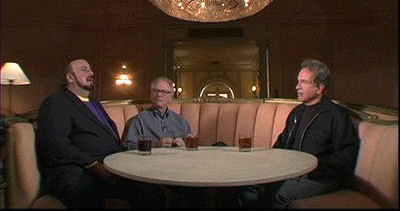
(l. to r.) Toback, Levinson and Beatty taping discussion about the making of Bugsy, which is included on the DVD.

We all know that extended versions of films are not necessarily better or fuller things to sit through. This one is, however. In so doing the all-new Bugsy ranks alongside Cameron Crowe’s longer “Untitled” version of Almost Famous and James Cameron‘s longer cut of Aliens.
I was going to run a tape of an interview I did with Bugsy screenwriter James Toback just before Christmas at the Harvard Club, but I screwed up by acciden- tally deleting it off the recorder as well as my hard drive — brilliant. I was only able to salvage this pathetically short snippet in which Jim discusses the Hollywood syndrome of “parasites feeding off parasites.”
To make up for the loss, I recorded the opening ten or twelve minutes of a chat between Toback, Bugsy director Barry Levinson and star-producer Warren Beatty that’s included in the DVD doc called “The Road to Damascus: The Reinvention of Bugsy Siegel.”

Weekend numbers

Night at the Museum, the four-day weekend’s #1 film, will end up with about $44,898,000 on Monday night (1.1.07), for an overall cume of $124 million…pretty good for a piece of CG shit. The Pursuit of Happyness, the #2 film, will have $24,200,000 as of Monday night, and a cume of $103,200,000. Dreamgirls, playing in 862 theatres, will end up with $17 million for the holiday weekend (i.e., not a bad haul), which makes it the #3 film.
The Good Shepherd (#4) will end up with 14,226,000 by Monday night. Charlotte’s Web (#5) will hit $14.091,000. Rocky Balboa (#6), $13,899,000. Eragon (#7), $10,448,000. We Are Marshall (#8), $10,228,000. Happy Feet (#9), $8,846,000. The Holiday (#10), $8,346,000.
None of the limited opening films are knockin’ em down: Children of Men, Pan’s Labyrinth, Notes on a Sandal and Letters From Iwo Jima are all puttering along…nothing earth-shaking or dish-rattling. Iwo Jima is dying, in fact — it did about $28,000 in 6 theatres last night, and will end up Monday night with about $110,000. Perfume, playing in only three theatres, did about $13,000 yesterday and should do about $52,000 for the four-day weekend. Miss Potter did $3000 in two theatres, and will end up with about $12,000 on Monday night. The Dead Girl died in two theatres — $2000 earnings last night, a projected $9000 for the holiday weekend.

“Dreamgirls” & box-office prospects

Dreamgirls will have roughly a $40 million cume by Monday night (1.1.07), but can it reach $100 million over the next four weeks? Big financial earnings in all sectors are seen as an indicator of Oscar potency, after all. And let’s face it — between now and the end of January (or early February) is the peak earning time for this DreamWorks musical. If it cleans up in the Oscar nominations (which are being announced on Tuesday, 1.23), its hand will obviously be strengthened. But by how much?
It reportedly made $4.7 million yesterday (Friday) compared to $8.7 million on opening day last Monday (12.25). To hit $100 mill by it needs to take in another $60 million over the next four weeks, but I’m guessing (tell me if I’m wrong) that it’s not looking at much more than a $12 to $14 million haul next weekend, tops…perhaps less.
Bottom line: if it doesn’t score with multi-Oscar nominations across the board three weeks and three days from now, Dreamgirls will stall somewhere south of $100 million. Can it still win the Best Picture Oscar with only a respectable (as opposed to astronomical) box-office tally? Sure — if people want it to win, it’ll win. But won’t this make it a tad harder?
Chicago ended up with $170,687,518 domestic, yes, but maybe it’s not fair to expect a musical with a somewhat restricted demographic (if I explain what it is I’ll be called a racist homophobe, right?) to make $100 million-plus. I don’t know. You tell me. Some feel it’s bad form to bring up racial matters in discussing box-office potency, but it’s a fact of American life. It’s nice to think we’re all clever, classless and free, but the lyrics from Randy Newman‘s “Rednecks” still apply in some areas, sorry to say.