Wolf of Wall Street

Boiler Room and Wall Street are both about a young, lean hungry-for-money guy (a) gaining entry to the world of high finance, (b) learning the ropes, making big bucks and getting a little drunk on the juice of it all, and (c) eventually going too far, getting busted and crashing into a hole of shame and disrepute. Now we have a third one to process — a big-screen adaptation of Jordan Belfort‘s The Wolf of Wall Street (Bantam, 9.25.07) with Martin Scorsese directing, Leonardo DiCaprio starring and Terence Winter writing the script.

Belfort’s book is about how he became one of Wall Street’s most predatory film-flam artists, plying the trade of “penny stock” trading. A “Page Six” summary says that Belfort’s Stratton Oakmont group “pulled off pump and dump schemes in which fast-talking boiler-room brokers ran up the prices of shares with fraudulent phone pitches.” The item says that whatever money Belfort makes off the book and the film “would immediately be seized,” that “he still owes a fortune to investors, [having] made $13 million in restitution with $75 million or more in claims.”

Question is, what is there to say about or bring to another high-hormone blue-chip cautionary tale? We know all about greedy young guys in suspenders who will do anything to get to the top, and we know what happens to most of them sooner or later, so….what’s new?
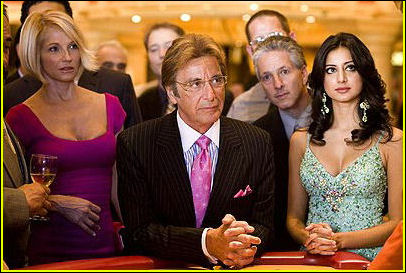
Pacino in “Ocean’s 13”

There is, to me, a kind of warm-bath comfort in the fact of Al Pacino appearing in some current or upcoming film (i.e., one that has a kind of substance) and surging on the oats of raging septugenarian hormones and looking like some kind of incorrigible sartorial dog.

Hiller running for hills

No more guest editorships at the L.A. Times op/ed section because publisher David Hiller has been spooked over the Brian Grazer/Andres Martinez/Kelly Mullens editorial-intimacy scandal and has decided to throw the baby out with the bathwater.

One should never make decisions about substantial matters out of fear or anger. Hiller is obviously being driven by the former — he’s running for the hills.

There’s nothing inherently corrupt about bringing in guest editors — the idea would obviously make things more nervy, exciting, lively. Nothing betokens death as much as a person or organization unwilling to take risks. As Charles Laughton‘s Graccus said to the Roman Senate in Spartacus, “I’ll take a little Republican corruption with a little Republican freedom…but I won’t take the dictatorship of Crassus, and no freedom at all!”

“Reign” is doing okay

Things aren’t as soft as they seem for Reign Over Me, which took in $8 million last weekend for an 8th place showing. What matters is that (a) the $4788 per-screen average was fairly decent and (b) the film is expected to motor along with good word-of-mouth from women and over-25s. The per-screen tally was better than the opening-frame $3617 average for Spanglish, a semi-serious Sandler film that “actually outgrossed comedies Billy Madison, Happy Gilmore and Little Nicky,” according to Variety‘s Ian Mohr. Reign director Mike Binder confided a couple of days ago that “we actually did okay [last weekend]. Not the kill I wanted but we got a bad [i.e., extremely crowded] weekend. It’s good though. I’m happy.”

Aronofsky directing “The Fighter”?

IGN’s Stax Flixburg is reporting that Darren Aronofsky‘s next directing chore will be The Fighter, a fact-based boxing drama that will reteam Departed co-stars Mark Wahlberg and Matt Damon. Filming is expected to begin this summer in Massachucetts, he says. (Variety‘s Michael Fleming and Pamela McClintock almost certainly read Stax’s story, made a few calls and posted their version last night at 7:16 pm, without acknowledging that Stax broke it. That’s the way they do things over there.)

“Sopranos” is a no-go

There’s a premiere screening of the first two episodes of the final season of The Sopranos tomorrow night at the Radio City Music Hall, plus an after-party with the cast somewhere…terrific. Just got into town, didn’t do my advance homework, there’s no chance of attending and this is the end of the line.

Beale on film critics

“In a world where everyone has an opinion — and can both share their own and seek out others online — respect for critics has taken a severe nose dive,” observes Lewis Beale in his latest Reeler essay. “But everyone seems to have forgotten that just because you have an opinion doesn’t mean it’s well-thought-out.

“None of the fanboys at Ain’t it Cool News, for example, can measure up to the chops of Jim Hoberman or Manohla Dargis. I mean, I love opera, but I’ll be damned if I’m going to write a critique of Don Giovanni — I just don’t know enough about the genre’s subtleties.

“Which raises the key question: Why are critics writing about movies like A Night at the Museum anyway? Films like this are absolutely review-proof. It’s also old news that people who want to see them couldn’t care less what any egghead says about them, and given the massive PR machines behind these films, you’d think a critic’s time would be better spent writing about deserving indies, thoughtful foreign releases or Hollywood flicks like Zodiac. You know, films that actually merit an essay.

“Even the thought of the New York Times wasting space on Norbit gives me the willies, so why bother? What does it prove? And who are they reviewing it for, anyway? Some works just do not warrant in-depth examination or critical mention. Does the New York Times Book Review cover every Danielle Steele novel? Or the TV section write about every new program on the Game Show Network?”

Pevere on “Barley”

A brilliant review by the Toronto Star‘s Geoff Pevere of Ken Loach‘s The Wind That Shakes The Barley, a sobering drama about the terrible price paid by Irish militants in their battle against British troops in the early 1920s. Pevere compares what Loach is saying about violent means — “when it comes to deciding to kill, there is no end” — to the traditional American six-shooter philosophy that “violence is a reasonable means to a justified end — especially if it pre-empts or avenges other forms of violence.”

Jamie Stuart vs. Paul Verhoeven

The great Jamie Stuart‘s latest video piece is an arch, goofball-satiric interview with Black Book director Paul Verhoeven. A female voice-interviewer, an audience-reaction soundtrack and a dash of canary-yellow animation have replaced Stuart’s trademark angst and ennui and lonely-guy gloom. In short, a startling stylistic departure.