
Esquire covers (Jolie, Johansson)

The hottest Esquire cover in several years, perhaps decades. I bought a copy in Newark airport last week, but until yesterday a thumbnail capture wasn’t viewable on the Esquire site….slackers.
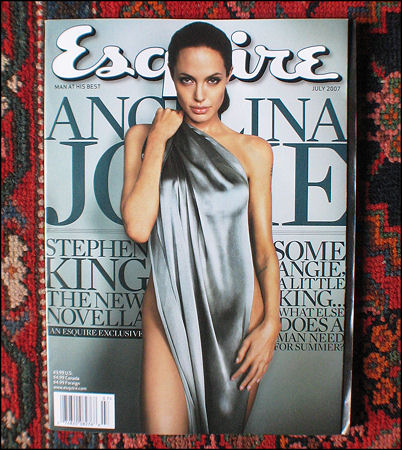

The star of Michael Winterbottom’s A Mighty Heart as she doesn’t appear in the film

The Jolie cover, of course, in no way makes up for the magazine’s (and particularly editor A.J. Jacobs‘) surreal, shark-jumping, bordering-on- deranged obsession last year with Scarlett Johansson. Esquire has been on indefinite probation status because of this. If it weren’t for those “What I’ve Learned” pieces, I would be boycotting the magazine right now over this. The only thing that will make up for the Johansson fixation right now is an online mea culpa statement from Jacobs and an apology from the editors.
Joe Queenan said it in the Guardian last December and I tried to explain the same thing last March: Johansson is over. Until she lucks into another semi-startling, Match Point-level part or re-invents herself in some other way.
Johansson’s acting repertory, Queenan said, “consists of staring intently at the person she is speaking to, keeping her lips spread apart, and hoping no one will notice that she is no threat to Meryl Streep, and not all that much of a threat to Hilary Duff.”

Radical Honesty

A 66-year-old Virginia-based psychotherapist named Brad Blanton, profiled by Esquire‘s A.J. Jacobs, “says everybody would be happier if we just stopped lying. Tell the truth, all the time. This would be radical enough — a world without fibs — but Blanton goes further.
“He says we should toss out the filters between our brains and our mouths. If you think it, say it. Confess to your boss your secret plans to start your own company. If you’re having fantasies about your wife’s sister, Blanton says to tell your wife and tell her sister. It’s the only path to authentic relationships. It’s the only way to smash through modernity’s soul-deadening alienation. Oversharing? No such thing.”

Signature of damnation

The day after that perplexing Sopranos finale, I compared it in one respect to the ending of Alfred Hitchcock‘s The Birds. Now MCN’s Larry Gross has compared it to unexpected killing of Janet Leigh in Hitchcock’s Psycho:
“There’s a famous choice in movie narrative that nominally offers resolution but in fact destroys the possibility of conclusiveness even more monstrously than this Soprano’s finale. That is the murder of Janet Leigh in Psycho, [which] did not emanate as an inspiration, from the psychological necessities of the character of Marion Crane in that movie, nor was it in any meaningful way a ‘resolution’ of her story.
“It was in fact the most aggressive insult to ‘meaning’ in the history of cinema. Marion Crane‘s death is precisely as black and arbitrary as the black screen that ended The Sopranos as a series.”
Gross also weighs in on did-Tony-get-hit?: ” Chase is not tantalizing us with specific narrative issues. There’s no one in the story left to kill Tony and the danger of a cop bust has already been covered in the scene with his lawyer. Tony’s anxious fearful looks to the door are not narratively specific. They are signatures of his soul’s perpetual divided state, as Michael Corleone‘s blank impassive stare was the signature of his damnation.”