
Roth shocking & awe-ing

Last night I attended an LA Film Festival discussion called “Shock & Awe: New Wave Exploitation.” Moderated by F.X. Feeney, the panelists were directors Eli Roth (Hostel, Hostel Part II), Craig Brewer (Hustle & Flow, Black Snake Moan) and Jack Hill (the ’70s exploitation flicks Foxy Brown, Switchblade Sisters). I recorded the whole discussion — here it is.
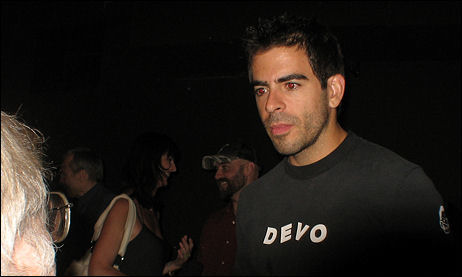

Director Eli Roth following last night’s disucssion at Westwood’s Armand Hammer Museum — 6.30.07, 8:10 pm

The idea was mainly to size up the 35 year-old Roth, who’s recently been on the skillet for two reasons. One is his having been tarred as the leading purveyor of “torture porn” (a term coined two years ago by New York magazine critic David Edelstein) and particularly due to the loathing expressed over the fetishistic gruesomeness in Hostel Part II, particularly the scene in which a character played by Heather Matarazzo is hung upside down and knife-sliced to death. The other is the recent notion that torture porn is on the wane or starting to be “over” due to the underwhelming earnings generated by Hostel Part II.
I learned last night that Roth is a bright, sophisticated operator — he’s hard-core and full of fire. He knows himself, his movie history, his directors, how to shoot cheap, what he’s proudest of, etc. The key thing is does he want to keep on being “Eli Roth” or does he want to shift into a new gear in order to avoid being typed and confined within the walls of the horror/torture-porn dungeon? (You’ll hear me asking this right after Feeney opens the session up to questions.)
The talk went on for a little more than an hour. I came out of it feeling a lot more respect for Roth than I had going in. He’s much more talented and sophisticated that his films and subject matter suggest. I only hope he doesn’t end up like Tarantino — a B movie fetishist and wallower who refuses to do anything but recycle and reconfigure old-time exploitation movies he fell for in his teens and 20s.
“Valance” at the Wilder

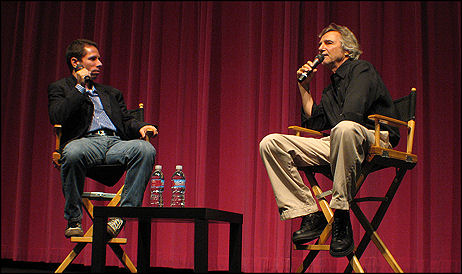
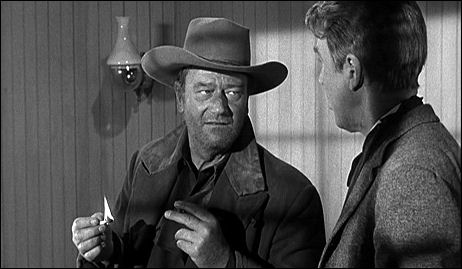
Director Curtis Hanson hosted an L.A. Film Festival screening last night at the Armand Hammer Museum’s Billy Wilder theatre of John Ford‘s The Man Who Shot Liberty Valance. I slipped into the theatre right after the exploitation films panel around 8:30 and caught the last 25 or 30 minutes, and then I sat through the post-screening discussion between Hanson and L.A. Weekly critic Scott Foundas. Variety critic Robert Koehler was also in attendance.

The scratch-free 35mm print was from John Wayne‘s private collection, Hanson said. It looked great, although it didn’t seem to have that super-silvery sheen and needle-sharp focus that I’ve gotten off viewings of the Paramount Home Video DVD.
The Man Who Shot Liberty Valance was critically dismissed for the most part when it opened in April 1962. N.Y. Times critic Bosley Crowther called it “creaky” and declared it proof that “the western, ravaged by repetition and television, has begun to show signs of age…[a] basically honest, rugged and mature saga has been sapped of a great deal of effect by an obvious, overlong and garrulous anticlimax.”
It didn’t make very much money either, and the reasons weren’t hard to figure. Ford shot Valance in black and white, and most of it on a somewhat echo-y sound stage. It’s very talky for a western. James Stewart and John Wayne are both 20 years too old to be playing their parts. And it’s basically an old man’s movie — an elegy for bygone times and regrettably false legends.
But elite critics starting calling it an absolute classic about 30 years ago. Transformers fans will never, ever rent the DVD, but every serious film critic from Maine to San Diego will tell you it’s one of Ford’s very best — his saddest and most personal film ever, and worthy of the highest respect.

I don’t dispute this for a second. You can talk about this film for hours and never run out of new things to discover or re-review. I’ve seen Liberty Valance many, many times on the tube, and I absolutely love the transfer on the most recent DVD.
But the older I’ve gotten (and I’ve said this before), the more trouble I’ve had with Ford’s sentimental cornball streak. The man’s affection for actorly colorfulness among his supporting players seems to get worse every time I re-watch one of his films. Andy Devine‘s performance in Liberty Valance as a cowardly, squealy- voiced sheriff is, for me, 90% torture. (His one good scene is in the very beginning when he takes Vera Miles out to visit Wayne’s burned-down ranch.) Edmond O’Brien‘s alcoholic newspaper editor is a problem performance also. The movie is littered with them.
As Newsweek critic Malcom Jones observed in March 2006, Ford’s movies “are a little antique, a little prim.”
The irony, of course, is that despite the irritating aspects, The Man Who Shot LIberty Valance becomes a greater and greater film with each re-viewing. Some- thing majestic and touching and compassionate seems to come out in greater and greater relief. Genius-level films always gain over the years, but to my surprise I was almost moved to tears last night — and this stagey monochrome oater has never quite melted me before. Go figure.

Sunday morning verdict

Ratatouille is still way in front of Live Free or Die Hard, but it’s been inching down over the last three days while the Bruce Willis actioner has continued to inch up. Both are doing very well with the French rat movie almost $14 million in front of the Willis, but a friend says that at a Marina del Rey showing of Ratatouille yesterday 80% to 85% of the crowd was adult, indicating that this “very sophisticated” film is “not really getting the kids.”
Is this true in Baton Rouge and Jacksonville also? How about Portland? I plan on checking out at least one major theatre showing the Disney/Pixar film later today, but has anyone noticed any similar audience proportions?
Ratatouille‘s three-day estimate is now down to $46,315,000. Thursday’s tracking said it would take in around $50 million while numbers for Friday, 6.29 (reported yesterday morning) projected a weekend tally of $48,406,000.
It would appear that a certain percentage of not-very-worldly types whose idea of world-class, mouth-watering cuisine is a double hamburger with ketchup and fried onions are saying to themselves (and their kids in particular), “Do we really want to go to an animated haute cuisine movie? Maybe the Die Hard flick is more our speed even if it’s not supposed to be as good…Bruce is family, after all, and absorbing familiar emotional assurances from a coarse action flick seems like a safer, more comfortable bet.”
Live Free or Die Hard is now looking at a three-day total of $32,750,000 and a five-day cume of $47,779,000, having been handed a five-day projection of just shy of $40 million last Thursday and $45.8 million yesterday morning.