High Noon vs. Rio Bravo

Talk to any impassioned, ahead-of-the-curve film snob about classic westerns, and he/she will probably tell you that Howard HawksRio Bravo (1959) is a much better, more substantial film than Fred Zinneman‘s High Noon (1952). More deeply felt, they’ll say. Better shoot-em-up swagger, tastier performances, more likable, more old-west iconic. Many people I know feel this way. And now here‘s director Peter Bogdanovich saying it again in a New York Observer pieceRio Bravo is even better than you thought, High Noon doesn’t hold up as well, etc.
Something snapped when I read Peter’s article this afternoon. Goddamn it, the Rio Bravo cult has gone on long enough. Bogdanovich calls it “a life-affirming, raucous, profound masterpiece” I’m going to respond politely and call that a reach. I admire Hawks’ movies and the whole Hawks ethos as much as the next guy, but it’s time to end this crap here and now.

High Noon may seem a bit stodgy or conventional to some and perhaps not as excitingly cinematic to the elites, but it’s a far greater film than Rio Bravo.

It’s not about the Old West, obviously — it’s a metaphor movie about the Hollywood climate in the early ’50s — but it walks and talks like a western, and is angry, blunt, honed and unequivocal to that end. It’s about the very worst in people, and the best in a single, anxious, far-from-perfect man. I’m speaking of screenwriter-producer Carl Foreman, who was being eyeballed by the Hollywood right for alleged Communist ties when he wrote it, and receiving a very tough lesson in human nature in the process. He wound up writing a crap-free movie that talks tough, cuts no slack and speaks with a single voice.

You know from the get-go that High Noon is going to say something hard and fundamental about who and what we are. It’s not going to poke along some dusty trail and go yippie-ki-yay and twirl a six-gun. It’s going to look you in the eye and say what’s what, and not just about the political and moral climate in some small western town that Gary Cooper‘s Willl Kane is the sheriff of.
Both are about a lawman facing up to bad guys who will kill him if he doesn’t arrest or kill them first. The similarities pretty much end there.

High Noon is about facing very tough odds alone, and how you can’t finally trust anyone but yourself because most of your “friends” and neighbors will equivocate or desert you when the going gets tough. Rio Bravo is about standing up to evil with your flawed but loyal pallies and nourishing their souls in the bargain — about doing what you can to help them become better men. This basically translates into everyone pitching in to help an alcoholic (Dean Martin) get straight and reclaim his self-respect. High Noon doesn’t need help. It’s about solitude, values…four o’clock in the morning courage.

We’d all like to have loyal supportive friends by our side, but honestly, which represents the more realistic view of human nature? The more admirable?

The first 10 or 12 minutes of Rio Bravo, I freely admit, are terrific in the way Hawks introduces character and mood and a complex situation without dialogue. Let it be clearly understood there is nothing quite like this in all of High Noon. I also love the way John Wayne rifle-butts a guy early on and then goes, “Aww, I didn’t hurt him.” But once the Duke and Walter Brennan, Martin, Ricky Nelson and Angie Dickinson settle into their routines and the easy-going pace of the thing, Rio Bravo becomes, at best, a somewhat entertaining sit-around-and-talk-and-occasionally-shoot-a-bad-guy movie.
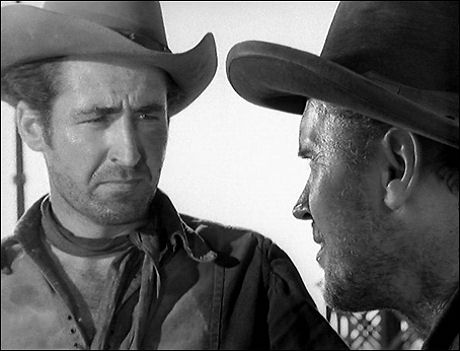
More than anything else, Rio Bravo just ambles along. Wayne and the guys hang out in the jailhouse and talk things over. Wayne walks up to the hotel to bark at (i.e., hit on) Dickinson. It tries to sell you on the idea of the big, hulking, 51 year-old Wayne being a suitable romantic match for Dickinson, who was willow slender and maybe 27 at the time but looking more like 22 or 23.

Plus the villains have no bite or flavor — they’re shooting gallery ducks played by run-of-the-mill TV actors. Most of Rio Bravo is lit too brightly. And it seems too colorfully decorated, like some old west tourist town. It has a dippy “downtime” singing sequence that was thrown in to give Nelson and Martin, big singers at the time, a chance to show their stuff. Then comes the big shootout at the end that’s okay but nothing legendary.

Does Rio Bravo have a sequence that equals the gripping metronomic ticking-clock montage near the end of High Noon? Is the dialogue in Rio Bravo up to the better passages in Zinneman’s film? No. (There’s nothing close to the scene between Cooper and Lon Chaney, Jr., or the brief one between Cooper and Katy Jurado.) Is there a moment in Rio Bravo that comes close to Cooper throwing his tin star into the dust at the end? Is there a “yes!” payoff moment in Rio Bravo as good as the one in High Noon when Grace Kelly, playing a Quaker who abhors violence, drills one of the bad guys in the back?
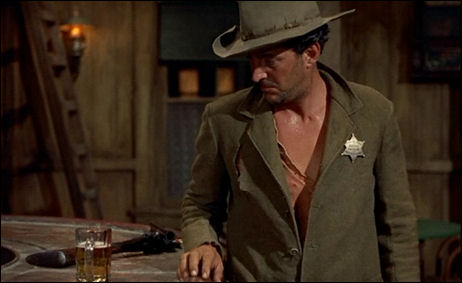
Floyd Crosby‘s High Noon photography is choice and precise and gets the job done. It doesn’t exactly call attention to itself, but it’s continually striking and well-framed. To me, the black-and-white images have always seemed grittier and less Hollywood “pretty” than Russell Harlan‘s lensing in Rio Bravo, which I would file under “pleasing and acceptable but no great shakes.”

Dimitri Tomkin wrote the scores for both High Noon and Rio Bravo, but they don’t exist in the same realm. The Bravo score is settled and kindly, a sleepy, end-of-the-day campfire score. High Noon‘s is strong, pronounced, “dramatic” — so clear and unified it’s like a character in itself. And I’ve never gotten over the way the rhythm in that Tex Ritter song, “Do Not Forsake Me O My Darling,” sounds like a heartbeat.

Bogdanovich writes that Rio Bravo didn’t win any Oscars or get much critical respect, but “it was far more popular with audiences than High Noon.” He’s right about this. The IMDB says Rio Bravo earned $5,750,000 in the U.S. when it came out in ’59, and that High Noon brought in $3,750,000 when it played in ’52. Big effin’ deal. High Noon whipsRio Bravo‘s ass in every other respect.
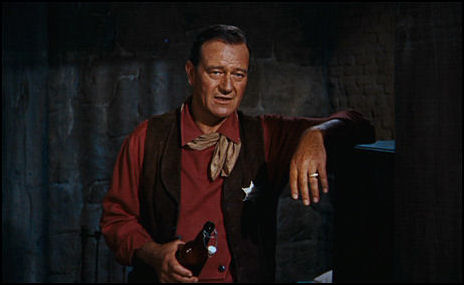
That said, there’s an intriguing Hawks assessment by French director Jean-Luc Godard in the Bogdanovich piece. Godard doesn’t argue that Rio Bravo is pretty much what I’ve described above, but says it’s still a better film than High Noon because — I love Jean-Luc Godard — the exceptionally good things in Rio Bravo can be ignored, and therefore may be unnoticable to a good-sized portion of the audience.

“The great filmmakers always tie themselves down by complying with the rules of the game,” he states. “Take, for example, the films of Howard Hawks, and in particular Rio Bravo. That is a work of extraordinary psychological insight and aesthetic perception, but Hawks has made his film so that the insight can pass unnoticed without disturbing the audience that has come to see a Western like all others. Hawks is the greater because he has succeeded in fitting all he holds most dear into a well-worn subject.”
Two “Atonement” trailers

Here are two trailers for Joe Wright‘s Atonement (Focus Features, 12.7), an adaptation of an Ian McEwan period drama which will play at both the Venice and Toronto Film Festivals in early September. The film doesn’t appear to be monumental art, but it’s almost shocking how differently these two trailers sell the film.
This cooler trailer makes it appear serious, adult, thoughtful, grounded; the other trailer makes it seem tawdry, vaguely cheap and almost soap opera-like. The differences are really amazing — the cooler version is posted above but watch the other one and compare.
The film, working from a screenplay by Christopher Hampton, seems to borrow a tiny bit from Lillian Helman‘s The Children’s Hour. Set in 1935 and moving into the World War II years and beyond, it’s about a 13 year-old girl who ruins at least a couple of lives when she accuses the lover (James McAvoy) of her older sister (Keira Knightley) of a crime he hasn’t committed. Shock from the observing of sexual intimacy seems to be part of her motive. Costars include Romola Garai, Saoirse Ronan, Brenda Blethyn and Vanessa Redgrave.

Helicopter, death, flames

This video footage from the fatal crash this afternoon of those two Pheonix news helicopters is, of course, ghastly — there’s a crash sound and then the picture goes out. (Four guys died — two pilots, two news phtographers.) But what was that Stepford Wife blonde anchor thinking as she totally ignored the visual and aural implications of what had seemingly just been broadcast?
Obviously something of a sudden, possibly catastrophic nature had just happened — it at least warranted a question or a moment of pause — and all this bimbo could could do was talk about a just-concluded car-chase scenario on the ground, which was what the choppers had been trying to shoot.

“Dark Knight” teaser, Joker photos

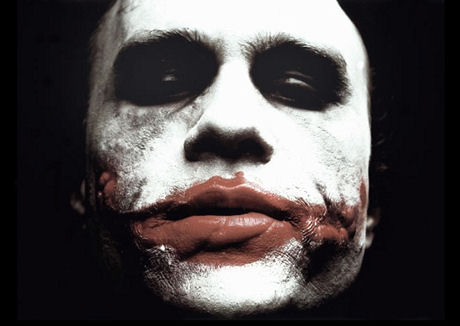
Here’s a fairly engrossing teaser for Chris Nolan‘s The Dark Knight (Warner Bros., 7.18.08) — medium and high. It’s mainly about darkness and voices and laser light piercing same, and a simulation of what might happen to a Batman logo if it were to enter the earth’s atmosphere and start to flake apart like a faulty heat shield. Plus a relatively recent still of Heath Ledger as “the Joker” — the crude stitchwork applied to a sliced-open mouth makes for a Leatherface effect. This shot has already turned up on AICN and other sites:

And here’s one that was sent to me today from Comic-Con:

Full-name movie titles

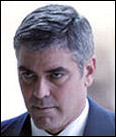
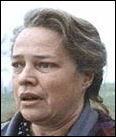
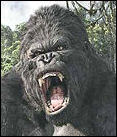
What do Michael Clayton, Dolores Claibourne, Jerry Maguire, Audrey Rose, Susan Slade, Mildred Pierce and King Kong have in common? They’re all titles of movies that are named after their main characters because…well, hard to say. Nothing poetic or allusive in them. Were they so named because a first and last name sounds straight and unpretentious? You tell me.


(l. to r.) George Clooney in Michael Clayton, Joan Crawford in Mildred Pierce, Kathy Bates in Dolores Claibourne, King Kong

Using a plain, simple-sounding “name” title that doesn’t imply or suggest anything thematic or tonal or alliterative. All these titles say is, “This is our main character’s name as it appears on his/her driver’s license.” (Except, obviously, in the case of one.)
I’ve heard from a friend of Michael Clayton (Warner Bros., 10.3), said to be a first-rate adult drama with George Clooney in the lead role, and he tells me that one reason for the title was that “the script/film starts with four page monologue voice-over from the Tom Wilkinson character” and so director-writer Tony Gilroy “didn’t want anyone to mistake his focus.”
Once “Michael Clayton” was typed on the cover page, the guy says, “everyone assumed they’d find a better title, and they were all still toying with alternatives until they saw the very first assemblage [of the film]. It’s so George’s movie. Suddenly, it felt dead-on.”
I had a question about this because “Michael Clayton” is just…well, a guy’s name. Nothing ironic or double-layered or smart-assy. And it’s not like the name rings a bell in a history-book sense, which was the justification for Neil Jordan and Liam Neeson calling their Irish rebellion story Michael Collins.
There’s obviously nothing “wrong” with Gilroy calling his film Michael Clayton — it’s fine — although it seems analagous to, say, Sydney Pollack deciding to throw out John Grisham‘s book title The Firm and call his 1993 Tom Cruise-Gene Hackman thriller Mitch McDeere instead.

Or Gregory Hoblit deciding against calling his 1998 Richard Gere-Edward Norton thriller Primal Fear and going instead with Martin Vail (i.e., the name of Gere’s lawyer character).
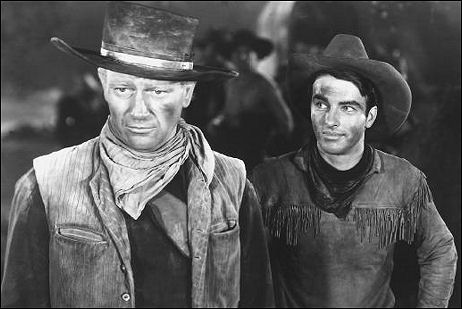
Or Howard Hawks decided against calling his 1948 western classic Red River and going instead with Matthew Garth (i.e., Montgomery Clift‘s character) or Tom Dunson (i.e., John Wayne‘s).
Or Changing Lanes being thrown out by director Roger Michell in favor of Gavin Banek (i.e., the name of Ben Affleck’s character).
Or Brian DePalma deciding upon Tony Montana instead of Scarface.
Greer Garson‘s Mrs. Miniver isn’t the same kind of deal because of the “Mrs.” — that lends a certain titled distinction. And it’s not like Andrew V. McLaglen‘s McLintock! because that was just the last name of John Wayne’s character, and it used an exclamation point. Napoleon Dynamite was a different deal as well — the weird goofball sound of that name made for a kind of attitude statement.

L.A. Times correction

Yesterday’s (7.26) L.A. Times CFCA correction read as follows: [Both] the headline (‘Online Critics Expand Boycott Against Fox’) and deck (‘Supporters Nationwide Join Chicago Group in Protesting Its Limited Access to Screenings’) on a July 20 article in the Calendar section inaccurately suggested that the Chicago Film Critics Assn.’s online critics alone were protesting 20th Century Fox and Fox Searchlight Films’ alleged practice of limiting access to screenings and that supporters nationwide had joined Chicago’s protest.
“Film critics in other cities voiced support for the Chicago group but did not formally join it. The organization’s chief, Dann Gire, now says there was no formal boycott but a voluntary ‘action of protest.’ The article also misspelled Gire’s first name as Dan.”

“No Reservations” bitch-slapped

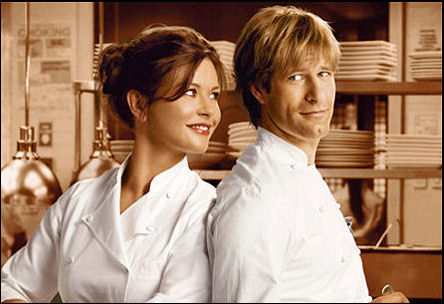
Opening weekend reviews don’t matter at all with most under 30s, and they probably don’t matter that much with the slightly or somewhat older female crowd that Warner Bros. is hoping will take a chance on Scott HicksNo Reservations this weekend. Many of them will, probably, although it would be better for WB if they don’t consult the pic’s Rotten Tomatoes score.

No Reservations has so far amassed a failing grade of 43%. Anything under 70% or 75% means trouble. Slip under 50% or 60& and you’re really in Shit City.
My favorite pan is by Newsday‘s John Anderson. My favorite graphs in his review are as follows:
“Like the planet-sized gourmand of Monty Python’s The Meaning of Life, director Scott HicksNo Reservations consumes and regurgitates everything in its path: The career of Catherine Zeta-Jones, any credibility Hicks (Shine) still has, and even Aaron Eckhart, who is the new Jeff Bridges, one who can balance a caper in his cleft chin.
“Based on the popular German comedy Mostly Martha, it doesn’t leave a bad taste. It doesn’t leave much taste at all, save perhaps for the cloying echoes of Velveeta cheese. It’s a film that should come with bicarbonate.
“While food may be art, and a good chef an artist, an artist is all about his or her inner life — and Hollywood abhors the inner life the way nature abhors a vacuum. It requires far too much consideration, time and effort to make a convincing film about a creative soul, so what we get, particularly in No Reservations, is the equivalent of cream of mushroom soup and Ritz crackers.
“Which serve no one really well but enable the filmmakers to give us beautiful decor, beautiful people, beautiful apartments, New York City streets devoid of anything that looks remotely real and a Greenwich Village restaurant that closes on Sundays. Huh? Call Zagat’s!”

Venice = Toronto

Per tradition, each and every film playing at the 64th Venice Film Festival (8. 28 to 9.8) will most likely play at Toronto, and many of these at Telluride just before. Except (possibly, know nothing, just guessing) for Woody Allen‘s Cassandra’s Dream, which will show out of competition at Venice, and which has unveiled itself skittishly (i.e., at that hidden-away Aviles Flm Festival in Spain) beforehand. And Wes Anderson‘s The Darjeeling Limited, of course, which can’t play Toronto because it’s the opening-night New York Film Festival attraction.
Put it this way — if one of these films plays Venice but doesn’t play Toronto, thousands of eyebrows will be raised.
Kenneth Branagh‘s Sleuth will go to Toronto. One presumes the same for Ken Loach‘s It’s a Free World. Joe Wright‘s Atonement, which won’t open in the U.S. until 12.7.07, will open the Venice Film Festival on 8.29 and almost certainly play Toronto right after that.
Brian De Palma‘s Redacted, Paul Haggis‘s In the Valley of Elah and Ang Lee‘s Lust, Caution will also, I’m sure, hit both. Ditto The Assassination of Jesse James by the Coward Robert Ford, Tony Gilroy‘s Michael Clayton and Todd HaynesI’m Not There.
Hey, what about Martin Scorsese‘s Rolling Stones concert documentary? It was assembled and shown to Paramount brass last May, but I haven’t heard zip since.

Lane on “Sunshine”

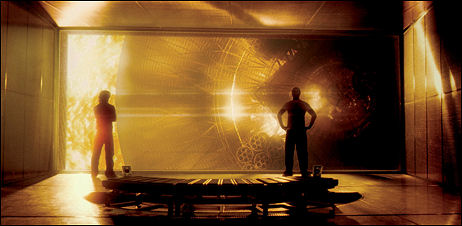
Danny Boyle‘s “change of tack” at the end of Sunshine (Fox Searchlight, 7.20) “feels jagged with impatience and panic,” writes New Yorker critic Anthony Lane in one of the best-written critiques of this interesting but enormously infuriating sci-fier that I’ve read anywhere. (It’s suddenly hit me that I haven’t posted a word myself — sometimes I just turn away and say nothing when a film seems as shockingly miscalculated as this one.)

“Villainy descends upon the spaceship, but so pressing is the question of why and how it got there, and what factor sun cream it must have been lathering on, that Boyle tries to disguise the uncertainty with visual effects, smearing almost every shot into a distorted haze.
“Beware of filmmakers who shy from clarity just when we need it most, and ask yourself what happened to the Boyle who offered that unflinching view of drug abuse in Trainspotting, with its scabrous highs. He has not so much taken leave of his senses, I think, as allowed them to overwhelm him. Blame it on the sunshine.”

Spielberg, China, Darfur, Steidle

That 7.26 ABC News story by Russell Goldman stating that Steven Spielberg “may quit his post as artistic adviser to the 2008 Beijing Olympics unless China takes a harder line against Sudan” has so far been disputed twice — in a piece yesterday by Deadline Hollywood Daily‘s Nikki Finke, and in a portion of an audio interview I posted earlier this week with The Devil Came on Horseback spokesperson/figurehead Brian Steidle.
In that Tuesday, 2.24 interview I asked Steidle about the Spielberg/Beijing Games/Darfur situation, and he said that he and other Darfur experts had sat down with Spielberg several weeks back and had gone over everything, and that their recommendation was that Spielberg not quit his post as creative director of the ’08 Olympic Games (the thought being that the Chinese don’t respond to ultimatums) and that he should use the position to press quiet but forceful diplomacy upon Beijing. He said that Spielberg seemed more or less inclined to follow their advice.
The topic comes up almost exactly at the halfway point, i.e., just above the play button.

Kubrick Collection coming

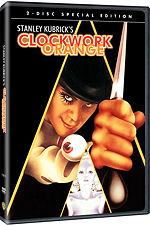
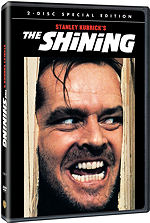
Warner Home Video will release a nine-disc “Director Series: Stanley Kubrick Collection” on 10.23.07. New two-disc special editions of 2001: A Space Odyssey, A Clockwork Orange, Eyes Wide Shut and The Shining as well as a “deluxe edition” of Full Metal Jacket (which would be…?). Also included: the doc called Stanley Kubrick: A Life in Pictures. The whole kit ‘n’ kaboodle with set you back $79.92, but titles will also be sold individually for $26.99 a throw.

“Red Dawn” returns

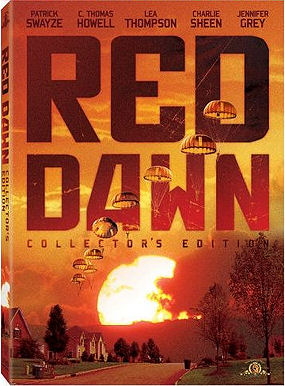
Ruthless, ogre-ish, heavily-armed invaders descend from the sky, take over the reins of government, and before you know it rebel groups are forming into grass-roots militias, fighting back like proud guerillas and asserting their nativist rights — this is our country! Death to the invaders! Death before submission! Does this like, uhm.. remind anyone of anything?

This double-disc DVD of John Milius’ Red Dawn hit stores on 7.17. Do you think the MGM/UA Home Video guys had any ideas about present-day parallels, or were they just after some 20th anniversary bucks? I once asked Milius himself about the Iraqi rebellion angle — he didn’t bite, but he didn’t strenuously argue it either.