Not knowing but pushing ahead

Andy Warhol once said “there’s nothing more middle-class than being afraid to look middle-class.” By the same token, in the realm of film columnists and critics there’s…now I can’t figure the analogy. I’m trying to say that if you’re afraid to sound downmarket and/or gut-level in your opinions, you’re lacking a certain degree of integrity.

Not that anyone is obliged to sound like Oscar Madison or Rufus T. Firefly or Roger Avary after three cans of beer in discussing new films, but most of us have these guys (or aspects of them) living inside us. And yet most high-end critics accept or at least recognize that they’re all obliged to express themselves in a manner that will be deemed “aesthetically correct” by their peers.

The secret to good writing is having the brass to begin a sentence with only a half-formed notion — and certainly without knowing exactly — what you’re about to put into words, but pushing ahead and writing it down anyway, knowing or at least trusting it’ll come out right in the end.

“3:10 to Yuma” sneak

Did anyone go to the 3:10 to Yuma sneak last night? Obviously tens of thousands did. Reactions, intuitions, leg twtichings? Any insect antennae readings about how it played with the crowd? What about Russell Crowe‘s horse hearing his whistle 40 or 50 feet away over the chug-chug-chug of the locomotive engines, and then galloping alongside the train with a special lock-picking skeleton key between his teeth?

The “big” Toronto films

David Poland wrote this morning in the Hot Blog that “the big films at Telluride have been the big films that were expected to fill that need and will be, with a few additions, the big titles at Toronto as well: The Diving Bell & The Butterfly, I’m Not There, The Savages, Into The Wild and Juno.” Fine, but take Juno out of the equation and that’s a fairly elitist assessment.

From those with the ability to recognize impassioned, cliff-leaping filmmaking, Butterfly will win respect and applause even if the actual watching of it, in the final analysis, is somewhat akin to gentle root canal surgery….the dentist’s drill boring into your jaw as you’re filled with spirit-lifting, life-affirming thoughts, as well as ones about claustrophobia, straight-jackets and total body entrapment.

Into The Wild is Sean Penn‘s absolute best film, but the more you think about and read up on the real Chris McCandless the next day the more it starts to tick you off. I was impressed by Penn’s passion (and I love the ending), but I wasn’t persuaded that his take on McCandless reflects what really happened, or who McCandless really was. A must-see, naturally, but for a film to be “big” it has to generate serious excitement and emotional rapport.

The Savages is sad, smart and very well acted. But it’s drearier than shit — right away you’re saying to yourself, “Wow, excellent indie character piece but how much longer before it’s over?” It makes you half-wonder why Phillip Seymour Hoffman can’t hold on to his Capote weight. (Sorry for the ticky neurosis, but it bothered me.) Phillip Bosco‘s angry-old-man-with-dementia performance — “good” as it is — filled me with an urge to bail. “I’m not going to watch this guy spit saliva and groan about the end of his life for another hour or so,” I told myself. Then, thank God, he went away.

Everyone will, of course, need to see I’m Not There, but from what I’m reading and where I’m sitting it seems to have been pretty much written off as a loopy in-joke for Dylanologists. Not “written off” as in “don’t see it” as much as “Blanchett aside, don’t expect all that much.”

“Cassandra” lamented

From the Venice Film Festival, The Independent‘s Gerry McNab reports that “many critics” who saw Woody Allen‘s Cassandra’s Dream yesterday declared it “feeble and dispiriting fare — the work of an old master in decline.”

McNab also calls it “a stuttering drama” that even conveys “a sense that cinematographer Vilmos Zsigmond and the composer Philip Glass [are] working at half-throttle.”

“No one [at the press conference inside the Venice Casino] picked up on the slack tempo of Cassandra’s Dream, its bizarrely genteel portrayal of London, (at times, the film resembles an episode of EastEnders) or its dramatic lacunae.

“When Allen came on stage in Venice’s Casino yesterday, he cut a strangely fragile and melancholic figure,” McNab writes. “Flanked by young British actress Hayley Attwell and the two males stars,. Ewan McGregor and Colin Farrell, he sat there silently in his headphones, waiting for an interminable opening question from an Italian journalist to be translated into English. When he finally did speak, his voice sounded faint.

“In Italy, as in France, Allen is still adored. He is still the ‘maestro,’ even if his films are increasingly lacking in the comic zest and ingenuity that once characterised them.

“The response he was given in Venice yesterday was gentle and solicitous. No curve balls were thrown in his direction. It was as if a beloved elderly relative had come to town. Sure enough, there was at least one Italian journalist ready to stand up and congratulate him on his latest ‘masterpiece,’ seemingly oblivious to the fact that this is surely one of his weakest films.”

McAvoy Fields

I’m not trying to be snarky or petty by suggesting a “separated at birth” thing. I’m only mildly suggesting (which is different than “asserting” or “declaring”) that there may be a variation on a genetic theme to be considered. Whatever.


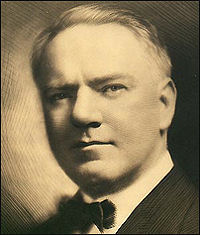
James McAvoy, W.C. Fields

Two reasons to see Ferguson doc

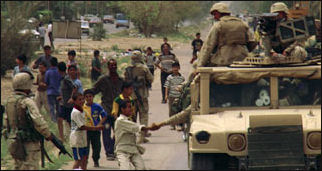
EW‘s Mark Harris has posted two dead-on reasons why people should see Charles Ferguson‘s No End In Sight, that infuriating doc (in a good way) that I’ve written about two or three times about how U.S. officials totally cocked up the Iraqi occupation and all but incited the insurgency with their outrageous bungling.

One is that “it’s made by someone who knows more than you do,” Harris writes, “so you’re guaranteed to come away from it smarter…[plus] the precision with which Ferguson lays out [the mistakes] is riveting.” And two, “the movie doesn’t fetishize outrage. It seems to have been made with the kind of calm focus that is bred by deep anger, but it always stays on mission. In an era of shout-first-ask-questions-later filmmaking, Ferguson’s frosty intensity is exciting.”

Why couples break up

Whenever mainstream publications report about a breakup of a celebrity couple (as People.com has in the case of Heath Ledger and Michelle Williams), it’s always because of work pressures and being apart shooting different films, blah, blah.

But in the real world people break up for one of three reasons — infidelity, money problems, or one of the partners having a drug/alcohol problem that isn’t being remedied. Money isn’t an issue with these two and I’ve never heard of booze or snorting being an issue with either (especially with a young daughter to look after) so…anyway, whatever. (An occasional, very obscure fourth reason for breakups — one of the partners realizes he/she will be happier with a lover of the same sex — isn’t an issue here either.)

McCarthy on “Juno”

“The way the torrents of archly amusing, vocabulary-bending dialogue trip off the tongues of the characters here, you know you’re in the hands of some manner of distinctive writer, and she would be Diablo Cody — a young scribe very handy at shotgunning bright teen quips, as well as catching the attitudes of two distinct types of adults. In fact, the voluminous ruminations of precocious sprite Juno MacGuff (Ellen Page) cascade so thick and fast at the outset that they almost weigh things down, so heavy are they with self-conscious cleverness.” — from Todd McCarthy‘s mostly positive review of Jason Reitman‘s Juno, filed yesterday afternoon from the Telluride Film Festival.

Corliss on “Darjeeling” similarities

Richard Corliss Darjeeling Limited Venice Film Festival Blast #1 (about the similarities between Owen Wilson and the character he plays): “It’s a shock, but not a surprise, to see Owen Wilson in The Darjeeling Limited, the new semi-comedy from Wes Anderson that premiered at the Venice Film Festival last night.” And a little jarring, he adds, when you consider dialogue in which Owen’s head-bandaged character says he has “some healing to do” but is “still alive” after he “smashed into a hill on purpose on my motorcycle.”

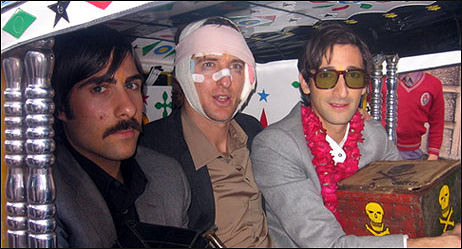
“As Francis Whitman, the eldest of the three Whitman brothers, Owen is clearly in physical distress,” Corliss reports. “His head is wrapped in two thick bandages, one horizontal, one vertical, as if to keep his brains from seeping out. The nose Wilson’s fans know to be charmingly broken has a Band Aid on it. His right hand and wrist are taped, and he uses a cane to walk.

“He looks a mess — funny, in the context of the film; not so, given Wilson’s hospitalization a week ago for what was described as a slashed-wrist suicide attempt. The actor was released Saturday and is in his Santa Monica home, People.com reported, under 24-hour watch by friends and family, instead of on the red carpet in Venice.

“In the movie, Francis is a man on a quest: to reconnect with his brothers Peter (Adrien Brody) and Jack (Jason Schwartzman). They’ve met in India, on a long train trip, for what Francis hopes will be a three-way spiritual quest. ‘I want us to be completely open,’ he tells Peter and Jack, ‘and say yes to everything, even if it’s shocking and painful.’ Okay, then, Peter has an open question for Francis: ‘What happened to your face?’

“He had an accident, Francis replies, and banged himself up pretty severely. Of his surgeons, he says, ‘They did all the procedures right, the result of which is I’m still alive.’ He admits he has ‘some healing to do,’ to which Jack cheerleadingly says, ‘Gettin’ there, though,’ and Peter offers the compliment, ‘Gives you character.’ Later Francis reveals that the incident was not quite an accident: ‘I smashed into a hill on purpose on my motorcycle.’

“This — along with the fact than Wilson is one of three brothers (Andrew and Luke are in movies too) — concludes the witness report on the coincidences between Francis Whitman and Owen Wilson. Enough already. I feel creepy just passing this information along, as if a critic were auditioning to be a coroner.”

Corliss “Darjeeling” Blast #2

Richard Corliss Darjeeling Limited Venice Film Festival Blast #2 (i.e., about the continuing Wes Anderson poised-attitude problem that dogs it): “Picaresque movies often feel longer than they are. For them to work, they need an interior spring with more thrust than Darjeeling Limited‘s attempt at reconstituted brotherhood. The problem is in Anderson’s approach, which is so super-cool, it’s chilly.

“In his elaborate visual construct, virtually every shot is followed by with the camera point-of-view shifted 90 or 180 degrees — which is geometrically groovy, no question, but pretty quickly predictable. Same goes for his stories, which rely on gifted people behaving goofily. Anderson has the attitude for comedy, but not the aptitude. His films are museum artifacts of what someone thought could be funny. They’re airless. Movies under glass.

“[Owen] Wilson has appeared in all five of Anderson’s feature films (Bottle Rocket, Rushmore, The Royal Tenenbaums, The Life Aquatic With Steve Zissou and the new one) and co-wrote the first three — the ones I prefer in the the director’s oeuvre. The Darjeeling script is by Anderson, Schwartzman and Roman Coppola (Francis’ son, Sofia’s brother) and it doesn’t add luster to anyone’s reputation.

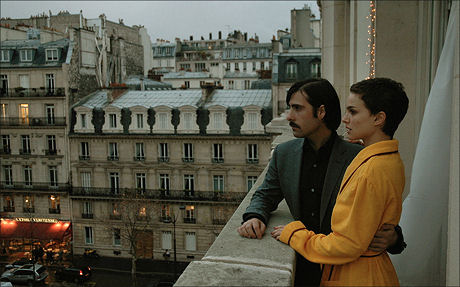
“The Darjeeling program includes a related 13-min. film, Hotel Chevalier. Schwartzman’s Jack seems uneasy when he gets a call from an ex-girlfriend (Natalie Portman) who insists on showing up in his swank hotel room. He draws a bubble bath for her. They flirt and parry and wind up in bed, exchanging dialogue that we hear again, at the end of Darjeeling, as part of a story Jack has written.

“It’s a beguiling vignette that, as Closer and My Blueberry Nights did, shows Portman as a comic actress in fresh bloom. I wish that she, and some of the feeling and wit of the short film, had been in the long one.”


Jason Schwartzman, Natalie Portman in scene from a 13-minute Wes Anderson Darjeeling Limited short called Hotel Chevalier, which is described above by Corliss [still provided by Dazza Buser of www.natalieportman.com]

Elley on “Cassandra’s Dream”

It’s safe to say that Variety‘s Derek Elley has problems with Woody Allen‘s way with earthy British dialogue — the Cockney accents and what Elley claims is a generally irritating-to-British-ears quality — in Cassandra’s Dream (Weinstein Co., 11.30), which has just played the Venice Film Festival.

But the most startling observation is that this supposedly super-dark drama — debt, murder, self-destruction and a femme fatale straight out of the Jane Greer handbook — is “actually a low-key, bumpy black comedy.” There’s no indication of this at all in the trailer, of course, but then trailers always lie.

The drama costars Ewan McGregor, Colin Farrell,Tom Wilkinson, Hayley Atwell and Sally Hawkins

Clinton, Obama, Guiliani, etc.

I’m just starting to come out of denial and face the distinct possibility that it’ll be the deeply divisive and (in some redneck quarters) deeply loathed Hilary Clinton vs. the eccentric Rudolph Giuliani (Vanity Fair‘s Michael Wolff says there’s reason to regard him as an out-and-out whackjob) in the ’08 Presidential race.

This, at least, is what’s indicated in a late August Gallup phone survey that was conducted, according to the N.Y. Times, from 8.23 to 8.26. Putting aside my Barack Obama loyalties, I’m more or less fine with Clinton on her own terms. But the lunchbucket rurals truly despise her, or so I’m given to believe. I read a piece yesterday (or the day before) that claimed some Democratic legislators up for reelection next year are terrified about how Clinton’s coattails may affect their chances.

How is it and why is it that Clinton is now (according to Gallup) beating Obama among Democratic voters by a nearly two-to-one margin — 48% to 25%? Because of that bullshit cheap shot she threw at Obama that implied he would talk to guys like Hugo Chavez without the usual advance diplomatic spade work? Because women are behind her because she’s a woman and it’s time to assert gender politics in a seismic way? Because Obama is African-American (which, of course, no one will ever cop to)?

Something’s strange here…off. Obama is the brilliant and charismatic “right now” guy — a man in his ’40s, almost a GenXer — who brings vision and practical-mind- edness to the table and who isn’t tied into decades-old battles and resentments and histories. And yet Hilary — a brittle, occasionally snippy, over-scripted boomer who brings along truckloads of poisonous baggage left over from the ’90s and Bill Clinton‘s Presidency — is way in front. Why isn’t the race closer?

In an ideal world it would be Obama or John Edwards vs. Fred Thompson. I don’t agree with Thompson’s right-wing beliefs and alliances plus he’s looking a bit old and crotchety these days, but he’s an urbane and witty guy who knows acting and the movie business, and he can feign a Bubba pickup-truck attitude at the drop of a hat.