Lumet chat

Yesterday’s over-before-it-began Sidney Lumet interview at the Hotel Intercontinental, the primary subject being Before the Devil Knows You’re Dead. We also discussed the bizarre mis-marketing of Find Me Guilty as well as Lumet’s affinity and respect for William Wyler‘s The Best Years of Our Lives.


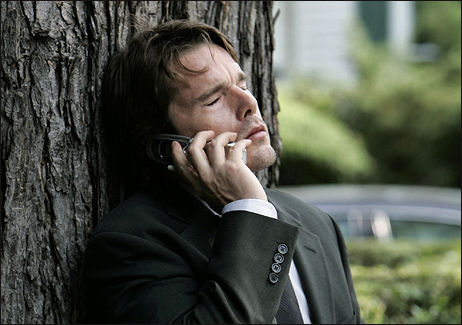
Ethan Hawke in Sidney Lumet’s Before the Devil Knows You’re Dead

Weinstein’s financial situation

Peter Lauria‘s New York Post analysis of the Weinstein Co.’s financial situation, which has lately been pummelled by negative rumors, states the following: (a) “The studio’s debt-to-equity ratio is running at an even 1-to-1, according to a source who has seen its finances, which compares to Lionsgate’s debt-to-equity ratio of 0.14-to-1; (b) “A second source who has seen The Weinstein Co.’s finances said the studio has ‘several hundred million dollars of liquidity’ available and that its debt-to-equity ratio is by no means problematic because ‘as losses turn to profits, it will go completely in the opposite direction’; and (c) a statement from Bob Weinstein that ‘debt is good, you use debt to acquire…If I wanted to access a billion dollars more debt from Goldman tomorrow and I had something worth buying or taking over, we’re now in a game where we can do that…we never were able to do that at Disney.”

But the best quote belongs to Harvey: Fuck everybody. We are back to being No. 1 in profitability and gross.”

Weekend numbers

My guy hasn’t called this morning, but Fantasy Moguls’ Steve Mason is reporting a shortfall for Neil Jordan and Jodie Foster‘s The Brave One, which was expected to reach or slightly surpass (according to tracking) $20 million this weekend. It opened with a relatively weak $4.8 million on Friday, says Mason, which will translate to a projected $15.1 million haul. As the wounded Steve McQueen says at the end of The Sand Pebbles, “What the hell happened?”

And bravo, American audiences, for the smart, sophisticated choices you’re making among the weekend’s three limited openers — the relentlessly vapid Beatles-music flick Across The Universe, the slithery-perverse Russian penis movie Eastern Promises, and the sad and solemn procedural/Iraq War drama In The Valley of Elah.

Naturally, Julie Taymor‘s Beatles film did “blazing” business on 23 screens ($9114 per situation) and David Cronenberg‘s Russian crime flick averaged $10,971 in 15 situations. And of course, Elah did the least amount of business, managing an “unspectacular” debut at 9 locations, having earned about $40,000 on Friday for a $4,492 average. Paul Haggis‘s pic should bring in $130,000 for the weekend.

It’s no secret that American moviegoers almost always favor films that seem the most emotionally obvious as well as the least challenging and/or complex, and they’ve certainly lived up to their reputation this weekend.

Bier linking with Curtis & Curtis

I haven’t read Jamie Curtis‘ screenplay of Lost for Words, which has been described as a story about a libidinous movie star who finds himself falling in love with a beautiful Chinese actress and her female translator, but it certainly sounds like a sell-out project for the great Susanne Bier (Things We Lost in the Fire, Brothers, Open Hearts) to direct.

The synopsis alone sounds coy and randy-cute, like something Hugh Grant would have made in the late ’90s. Jamie Curtis’ biggest credits are having produced The Good Sex Guide, a British TV series, in the early ’90s, and then writing “additional dialogue” on ’97’s Spice World — what does that tell you about her vistas? But the dagger-in-the-chest element is the producing presence of Richard Curtis, the Love Actually director-writer, along with Tim Bevan and Eric Fellner.

One of the most shallow and sickly-treacly British films ever made, Love Actually is Curtis’ testament and emblem. All you need to know about Curtis’ filmmaking philosophy can be found in the following statement, which is on his IMDB page: “If you write a story about a soldier going AWOL and kidnapping a pregnant woman and finally shooting her in the head, it’s called searingly realistic, even though it’s never happened in the history of mankind. Whereas if you write about two people falling in love, which happens about a million times a day all over the world, for some reason or another, you’re accused of writing something unrealistic and sentimental.”

Bier is talented enough to recover from her association with Curtis (who doesn’t appear to have any family ties with Jamie, although they seem similar in attitude), but why is she even going there in the first place?