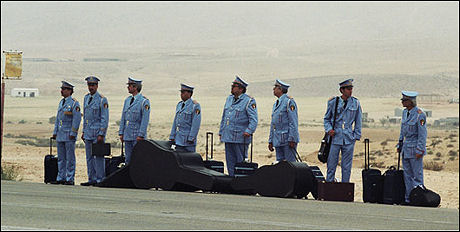
Having read my clarification on Sunday, 10.28, about some of the maneuvers that may or may not have lead to the disqualification of The Band’s Visit over language issue (i.e., over 50% of the films’ dialogue being in English, according to the Academy’s foreign film committee), the film’s producer Ehud Bleiberg has written to explain his position on the qualification issues.
“One, the team of The Band’s Visit believes that the English dialogue in the film is around 23 to 25 minutes in an 85 minute film and isn’t predominant in the film. The silence, expressions, and music are the predominant elements of the film.
“Two, The English is incorrect a lot of the time, requiring subtitles throughout the entire film.
“Three, In the (Beverly Hills) Academy rule book there is one important rule that says that Academy reserves the right to make rulings that do not follow their guidelines .
“These are the three main reasons why we felt our film would be eligible for the Best Foreign Language Academy Award, despite having been told in the late stages there may be an issue with the dialogue.
“Also, he Academy decided to disqualify the film based on dialogue vs. dialogue only. From what we have heard, the only person who has seen our film is the person who was clocking the dialogue. We have reason to believe that if there wasn’t so much noise and controversy surrounding the film before their viewing, they might have seen the film differently.
“As it is, they didn’t seem to take into account points A and B above or the difference between English, Arabic and Hebrew. For example, if a film has the English dialogue ‘he was walking,’ that comes to three words, whereas in Hebrew it’s only two. Also, the songs that are sung in Arabic were not included in the dialogue clocking, even though they were significant to the story.
“At the time of our appeal, to our disappointment, none of the other members of the (LA) Academy had seen the film in order to consider points A, B, and C. The team of The Band’s Visit believes that after winning the majority votes in 8 of the top categories of the Israeli Film Academy Awards including Best Picture, Director and Screenplay, it is the film that would have best represented Israel at the upcoming (U.S.) Academy Awards in the Best Foreign Language category.
“Sony Pictures Classics has faith in this film,” he says, “and we are now trying to push the film for other categories including Best Director and Best Original Screenplay. We hope that once the Academy has had a chance to see the film, they will be as impressed with it as the rest of the world has been.”
Bleiberg questions the accuracy of Yair Raveh‘s story “that he heard Beaufort‘s producers sent the Israeli Academy a letter from their international sales agent Bavaria Films, saying they counted the words in The Band’s Visit, it has 60 percent English and therefore will be probably be disqualified.”
Bleiberg says that Bavaria’s sales agent couldn’t have precisely tabulated the amount of English, Hebrew and Arabic in The Band’s Visit because “no DVD screeners were made available to anyone.”
However, he says, after The Band’s Visit won Israel’s Ofir Award for Best Film, Ilana Sharon, director-manager of the Israeli Academy, requested and got from Eilon Rtzkovsky. Bleiberg’s partner producer, two DVDs of The Band’s Visit in order to screen the film and determine if the language issue might be an issue before sending the film on to the L.A. Academy.”