Harris offers four things to remember

EW columnist Mark Harris recently ran a list of things to remember in calibrating the Oscar race, including four that apply to online columnists:

1. “Don’t trust any handicapper who’s beating a drum too loudly,” Harris warns. “In the last few years, bloggers have blurred the line between Oscar prediction and advocacy — something that has had no discernible effect on the nominations, but has lowered their batting average. Nine out of 10 bad calls are made because you love or hate a movie so intensely you’re blind to reason. Everybody relishes making an out-on-a-limb guess that pays off, but try to keep one foot on planet Earth: If you’re the only one talking up Billy Bob Thornton for Mr. Woodcock, it’s not because everybody else is an idiot.”

HE response: So beating a passionate drum for the incontestably great Zodiac ** as a Best Picture contender or Benicio del Toro or Sam Riley for Best Actor means a columnist is untrustworthy? Dispassionate pundits and finger-to-the-wind pulse-readers are a dime a dozen. Gotta feel it, gotta want it, gotta lay it on the line. “Reason” is the last thing you want to bring into a debate about movies. (Are Boston Red Sox fans “reasonable”?) Be reasonable, Mr. Prognosticator. People love Chicago, the singing and dancing make them feel good, and it’s going to win the Best Picture Oscar. Sit down and be reasonable and accept the genius of the crowd.

2. “Keep internet noise in perspective,” Harris cautions. “Remember that Oscar voters don’t follow every who’s-up/who’s-down microtwitch; they’re busy seeing (or making) movies. And bear in mind that some of those bloggers tend to get chest-thumpy about a certain type of (usually male, usually violent) film: This year, a lot of bluster is already massing around No Country for Old Men and There Will Be Blood. They’re contenders, but rhetoric doesn’t equal votes.”

HE response: Fair enough, but anyone who dismisses No Country because of its ending..forget it. That drum has been beaten enough over the last couple of days.

3. “Don’t trust lingo,” Harris cautions. “Memorize these translations: ‘Insiders tell me…’ (Meaning: I talked to a publicist.) ‘Word on the street is…’ (Meaning: I talked to a publicist.) ”The Academy screening went well.’ (Meaning: The Academy screening took place.) ‘Voters are leaning toward…’ (Meaning: I am completely making this up.)”

HE response: There’s obviously truth in what Harris says, but there is also a very real thing that I’ve described a couple of times as “intellectual dandelion pollen” — ideas, moods and intellectual currents that float and swirl around and seep into people’s ears and heads. If you have what I’ve long referred to as “insect antennae” — two invisible mood/current/state-of-the-zeitgeist detectors sticking out of the top of your head — you can feel read what’s being felt, what’s catching on or cooling off, what’s being re-assessed.

4. “Beware numerical formulas,” says Harris. “A prognosticator who tells you, ”Only four times in history has the second-place finisher in the New York Film Critics Circle also received a SAG nomination and still failed to…’ is working too hard. Math can’t trump instinct.”

HE response: Total agreement.

** The fact that safety-zone bloggers haven’t supported, much less acknowledged, Zodiac‘s greatness means it probably won’t be nominated by the Academy, but that doesn’t change what it is, how history will see it down the road, and how short-sighted those who pooh-poohed it will seem to their children and grandchildren.
Special NYC “Zodiac” screening

Zodiac isn’t “just about a serial killer — it feels like it was made by one as well…for my money one of the finest films of the decade…host Kent Jones wasn’t the only one confessing to having seen the movie five times or more…one man prefaced his question with such ecstatic praise that [director] David Fincher interrupted him before he could even get to the question: ‘Thank God for you, sir.” — from Vadim Rizov‘s Reeler coverage of Monday night’s screening of the slightly longer Zodiac director’s cut at NYC’s Walter Reade theatre.

Question: No pictures of Fincher and Jones on stage. What’s the big difficulty in taking a photo of an event and posting it along with the article?

Beale on watered-down entertainment journalism

“The term ‘entertainment journalism’ has practically become an oxymoron, often uttered derisively,” writes The Reeler‘s Lewis Beale in an 11.20 posting. “It has become more and more difficult to pitch stories with any kind of depth. Except for a handful of publications — the New York Times, L.A. Times, Washington Post and occasionally Entertainment Weekly — almost no one is covering the film industry as an industry anymore, and even fewer are dealing with it as a cultural force whose images influence billions of people around the globe.”

Which is one more reason why print — excluding the above publications and the work of ink-stained critic-essayists like Shawn Levy, Peter Howell, Phil Villarreal, Scott Foundas and a few others — is slowly coming to an end, and internet punditry and criticism are the wave of the now and forever-after.

The tendency of print editors to sidestep adult-level content and dilute and dumb stories down “is, needless to add, shortchanging you, the reader,” Beale writes, with “a steady diet of warmed-over, surface-thin interviews — gossip disguised as news and cheerleading pretending to be criticism. Editors assume this is what you want, so they regurgitate the same tired stories about film openings, celebrity bad behavior, features that read like ad copy and stories about why such-and-such [insert term here] is the latest cutting-edge [insert additional term here].

“Can anything be done about this? Probably not, given the craven state of entertainment coverage these days, but I do have at least two suggestions, naive though they might seem.

“First, film journalists can refuse to do business the way flacks want them to. If just a few major outlets took a principled stand — no, we won’t sign your disclaimers; no, we won’t guarantee a cover — publicists would eventually get the message. If nothing else, the studios and distributors, who are not the villains here (most studio publicists will confess off the record how much they despise the personal publicists), would confront the personal publicists about changing their ways.

“More importantly, editors must stop assuming their readers are idiots. Just because US Weekly and InTouch sell millions of copies doesn’t mean that’s all anyone wants to read about showbiz. I know this from experience: The most reader feedback I’ve ever gotten was not from any celebrity interview I’ve ever done, but from in-depth feature stories that probed topical Hollywood issues. (Remember what happened last year on this site when I called out the sycophantic press corps covering Borat?) Readers actually like, and respond to, provocative reporting — same as it ever was.”

“No one ever went broke underestimating the intelligence of the American public.” — H.L. Mencken.

Corliss damns “Charlie”

With two lines and one fell swoop, Time‘s Richard Corliss has simultaneously given Charlie Wilson’s War a nice pat on the back and damned its Oscar chances with faint praise. Death quote #1: “It could be the one war film people will enjoy seeing.” Death quote #2: “Audiences should have a great time watching it.”

Corliss is saying the film has a decent shot with the “leave-us-aloners” who’ve avoided all the Middle Eastern sand movies thus far. He’s not saying it’s a lock with this crowd — words like “should” and “could” in this context are obviously fraught with qualification — but he’s obviously implying that a moviegoer who enjoys going to Disneyworld one week may also have a good time with Charlie Wilson’s War the next.

Mike Nichols‘ film is about a good-time Texas Congressman (Tom Hanks), a Houston socialtie (Julia Roberts) and a CIA guy (Philip Seymour Hoffman) helping to surreptitiously funnel arms to Afgahnistan’s mujahdin in their early ’80s battle against the Soviet invaders. Corliss is calling it “at heart a can-do comedy about a wheeler-dealer having a good time doing good.”

Obama ahead fo Clinton

Barack Obama is finally whipping Hillary Clinton‘s ass in Iowa. A just-out ABC News/Washington Post poll is reporting that the Illinois senator has the allegiance of 30% of likely Democratic caucus-goers in Iowa, compared with 26% for Clinton, 22% for former senator John Edwards and 11% for New Mexico Gov. Bill Richardson. “Significant signs of progress for Obama and harbingers of concern for Clinton,” a Post story declares.

Grazer N.Y. Times profile

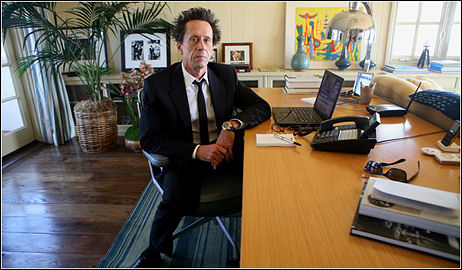
Alison Hope Weiner‘s N.Y. Times profile of producer Brian Grazer covers the bases (smart guy, dreams up ideas for films, people don’t know him as well as they do Jerry Bruckheimer). But nothing says it like Monica Almeida‘s photo of Grazer in his Malibu office. I’m not saying it shows a “producer’s heart of darkness” or anything along those cliched lines, but there’s an amazing amount of current in that expression and especially in those eyes.

Finke will run WGA spots

Those hooray-for-the-WGA spots that I described yesterday — directed by many (Paul Haggis, Rod Lurie and George Hickenlooper are three I know about), numbering 50 and with the participation of William H. Macy, Sean Penn, Ed Asner and Woody Allen — will debut on Thursday, 11.22 (Thanksgiving Day) on Nikki Finke‘s Deadline Hollywood Daily. Finke has excellent ties with the WGA (her strike coverage has been unmatched), and so attention and respect has been paid to that fact.

Kent on “No Country”

A quick little chime in from HE reader James Kent on No Country For Old Men and the whole funny ending thing: “I saw it this past weekend and it’s a great film. And you are spot on — it is one of those movies you can’t emerge from and talk about right away. You need a couple of hours to digest the thing. Did I love the ending? No. But does that diminish the love I have for the film? Absolutely not.

“Look, if the Brothers Coen had found a different way to resolve the film in some awesome, slam-bang way…who knows? Maybe it would have a more short-term, this-film-kicks-ass-but-much-else type feeling. But because it is so unsettling and unresolved it will last a lot longer in the history of film.

“And what the fuck do people want anyway? How many horror movies end with the killer still alive, primed for sequels 1 through 5? Well, by the end of this film our boy Javier Bardem is still on the loose. But isn’t that the point? Evil lives on in this world. It isn’t fair, or it is about as fair and arbitrary as a coin toss.

“This is one of those second-time-arounders. Once you know how it ends and you understand what role Tommy Lee Jones plays in the film, you go back and you listen to the script more. That’s when the end of this film will have a real punch. Gee, imagine that — a film worth seeing a second time! How many films work on that level?

“Did I want Josh Brolin to have the that like he did? No. Did I want him to engage in an awesome showdown with Javier at the end of the film? Hell yeah. In lieu of that, did I want Tommy Lee Jones to show up, Marge Gunderson-style, and pull Brolin’s wife out of the woodchipper in the nick of time? Most definitely. But that is what we get time and time again. And let’s face it, we’re never really happy with that.

“Actually, if you want the Hollywood ending — Tommy Lee Jones saves Josh’s wife, kills Bardem…or wait….we only think he’s killed him. It’s only in the last scene when the audience has received its tacked-on happy ending that Bardem shows up in some gas station or hotel and you know it isn’t over. So screw all of those who dislike the ending.”

Close Encounters Deflation

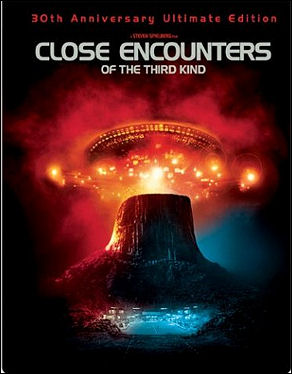
A 30th anniversary, 3-disc, triple-dip Close Encounters of the Third Kind DVD came out on 11.13. It’s a Blade Runner package in that it has the original ’77 version, that awful extra-footage, inside-the-mother-ship version that came out in ’80, and the director’s cut that came out in ’98 or thereabouts. Reading about it reminded me to never, ever see this film again.

I’ll always love the opening seconds of Steven Spielberg‘s once-legendary film, which I saw on opening day at Manhattan’s Zeigfeld theatre on 11.16.77. (I wasn’t a journalist or even a New Yorker at that stage — I took the train in from Connecticut that morning.) I still get chills thinking about that black-screen silence as the main credits fade in and out — plainly but ominously. And then John Williams‘ organish space-music sounding faintly, and then a bit more…slowly building, louder and louder. And then that huge orchestral CRASH! at the exact split second that the screen turns the color of warm desert sand, and we’re in the Sonoran desert looking for those pristine WW II planes without the pilots.

That was probably Spielberg’s finest creative wow-stroke. He never delivered a more thrilling moment after that, and sometimes I think it may have been all downhill from then on, even during the unfolding of Close Encounters itself.

I saw it three times during the initial run, but when I saw it again on laser disc in the early ’90s I began to realize how consistently irritating and assaultive it is from beginning to end. There are so many moments that are either stylistically affected or irritating or impossible to swallow, I’m starting to conclude that there isn’t a single scene in that film that doesn’t offend in some way. I could write 100 pages on all the things that irk me about Close Encounters. I can’t watch it now without gritting my teeth. Everything about that film that seemed delightful or stunning or even breathtaking in ’77 (excepting those first few seconds and the mothership arrival at the end) now makes me want to jump out the window.

That stupid mechanical monkey with the cymbals. The way those little screws on the floor heating vent unscrew themselves. The way those Indian guys all point heavenward at the the exact same moment when they’re asked where the sounds came from. “Bahahahhahhree!” That idiotic invisible poison gas scare around Devil’s Tower. That awful actor playing that senior Army officer who denies it’s a charade. The way the electricity comes back on in Muncie, Indiana, at the same moment that those three small UFOs drones disappear in the heavens. The mule-like resistance of Teri Garr‘s character to believe even a little bit in Richard Dreyfuss‘s sightings. It’s one unlikely, implausible, baldly manipulative crap move after another.

If only Spielberg had the talent to blend his fertile imaginings with a semblance of half-believable realism…but he doesn’t. Or didn’t back then.

The worst element of all is the way Spielberg has those guys who are supposed to board the mother ship wearing the same red jumpsuits and sunglasses and acting like total robots. Why? No reason. Spielberg just liked the idea of them looking and acting that way. This is a prime example of why his considerable gifts don’t overcome the fact that he’s a hack. He knows how to get you but there’s never anything under the “get.”

The ending of No Country for Old Men is obviously irritating to some, but the thematic echoes and undercurrents from the last scene stay with you like some kind of sad back-porch symphony. Spielberg’s films have almost never accomplished anything close to this. I’m not sure they have even once. Has anyone tried watching the “little girl in red” scene in Schindler’s List lately? I love most of that 1993 film, but this scene gets a little bit worse every time.

Hollywood Blvd. WGA March

Tomorrow’s “Labor Solidarity with Writers” march down Hollywood Boulevard is a must-attend. Good photos and sound ops. The westward march will start at 1 pm from the corner of Ivar and Hollywood Blvd., and end somewhere before La Brea.

Docs Short List

David Sington‘s In the Shadow of the Moon (which Ron Howard lent his name to as a “present”-ing exec producer) is one of the most stirring “heart” docs I’ve seen all year. It’s a shame it didn’t make the short list of Best Feature Docs.

Congrats, though, to the ones that did: Autism: The Musical (dir: Tricia Regan), Body of War (dirs: Phil Donahue, Ellen Spiro); For The Bible Tells Me So (dir: Daniel G. Karslake), Lake of Fire (dir: Tony Kaye), Nanking (dirs: Bill Guttentag, Dan Sturman); No End in Sight (dir: Charles Ferguson), Operation Homecoming: Writing the Wartime Experience (dir: Richard Robbins), Please Vote For Me (dir: Wejun Chen); The Price of Sugar, (dir: Bill Haney); A Promise to the Dead: The Exile Journey of Ariel Dorfman (dir: Peter Raymont); The Rape of Europa (dirs: Richard Berge, Bonni Cohen), Sicko (dir: Michael Moore); Taxi to the Dark Side (dir: Alex Gibney), War/Dance (dirs: Sean Fine, Andrea Nix Fine), White Light/Black Rain (dir: Steven Okazaki).

The final five nominees will be announced on 1.22.08.