
The Cloverfield 2 trailer (i.e., the one that preemed iin theatres last weekend in front of Beowulf) is up. Great stuff. No monster glimpses — just the old throaty Godzilla roar, lots of herky-jerky photography, lots of running around Manhattan. Helicopters, subway tunnels, walls collapsing…”what’s that?” Underneath the monster-movie trappings, producer J.J. Abrams isn’t trying to hide the fact that it’s basically a 9.11 revisiting. “Whatever it is, it’s winning.”
Month: November 2007
The “In Bruges” situation
In Bruges, the first film from British playwright Martin McDonagh (The Pillowman) with Colin Farrell, Brendan Gleeson and Ralph Fiennes, will open the ’08 Sundance Film Festival on 1.7.08 in good old overdeveloped Park City, Utah. I saw the trailer last weekend while watching a film at the new Arclight Cinemas in Sherman Oaks. You can tell it’s antsy, angular and a bit nuts — a crime story about a couple of boob-level London assassins who may be a target of a hit themselves while staying in Bruges, Belgium — with fast punchy dialogue.

The only problem, of course, is the title, which 98% of U.S. moviegoers are going to go, “Huh?” I’ve been to northern Europe eight or nine times and even I didn’t know what “Bruges ” was unti llooking it up, and I’m still not 100% clear about how to pronounce it. McDonagh is said to be a feisty and forceful talent (he’s famed for having gotten into a tussle with Sean Connery at a London event 11 years ago, when he was 26), and he wouldn’t be successful if he listened to suggestions from journalists. But this title will do nothing to enhance business among the schmoes. At best it sounds like a James Ivory film. It would suck if the title was In Boston or In Providence, but In Bruges? Forget it.
The other thing I got from the trailer is that Farrell is starting to look a little too puffy and weather-beaten up for a 31 year-old guy. All those pints and fags will get to you after a while. He was a twentysomething pretty boy only two or three years ago, but right now he could pass for being 37 or 38. I know Farrell looks a bit older that his years in Woody Allen‘s Cassandra’s Dream. I realize that British and Irish guys aren’t known for aging all that well, but if he keeps up like this he’ll be a character actor by the time he’s 40.
“Zodiac” director’s cut explanation
213.net’s Jason Coleman has provided very precise descriptions of the nine (9) additions on the 162-minute Zodiac Directors Cut DVD (due January 8th), including (a) a scene with Detectives Toschi (Mark Ruffalo), Armstrong (Anthony Edwards) and Lee (Dermot Mulroney) speaking to a superior on a voice box about the details that make Arthur Leigh Allen a prime Zodiac suspect and (b) the famous black-screen sequence in which the passage of four years — from the early to mid ’70s — is conveyed with a sequence of songs and news stories from the period. The Paramount executive(s) who forced this sequence to be removed from the theatrical version should be brought up on charges.
Baldwin on Huffington Post
Two Alec Baldwin thoughts via an 11.18 Huffington Post-ing: (1) “I saw Sean Penn‘s Into The Wild this weekend. Give Emile Hirsch the Jim Caviezel Award for the greatest suffering on film. I have not seen an actor put through this much in quite a while. Good job by Sean and Co.” and (2) “I miss my make-up artist, Stacey Panepinto. I miss my hairstylist, Richard Esposito. I miss all of the 30 Rock cast and crew, whom I don’t see anymore because of this motherfucking, motherfucking, motherfucking strike.”
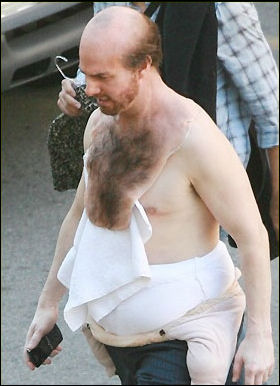
Fat suit but no mobile
No clue when this Tom Cruise shot was taken or on what film set, but it seems to call into question his 11.12 statement that he has “no iPhone, no mobile.”
Apatow spells it out
Walk Hard, Knocked Up and Superbad producer-writer Judd Apatow has told N.Y. Times media columnist David Carr that “the business model that is driving the studios’ hard line is a little backward. Digital or not, well-written content can be a lucrative business.
“One of the problems is a lack of creativity,” Apatow says. “The studios spend enormous amounts of money making these massive spectacles when they could be making much better written, lower-cost movies. A few less of those and they could fund a settlement for years. There would be no reason for this strike.”
WGA spots shot, soon to play online
Polls are saying the public is far more supportive of the striking Writers Guild members than the studios and producers they’re striking against. Sensing a headwind, numerous name-level director-writers have recently shot a series of short spots intended for viewing either just before or soon after Thanksgiving that will presumably boost the WGA’s profile even higher and…whatever, energize the membership. As many as 50 spots will push the standard but irrefutable notion that screenwriters are absolutely invaluable and certainly deserve a small piece of the internet revenues to come.

Three of the spots have been directed by Paul Haggis (In The Valley of Elah), Rod Lurie (Nothing But The Truth) and George Hickenlooper (Factory Girl). William H. Macy, Sean Penn and Ed Asner have also, I’m told, participated in some fashion.
The spots are probably going to be viewable online starting on Wednesday, 11.21, although this date isn’t totally set in stone. One or two established entertainment websites may present the spots with (perhaps) a WGA-funded site doing so also. One concept calls for five new spots to appear online each day.
Some of the spots are dialogue-free and being rendered in black and white, the theme being that movies without writers would be, in a manner of speaking, silent.
If it turns out that a significant portion of the directors of the internet spots are members of the Directors Guild as well as the WGA, the appearance of the spots will probably be interpreted as a significant show of DGA solidarity with the writers.
Lurie’s spot will feature Nothing But The Truth costars Kate Beckinsale, David Schwimmer and Angela Bassett.
Haggis has shot a collection of spots joined by one concept with “nine or ten actor friends participating,” I was told this evening.

Real-life events behind “No Country”?
Kevin Bowen, who writes well, posted a fascinating piece last night about the certain names, places and events that may have inspired Cormac McCarthy‘s No Country for Old Men. In particular one Jamiel “Jimmy” Chagra, whose last name isn’t all that different from “Chigurh.”
Comfort blanket crowd
Every year the gulf between between those who judge films for what they actually are (or seem to be) and those who like or dislike films based on what the films do for them seems to get wider and wider. Industry lowbrows tend to favor comfort-blanket movies; others get their comfort blankets at Bed, Bath and Beyond and deal with movies on a slightly more engaged or inquisitive or cultured basis.
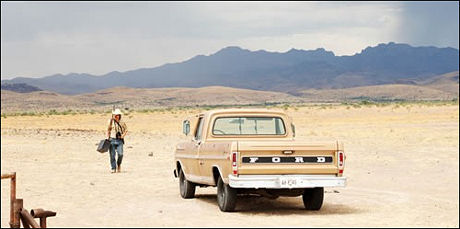
Case in point: Kris Tapley‘s item about No Country for Old Men screening at the Academy yesterday afternoon, and, according to one witness, how “‘people just got up shaking their heads’ following the film’s admittedly chilling ending.”
The guy also tells Tapley that “the screening was going well for the first hour or so, but the final act induced a certain level of shock that did not read as the positive sort. And, the attendee notes, there was very little applause over the film’s credits.”
You can’t goad people into being brighter or more educated or more respectful of the craft and intentions of the Coen brothers or original author Cormac McCarthy. You can try and shame them into responding a little less impulsively, but most of the comfort-blanketers are fairly dug into their way of seeing and processing. Some films reach right in and touch you; other times you have to probe and work your way into them. The general rule-of-thumb is that you need to at least try and meet a film halfway, but the comfort-blanket crowd…I don’t know. It’s very dispiriting. Infuriating, I really mean.
Due respect to a fellow columnist, but the ending of No County for Old Men isn’t “chilling” — it’s about sadness, lament, resignation. And no audience has ever clapped or or cheered as No Country cuts to black and final credits. It’s not that kind of film. It’s the kind of film that kicks in an hour or two later, or over dinner later on or while you’re driving or showering the next day.
Alzheimer’s Oscar Edge
Everyone’s noted the parallels between Sarah Polley‘s Away From Her, which is about an Alzheimer’s-afflicted older woman (Julie Christie) gently rebuffing her husband as she falls in love with another man (a syndrome common to sufferers of this disease), and the recently reported story about Supreme Court Justice Sandra Day O’Connor‘s Alzheimer’s- afflicted husband John falling for another woman.

Sandra Day O’Connor and her husband John March 2004
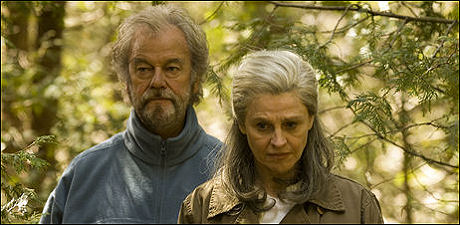
Gordon Pinsent, Julie Christie in Away From Her.
This will almost certainly push Academy members who haven’t seen Away From Her to pop the DVD in. It will also boost Christie’s chances of nabbing a Best Actress Oscar. (Not to sound insensitive or anything, but how can it not?) There was a feeling a few weeks ago that things were looking a little iffy because of Christie’s stated aversion to (cough) “campaigning.”
When will it end?
A voice is telling me that writers and producers will come to terms before Xmas, and if that doesn’t happen then by early to mid-January. I can’t see it going much further than that. Nobody wants an unscripted, sloppily improvised Oscar telecast, for one thing. And once films delayed or sidelined by the strike start to really pile up (Oliver Stone‘s Pinkville and Ron Howard‘s Angels & Demons are the first two victims), producers’ resolve will start to crack. How many deaths will it take ’til they know that too many revenue opportunities have died?