What happened to “Cloverfield”?

Features of Hasbro’s Cloverfield monster: (a) 70 points of articulation and incredible life-like detail; (B) Authentic sound; (c) 14 inches tall; (d) 10 parasites; (e) Two interchangeable heads; (f) Statue of Liberty head accessory. The Cloverfield monster is available exclusively through HasbroToyShop.com. Limited quantities are available. Includes 3 AAA batteries. Price: $99.99.

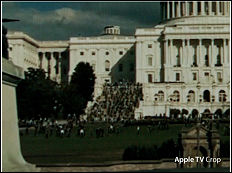
What finally happened with Cloverfield? It was at $71,915,658 domestic as of 2.3 and has sold well overseas, but why did the U.S. box-office plummet so radically after the first weekend? Was it the crazy-cam photography, which reportedly made some people sick? Or was is the nonsensical-inexplicable monster to some extent? Flesh-colored, huge ears, 20 stories tall, long spindly arms…pretty damn absurd.
In a cool way, I mean. I genuinely enjoyed the absurdist approach because it made the monster more of an emotional/psychological construct than a pseudo-literal one that might have barely passed muster by movie-logic standards (i.e., the ones that have explained all past movie monsters). But maybe people might have gotten into it a bit more if the monster had been a old-fashioned Godzilla-like super-reptile with flippers and claws and the ability to breathe fire.
Don’t even start with the spoiler whinings. I don’t want to hear even one peep. The movie was seen by millions and now the Hasbro people are marketing the image online. Just shut up. You know who you are.
Docs’ Day in the Sun

To me, the most interesting thing about Caryn James2.15 N.Y. Times article about how the Oscar nominees for Best Feature Documentary are “where the action is” — politically charged, focused on conflict, urgent messages — is the flames-of-hell photo from Charles Ferguson‘s No End in Sight.

The richest quote comes at the end when James asks Ferguson if the nomination [is] having any effect on his film. He says he has no evidence of this but adds: “If the film wins, there will be one effect. I will have about 60 seconds to say something about Iraq to 200 million people, and I will.”

Jamie Bell “Jumper” factor

Enough people are writing that Jamie Bell steals (or almost steals) Doug Liman‘s Jumper that I’m actually thinking about paying to see it this weekend from beginning to end instead of the previously mentioned catch-a-few-minutes’-worth plan. 20th Century Fox never invited me to see it at a screening. I might have gone if they had, but something more important (like taking a nap on the couch) might have come up.

The Lives of Loudmouths

Rule #5 in David Poland‘s Ten Rules of the Oscar Season (posted yesterday) states that “critics only matter when unanimous,” that they “can’t really kill or make an Oscar movie unless they are united in a clear, loud voice (even if that clear, loud voice is not a vast majority, just the right loudmouths).”
In other words, a sufficient number of loudmouths with a unified theory (this is right out of the handbook of Nikolai Lenin) can sway the industry masses? I don’t think he means that. All loudmouths can do is start a conversation, which the industry sometimes listens to and sometimes not, or picks up on or doesn’t pick up on. I recall at least two or three major-soapbox loudmouths beating the Dreamgirls drum pretty loudly in late ’06 and early ’07, but we know what happened there.
In any case, he says, “this year we saw what we haven’t seen since 2002, [which is] critics muscling a film into the Best Picture race.” Referring, of course, to There Will be Blood. Which, agreed, is an “honorable thing.”
But what other films have been strong-armed into Oscar contention circles by impassioned critical support, and which have been torpedoed and sunk by critical sneers? I could run a list but I’m wondering which films stand out in this regard in the minds of HE readers.

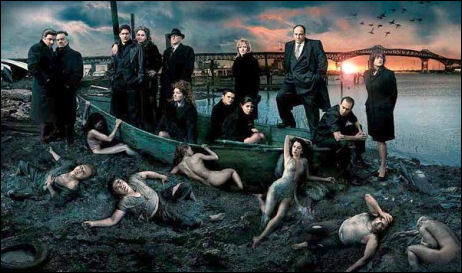
Like nothing since “The Sopranos”

Two weeks ago Boston Globe film critic Ty Burr delivered an NPR essay about how the “reality TV show with the craziest plot twists, the nuttiest characters and the biggest payoff is what he’s dubbed Primary Reality. It’s on at all hours, on almost every channel. And everyone else is watching, too. It also happens to be the race for the presidency of the United States.”

It dawned on me after listening to this yesterday that I’ve become absorbed in the presidential contest like nothing else since The Sopranos. There are no plot or character parallels (except for Hillary Clinton being a kind of Livia Soprano) but the campaign, like David Chase‘s long-running HBO series, is all about us. Recognizable values, identities, echoes, experiences. We all “know” who the political players are deep down (or think we do) and are caught up in guessing their fates and futures, and what forces are working for and against them.
All I know is that the campaign is providing major mainline highs on an almost daily basis, which makes it, in a very real sense, better than The Sopranos. The suspense is constant, there are no bad episodes, the plot turns are fast and furious. That’s why I’m writing about it a lot. It’s a first-rate drama with stirring characters. A stand-up hero, a scheming evil queen, a white-haired soldier with a take-it-or-leave-it attitude, a slick and squishy lawyer with a southern drawl, court jesters, Greek choruses, two-faced acolytes, knaves and fools, etc.

“The Substitute” Rules

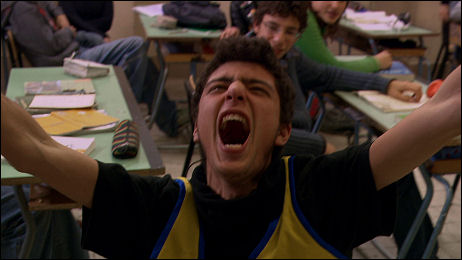
I’ve finally seen all the Oscar-nominated live shorts (which are opening, by the way, on some 70 screens nationwide starting today), and my absolute favorite, hands down, is Andrea Judlin‘s The Substitute, a 15-minute Italian high-school comedy with a slight touch of Bunuelian surrealism.

Somehow a throughly unhinged businessman just waltzes into a high school classroom and pretends to be a substitute teacher. He’s a kind of Jerry Lewis– styled madman, a taunter, a mind-fucker and, oddly, a kind of divine interventionist.
He puts the students int their place, goofing on their atttitudes, making fun of them like a circus clown on drugs. He humiliates the class apple-polisher. He steals a valuable small ball from a fat kid (i.e., one that’s been signed by a soccer star) and won’t give it back. He’s a big-eyed nutter but not what I’d call harmful. Why he’s doing this is a mystery, and it doesn’t matter.
Then he asks a bespectacled bohemian-type girl to read a piece of private poetry she’s written to the class…and she refuses. The beauty of The Substitute is that this refusal, which happens around the ten-minute mark, kicks in at the very end in an identical but different context. It doesn’t precisely make sense, but at the same time it’s perfect. I’ve said it over and over — a great ending is worth its weight in gold.
The other nominated shorts are listed on this page. My second favorite short is At Night, a Danish-produced drama about a friendship between three young women who are marking time in a cancer ward. The other three — The Mozart of Pickpockets, Tanghi Argentina and The Tonto Woman — have their charms and intrigues, but none blew me away like The Substitute.