I’ve been trying to refine my reactions to Amir Bar-Lev‘s My Kid Could Paint That, an ’07 Sony Classics release that came out on DVD earlier this month. And they won’t. It’s a documentary that nearly kills you with its refusal to say “this is this.” Life itself may have indeed refused to provide a clear answer to the film’s Big Question, which has to do with a possible art fraud, but that doesn’t make the film any less irksome.
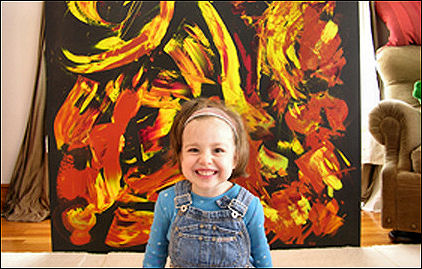
Marla Olmstead
I only know that when Bar-Lev’s film was over, I put it out of my mind. Later! All movies are show-and-tell games, but this one, however open and probing and appropriately non-judgmental, shows and blows smoke.
The B.Q. concerns Marla Olmstead, an eight year-old from Binghampton who became moderately famous in ’04 for having painted (when she was four) abstract oil paintings that were striking enough to sell modestly, and then get atttention from more and more journalists, and then sell in the big-time market for five figures.
Average Joe types have been snickering at high-priced canvases for decades, dismissing the whole modern-art culture as a kind of con game, etc. Which My Kid Could Paint That toys with throughout its running time. But the film mainly follows the lead of a big expose piece that Charlie Rose and 60 Minutes aired in February ’05 about whether Marla”s canvases were entirely self-created or whether she was helped a bit by her dad, Mark, a Frito-Lay factory manager who paints on the side.
Mark and his wife Laura, a dental technician, don’t seem like con artists, but they do seem to enjoy the attention and wealth that comes through Marla’s celebrity. And we’re all whores in the sense that we all like to glide along when things are grooving along. I don’t think Mark deliberately duped the art world by standing nearby and specifically telling his daughter what to do with the paint and brushes, but who knows? Maybe he suggested a couple of ideas here and there. Or more than a couple. Or none at all.
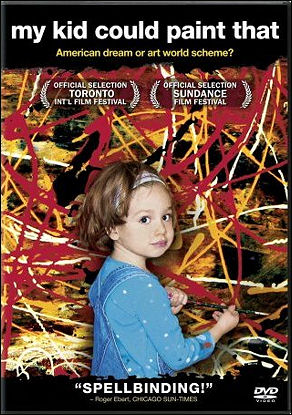
And perhaps “maybe” is all one can say about this situation. Maybe a definitive bust or exoneration is out of the question. But I don’t want fucking maybes when I go to see a movie. The only way I’ll accept them is when the filmmaker somehow conveys what he/she really thinks, and persuades me to come to the same gut conclusions. If there’s no clarity or closure or at least some kind of ending that has a discernible undercurrent, then whadaya whadaya?
I didn’t hate My Kid Could Paint That. It’s not boring, it’s intelligent and well made, it had me start to finish. But there’s a part of me that is mildly pissed at Bar-Lev for making a film good enough to get a 95% positive from the Rotten Tomatoes elite, and persuade Sony Classics’ Tom Bernard and Michael Barker, a couple of shrewd hombres, to pick it up and release it, and at the same time make me feel the way I did after it was over, which was more or less “what the fuck?”
The only clear conviction you come away with is a good feeling about Marla herself. She’s a character, mature beyond her years, robst of spirit. She may continue to paint or not. But I wonder what she’ll say about all this hoo-hah 10 or 15 years hence. Whatever and whenever she spills, it’ll probably be more intriguing than Amir Bar-Lev’s film.
If you want a satisfying dissection of the art world, something that provides a genuine sensation of curtains parting, some kind of semblance of the “aha!” phenomenon, read Tom Wolfe‘s “The Painted Word.”