Mary and Max

Adam Elliot‘s Mary and Max, which opened the Sundance Film Festival tonight with separate but simultaneous screenings for press and the public, is a very high-end claymation drama in every respect — adult yet sweet, tender but not twee, beautifully written, honest about handicaps and melancholia but full of warmth and caring and a general mood of oddball quirk. Older kids will roll with it (I hope) but it’s not aimed at the conventional family trade, which tends to prefer upbeat formula stuff with far-less-weird characters and euphoric endings.
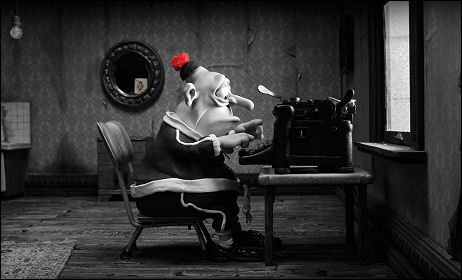
Mary and Max ends sadly but movingly in a way that animation-claymation has rarely touched. It’s a lot darker, wittier, sadder, dankier, more morose and — this is a key thing — Asperger’s Syndrome-y than I expected, and so I kind of warmed to it early on. It could have been shorter — 70 minutes, say, instead of 92 — but that aside, it’s not at all bad and is actually something I can fully recommend.

Cheers to Elliott (who, I’m told, has a mild Asperger’s affliction himself, which explains some of the authority the film has) and his voice cast — Phillip Seymour Hoffman, Toni Collette, Barry Humphries and Eric Bana.

I realize I was full of resistance about seeing this film in previous posts. That’s actually a good way to come at a new film — i.e., expecting very little.
Watchmen Fight Over

Variety‘s Michael Fleming and Dave McNary are reporting that Warner Bros. and 20th Century Fox “have settled their battle over Watchmen with WB getting some face-saving points, but Fox getting the equivalent of a movie star’s gross participation.

“Warner Bros. gets the right to open its superhero pic on March 6th as planned, and the WB logo will be the only one on the film, sources said.

“Fox, on the other hand, will emerge with an upfront cash payment that sources pegged between $5 million and $10 million, covering reimbursement of $1.4 million the studio invested in development fees, and also millions of dollars in legal fees incurred during the case.”

NFI Rebuts Piven

The National Fisheries Institute has issued a video challenge to Jeremy Piven over statements he made this morning to Diane Sawyer on Good Morning America.

Makes You Stranger

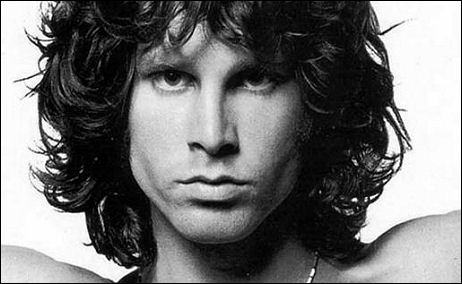
I caught Tom DiCillo‘s When You’re Strange, a 90-minute doc about Jim Morrison and The Doors, inside a viewing booth at the Park City Marriott early this afternoon. I also saw Ondi Timoner‘s We Live in Public, a doc about ’90s internet pioneer Josh Harris. A study and a history of internet obsession, Timoner’s film is easily the more thoughtful and provocative of the two. But DeCillo’s is more engaging because Morrison is still a fascinating wild man, and at the same time a little more average-human than he seemed in the Stone pic.

The short reaction to When You’re Strange is (a) it’s a much more perceptive dive into the legend of the Doors than Oliver Stone‘s film was, (b) it’s in love with Doors music (which I feel is a very good thing); (c) it has a good amount of heretofore unseen footage of Morrison and the band; but (d) it’s stymied time and again by DeCillo’s trite narration. And I mean “give me a fucking break” trite.

There has to be some way to recount the turnovers and disturbances of the hallucinatory ’60s without sounding like Tom Brokaw. You have to write and talk about those times with a sense of psychedelic impressionism. Or you have to talk about them like Peter Fonda did in The Limey — i.e., with subdued feeling and authority. I can only report that I began to go crazy listening to DeCillo’s litany of pat cliches. It’s not that the narration gets it “wrong” per se, but it makes one of the most electric and tumultuous times in American history sound so damn tidy and sorted out…almost vanilla.

And I didn’t like the voice of the narrator either. (I don’t know who it is, but he sounds like an ad agency guy who hasn’t done enough and hasn’t read enough.) It should have been narrated by someone with a hung-over voice, like Martin Sheen in Apocalypse Now. Speaking like Michael Herr in Dispatches, maybe, because the ’60s were nothing if not a war. A voice that sounds like it knows from strangeness and pot and other-ness, a little shade of the weird and the fanciful.

Doors keyboardist Ray Manzarek has said he’s had no input into the film, but that he’s seen it and likes it, calling it “a tale of American shamanism” with a touch of the “supernatural”. He says there’s also some rare footage in there that even stumped the Doors archivist. That’s all true as far as it goes. I don’t want to sound dismissive of this film, but it occasionally irritated the fuck out of me.

Manzarek told Billboard earlier this year that When You’re Strange is “the anti-Oliver Stone… the true story of the Doors.” Fine. Close enough.

Blurs


Yarrow Hotel lobby — 1.15.09, 4:20 pm. Sitting here filing, waiting for the 6:30 pm press screening of Mary and Max, which I’ve been calling Mikey and Nickey and Moxie Heller and Cottontail.

I Feel Free

To be in an airborne jet, hit a flock of geese, crash land in the Hudson River, not sink, climb out on the wing, get your pants and feet wet, get picked up by a boat, get dropped off somewhere in Manhattan’s West 40s, visit an emergency room for a check-up and then be driven downtown to the Tribeca Bar & Grill for a plate of seared salmon and a couple glasses of perfect Pinot Grigio. Talk about feeling tremendously alive!

As Winston Churchill once said, “There is nothing so exhilarating as to be shot at without result.”

Can’t Stop

Jeremy Piven spoke to Good Morning America‘s Diane Sawyer this morning to try to put the mercury-poisoning/Speed-The-Plow thing to bed once and for all. Never!

Jabs and Pokes

Variety‘s Robert Koehler has called Jonathan Parker ‘s (Untitled) “one of the rare American indie films to land a world premiere at a fest prior to Sundance [that nonetheless] bears all the hallmarks of a prestige Sundance movie, from a hip cast including Adam Goldberg, Marley Shelton and Eion Bailey to a brilliant score by leading new music composer and Pulitzer winner David Lang.

“Parker jabs and pokes at the New York contemporary art world with some satirical success. Teasing today’s new realms in painting, conceptual art and music is almost too easy, and the impressive aspect of Parker’s latest is an evident grasp and respect for what’s worthy and worthless in the fecund present-day scene. The smart-ass comedy isn’t sustained throughout, but there’s more than enough here for a bright fest roadshow and theatrical gallery space.”

Here’s my review again.

Three Types

“I have to believe that if Slumdog Millionaire wins Best Picture, it will further cement the awards as an elitist back-patting ceremony which is rapidly distancing itself from the general moviegoing public as it is, ” writes HE reader Evan Boucher.

“There are three different types of people seeing movies these days. The A students of cinema like yourself — journalists, buffs and your grad students living in the village who see mainstream, indie, shorts, foreign,cult…everything. On the other end are the F students, the ones lining up for things like Saw V and Wanted, thinking the latter is the best thing they’ve ever seen because someone made a bullet curve. And in the middle you have people with the intelligence to realize when a movie sucks and to appreciate something when it’s really really good.

“Which brings me to Slumdog., which is a very good film but a tough watch. Personally I felt like I had to pay unbelievably strict attention to understand what people were saying, and even then I feel like I missed half of it. But I can spot when a director or actor as at the top of their game, even if I can’t always understand it, and you can tell that this is a special film, if you have the capacity to understand it.

“This is a perfect year for the academy to step out of its elitist, country-club mode. Because there are two films out there that were widely regarded by critics and people who actually pay to see movies — WALL*E and The Dark Knight. More people paid to see these two movies and came away satisfied than every other Oscar contender combined. They’re powerful in their own ways and entertaining and universal, which a lot of the films on your Oscar Balloon list are not.

“We live in a cinematic environment where there are movies for people, and then there are movies for critics. The critics used to be a barometer for what people would like, but the disconnect is huge right now and the gap is widening. Ten years from now, people will look back and say that 2008 was the year The Dark Knight came out, not Revolutionary Road or The Reader.”

Nip This

Following her double-win at the Golden Globes last Sunday (Best Actress for Rev Road plus Best Supporting Actress for The Reader), Kate Winslet being double-nominated by BAFTA yesterday has me worried. We wouldn’t want to see this happen with the Oscar nominations or in the final voting. It’s too much. It feels hoggish.

I understand Kate’s people pushing her in both categories in order to build a storm of acclamation and critical mass, but I really think it’s time to nip this one in the bud. She’ll probably win the Best Actress trophy for Rev Road — highly deserved — but that’s enough. It wouldn’t be cool for her to manage a double win. Most of us, I think, want to see either Doubt‘s Viola Davis or Vicky Cristina Barcelona‘s Penelope Cruz win the Best Supporting Actress Oscar.

Man in the White Suit

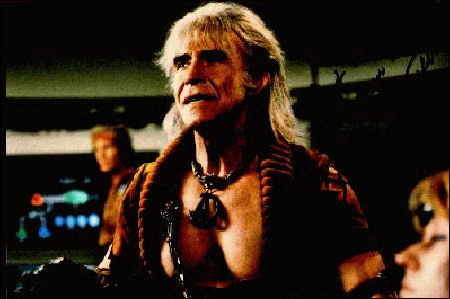
Ricardo Montalban passed yesterday at age 88 — sorry. Then again, having lived a exciting high-style life for 88 years is hardly a tragedy. When you hear his name you think (a) Fantasy Island, (b) his muscular pecs in Star Trek: The Wrath of Khan (very impressive for a guy who was 61 years old) and (c) Esther Wiliams costar. But my strongest memory is the way he said the words “rich Corinthian leather” in those Chrysler Cordoba commercials. (His Wikipedia bio says that the adjective was “soft,” not “rich.”)

I loved Montalban’s Ahab-ish dying words in The Wrath of Khan — “for hate’s sake, I spit my last breath,” etc. And he was half-decent, I thought, as a Kabuki player in Joshua Logan‘s Sayonara (’57), although it was pretty silly to hire a Mexico City Latino to play a Japanese guy.