
Work Cut Out

The 2.5 print edition of the N.Y. Times includes a story by Brooks Barnes about how Oprah Winfrey and Tyler Perry‘s enthusiastic support led to Lionsgate shelling out $5.5 million for Lee DanielsPush — a reportedly strong but depressing drama that may play well among black audiences but probably hasn’t a prayer elsewhere.
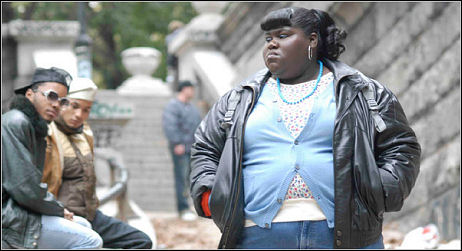
“One veteran studio marketer, who would speak only anonymously because he has ties to Lionsgate, said he saw almost no hope in selling it to a broad audience,” Barnes writes.

I could say something but I should see the film first. I didn’t want to see it at Sundance because (a) I don’t trust Lee Daniels and (b) I didn’t feel particularly enthused about immersing myself in the sadness of a morbidly obese African-American girl who’s carrying her father’s child for the second time and has self-esteem issues that would bring down an African bull elephant.

What’s wrong with me? Why didn’t I take the plunge? Apart from the fact that I’m not as deep and open to new realms as critics like John Anderson and Scott Foundas? I don’t know but I feel vaguely guilty about this. Emphasis on vaguely.
Bale Is For Real

The night before last Rescue Dawn producer Harry Knapp posted a somewhat raggedly composed but convincing defense of Christian Bale — a once-famous and respected actor, now an internet legend for his screaming madman volcano rant on the set of McG’s Terminator film last summer.

Key passage: “Think about it…why don’t you see photos of Christian at the clubs or TMZ video of him dining at Nobu or walking the red carpet pimping himself? I’ll tell you why — he’s about the work, period. He’s a family man living a modest life knowing it could all end tomorrow, and one gets the feeling he would be okay with that.”

If it’s mainly about the work, then why is Bale starring in a friggin’ Terminator film under McG, one of the genuine demonic forces working today? That isn’t about the work — it’s about the paycheck.

Good Info

To hear it from Salon‘s Andrew O’Hehir, the two most likely winners of the Best Live Short Film Oscar are Jochen Alexander Freydank’s Toyland (i.e., this year’s Holocaust contender) and Elizabeth Marre and Olivier Pont‘s Manon on the Asphalt.

A 13-minute long World War II-era drama, Toyland is about a German mom having a panic about whether her missing son might have unintentionally left with the Silversteins, her neighbors, on a train trip to “Toyland.” O’Hehir calls it “the obvious choice to take home the award,” especially given that there’s a “twist at the end…that will break your heart.

Manon on the Asphalt, he says, is “arguably the most risky and adventurous film on the list…a miniature, more Parisian and even cuter version of Crash” that is either “heartfelt and affecting or trivial and prepackaged.” Nonetheless, “a strong contender to take the prize.”

These and other nominated shorts will be playing in various high-culture burghs starting this Friday, 2.6. Magnolia Pictures and Shorts International are the responsible booking parties.

New Boy

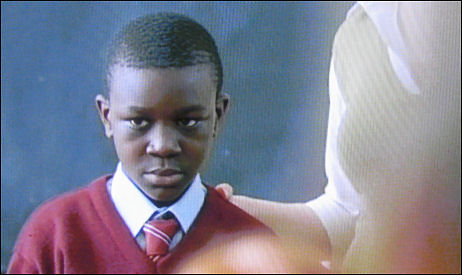
For what it’s worth, I’ve seen Steph Green‘s New Boy, one of the Oscar-nominated Best Live Action Shorts, and understand why it’s won awards in some 20 film festivals worldwide. (Uh-oh…resentment!) Except it is a fine film. It’s about a nine year-old African boy (Olutunji Ebun-Cole) experiencing the usual rough and tumble in getting to know some new classmates at a school in Ireland.

We learn in flashbacks that the boy has come from a turbulent, strife-torn African nation, and that his father was killed by militants of one persuasion or another. More turbulence greets the boy in class, particularly in the form of taunts and challenges from two other laddies who don’t like his looks. They all become friends at the end, of course, bonded in their derisive mockery of the teacher and a young female classmate.

The short is based on a short story by Roddy Doyle. (Resentment again!)

The racial-outsider element didn’t move me all that strongly. I just found it a plain and truthful portrait of what it’s like to define and stand up for yourself in a tough milieu. It reminded me of the hard times I went through during my first few days of fourth grade. (Don’t ask.)

Magnolia Pictures and Shorts International are once again showing the 10 nominated animated and live action shorts. They’ll be viewable this Friday (2.6) in New York, Los Angeles and…I don’t know, a few other cities. They’re also downloadable on iTunes.

Deal

Hard times call for harsh measures and a constant eye for bargains. I’m offering one to anyone planning to attend the Cannes Film Festival three months from now, but who lacks an expense account. A well-situated, high-ceilinged studio in Old Town that allegedly sleeps four for 1200 euros — 600 each for two persons, which is how I’d prefer it. Get in touch.

Safe Bet vs. Who Knows?

With this blow-dryer joke, it’s safe to say that Penelope Cruz has the Best Supporting Actress Oscar in the bag. Maybe she already had it and this is icing on the cake. Whatever. I do know that 65-and-over male Academy members (i.e., the Lorenzo Semple, Jr. crowd) have a rep for responding to alluring female contenders. From this point those who haven’t yet voted will be thinking the following about Cruz: (a) great firecracker performance in the Woody Allen film, (b) beautiful, (c) superb in Volver and (b) blowjob joke on Leno. That cinches it.

The question I haven’t settled is whether Kate Winslet will take the Best Actress Oscar for The Reader or if — this is a tangle — uncertainty about what category her Reader performance really and truly belongs in plus Meryl Streep‘s popularity with the acting branch (i.e., that SAG Best Actress award) will upset the apple cart.

Bashaway

WGA Noms

For me, the biggest omission among the WGA nominees for Best Original Screenplay was Martin McDonagh‘s In Bruges — a deliciously offbeat screenplay that wasn’t too dark or comedic, and was genuinely warm and romantic besides.

Due respect to the reservations expressed today by Defamer‘s Kyle Buchanan, but there are simple reasons why Charlie Kaufman‘s Synecdoche and Jenny Lumet‘s Rachel Getting Married were passed over for Best Original Screenplay. One, Synecdoche was overly permeated with Kaufman’s trademark deathhouse gloom and two, Lumet’s screenplay didn’t render enough bombast and sword thrusts in the big-money confrontation scene between Anne Hathaway and Debra Winger. They start to get into the “why did you leave me with him?” issue, Winger freaks and slaps and then Hathaway runs out — not satisfying!

The Best Original Screenplay noms were for Burn After Reading (Joel & Ethan Coen), Milk (Dustin Lance Black), Vicky Cristina Barcelona (Woody Allen), The Visitor (Tom McCarthy) and The Wrestler (Robert Siegel).

Given the general understanding at this stage that The Curious Case of Benjamin Button is basically Forrest Gump with cosmetic/atmospheric changes, I’m a little surprised that screenplay author Eric Roth (and I don’t mean to slight the guy given his bad luck at the hands of Bernard Madoff) was nominated for Best Adapted Screenplay. Adapted from Gump, do they mean?

The other Best Adapted Screenplay nominees are The Dark Knight (Jonathan and Christopher Nolan; story by Christopher Nolan & David S. Goyer), Doubt (John Patrick Shanley), Frost/Nixon (Peter Morgan) and Slumdog Millionaire (Simon Beaufoy).

Repulsion

“How can I explain the feeling of rage that had me white-knuckling my armrest by the end of He’s Just Not That Into You?,” asks N.Y. Observer‘s Sara Vilkomerson. “Unlike the best of romantic comedies — the ones that send you swooning home with thoughts of first kisses and your own private montage of slo-mo paint fights in your first shared apartment, chasing lobsters or dragging a Christmas tree down a West Village cobblestoned street — this movie honestly made me never want to date again. It kind of made me not want to be a woman! Actually, it made me not want to be a member of the human race.”

Worries About The Box

Back in the ’50s or early ’60s a modest-sounding movie like Richard Kelly‘s The Box would have been shot, cut and released within nine to twelve months. Even by today’s dragged-out standards The Box, which shot in the Boston area in December 2007, would have been playing by late October 2008 (i.e., Halloween) or certainly sometime between the spring and summer of ’09. If it’s any kind of commercial draw, I mean.

I say “modest sounding” because The Box is based on a little old Twilight Zone episode called “Button, Button,” which itself was based on a Richard Matheson short story that was written in 1970. It’s not Close Encounters of the Third Kind. It’s just a suburban moral fable that says “don’t be a greedy yuppie.”

Last June, however, Warner Bros. reportedly decided on a release date of 9.11.09. Then on 9.22.08 RichardKelly.net announced that WB “has pushed the release date of The Box back up to 3.20.09.” More recently the studio changed the release date to 11.6.09, which will be nearly two years after the start of principal photography.

Obviously concerns and hesitations are afoot here. Release dates getting shuffled around like this always means something’s amiss. Kelly needed to do something straight and modest after the disaster of Southland Tales, and The Box certainly looked like that — no big deal, open-and-shut thrills, no muss or fuss. I really hope he hasn’t blown it again by getting too ambitious and over-thinking things. Sometimes a thriller needs to just be a thriller the way a cigar needs to just be a cigar.

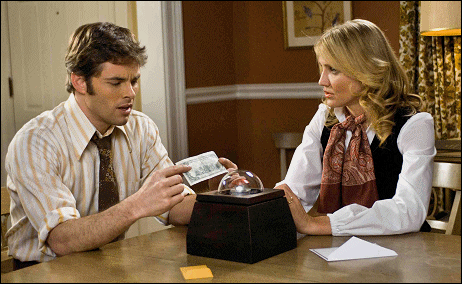
The movie plot involves a suburban white-bread couple (James Marsden, Cameron Diaz) receiving a strange wooden box from a very creepy older guy (Frank Langella). Press the button on the box, he says, and the owner will receive $1 million, although this act will simultaneously cause the death of another human being somewhere in the world — someone they don’t know.