Fox-Friedman Smoke

Reportedly whacked Fox News entertainment columnist Roger Friedman has been quoted by the Hollywood Reporter‘s Gregg Kilday as saying that “reports of my death have been greatly exaggerated“?

I took this to mean that (a) Friedman sees himself as a cat who always lands on his feet, and (b) that he plans to keep rolling with another job or a new self-launched website. It certainly doesn’t seem to contradict a statement put out late Saturday by News. Corp., wo wit: “We, along with 20th Century Fox Film Corp., have been a consistent leader in the fight against piracy and have zero tolerance for any action that encourages and promotes piracy. When we advised Fox News of the facts they took immediate action, removed the post, and promptly terminated Mr. Friedman.”

How can the owner of 20th Century Fox and Fox News put out a statement like that and then backpedal? That’s not an option. (Here’s the HE rundown on what happened last weekend. And another story that appeared on Saturday.)

So why isn’t Friedman saying something more particular? He’s handling this thing like Soviet apparatchiks dealing with reports of food shortages in the 1950s. If he hasn’t formulated his next move, so what? No doubt he’s huddling with this and that party, but where’s the upside in freezing out people who’ve reported what’s happened fairly and evenly?

Chairs and Nameplates

In reporting about Tim Gray‘s de facto replacing of Peter Bart as Variety editor, Anne Thompson alluded to the Who’s “Won’t Get Fooled Again” line — “Meet the new boss, same as the old boss.” Except she re-phrased it as “Good-bye to the old boss — hello to the new boss.” I think she had the Who’s meaning in mind anyway. There’s a difference between Gray and Bart — the former seen as being less prickly and more in tune with 21st Century currents — but not a huge one.


Tim Gray, Peter Bart

To tens of thousands in the entertainment industry, Variety is a comfort blanket. It’s a community gathering place, a church, an old friend, a reassurance of normality and stability. Not just an entertainment-industry Bible and paper-of-record but a kind of guidance counselor, preacher, accountant, community agent and next-door neighbor saying “hi” over the fence.

Reliability, constancy and general alertness aside, what I love about Variety is the secular mentality of it. A kind of members-and-followers-only attitude that the schmoes in Cape May, Bangor and Fayetteville aren’t supposed to understand. There’s a kind of beauty in that.

It’s going to have to maintain that 45,000 copies-per-day print presence that the older GenX and Boomer crowd value so highly. But of course the necessity of this will fade down the road.

David Poland wrote last night that Gray “will keep the machine running and running with less personality issues than Bart, but he will surely be managing someone else’s idea of the future. Gray is a good man and a very good company man…but I don’t see him as the visionary of the paper’s future either.” Probably not, but “the future” has never been all it’s been cracked up to be. It’s never been that hard to figure what’s coming ’round the bend and to make your move before it gets here. And even for the slowpokes life has a way of making everyone fall into line sooner or later. So strategy matters, obviously, but a paper don’t have nothin’ if it ain’t got that old soul. That’s all I’m saying.

So Gray’s the top dog but Bart isn’t out the door. He’ll continue to blog and knock out his weekly column as Variety‘s vp and editorial director.

State of Anxiety

“It’s amicable. I have no bad feelings towards him except that it was at the very last minute and that was tough on me and the studio. Actually, it was a fiasco. A week before shooting, I was left with this $2 million set of a newspaper room, dressed and ready to go. I was thinking it was all going to be knocked down unless I could find another actor.” — State of Play director Kevin McDonald talking with the Guardian‘s Amy Raphael about his relations with Brad Pitt, who bailed over script issues, as well as the intense script compression that involved translating a six-part British miniseries into a two-hour feature. .

Homecoming

I drove down to Long Beach Island early yesterday evening with my brother Tony. The plan is to do a Big Lebowski later this morning with my sister Laura’s ashes, which Tony has been holding since her death last March. Tony has persuaded me that Laura would have preferred to be scattered under the shadow of the Barnegat Lighthouse (which she came to love as a result of our family’s frequent summer vacations in Beach Haven and Shipbottom) than in my parents’ cemetery plot in Wilton, Connecticut.

A problem happened on the way down with the Dollar rental car I’m driving. Within minutes of leaving the car lot I could feel something wrong with the left-front tire — a misaligned or unbalanced vibration of some kind. It got really bad (and particularly noisy) on the Garden State Parkway. We pulled over in Asbury Park with the idea of taking the tire off and then putting it back on with re-tightened lug bolts, but there was no lug wrench in the trunk. So we limped down to L.B.I. and called AAA for roadside assistance this morning.

The guy said there’s definitely something wrong with the wheel bearing or the motor mount, but that the wheel won’t fall off if we drive back to Manhattan.

Tonight Again

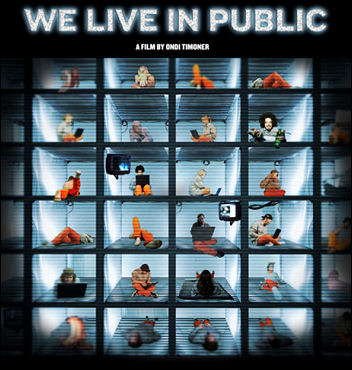
Ondi Timoner‘s We Live in Public will be closing the “New Directors, New Films” series early this evening at the Museum of Modern Art. I met with her a little more than a week ago. I decided to wait for tonight’s screening (rather than request a screener) to see it again. I saw it in a Sundance screening booth the first time. Now I want to feel how it plays with a crowd.

We Live in Public, which is easily one of the most thought-provoking docs I’ve seen (as well as the most disturbing), is about ’90s internet pioneer and onetime dto.com milionaire Josh Harris. Timoner documented Harris’s life for more than a decade “to create a riveting, cautionary tale of what to expect as the virtual world inevitably takes control of our lives,” as one synopsis reads.

My attraction/fascination with We Live in Public is based on the fact that my life as an 24/7 internet columnist is necessarily obsessive and all-consuming, and that Harris’s experience is somehow reflective of my own. I’m an extreme case, but I suspect that everyone with a computer and/or a smart phone is succumbing to the virtual world as well — and at the same time losing touch with the semi-natural/organic life that we all knew before digital seeped in.

They Whacked Him

For the sin of shutting down around 8 pm last night and ignoring all online happenings, I missed the news — broken by Nikki Finke — about Fox 411’s Roger Friedman getting fired for posting that review of the pirated Wolverine work print. I can’t say I was surprised, given Friedman’s provocation and the stakes involved.


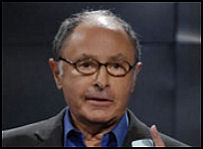
(l. to r.) former Fox News columnist Roger Friedman, Wolverine star Hugh Jackman, Fox Filmed Entertainment chairman Tom Rothman, Fox News chief Roger Ailes.

“I hear the move was done with the full support of News Corp,” Finke posted at 5:57 pm Pacific last night. A Fox News source told Finke that “[Friedman] promoted piracy…he basically suggested that viewing a stolen film is okay, which is absolutely intolerable…so we fired him. Fox News acted promptly on all fronts.”

Actually they took a couple of days. Friedman downloaded and viewed the film on Wednesday evening. His review (which has now entirely disappeared) was posted on Thursday morning. Fox issued its condemning press release on Friday. The axe, I gather, fell more or less at the same time. And Finke was apparently told about the dismissal sometime on Saturday afternoon.

I wrote Friedman on Friday morning, asking him what’s what, looking for any kind of update or elaboration — nothing.

Although I suspect he thought he was doing 20th Century Fox a roundabout solid by posting a thumbs-up response to Wolverine (which, let’s face facts, has not been the recipient of ecstatic buzz so far), Friedman’s Thursday column did appear to blithely approve of an illegal downloading of the 20th Century Fox release, which will open on 5.1.09. Friedman especially conveyed this in the cavalier tone of his prose.

Certain columnists (Hitfix’s Drew McWeeny, MCN’s David Poland) called for Friedman’s dismissal. It goes without saying that Poland — a longtime Friedman hater — is delighted.

Friedman put his neck on the block in doing what he did. He blundered. Piracy is too threatening an issue for 20th Century Fox and Hollywood in general for Newscorp. not to react as it did.

I for one feel badly for Friedman. He screwed up in this instance, but he’s a ballsy, sharp-eyed reporter-columnist who knows what he’s doing, and who’s delivered some very solid and tough reporting.

In his now-disappeared Thursday column, Friedman wrote that he decided to review the downloaded print because “the cat is out of the bag and the genie is out of the bottle” and “there’s no turning back.”

A guy identified as “Kenny” in Finke’s talkback section wrote that “Friedman wasn’t advocating a crime — he was just telling it like it is. But rather than find a way to monetize reality, Fox pretends most people aren’t already aware movies are easy to find on-line. As long as Fox would rather grandstand then try to monetize what’s already happening, they’ll lose money to people stealing their movies.”

When you go to the URL where Friedman’s Thursday column appeared, you see a message that says “this is Google’s cache of http://www.foxnews.com/story/0,2933,512139,00.html. It is a snapshot of the page as it appeared on Apr 4, 2009 13:20:23 GMT. The current page could have changed in the meantime. These search terms are highlighted: roger friedman. These terms only appear in links pointing to this page: wolverine.”

Last Light


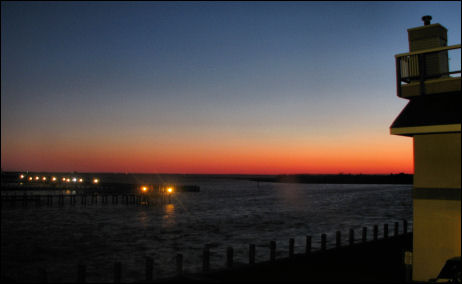
Looking west across Barnegat Bay, taken from balcony of Buccaneer Motel, Spray Beach, N.J. on Long Beach Island — 4.4.09.

Frank-Out

“The March employment numbers, out this morning, are bleak: 8.5 percent of Americans officially unemployed, 663,000 more jobs lost. But if you include people who are out of work and have given up trying to find a job, the real unemployment rate is 9 percent. And if you include people working part time who’d rather be working full time, it’s now up to 15.6 percent. One in every six workers in America is now either unemployed or underemployed.” — from a 4.3.09 Truthout piece by former Labor secretary Robert Reich, called “It’s A Depression.”

Bad Timing?

“I’d also argue that Duplicity hit the zeitgeist slightly wrong,” Variety‘s Anne Thompson wrote on 4.2. “Greenlit before the recession, the movie painted a portrait of rapacious uncaring corporations and workaholic ambitious untrusting spies that may have cut just a little too close to the bone at a time when anxious Americans are seeking escape, fun and comfort.

“[Director-writer Tony] Gilroy is a smart cookie whose next film I look forward to seeing. While he has every right to chase Hollywood budgets and status, I’d prefer to see him go back to the Michael Clayton model: lower budget, stars at a cut-rate price, and the freedom to throw off the shackles of trying to please the suits.”

Sure Thing

It’s understood that Quentin Tarantino is incapable of writing or shooting anything unironically — everything he does has to have quote marks. He’s never tried to ape Bressonian simplicity (which is pretty much the opposite of ’70s exploitation shlock, which is where he lives), and he could never replicate it if he tried so why bring it up? I’m just saying I’d be delighted if Tarantino had shot Inglourious Basterds in black and white. God, think of the lusciousness.


From the just-published Vanity Fair gallery of Inglourious Basterds stills.

Escapist Tunnel Job

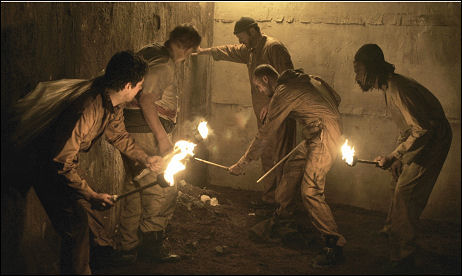
Vague spoiler in third paragraph on this article…beware!: For the last several days I’ve been grappling with one of the roughest cases of movie-contemplation blockage I’ve ever dealt with, and over a film I mostly liked and admired when I first saw it at Sundance ’08. The film is Rupert Wyatt‘s The Escapist, which opened yesterday at Manhattan’s Village East and will open next Friday (4.10) at Laemmle’s Sunset 5. And I’ve only just figured out why I haven’t been able to write anything about it despite five or six tries.


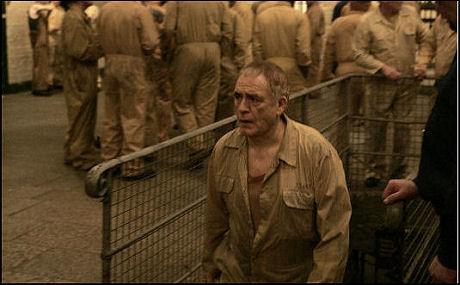
Brian Cox in The Escapist.

There’s no denying that The Escapist is a prison-break film cut from fresh cloth. On top of being dramatically pungent and atmospherically ripe, the story it tells is nothing if not original (or at least atypical). It uses a flashback/flash-forward editing scheme that I felt was diverting enough. And despite adhering to a conventional tale of a small group of convicts planning and executing a complex escape from a tough jail, it all boils down in the end to being a father-daughter love story — the father played by the great Brian Cox and the daughter…leave it alone.

The bottom line is that The Escapist bears a slight similarity to Occurence at Owl Creek Bridge , and after catching it a second time last week at home — seeing it cold as it were, as opposed to seeing it under enthusiastic communal conditions at Park City’s Eccles theatre some 14 months ago, with everyone in that huge theatre spellbound and into each and every twist and turn — I began to feel a bit differently about the finale.

I still valued the refined moves and unusual calibration and certainly the tough, lived-in performances — Cox’s first and foremost but also those from Joseph Fiennes, Dominic Cooper, Liam Cunningham, Seu Jorge, Damian Lewis and Steven Mackintosh . But I found myself longing for the elation of a purely successful escape even more this time around, and I had a slightly more difficult reaction to where the film left me.

Prison-break movies (or plots about same) are metaphors, of course, for an escape that we all desire and dream about, which is release from the prison of our bodies, our pasts, our genes, our debts, our mistakes, our long-buried fears. I take this idea-fantasy very seriously. I’ve watched Escape From Alcatraz ten times if I’ve watched it once, and I don’t care if Clint and the gang were never found after they paddled away — the point is that they made it out, and that you could feel the euphoric release after the last barrier had been scaled or tunnelled through.

I’m just saying that if you’re going to invite the audience to become an accomplice on a very complex escape attempt, you’d do well to respect what most people want and need out of this.

I spoke to Escapist director Rupert Wyatt on the phone last week after notifying everyone I was unable to meet him at a restaurant as planned. But he was on a cell phone (somewhere in the Chelsea distrcit) and the reception was in and out so I decided not to use it.

Please don’t let my personal feelings about one aspect of The Escapist cast a shadow upon Wyatt’s directing chops. He’s audacious-minded and yet he knows his way around traditional moods and genres and shooting styles. I’m looking forward to his next film (according to Coming Soon’s Ed Douglas) — an adaptation of Sebastian Faulks‘ “Birdsong” which will costar Hunger‘s Michael Fassbender and Paddy Considine. There may also be a heist movie about stealing the Mona Lisa, to be made with his Escapist partner-producer Alan Maloney.