Brutal Class System

It took me years of begging the Cannes Film Festival team before they finally gave me a pink-with-yellow-pastille credential, which is golden because it allows you to run into a screening at the last minute without waiting in line. The highest-level pass is white, then my kind of pass followed by pink sans pastille, blue and then yellow.

The queer thing is that high journalistic cred in the States doesn’t necessarily mean the Cannes people will acknowledge. Karina Longworth of Spoutblog couldn’t get a pass at all — she’s wearing a market badge that she had to buy. Variety‘s Michael Fleming was given a blue pass; ditto Vanity Fair‘s Julian Sancton. Wrap honcho Sharon Waxman has a yellow — bizarre.

Finally Saw Precious

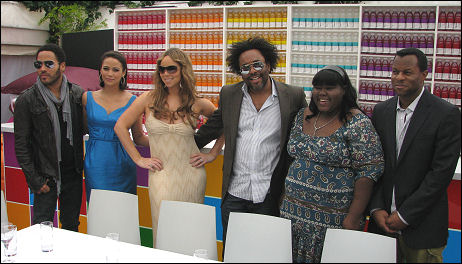
I’m too whipped to review Lee DanielsPrecious (the Taking Woodstock piece did me in) but it’s an immensely sad, fully felt and deeply compassionate film with solid performances up and down, especially from Mariah Carey (much better than I expected, her best performance ever) as a welfare worker and Mo’Nique as the all-time champion mom-from-hell. I attended a Precious luncheon today from 12:40 to 1:50 pm; took this right before the press conference part began.


(l. to r.) Precious costars Lenny Kravitz, Paula Patton, Mariah Carey, director Lee Daniels, star Gabourey ‘Gabby’ Sidibe, screenwriter Damien Paul.

Taking Woodstock

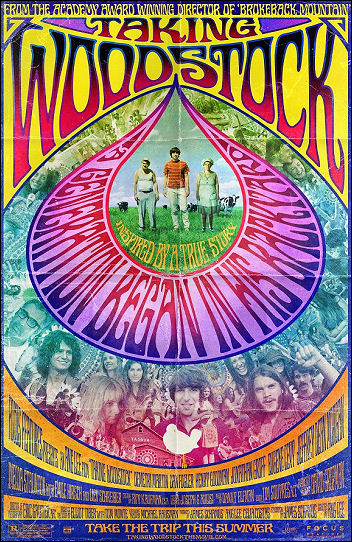
I don’t know what I was expecting exactly from Ang Lee‘s Taking Woodstock (Focus Features, 8.14.09), which had its first big press screening this afternoon at the Cannes Film Festival, but what I saw didn’t deliver. This backstory saga about the legendary Woodstock Music Festival of ’69 works in spots and spurts, but it too often feels ragged and unsure of itself, and doesn’t coalesce in a way that feels truly solid or self-knowing.

At best it’s a decent try, an in-and-outer. Spit it out — it’s a letdown. I’ve talked to a few critic friends since the 4:30 screening got out and all but one are feeling and saying the same.

I wish it were otherwise. I’d like to be more obliging because I love many of Lee’s films and fully respect his talent. I remember and cherish the spirit and the legend of the 1969 Woodstock Music Festival. I’m looking forward to watching the forthcoming Warner Home Video Bluray of Michael Wadleigh‘s 1970 documentary (out June 9th). And I appreciate what a massive undertaking it must have been to try and recreate it all within a dramatic prism.

James Schamus‘s script is based on the story of Eliot Tiber, the artist who stepped in and pretty much saved the disenfranchised festival by finagling a land permit in Bethel, New York. (The source is a same-titled book by Tiber and Tom Monte.) The story is basically about how a closeted gay Jewish guy got over feeling obliged to help his parents survive by helping them run their rundown El Monaco motel in White Lake, N.Y., and freed himself to live his own life.

This story comes through but it feels analagous to a story of the D-Day Invasion that focuses on Francois, a closeted young man in his 30s who doesn’t want to work at his parents’ Normandy bakery any more. (“Merci, General Eisenhower, for allowing me to move to Nice and be openly gay!”) And the Eliot story is weakened, in my book, by Imelda Staunton‘s strident and braying portrayal of Tiber’s mother-from-hell. I’ve known my share of Jewish moms and I didn’t believe her. Nobody is that humorless or stupid (in terms of recognizing economic opportunity) or dark-hearted.
And as noted, the big sprawling back-saga of how the festival came together — the element that audiences will be coming to see when it opens — too often feels catch-as-catch-can. It doesn’t seem to develop or intensify, and there’s no clean sense of chronology. (And there’s at least one glaring inaccuracy when a random festivalgoer declares a day or two before the event begins that “it’s a free concert, man…haven’t you heard?” My recollection is that it wasn’t declared free until the concert had begun and the fences had come down and the organizers realized they’d lost control.)

Taking Woodstock should have been dated here and there like The Longest Day. That way, at least, we’d have an idea of how many days are left before the festival begins, a sense of “okay, getting closer, things are heating up.”

Lee references Wadleigh’s 1970 doc by using the same split-screen editing style and by shooting it with a semblance of ’70s grainy color. But no Woodstock concert footage is mixed into Lee’s movie, and this just seems unfulfilling somehow. It’s a shame that Lee and Schamus (who also produced) and Focus Features couldn’t have worked out a cross-promotional deal with Warner Bros. that would have allowed for this. I kept telling myself that it’s Eliot’s story, not Woodstock II, but I wanted glimpses of the real thing, dammit.

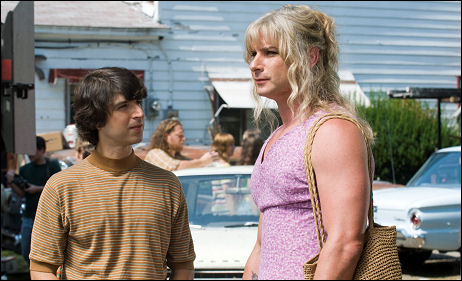
Comedian Demetri Martin is steady and likable as Tiber, although too much of the time he’s been directed to look overwhelmed or mildly freaked. (This was a man of 34 who’d been around a bit — Martin plays him like Dustin Hoffman‘s Benjamin Braddock.) Eugene Levy is quite good as Max Yagur, the kindly but shrewd dairy farmer who leased the land to Woodstock Ventures. Liev Schreiber delivers a mildly amusing turn as Vilma, a blond-haired cross-dresser whom Eliot hires to provide security for the El Monaco, but his character has no real function or arc — he’s just providing Greek-chorus commentary. Jonathan Groff does a decent job as Michael Lang, the most well-known of the concert promoters, playing him as a serenely confident Zen type. (I loved the way he gets around on horseback in the second half of the film, whether or not that’s accurate — it’s a good bit.)


Emile Hirsch, Ang Lee during shooting.

It may be impossible to have characters speak in ’60s cliches without the effort feeling tiresome, but that’s what happens here. I realize that people actually used the terms “groovy” and “far out, man” back then, but every time you hear them in the film…God!

Taking Woodstock was just too big an undertaking, I suppose. In the same way that Lang and his partners instigated but couldn’t control the enormity and chaos of the ’69 festival, Lee was also overwhelmed. Tough fame, tough call, I’m sorry. Better luck next time.

Bop Around


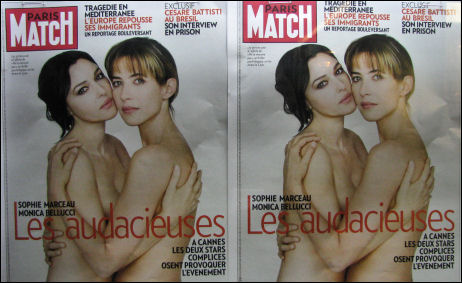
Marina De Van’s Ne Te Retourne Pas, a Cannes midnight selection that looks/seems roughly similar to David Lynch’s Lost Highway, stars Monica Bellucci and Sophie Marceau as (it would appear) the same character. The Paris Match cover caught my attention as I was walking around last night.

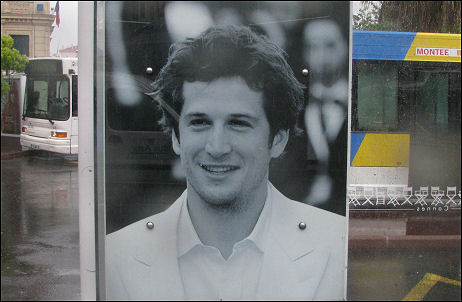
It took me a few seconds to realize who this is. Taken in Cannes either 28 or 30 years ago, I’m guessing. If I say for which films I’ll be giving it away.

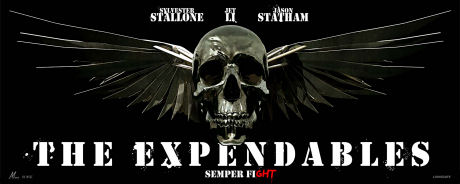
Poster art for Sylvester Stallone’s The Expendables. Brute commandos vs. Hugo Chavez, or something like that. Stallone, Jason Statham, Jet Li, Mickey Rourke, Arnold Schwarzenegger, Brittany Murphy, Dolph Lundgren .

If The Shoe Fits

To go by the trailer, Richard Halpern‘s W.M.D. is a inflammatory political fantasy along the lines of Robert Aldrich’s Twilight’s Last Gleaming (’77). A dud when released and pretty much forgotten, it was about a renegade USAF general (Burt Lancaster) who takes over an ICBM silo and threatens to start World War III unless the President (Charles Durning) reveals the real reason why America waged the Vietnam War. W.M.D. looks iffy and lurid and on-the-nose, but I want to see it.

WMD FINAL TEASER from Richard Halpern on Vimeo.

Bright Star

Jane Campion‘s Bright Star, which screened this morning, is about the subdued and conflicted passions that defined the brief love affair between poet John Keats (Ben Whishaw) and seamstress Fanny Brawne (Abbie Cornish) from 1818 until Keats’ death, at age 25 from tuberculosis, in 1821.

It’s been done quite perfectly — I was especially taken with Greig Fraser‘s Vermeer-lit photography — with immaculate fealty for the textures and tones of early 19th Century London, and a devotion to capturing the kind of love that is achingly conveyed in hand-written notes that are hand delivered by caring young fellows in waistcoats. You know what I mean.

But it struck me nonetheless as too slow and restricted and…well, just too damnably refined. I looked at my watch three times and decided around the two-thirds mark that it should have run 100 rather than 120 minutes. I know — a typical guy reaction, right? The pacing is just right for the time period — it would have felt appalling on some level if it had been shot and cut with haste for haste’s sake — but there’s no getting around the feeling that it’s a too-long sit. It’s basically a Masterpiece Theatre thing that my mother will love. I’m not putting it down on its own terms. I felt nothing but admiration for the various elements.

A journalist friend told me an hour ago that Bright Star will be Oscar nominated in seven or eight categories because it delivers that particular brand of period romance fulfillment that people of a certain persuasion line up for when movies of this sort play the Royal in West Los Angeles and the Lincoln Plaza in Manhattan.

Go In Peace

“I have not read Dan Brown‘s ‘Angels & Demons,'” N.Y. Times critic A.O. Scott confesses in his review of the film version. “I have come to believe that to do so would be a sin against my faith, not in the Church of Rome but in the English language, a noble and beleaguered institution against which Mr. Brown practices vile and unspeakable blasphemy.

“The movie, without being particularly good, is nonetheless far less hysterical than The Da Vinci Code. Its preposterous narrative, efficiently rendered by the blue-chip screenwriting team of Akiva Goldsman and David Koepp, unfolds with the locomotive elegance of a Tintin comic or an episode of Murder, She Wrote.” [Director Ron] Howard‘s direction combines the visual charm of mass-produced postcards with the mental stimulation of an easy Monday crossword puzzle. It could be worse.

“The utter silliness of Angels & Demons is either its fatal flaw or its saving grace, and in the spirit of compassion I suppose I’d be inclined to go with the second option. The movie all but begs for such treatment.”

No Hurry

A friend who passed along A.O. Scott‘s Angels & Demons review asked when I’d be posting my own. “I forgot to post one,” I confessed. “I guess I’ll write something tomorrow morning. It’s a hugely unimportant film.”

Nine

The Nine trailer is up. I want to like this and am looking forward despite Rob Marshall directing and Kate Hudson costarring. “A vibrant and provocative musical,” the copy says, “that follows the life of film director Guido Contini (Daniel Day-Lewis) as he reaches a creative and personal crisis of epic proportion, while balancing the numerous women in his life including his wife (Marion Cotillard), his mistress (Penelope Cruz), his film star muse (Nicole Kidman), his confidant and costume designer (Judi Dench), an American fashion journalist (Kate Hudson), the whore from his youth (Fergie) and his mother (Sophia Loren),” etc.

Scorsese Sinatra

If Martin Scorsese plans to do a warts-and-all, Raging Bull-styled biopic of Frank Sinatra, bring it on. The mafia ties, the downswirl period from ’48 to From Here To Eternity, the temper, snubbed by JFK in ’62, etc. The Sinatra cult is so dug in and devotional that anything the least bit fawning would be seen as a capitulation. Phil Alden Robinson is reportedly doing the screenplay.

Tatiana Siegel‘s Variety story says with absolute seriousness that Leonardo DiCaprio is an “obvious candidate” to play Sinatra. Who else to play a skinny, narrow-faced Italian who was 5’7″ in heels than a 73 inch tall, no-longer-thin, wide-faced guy who looks mostly German?