On The Other Hand…

Awards Daily‘s Sasha Stone has suggested five rules to follow if you’re trying to launch a grassroots/word-of-mouth Oscar nomination talking campaign. So I’ve come up with a few arguments, counter-suggestions and “oh, yeah?”s.

Stone Rule #1: “Never strong-arm people into voting for someone or something. People hate to be told what to do in general. No one wants to be thought of as stupid or out of touch.”

Wells response: Yeah, except the majority of people out there are out of touch (or at least not as in touch as they should be). It’s also a pretty safe bet that the main reason they’re out of touch is that they live with certain levels of timidity and hesitancy. They tend to like the same things over and over in films and they don’t particularly like to be challenged or provoked. It’s also a fairly safe bet that deep down they know this about themselves. In short, most film industry people are walking around with the mentality of sophisticated, self-aware sheep. There’s only way to respond to this, which is to treat them the way a shepherd treats his flock. Use your shepherd’s staff and goad them along. Do it politely or sternly, but tell them what to do. Because deep down they want to be led. It’s easier to follow a strong leader than make semi-nervy, semi-bold decisions on your lonesome.

Stone Rule #2: “Make them think it’s their idea. Present all of the reasons a film or person is worthy without ever falling into the trap of saying ‘nominate them now because they deserve it!'”

Wells response: I agree with this, but how provincial and donkey-stupid do you have to be to dig in your heels and decide to not see or admire a film or not vote for one of the people who helped make it, because you resent the manner of a person (or persons) telling you how great or at least worthwhile it is? When someone urgently tells me I need to put a film or filmmaker into the Oscar Balloon I never reject them out of hand. I always reconsider my thinking and/or my original reactions to the film in question.

Stone Rule #3: “Reverse psychology – it works quite well. The old ‘this is the best film of the year but no way will the Academy nominate it…it’s the best film to come along in ten years but it’s too small, too dark, the genre isn’t right…no way will the Academy go for it.’ That works ten times better than ‘of course they’ll nominate it…there is no way they can’t nominate it.'”

Wells response: Of course — very wise thinking. But if the Academy doesn’t nominate The Hurt Locker for Best Picture there’ll be blood on the floor. Sometimes reverse psychology isn’t all it’s cracked up to be. Because sometimes the wrong film or filmmaker wins no matter what psychological strategy is in play. People like what they like while realizing deep down that they’re a little bit lazy and Zelig-ish in their thinking. They secretly want to be led, driven, pushed, admonished, browbeaten. (See Stone Rule #1.)

Stone Rules #4 and #5 are okay with me.

“Flopping About”?

I read that 10.20 Playlist review of Anthony Peckham‘s Invictus script, sure. Key quote: “We get into a rhythm with Morgan Freeman‘s Mandela, but as the story expands to encompass the rugby storyline, Matt Damon‘s Francois Pienaar character and the country at large, we lose rhythm and end up flopping about in the middle of the familiar sea of cinderella-sports-story cliches.” It mainly inspired me to read the damn thing myself. In fact, no…I only have an ’08 draft. If anyone has a more recent version, please send along and I’ll have at it.

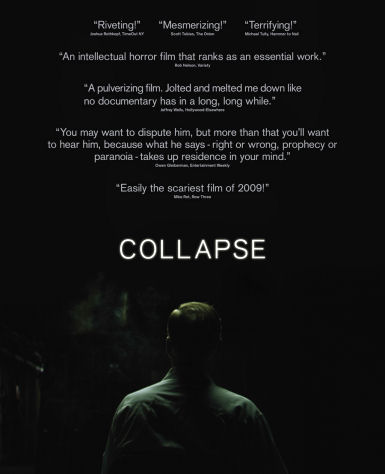
Coming Collapse

I wrote the following on 9.19.09: “Shot over a two-day period last March, Collapse is basically a Spalding Gray-like soliloquy piece in which Michael Ruppert, a former LA police officer turned independent reporter, author and truth teller, explains in a blunt spoken, highly detailed and extremely persuasive way that our economic and energy-using infrastructure is on the verge of worldwide collapse.

“There’s too much debt, too much greed, not enough oil and it’s all going to start falling apart — in fits and starts, bit by bit and then more and more, and then eventually…well, look out. A vast and terrible turnover that will devastate and destruct is just around the corner. Ten years, twenty years…forget it. I listened and listened to what Ruppert said, and “a hard rain’s gonna fall” ain’t the half of it. A survivable scenario, but a very different and much tougher world awaits.

“Before I saw Collapse I would have readily agreed with the view that things are very, very bad in terms of the world’s economic and energy scenarios. After seeing Collapse I’m 95% convinced that we’re on the brink of Armageddon — that we’re truly and royally fucked. Get hold of as many organic vegetable seeds as you can and start growing your own food. Hey, Viggo…nice shopping cart!

“The 5% of me that isn’t fully convinced has concerns about Ruppert’s personality and temperament, which seem a little bit wiggy at times. He’s been called a 9/11 Truther and, according to a CBC News summary, ‘claims to have met one of JFK’s shooters.’ He seems stable and knowledgable enough and is obviously quite bright, but he chain smokes, is having trouble paying his rent, and is clearly emotionally distraught over the data he’s gathered and the information he’s sharing. Collapse gets into his head and soul the way Erroll Morris‘s The Fog of War burrowed into Robert McNamara.

“Isn’t it in the nature of most whole-equation alarmists to be alone and uninvested in establishment currencies and memberships with a tendency to shout from streetcorners, publish nickel-and-dime newsletters or expound in low-budget documentaries such as Collapse?

“There were three basic kinds of group mentalities aboard the Titanic, Ruppert remarks, once the crew understood the extent of the iceberg damage. The first was the reaction of sheep — ‘We don’t know what to do, we’re scared, we’re cold, and all we want to do is huddle together.’ The second was ‘yes, this is serious, we get it — and what can we do to build lifeboats?’ And the third was ‘you’re crazy, this ship can’t sink, the people who are saying this are pathetic alarmists, and we’re just going to sit at the bar and enjoy the pleasures of decades-old bourbon.'”

Collapse will simultaneously debut on video and theatrical debut November 6th. Vitagraph will handle the film’s theatrical release, while FilmBuff will launch the film simultaneously on video-on-demand. The 11.6 Manhattan debut will be at the Angelika Theater;Collapse will premiere that day on FilmBuff. It will open at Landmark theaters in San Francisco, Berkeley and San Diego on 12.4.

Valance Again

In tribute to tonight’s BAM screening of John Ford‘s The Man Who Shot Liberty Valance (as part of the New York Film Critics Circle 1962 series), the New Yorker‘s Richard Brody has assembled a video piece and written a few words, among them a declaration that it’s “both the most romantic of Westerns and the greatest American political movie.

“The Western is intrinsically the most political movie genre, because, like Plato’s ‘Republic,; it is concerned with the founding of cities, and because it depicts the various abstract functions of government as direct, physical actions. It’s also an inherently romantic genre, because of its connection with the nation’s founding mythology. (One of the strengths of Ford’s movie is its depiction of the actual grassroots practical politicking in the Western territories.)

“The movie’s most famous line, of course, is that of a newspaperman: ‘This is the West, sir. When the legend becomes fact, print the legend.’ Ford prints it — and prints the facts behind it — and makes a movie about the moral burden of a life lived in the name of a myth and the ethical implications of direct action. Implicitly, the subject of the film is also that of a nation founded in this way. In his next Western, Cheyenne Autumn, from 1964, Ford takes on another overlooked Western reality: that of the Native Americans and their relations with the United States government.

“But the movie is also romantic in another, intimate way — it’s a great love story and a painful triangle, involving the tenderfoot lawyer (James Stewart), his gunslinger friend (John Wayne), and the woman they both love (Vera Miles). The tale’s epic span — it’s framed as a flashback to distant youth — stretches that love story over a vast arc of experience and renders it immeasurably poignant.

“As it draws to a close, there’s hardly a dry eye in the house — at least, in our house.”

I wrote about 15 months ago that I didn’t like The Man Who Shot Liberty Valance “as much as I should because of the TV sound stage vibe, the hamminess of the acting, the fact that John Wayne and Jimmy Stewart are at least 15 years too old for their parts, etc.”


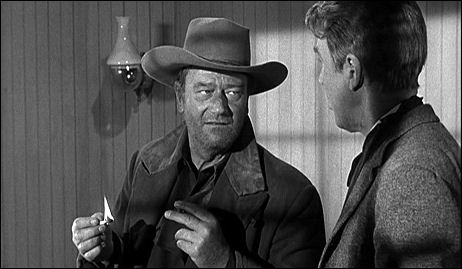
John Wayne, James Stewart

I also wrote the following in July 2007: “You can talk about this film for hours and never run out of new things to discover or re-review. I’ve seen Liberty Valance many, many times on the tube, and I absolutely love the transfer on the most recent DVD. It’s basically an old man’s movie — an elegy for bygone times and regrettably false legends. There’s also no denying it’s one of Ford’s very best — his saddest and most personal film ever, and worthy of the highest respect.

“But the older I’ve gotten (and I’ve said this before), the more trouble I’ve had with Ford’s sentimental cornball streak. His affection for actorly colorfulness among his supporting players seems to get worse every time I re-watch one of his films. Andy Devine‘s performance in Liberty Valance as a cowardly, squealy-voiced sheriff is, for me, 90% torture . (His one good scene is in the very beginning when he takes Vera Miles out to visit Wayne’s burned-down ranch.) Edmond O’Brien‘s alcoholic newspaper editor is a problem performance also. The movie is littered with them.

“As Newsweek critic Malcom Jones observed in March 2006, Ford’s movies “are a little antique, a little prim.”

“The irony, of course, is that despite the irritating aspects, The Man Who Shot LIberty Valance becomes a greater and greater film with each re-viewing. Some- thing majestic and touching and compassionate seems to come out in greater and greater relief. Genius-level films always gain over the years, but to my surprise I was almost moved to tears last night — and this stagey monochrome oater has never quite melted me before. Go figure.”

Abbie Hottie

I sat down late yesterday with Bright Star‘s Abbie Cornish, whom I found quite personable, steady, friendly and straight-shooting. And a serious knockout, of course. She’ll most likely land a Best Actress nomination for her performance as Fanny Brawne. I mean, does anyone see this not happening? There’s never a second in which she isn’t fully submerged in that character and Bright Star‘s milieu (i.e., early 1800s London) and the intense romantic stakes. By any standard it’s a fairly serious sink-in.

I forgot Cornish was playing this somewhat limited and yet finally impassioned woman. She just “was” and I went with that. I didn’t experience the usual hesitation during the first few minutes of her performance. It was a fast sell and a deep dive.

Cornish has a kind of a chubby-cheeks going on in Bright Star (which seems a bit accentuated by her dark hair being constantly worn in a bun), which is why I noted that she seemed as if she could take her lover, John Keats (Ben Whishaw), in a wrestling match but that’s neither here nor there. She’s now her naturally blonde self and seemingly in prime athletic shape for her role as “Sweetpea” in the currently filming Sucker Punch, now being directed by Zack Snyder in Vancouver. Warner Bros. will release it in 2011.

My interview is in two parts — part 1 above, part 2 below.

Liquidity

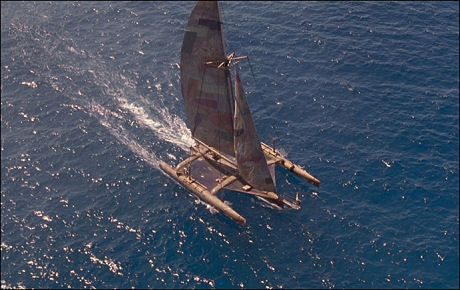
A Blu-ray of Kevin ReynoldsWaterworld came out last Tuesday. It’s been 14 years since it opened and I’ve never seen it twice. I honestly don’t know if I’d even watch a free screener, much less rent or buy it. The more I think back on it the more nothing it seems — an over-produced high-concept thing that nobody really wanted to see to begin with.


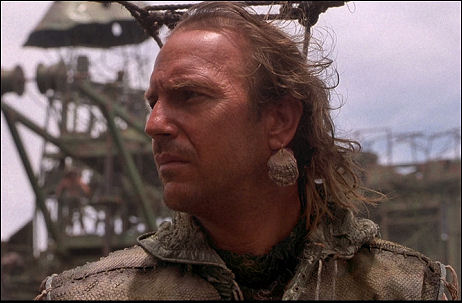
Kevin Costner in Waterworld.

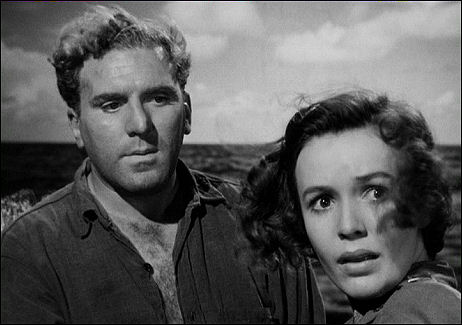
Lifeboat.

The story is hugely disappointing, particularly the windup over last 20 or so minutes. The only things that have lingered from my first-and-only viewing are (a) that device that converted urine to fresh drinking water, (b) Dennis Hopper‘s ridiculous one-eyed bad guy, and (c) Jeanne Tripplehorn‘s performance, which had gravity and sincerity.

I remember being shocked when I realized that the first of the two dps (I forget if it was Scott Fuller followed by Dean Semler or vice versa) had decided to shoot it in 1.85 rather than 2.39 Scope. The dominant idea had to be about visually conveying how overwhelming and absolute the sight of a world cover by water would be, and yet they decided not to use a Scope image? I read somewhere that the producers were afraid that widescreen footage of a constantly bobbing-around milieu would make audiences sick, but that strikes me as ridiculous.

I’ve written this before, but I’ve always felt a much stronger sense of the raging energy and fearsomeness of the ocean from Alfred Hitchcock‘s Lifeboat (1943), which was shot in an indoor studio tank with wind and rain machines and whatnot.


Kevin Costner, Jeanne Tripplehorn in Waterworld.

Blue Crash

Almost every time I drive back to Los Angeles from Santa Barbara, I stop at this location and just stare for five minutes or so. Everyone needs an atmospheric submission moment from time to time. Coastlines are like non-denominational churches, providing comfort to all seekers, even the lowest of the low. Even the Hispanic Party Elephant from North Bergen could savor this.

Kooza

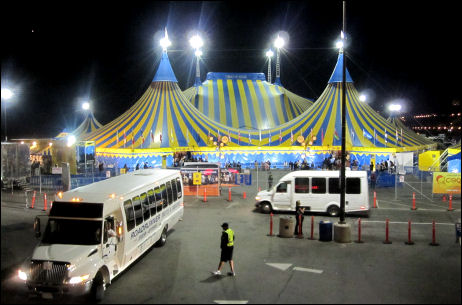
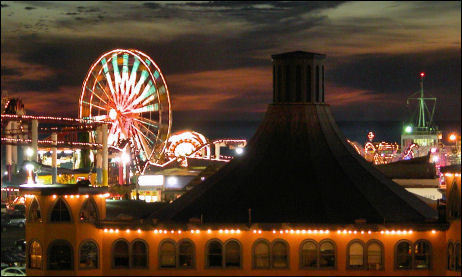
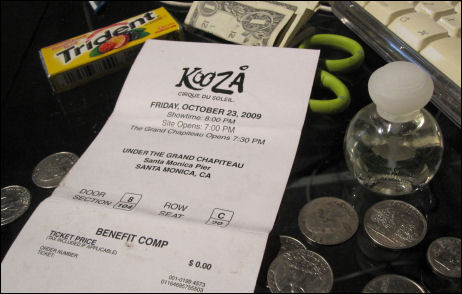
I was graciously guested last night into Kooza, the latest Cirque de Soleil spectacular that is nothing short of brilliant. It’s ballet, slapstick, harmony, transcendence, gymnastics, derring-do, poetry, wonder and thrills. The show runs just short of three hours with a 30-minute intermission. I spilled half of an 18 oz. can of Beck’s on my right pant leg and it didn’t faze me a bit. The Santa Monica engagement began on 10.17. Upcoming engagements are scheduled for Irvine, San Diego, Portland, Seattle and Vancouver.


Cirque de Soleil tent adjacent to Santa Monica pier — Friday, 10.23.09, 7:25 pm

Friday, 10.23, 11:05 pm