Stormy Island

In the view of Variety‘s Todd McCarthy, Martin Scorsese‘s Shutter Island is “expert, screw-turning narrative filmmaking put at the service of old-dark-madhouse claptrap.”

I’ve seen Shutter Island myself and wholeheartedly agree about the last four words.

The film “arguably occupies a similar place in Scorsese’s filmography as The Shining does in Stanley Kubrick‘s,” McCarthy goes on. “Protean skill and unsurpassed knowledge of Hollywood genres [are used to] create a dark, intense thriller involving insanity, ghastly memories, mind-alteration and violence, all wrapped in a story about the search for a missing patient at an island asylum.”

That’s all well and good, but without story tension — which Shutter Island utterly lacks — the viewer is stuck in a theatrical asylum watching masterful Marty technique, masterful Marty technique and more masterful Marty technique.

A Little Knowledge

You may think you’ve absorbed all you can of the appalling Sarah Palin, but John Heilemann and Mark Halperin‘s Game Change manages to up the ante. Their account of her behavior during the ’08 campaign is — no exaggeration whatsoever — mind-blowing. Particularly their reporting in the chapter called “Seconds in Command,” which starts on page 395. Palin is portrayed — quite convincingly — as an astonishingly arrogant cretin.

Realizing she urgently needed to prepare big-time for upcoming press interviews, McCain campaign staffers Randy Scheuneman and Steve Biegun “sat Palin down, spread out a map of the world, and proceeded to give her a potted history of foreign policy,” it says on page 360. “They started with the Spanish Civil War, then moved on to World War I, World War II, the cold war and what Scheuneman liked to call ‘the three wars’ of today — Iraq, Afghanistan and the global war on terror.

“The tutorial took up most of Monday, starting early and going late. When the teachers suggested breaking for lunch or dinner, the student resisted. ‘No, no, no, no…let’s keep going,’ Palin said. ‘This is awesome.'”

Stagecoach Sheen

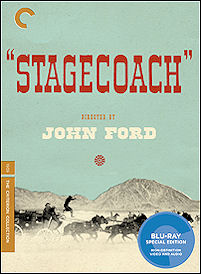
On May 25th Criterion is bringing out a remastered DVD and a Bluray of John Ford‘s legendary Stagecoach (1939). I’ve never thought of Bert Glennon‘s black-and-white capturing of this classic western as exceptional or stunning or anything in that realm, but maybe I’ve never really “seen” Stagecoach.


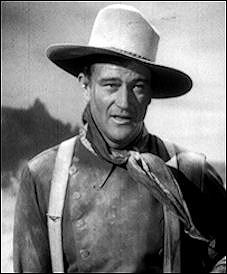
Cover of Criterion’s Stagecoach Blu-ray, due May 3rd; John Wayne as the Ringo Kid.

I know it’s an iconic film and all, but somehow it’s never quite rung my cowbell. I love that famous rapid dolly-forward shot of John Wayne as much as the next guy, but I’ve never really fallen for the thing as a whole. Among Ford’s 1930s films I’ve always ranked it below The Informer and Drums Along the Mohawk, and it’s way below The Grapes of Wrath, Young Mr. Lincoln and How Green Was My Valley.

Stagecoach‘s biggest accomplishment is that it made Wayne a star. It also won Ford a Best Director award from the New York Film Critics, and an Academy Award for Best Supporting Actor for costar Thomas Mitchell.

I can’t for the life of me understand what Orson Welles was referring to when he called it “a perfect textbook of film making” and “claimed to have watched it more than 40 times during the making of Citizen Kane.” C’mon…

Can’t Go Home Again

Why do I feel slightly conflicted about this musical Haiti heart video? It’s well shot, well cut, well performed, etc. And everyone is coming from the right place. Except a voice is telling me it’s an advertisement for the performers first and a plea for donations second. (Or third.) I guess it’s also the sight of Jackostein at the original 1985 “We Are The World” recording. I was sorta with it until he showed. A bad taste.

The Group

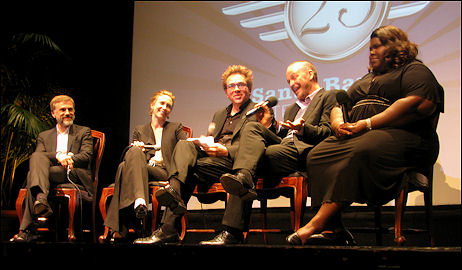
Last night’s Santa Barbara Film Festival tribute was a presentation of Cinema Vanguard awards to Up In The Air‘s Vera Farmiga, An Education‘s Peter Sarsgaard, Inglourious Basterds costar Christoph Waltz and Precious star Gabby Sidibe. (Lovely Bones costar Stanley Tucci was also honored but in absentia — he’s directing a play in New York.)


At Santa Barbara’s Lobero theatre during last night’s Cinema Vanguard tribute: (l. to r.) Christoph Waltz, Vera Farmiga, Roger Durling, Peter Sarsgaard, Gabby Sidibe.

Festival chief Roger Durling handled the introductions, patter and chit-chat with smoothitude and high intelligence. It was all to the good.

Sarsgaard was the wittiest, I thought — he always is. Razor sharp, fast on his feet, straight-shooting, resistant to gushy platitudes, etc. I admired Waltz for his no b.s. answers and his general reluctance to grin too broadly. Farmiga’s plain-spokenness was equally appealing. And Sidibe was cool — she’s very bright, confident, likable.

Durling declined to ask Sarsgaard why he had a Bruce Willis shaved-head cut. That would have been the first question out of my mouth. He’s playing Hector Hammond in The Green Lantern — maybe he had to go tennis-ball because he’s wearing a wig or something.

It would have been cruel to ask Sidibe — by all indications an emotionally vibrant woman with a healthy outlook on everything — why she’s so excessively obese, but that, honestly, was all I could think of as I sat there (second row, right in front of Sharon Waxman ) last night.

Two-Hour Drive

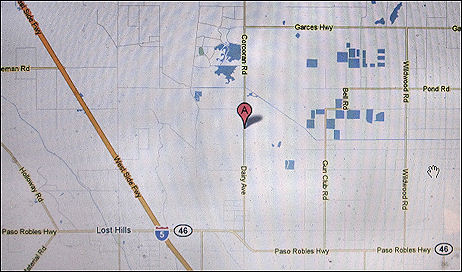
My movie-monk life won’t be fulfilled, I’ve just decided, until I visit the site where Alfred Hitchcock and Cary Grant shot the crop-dusting scene from North by Northwest. For whatever reason I’ve never learned before today where the location actually was. It’s just east of the intersection of Corcoran Road and Garces Highway (155) outside the towns of Wasco and Delano, near Highway 46 off interstate 5.

By His Right Name

In a 2.12 Huffington Post-ing, Center for Transatlantic Relations senior fellow Michael Brenner explains how President Barack Obama has gradually revealed his true nature as that of a “moderate Republican before the species became extinct.”

The Obama enigma “grows day by day,” he writes. “Contradiction after contradiction, abrupt gear shifts, perpetual motion that never reaches a destination. ‘Obscene’ Wall Street bonuses suddenly transmute into well-earned rewards for a good-guy golfing buddy; the imperative to act boldly on the jobs crisis means placing it the callous hands of Max Baucus and Chuck Grassley of health care fame; the plotting of exit strategies from Afghanistan by 2011 becomes a ‘long as we have to’ occupation. All these contrapuntal reversals against a sound track of non-stop exhortation and a restless shuttling from one photo-op to another. Who is this guy, anyway?

“A few elements of Obama’s personality are now evident: a strong narcissistic streak, an ingrained sense of superiority, a nimbleness — intellectual and political — enabled by the incredible lightness of his conviction about anything, an audacious ambition yet no gumption for a fight. Behind these traits, there is something even more basic discernible. Obama is two people, one superimposed on the other.

“The visible surface man is the epitome of an enlightened, Ivy League, socially responsible liberal. This is Obama the community organizer (albeit an exceptionally non-confrontational one), Obama the African-American political activist who attends Jeremiah Wright‘s cosmopolitan church, Obama the orator who routinely hits the high ‘Cs’ of the call to conscience, Obama the optimist who appeals to, and for the better angels of our idealistic American selves. This is Obama the African-American who moved enough voters to be elected President of the United States.

“To this portrait, we must juxtapose the other Barack Obama who has surfaced as he quickly shed his ‘liberal’ skin amidst the trappings of the White House. This other personality, I contend, is the underlying one — truer to the man’s core nature.

“This is the Obama who twice in his young career sought out positions in big corporate law firms; this is the Obama who was raised by three Kansans who instilled in him conservative heartland values; this is the Obama who relishes wealth and what it can buy; this is the Obama who feels more at ease with his Wall Street buddies (Jaime Dimon, et al) playing golf than with anyone of the Move On American crowd; this is the Obama who chose as his trusted confidant that unscrupulous, liberals-be-damned fixer Rahm Emanuel; this is the Obama who absorbed the spirit of Ronald Reagan‘s America he himself has said stands as the model of inspirational leadership.”

Elley Pushback

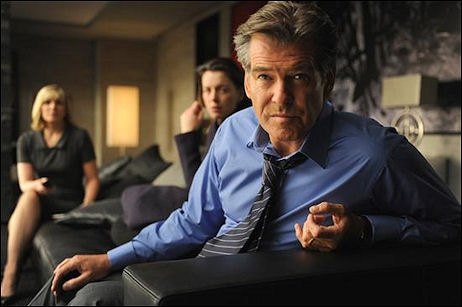
Derek Elley‘s Variety review of The Ghost Writer “is nonsense…it’s Roman Polanski‘s best in years,” says an HE reader who’s also seen it. I’m also struck by an observation from Screen Daily‘s Fionnuala Halligan that the film “bears all the hallmarks of Polanski’s distinctive style” while Elley said that Polanski “brings not a jot of his own directorial personality or quirks” to the film. Disparate much?


(l. to r.) Kim Cattrall, Olivia Williams, Pierce Brosnan in Roman Polanski’s The Ghost Writer.

Here’s a rave by the Guardian‘s Peter Bradshaw. He calls it “a gripping conspiracy thriller and scabrous political satire, a Manchurian Candidate for the 2010s, as addictive and outrageous as the Robert Harris bestseller on which it’s based…Polanski keeps the narrative engine ticking over with a downbeat but compelling throb…this is his most purely enjoyable picture for years, a Hitchcockian nightmare with a persistent, stomach-turning sense of disquiet, brought off with confidence and dash.”

There also seems to be an undercurrent of approval in this analysis of the paranoid current in Polanski’s films by N.Y. Times contributor Dennis Lim.

At the very least I’m intrigued and encouraged. I’m also beginning to wonder if Elley’s review is another Hurt Locker-ish dismissal — a case of Elley once again being the odd man out?