The Man Who Fell To Earth

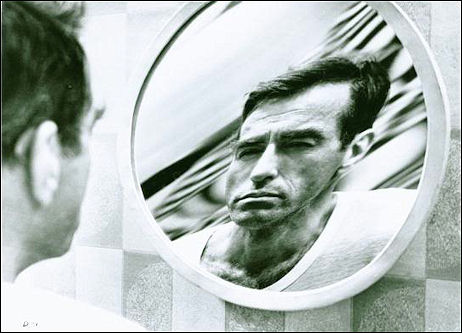
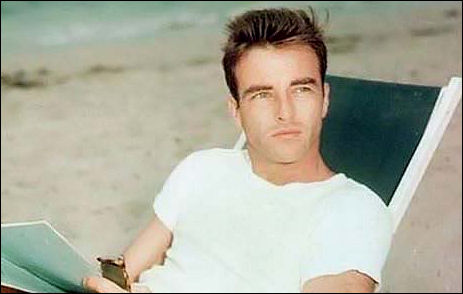
A film series tribute to Montgomery Clift began at BAM Cinematek on 3.11, and will end two weeks hence on 3.25.

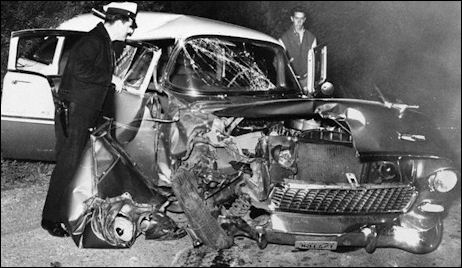
I’ve read two books on Clift (Patricia Bosworth’s and another one) and feel I know most of his story. He had a ten-year film career (’46 to ’56) before the Los Angeles car accident that ruined his face and pretty much turned him into a wreck — “the slowest suicide in Hollywood history.” Alcohol and pills and the stress of living in the closet eventually led to his death in 1966 — at age 45! — from “occlusive coronary artery disease.”

How many of his pre-accident films present Clift in a truly luminous and commanding state, that anxious and willowy God-like thing that made his rep and his name? Four — Red River (shot in ’46, released in ’48), A Place in the Sun (’51), I Confess (’53) and From Here to Eternity (’53).

He made other intriguing or fascinating films, but no other major-league star was so totally ruined as Clift was after the smash-up. He didn’t just look different but seemed internally mangled and mashed in.

During those first seven years (River to Eternity) he seemed to be coming from a relatively calm and steady place for the most part — a serene one at times. Plus he had those beautiful, perfectly chiselled features. But after the pile-up he acquired the look and manner of an out-and-out spaz — a twitchy-fidgety fellow with bulging eyeballs and jug ears, and a voice (or vocal delivery) that seemed impaled by nerves. This transformation was first evident in The Young Lions in ’58. Matthew Garth in Red River was no more. Clift had nowhere to go but to become a character actor, which he did and quite well at that.

Marilyn Monroe reportedly once described Clift as “the only person I know who is in worse shape than I am.”

The BAM Cinematek selections include Red River (Howard Hawks, 1948); The Heiress (William Wyler, 1949); The Big Lift (George Seaton, 1950); A Place in the Sun (George Stevens, 1951); From Here to Eternity (Fred Zinnemann, 1953); I Confess (Alfred Hitchcock, 1953); Lonelyhearts (Vincent J. Donehue, 1958); The Young Lions (Edward Dmytryk, 1958); Suddenly, Last Summer (Joseph L. Mankiewicz, 1959); Wild River (Elia Kazan, 1960); The Misfits (John Huston, 1961); Freud (Huston, 1962).
Hubble 3D

“The newly resurgent 3D format gets an out-of-this-world showcase in Hubble 3D,” writes Variety‘s Justin Chang. “Structured around a tricky NASA service-and-repair mission, the latest Imax venture from producer-director Toni Myers (Space Station 3D) lingers to transfixing effect on images captured by the famous telescope, inspiring the viewer’s awe in the possibilities of giant-screen cinema as well as the mysteries of space.

“Shortly after the Hubble Space Telescope was launched in April 1990, scientists discovered a tiny yet damaging flaw in its primary mirror, which was rectified by a crew of astronauts in 1993. Since then, the telescope — roughly the size of a school bus, and the most sophisticated of its kind ever put into orbit — has undergone regular service missions, enabling ever sharper, clearer and wider-ranging glimpses of the universe.

“Pic documents the most recent of these excursions, the STS-125 Mission — which, though initially canceled in the wake of the 2003 Columbia shuttle crash, went ahead successfully in May 2009. A 700-lb. Imax 3D camera was installed in the shuttle’s cargo bay, while Myers and d.p. James Neihouse trained the astronauts to use it, also positioning HD cameras throughout the spacecraft.

“Apart from shots of the astronauts going about their routines inside the shuttle and marveling at the properties of zero gravity — which turns out to be ideally suited to 3D, as floating objects provide a natural depth of field — most of the footage is devoted to the spacewalks undertaken by those repairing the telescope.

“Narrator Leonardo DiCaprio (who also did the voiceover honors for global-warming docu The 11th Hour) works hard to impart a sense of the mission’s danger, enumerating the various risks to the astronauts’ safety as well as the many points at which the repair procedure hits a snag.

“Fascinating as much of this footage is, the docu’s strongest images are to be found elsewhere. As though keenly aware that the sight of a shuttle launch never loses its thrill, Myers and Neihouse film the blast-off twice — first from a distance, so you can appreciate the big-picture spectacle of a column of flame against a blue sky, and then from up close, so you can feel the roar of the rockets, an effect that should make any theater quake if its sound system is working properly.

“Most mesmerizing of all are the photographs taken by Hubble itself, expertly enhanced through computer-visualization techniques applied by the Space Telescope Science Institute in Baltimore. Consequently, Hubble 3D comes as close as any film to reproducing the curious, cosmic sensation of floating through outer space; with the bonus of the telescope’s infrared camera and ultrasharp focus, pic affords tremendous views of everything from the young stars emerging from the Orion Nebula to a black hole in the more distant Virgo Cluster.

“It’s an experience so pure and vivid, you may actually wish for less of DiCaprio’s voiceover — which, though useful in explaining what you’re looking at, becomes a bit of a distraction. In space, no one can hear you narrate.”

Graves Is Gone

Peter Graves, 83, died earlier today at his Pacific Palisades home. Jim Phelps on TV’s Mission Impossible, the Nazi spy-fink in Billy Wilder‘s Stalag 17, the Airplane! pilot who loved the company of young Timmy. Brother of James Arness (Marshall Matt Dillon on TV’s Gunsmoke, the thorn-fingered vegetable in Christian Nyby and Howard HawksThe Thing).

Anemic

The Green Zone made a pathetic $14.5 million this weekend on more than 3000 screens — a wipeout. It cost over $100 million to produce not counting marketing, For now the Greengrass/shakycam brand is mud. Another Iraq movie goes down. Tough darts.

The Crowd

A friend is visiting Italy with her mother in June. She told me yesterday that at her mother’s cautious behest they’ll only be visiting mainstream tourist magnets like Florence and Siena and Montepulciano. And that they’ll be starting out with a visit to Lucca. I replied as follows:

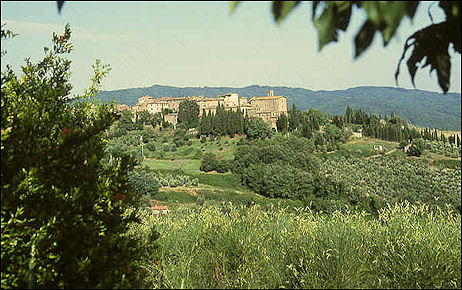
“I’m begging you for your own spiritual good (and your mom’s) — don’t submit to a typical-tourist agenda in Tuscany. And please think about compassionately persuading your mom to submit to a little Sheltering Sky atmosphere with visits to San Donato or Volpaia. Or places like them, at least.

“Lucca is fine — architecturally appealing and all that — but the topography, while contoured, is on the flat side and too far north of the really cool area. It’s not part of the truly verdant, rolling-hill wine-country wonderland that San Donato and particularly Volpaia are part of.

“To do only tourist spots is to ensure that your journey will be colored if not compromised by mobs of people, and worse than that — people from Topeka, Trenton, Minneapolis, Augusta, Waco, Terre Haute, Orlando and Sacramento. It’ll be like making love with re-runs from TV Land and Nickleodeon playing loudly on the TV nearby. It just breaks my heart, knowing what you guys are headed for. And willingly yet!”

Let It Go

There are many people out there whose absence would greatly improve world conditions. Dick Cheney, Michele Bachman, Glenn Beck…that line of country. In the old days people used to suggest that such people could “go jump in a lake” or “take three running jumps and go to hell.” These days people tend to be a little more inventive in their phrasings, like “may they get rectal cancer.” And so what?

Sean Penn will get no static or condemnation from this corner for that blunt remark. Paparazzi anger issues aside, he’s a man of honor, conviction and integrity. I’m being dead straight.

Slacker Central

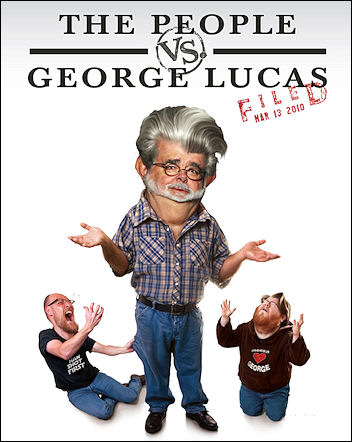
Alexandre Philippe‘s The People vs. George Lucas, which in my dreams would (and actually could) be the most emotionally satisfying hit-job documentary of 2010, had its world premiere last night at South by Southwest, and at 6:30 pm yet. And now it’s just after 1 pm New York time the next day and no one has any reviews up. Not Anne Thompson, not Devin Faraci, not Moises Chiullan, not Eric Kohn, not Joe Leydon…no one.

Has anyone even posted a Twitter reaction? Update: Here’s a Hollywood Reporter review by John DeFore.

In this day and age of lightning covering a festival is about lickety-split filing, lickety-split filing and more lickety-split filing. When I see a hot or high-interest movie in Cannes, Toronto or Sundance I’ll post something on that sucker (at least a mini-review) within three or four hours, if not sooner. If I were there you can bet your ass I would have had some kind of People vs. George Lucas reaction up by 10 or 11 pm last night, or certainly by early this morning. All I can say is that I’m very disappointed all around, guys. From here on the T-shirt slogan for SXSW journalists needs to be “fewer Margaritas, faster filing!”

Further update: a mezzo-mezzo review from The Reviewer.net.

The Devil His Due

I’m feeling a certain je ne sais quoi emotional satisfaction with the South by Southwest premiere of Alexandre Philippe‘s The People vs. George Lucas, a takedown doc about a guy I’ve long regarded as the single most demonic figure in the motion picture industry.

I’ve been calling Lucas a devil figure since the late ’90s, so even if Phillippe’s doc turns out to be so-so it still feels good to have it out there and its central thesis — that Lucas is a very real metaphor for total flaccidifying of directorial chops and a complete corruption of the spirit — presented en masse.

I can remember David Poland cluck-clucking when I called Lucas “the devil” in the wake of The Phantom Menace, which was nearly 11 years ago. And now the world has come around, the sands have shifted and it’s time for Poland to bow down and say “okay, you had a point.”

“George Lucas is not the devil, Jeffrey,” he said. He most certainly is, I replied, in the sense that Albert Brooks called William Hurt “the devil” in Broadcast News. Lucas is an embodiment of evil in that he destroyed his own Arthurian mythology and sacrificed the church of millions of Star Wars believers on the altar of commercialism and Jake Lloyd and Jar-Jar Binks action-figures.

Poland has never been wrong or off-the-mark in his opinions, of course. His psychology, I should say, doesn’t allow for any admissions along these lines. On top of which his “Jeffrey who?” posture has been maintained for years on end so forget it. But I was out there on the battle lines, calling for Lucas’s head when Bill Clinton was still president and assigning all kinds of odious metaphors, etc. And Poland knows this, and he knows that he fairly staunchly defended Lucas and his creations all through that awful Phantom Menace period. I’m not saying he loved the film, but he found a way to say it’s okay and that Lucas had his reasons and rationales.

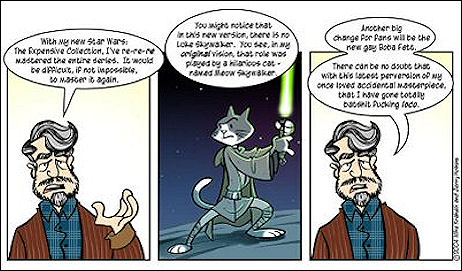
“Lucas began as Luke Skywalker, and has been described by biographer Dale Pollock as a kind of a brave and beautiful warrior when he was under the gun and struggling to make it in the ’60s and into the early ’70s,” I wrote a couple of years ago. “But once he got fat and successful he slowly began to morph into an amiable corporate-minded Darth Vader figure.”

A King in New York

Christopher Walken gives the single most enjoyable performance I’ve ever seen him give, bar none, in A Behanding in Spokane, which I caught yesterday afternoon. It’s a classic “Walken performance” par excellence — hilarious, bent, brilliant, a hoot. The play’s (i.e., Martin McDonaugh‘s) humor is dark and perverse and most definitely around the bend, but in a Quentin Tarantino/Pulp Fiction-y sense, to some extent.

The pisshead critics who’ve dismissed Behanding for lacking soul and gravitas aren’t deluded, but they’re under-value-ing (or discounting) the delicious whack factor.

The audience was laughing all through it. Really laughing, I mean. And we’re talking about a mostly Saturday Night Live crowd — i.e., people in bizarrely-patterned sweaters and easy-fit jeans and ugly Nike shoes who showed up, I’m guessing, because of Walken’s numerous hosting gigs on that show over the years, and because of that Fat Boy Slim video. It’s a play for people who love hamburgers and potato salad, not arugula and foie gras. I realize that I put down the hamburger-and-potato-salad crowd (i.e., Joe Popcorn) all the time, but Behanding put me in a different frame of mind. I guess it’s really a play for the hamburger-and-foie gras demo…how about that?

Some audience members may have attended because they loved Walken’s scene with Dennis Hopper in True Romance, or because of his oddly or crazily enjoyable turns in King of New York , At Close Range or Things To Do in Denver When You’re Dead. But not many, I’m guessing.

Sam Rockwell, playing an intellectually-challenged hotel clerk, seems to quietly snicker his way through the show. He’s in the role and in the play in a serious thespian sense, but he’s having such a good time it’s like he’s almost goofing off besides, and it’s infectious. You’re with him. Zoe Kazan and Anthony Mackie portray clueless con artists — not that interesting on the page — but they bring a certain firecracker farce quality. The play is that much more charged because of them.

A Behanding in Spokane isn’t about all that much. If anything it’s about how we’re all stuck in our own realms, caught up with our pasts, pissed off, looking to settle scores, keeping ourselves from living in the here-and-now. That theme is there, but the play itself is pure dark-assed entertainment. You go out on a high. Money well spent.