Shane's Moment

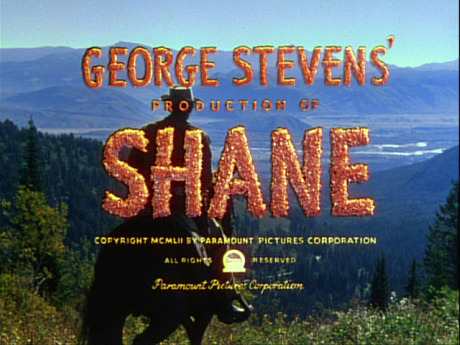
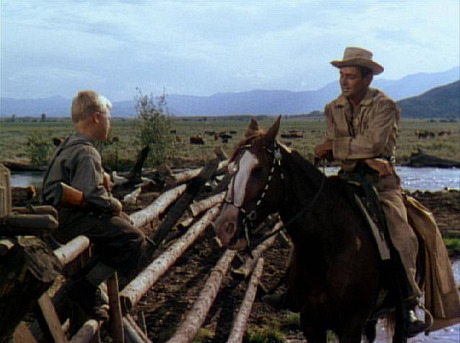
It feels mildly irksome that Paramount Home Video has never to my knowledge stated an intention to issue a Bluray of George StevensShane. Wouldn’t this fit almost anyone’s definition of a no-brainer? It’s all but de rigueur for major studios to give their classic titles Bluray upgrades, so it seems odd that one as beautiful-looking as Shane would be sitting on the sidelines.

It’s been almost seven years since Paramount Home Video’s Shane DVD, which was fine for what it was. But it’s time to step up and do this film proud and give a nice angel erection to George Stevens, who no doubt has been wondering from whatever realm or region why Paramount hasn’t yet bit the bullet on this thing.

The Bluray format (coupled with an exacting, first-rate remastering, of course) would dramatically enhance if not do wonders for Loyal Griggs‘ legendary capturings of this iconic 1953 western. To my eyes Griggs’ richly-hued color lensings — he shot The Buccaneer, The Ten Commandments, The Bridges at Toko-Ri, White Christmas — were on the level of Jack Cardiff‘s.

This morning I asked Paramount restoration/remastering guy Ron Smith (who supervised the superb work on Paramount’s recently-released African Queen Bluray) if a Shane Bluray was at least in the planning stages. Guys like Smith are told to never say “boo” to guys like me without corporate publicity’s approval, but I wanted to at least put this on the table.

Digi-Bathed?

At the end of a thoughtful assessment of Sergio Leone‘s “Man With No Name” trilogy, L.A. Times contributor Sam Adams says that the new MGM Bluray versions (available Tuesday, 6.1) are afflicted with the Patton/Spartacus virus.

“[Featuring] exemplary audio commentaries by biographer Christopher Frayling, the ‘Man With No Name’ set duplicates earlier editions in terms of features, giving the images a high-definition upgrade that is something of a mixed bag,” he writes.

“To minimize natural film grain, The Good, the Bad and the Ugly is rendered mushy and plastic at times. [And] the re-recorded surround-sound on all three movies is an overactive mess, panning dialogue into the side speakers in a fashion that has more to do with showing off than serving the film. (The discs include the original mono as well, although they default to the new soundtrack.)

“It’s unfortunate that the Good, Bad disc includes only the questionably ‘restored’ version of the film, with newly recorded dialogue and scenes that Leone himself cut for release, but some judicious reprogramming can take care of that.”

Boomer Bond

The Special Relationship…ah, yes. An “entertaining period piece” and a pleasurable trio of performances, it is widely agreed, from Dennis Quaid (Bill Clinton), Michael Sheen (Tony Blair) and Hope Davis (Hillary Clinton). I won’t be seeing it until tomorrow night, when I arrive back home, so if anyone’s had the pleasure, please share.

Return to Rome


This morning’s sunrise (taken around 6:15 am) from the deck of the Palermo-to-Napoli ferry that we took last night. Nice quiet cabin w/shower. Good way to go.

I bought a warm salami panini for this guy in Capua this morning, and then laid the slices on the ground before him, and he just sniffed it. No sale.

Hopper Into Space

My all-time favorite Dennis Hopper imprint, on the occasion of his passing earlier today: “You can’t travel in space, you can’t go out into space, you know, without, like, you know, with fractions, man. What are you going to land on — one-quarter, three-eighths? What are you going to do when you go from here to Venus or something? That’s dialectic physics. You either love somebody or you hate ’em.”

I’ve written a few short Hopper articles in recent months: (a) a 10.14.08 riff called “Man of Moods“; (b) a 3.27.10 post called “Thousand Yard Stare“; and (c) a 4.13.10 jotting called “Best-Yet Hopper Tribute.”

And once again, here’s that beautifully cut, perfectly on-target video essay from Moving Image Source‘s Matt Zoller Seitz.

Howell vs. Burton (and Boonmee)

Forgive the tardiness (which I’m blaming on Sicilian distractions), but Peter Howell‘s 5.27 Toronto Star piece on the decision by Tim Burton‘s Cannes jury to hand the Palme d’Or to Apichatpong Weerasethakul‘s Uncle Boonmee Who Can Recall His Past Lives is delicious stuff.

“In the same week that Burton’s box-office champ Alice In Wonderland hit the $1 billion mark globally, one of just six movies ever to do so, he presided over golden laurels for a film so resolutely uncommercial, even Thais can’t figure it out. The gesture struck me as one of the most political and cynical moves ever from a Cannes jury. Burton and his crew, acting on his cue, wanted to show how cool and cutting-edge they were.

“Many critics at Cannes, who are used to seeing challenging material, found Uncle Boonmee to be a shapeless mass of wacky images masquerading as a spiritual journey. I predict that a lot of people will be saying, ‘This won the Palme d’Or?’ when Uncle Boonmeescreens at TIFF this September, as it most likely will.

“I don’t completely disparage Uncle Boonmee [in my review]. I was impressed by the vivid cinematography and by Weerasethakul’s inventive use of special effects, which he achieved with a tiny budget. But did it deserve the Palme, a prize second only to Oscar’s Best Picture for prestige and previously awarded to such classics as La Dolce Vita, Apocalypse Now and Kagemusha? No way.

“As a cinema experience, Uncle Boonmee is about as gripping as watching a variety store security video. There is no acting to speak of, only rote line readings of mystical babble.

“Burton said he was simply enraptured by Uncle Boonmee, precisely because it was so unlike the Hollywood fare that Burton personally chooses to make. He’s delighted to see other people taking chances that he’s afraid to take himself.

“If Burton is so thrilled by such avant-garde experiences as Uncle Boonmee, why doesn’t he try making one himself instead of always swinging for the multiplex with movies starring Johnny Depp, his favorite A-lister, and proven stories like Alice in Wonderland?

“Even better, why doesn’t he use some of his Alice loot to help promote, distribute and champion independent films like Uncle Boonmee, instead of just handing out golden goodies before jetting back to Hollywood for his next Johnny Depp power breakfast?”

Without A Trace

Reviewing Peter Weir‘s recently Blu-rayed Picnic at Hanging Rock (1979) some 31 years ago was a kind of cliff-leap experience. I didn’t know at first how to explain what it actually amounted to (at least according to the cinema-appreciation terms I was used to), or where it had actually “gone” in a narrative sense, but I knew it had a curiously haunting (and haunted) quality, and that the unsolvability of the disappearance of two or three schoolgirls wasn’t the thing as much as how the mystery just hung there in the air, and how the humid Australian sun seemed to gradually melt the characters’ brains.

Martin & Allyson

This clip from a 1978 Jimmy Stewart roast, HE’s third Orson Welles post since Wednesday, includes remarks from emcee Dean Martin and a brief shot of June Allyson laughing along. I was immediately reminded of Nick Tosches‘ descriptions of their 1948 affair, surely one of the strangest extra-marital couplings in Hollywood history, in Dino: Living High in the Dirty Business of Dreams.

There are some couples who just seem “right” together, and there are some that make you wonder how and why. The idea of the cynical but easygoing Martin — married with children, easy-friendly with certain gangsters, and a serious poon-hound in his prime — getting all hot and nasty with Allyson, who always seemed so enveloped in the legend of being “America’s Sweetheart” that it was difficult to imagine her having had sex at all, with anyone, has, for me, always fit into the latter category.

At the time of their affair Allyson was married to actor-director Dick Powell , with whom she had two kids (one adopted, one natural). Martin was on the downslope of a difficult marriage to Betty McDonald, with whom he’d had four kids.

In a N.Y. Times review of Allyson’s sunny and peppy autobiography, which came out in ’82, Janet Maslin wrote that Allyson “presents herself as the same sunny, tomboyish figure she played on screen Hollywood…like someone who has come to inhabit the very myths she helped to create on the screen.”

Non-Verbal

“And I don’t know your noises yet.”

That’s one of Renee Zellweger‘s lines in Jerry Maguire, spoken to Tom Cruise. I for one was glad to hear her say that. Because this is one of the things that well-written movies always do (while doing other things, of course). They remind us of recurrent, recognizable, sometimes banal things about ourselves, but with a little English.

One of my noises is a simulation of a very old man groaning in pain. I won’t attempt to simulate it phonetically, but I make this guttural sound when I’m tired and walking and under some physical stress. Jett commented on it the other day, and I found myself explaining where it came from. I began using it in my teens as a form of quiet mockery (i.e., for my own ears, not meant to be heard) whenever I would see a really old-looking guy — white-haired, stooped over. But it came from a real incident, one that I was told about by a neighborhood friend when I was 11 or 12.

My friend was taken to a baseball game at Yankee Stadium by his father or grandfather. They were sitting in the right-field bleachers, and everyone stood up like a shot when a batter tagged one — crack! The ball was hit long and high and heading right for them. Several guys tried to catch it, but the ball struck a bent-over old man who happened to be walking up the aisle, hitting him right square in the back. And when this happened he stumbled and threw his head back and bellowed like an animal, my friend said. And that sound, or rather my friend’s imitation of it, stayed with me for decades.

And somehow it gradually morphed from being a sound I would use to quietly make fun of grandfatherly-looking guys to a sound I myself would make when I temporarily felt like one of them. I gradually adopted the damn thing and made it my own.

Anyway, since Jett asked me about this, I’ve been engaged in a discipline in which I tell myself to not make that wildebeest sound when I’m feeling whipped because it’s pathetic all around — because it was thoughtless of me to laugh at the idea of an 80-something guy getting hit in the back by a fly ball, and to make fun of older people in such a way, and finally to use this sound as some kind of subconscious stress call.

My point — call it a theory — is that most of our personal “noises” are based on some kind of tucked-away memory, some residue of a childhood experience. Usually from infancy, I’m thinking, although my movie-centric mentality has resulted in most of my noises being borrowed from movies.

I used to imitate Cary Grant‘s whinny from Gunga Din and Bringing Up Baby whenever I felt flustered or overwhelmed. (I don’t know why but it’s been years since I’ve gone there.) A similar one I’ve sometimes resorted to is the fear-and-frustration whine that Peter Boyle ‘s Frankenstein monster used in Mel BrooksYoung Frankenstein .

But we all have them. We all have a repertoire. I don’t know how important this is to mention in a general context but it came to mind the other day, and I guess there’s a point to be made about how movies sometimes work their way into our subconscious. I can’t develop the thought much beyond that.