Sack of Palermo

I did a little reading about Palermo over the last few weeks, knowing I’d be visiting there during my post-Cannes travels. And having yesterday spent a few hours traipsing around Palermo’s mean streets, I can now state with authority that certain travel writers and travel websites have lied through their teeth about the largely ugly and rancid nature of this city.
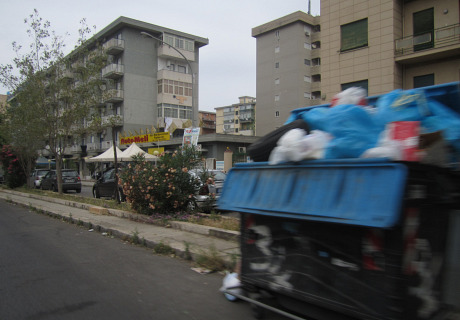

Entering Palermo — Friday, 5.28.10, 11:55 am.

Palermo is a Mafia rathole — a corrupt, crime-infested, economically challenged, overly-congested sprawl of mostly unattractive apartment and commercial buildings (mostly of a skanky gray, grayish-brown or dogshit-orange color) with a few historical buildings and commercial diversions to keep the tourists happy or at least diverted.

I’m sorry but my primary impressions are as follows: air-polluted, generally unkempt, vaguely smelly, over-populated, too many buses and scooters, overstuffed garbage bins — a festival of clutter and crap. Certainly not what anyone would call “clean” or “well-maintained.”

Are there tiny little pockets of beauty and cultivation here and there? I’ve read about them and I’m sure they exist (I’m sitting in a very pleasant air-conditioned hotel lobby five blocks from the harbor), but much or most of Palermo feels like some kind of hot and humid thirdworld nightmare that you can’t escape from fast enough.

The various mafia corruptions are probably the main reason why Palermo feels like a “favela” out of Fernando MeirellesCity of God.

Napoli, Italy’s other urban armpit, is also crime-infested, and it looks, feels and smells the same way. The influence of the Cosa Nostra is not good for tourism because the guys who’ve profited from what’s happened in these cities are clearly opposed to civic enhancement when it interferes with stuffing their own pockets.

Wikipedia’s Palermo page says the following: “The main topic of the contemporary age is the struggle against Mafia and bandits like Salvatore Giuliano, who controlled the neighboring area of Montelepri. The Italian State had to share effective control, economic as well as the administrative, of the territory with the Mafiosi families.
“The so-called ‘sack of Palermo‘ is one of the major visible faces of this problem. The term is used to indicate the wildcat, unregulated speculations that filled the city with brutalist apartment buildings. The reduced importance of agriculture in the Sicilian economy had led to a massive migration to the cities, especially Palermo, which swelled in size.

“Instead of rebuilding the city center the town was thrown into a frantic expansion towards the north, where practically a new town was built. The regulatory plan for the expansion was largely ignored. New parts of town appeared almost out of nowhere, but without parks, schools, public buildings, proper roads and the other amenities that characterise a modern city.

“The Mafia played a huge role in this process, which was an important element in the Mafia’s transition from a mostly rural phenomenon into a modern criminal organisation. The Mafia took advantage of corrupt city officials (a former mayor of Palermo, Vito Ciancimino, has been condemned for his bribery with Mafiosi) and protection coming from the Italian central government itself.

“The historic city center is still partly in ruins, the traffic is horrific, and poverty is widespread. Being the city in which the Italian Mafia historically had its main interests, it has also been the place of several recent well-publicized murders. Situated on one of the most beautiful promontories of the Mediterranean, Palermo is anyway an important trading and business centre and the seat of a University frequented by many students coming from Islamic countries, as its relationships with Muslim world were never ceased.”

Slave Dwellings

There’s a soulless, stone-glass-and-steel, black-and-white corporate hotel sitting next to our hotel (the Villa Gaia) here in Cefula. I suspect that you need to be a kind of soulless, stone-glass-and-steel corporate asshole (or the wife or girlfriend of one) to want to stay in one of these chilly Dante-esque abodes. Every attractive European town has one, and the people walking in and out are always Masters-of-the-Universe types driving shiny black cars and wearing slick dark suits.

In an era of diminishing natural resources and encroaching corporate cancer, old-world elegance (i.e., aged wooden floors, organic plaster or brick exteriors, organic clay-tile roofs, Oriental throw rugs, grandfather clocks, 19th Century paintings) is the only way to go for anyone with a smidgen of taste. Try telling that to the Hugo Boss hotshots who swear by those corporate hell palaces. They don’t get it, and they probably never will. Or at least not until they’ve kicked around for a couple of decades and learned a few things.

The general theory is that people who prefer splendorous hard-stone dwellings are looking to make a statement (to themselves or to others) about where they want to be or how they’d like to project themselves, as opposed to who they really are or where they’ve come from (genetically, culturally, economically). They’re looking to dwell in a nouveau-riche atmosphere of faux-Roman splendor, and figuring that if they don’t buy into this Blaupunkt life-of-Nero lifestyle their competitors (or women they’d like to attract) will suspect they’re wood-floor losers at heart, and will write them off. Or something like that.

In short, the more your lodgings reflect this ancient-Rome-meets-Gordon-Gekko style, the more socially insecure and desperate-for-approval you’re likely to be. Just saying.

Ibid

Deadline‘s tube reporter Nellie Andreva has posted an official “yup, it’s really happening” story about Diane Keaton and Ellen Page being set to star in HBO’s Tilda, a forthcoming half-hour series about a female Hollywood blogger modelled on Nikki Finke. I reported the Keaton-Page castings as a straight fact on 4.29.

Last month an HBO spokesperson told Hollywood Reporter columnist Matthew Belloni that ‘”the Tilda script is a fictional composite and not based on any one person,” I mentioned in the same piece. “Bullshit, bullshit, bullshit,” came the response. “The Tilda Watski character is Finke, Finke, Finke all the way.”

Page’s Carolyn character, who wasn’t all that filled out in the first-episode script I read last month, is described by Andreva as “a morally conflicted creative assistant caught between following the corporate culture of the studio she works for and following Tilda, who has taken a keen interest in her.” She could, in other words, turn to the dark side and wind up slightly scheming against Tilda in a kind of Anne Baxter-in- All About Eve sort of way. Maybe.

Good One

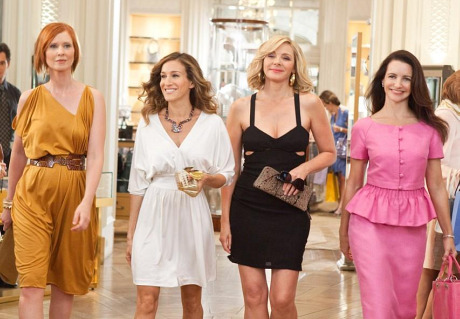
“The ugly smell of unexamined privilege hangs over this film like the smoke from cheap incense.” — from A.O. Scott‘s 5.27 review of Sex and the City 2.

Sex and the City 2 has drawn 14% and 33% positive ratings on Rotten Tomatoes and Metacritic, respectively. Who, then, has given it a pass? The Philadelpha Inquirer‘s Carrie Rickey, Boston Pheonix‘s Jeffrey Gantz, the St. Louis Post-Dispatch‘s Gail Pennington, the Hollywood Reporter‘s Stephen Farber, NPR’s Mia Mask, etc.

Stinko

Yesterday The Pursuitist posted outtakes of a sloshed Orson Welles attempting to say his lines for one of his Paul Masson Wine commercials, which ran in the ’70s.

I thought immediately of Malcolm Lowry‘s Geoffrey Firmin character in Under The Volcano, a penetrating portrayal of a British consul with an alcohol problem but more profoundly a book about “a constant struggle against the elemental forces that threaten to destroy him,” as one reviewer stated.

In Welles’ case those forces would be those many, many producers, studio chiefs and industry players who refused to take him seriously as a filmmaker, preferring to regard him as a colorful, storied fellow who had been permanently put out to pasture.

Then again it’s impossible to think of the Paul Masson brand without recalling Welles’ famous line, to wit: “We will sell no wine before its time.” Welles was canned as a Paul Masson spokesperson in the early 1980s after admitting on a talk show that he never drank Paul Masson wine.

Last Softballer Standing

In what amounts to an end-of-the-road obituary for CNN’s Larry King Live, and particularly the demise of King’s amiable, live-and-let-live, just-asking-questions style as a news-discussion host, N.Y. Times reporter Brian Stelter reports that “there is a growing feeling at [CNN] that a succession plan should be put in place.

“CNN executives will not say whether they will renew Mr. King’s contract when it ends next year” and “there is no evidence that CNN is actually preparing such a plan,” Stelter reports. “[But] King was noticeably absent during a presentation for advertisers last month, which heavily featured CNN stars like Anderson Cooper and Soledad O’Brien, but only fleetingly included Mr. King in a video clip.

Larry King Live is the last trace of an earlier age of cable TV, one that had little interest in the opinions of its hosts.

“‘They have this iconic personality who is going to disappear in the not-too-distant future, and they don’t have any clue what they’re going to do,’ one senior employee said, speaking on the condition of anonymity because he did not have permission from the channel to speak publicly.

“Mr. King has shown no desire to retire, and he continues to work almost year-round, even coming in to host on weekends when news breaks.

“But Mr. King’s contract is up in June 2011, and there has long been speculation that the CBS Evening News anchor Katie Couric could slide into his chair. Her contract is up in May 2011, and she sees CNN’s 9 pm time slot as a possible new job, according to four of her friends and colleagues.

“Next week will be Mr. King’s 25th year on CNN, but these are hard days for the host, and not just because he is being beaten in ratings and bookings.

“Although still the linchpin of CNN’s lineup, he has come to embody an enormous problem facing the cable news channel. How can he and CNN compete in prime time when viewers seem to crave partisan political programs and when prominent guests — the lifeblood of Mr. King’s show — would rather burnish their images on other channels?

So far, CNN cannot compete. Larry King Live is now struggling in the ratings, as is CNN as a whole. The ratings for the new John King, USA political show at 7 p.m. have been disappointing, and Campbell Brown announced last week that she was quitting her 8 p.m. show after concluding that her newscast could not compete with the bombastic opinion-oriented shows on Fox News and MSNBC.

“Ratings for Mr. King, 76, are about 20 percent better than those of Brown, but he ranks a distant third behind the conservative Sean Hannity on Fox and the liberal Ms. Maddow.”

Don't Know It

“I’m a sucker for series that end with a complete repudiation of everything that’s gone before — like the one for St. Elsewhere where everything turned out to be an autistic child’s fantasies of life inside a snow globe. Still, it is kind of cheating to just announce that the characters in this long, complicated series were dead. And that half of Season 6 took place in purgatory. And I do not like the idea of heaven being a church with what looked like uncomfortable seats.” — N.Y. Times columnist Gail Collins riffing on the final episode of Lost.

McAdams vs. Ford

I’m presumably being afforded a little slack for being slow to post this, given this and that Sicilian distraction. You can sense off the top that this TV-news dramedy (Paramount, 11.12), directed by Roger Michell and written by Aline Brosh McKenna, isn’t quite operating at a Broadcast News level. Or am I being too sensitive?

Snake Pit

Delivering an opinionated shocker that no one could have seen coming, Marshall Fine declares that Sex and the City 2 “is not very much” and that it “rarely made me laugh. And at two hours and 23 minutes, that’s a lot of not laughing.”

143 minutes? Who’s running the store at New Line/Warner Bros.? If I was the top hot dog I’d politely explain to director Michael Patrick King that he can use whatever unfunny horseshit that strikes his fancy, but come hell or high water SATC2 won’t run any longer that 110 to 112 minutes, tops. No discussions….finito.

“At the screening I attended, which was more than 50 percent women, the moments of actual out-loud laughter could be counted on one hand,” Fine remarks. “The verbal grumbles about the clothes or the lameness of the jokes outnumbered the expressions of mirth.”

“The first SATC film was such a downbeat snooze that one assumed it couldn’t get worse. But it can and it does.

“The most controversial this film gets is when Samantha (Kim Cattrall) gets arrested for publicly kissing a man she’s just met and incidentally aroused so that his cotton drawstring pants reveal an erection when he stands up in a restaurant — a guaranteed laugh-getter.

“Is this film offensive to Islam? These days, what isn’t? Muslims are touchier than the Catholics. It’s a Sex and the City movie set in an Arab country. Of course, it’s going to be offensive to Muslims! The title is offensive to fundamentalist Muslims.”

On top of which “the sour taste of conspicuous consumption is unmitigated by a couple of lines about how bad the economy is, [which are] obvious attempts at vaccinating this film against charges of tasteless irrelevance.

“If the women of Sex and the City 2 were to ever actually engage with the real world, it might cause a rift in the space-time continuum that would doom us all.”

Fluff It Up

In the view of The Wrap’s Sharon Waxman and Dylan Stableford, the Hollywood Reporter‘s hiring of former Us editor-in-chief Janice Min as editorial director, along with the recent hiring of former OK! honcho Lori Burgess as THR‘s publisher, “seems to suggest a tilt toward celebrity news for the traditionally business-oriented trade.” Whoa, guys…don’t go out on a limb.

Fifteen Years Ago

In recognition of MGM Video’s upcoming Bluray release of Paul Verhoeven‘s Showgirls, I’m reposting an August 2007 piece about a very special screening of this legendary howler at Robert Evans‘ Beverly Hills home in the early fall of ’95:

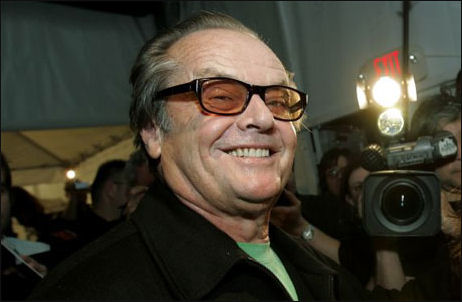
“It happened in Evans’ legendary rear bungalow, which lies behind his egg-shaped pool in the backyard of his French chateau-styled place on Woodland Avenue. With Jack Nicholson of all people, as well as Bryan Singer, Chris McQuarrie, Tom DeSanto and two or three others. And with everyone hating it but sitting through the damn thing anyway because Nicholson had dropped by to see it and nobody wanted to mess with the moment.

“All that ended when Nicholson, who was sitting right under the projection window against the rear wall, stretched his arms and put his two hands right in front of the lamp. The hand-silhouette on top of Elizabeth Berkeley and her grinding costars conveyed his opinion well enough, and suddenly everyone felt at liberty to talk and groan and make cracks and leave for cigarette breaks.

“Nicholson and Singer ducked out at one point, and I joined them. Their chat was all about Nicholson wanting to bond with Singer — my presence was totally superfluous — but it was worth the faint humiliation.

“I was Evans’ journalist pal that year (or part of it, at least). I had written a big piece about Hollywood Republicans earlier that year for Los Angeles magazine, and Evans had been a very helpful source. As a favor I’d arranged for him to meet some just-emerging GenX filmmakers — Owen Wilson, Don Murphy, Jane Hamsher, et. al. — so that maybe, just maybe, he could possibly talk about making films with them down the road.

“Anyway, it was sometime in late September and Evans, myself, Singer, DeSanto and McQuarrie were having dinner in the back house, and Evans was doing a superb job of not asking the younger guys anything about themselves. He spoke only about his storied past, his lore, his legend. But the food was excellent and the vibe was cool and settled.

“Then out of the blue (or out of the black of night) a French door opened and Nicholson, wearing his trademark shades, popped his head in and announced to everyone without saying hello that ‘you guys should finish…don’t worry, don’t hurry or anything…we’ll just be in the house…take your time.’

What? Singer, McQuarrie and DeSanto glanced at each other. Did that just happen? Evans told us that Nicholson was there to watch Showgirls, which they’d made arrangements for much earlier. He invited us stay and watch if we wanted. Nobody wanted to sit through Showgirls — the word was out on it — but missing out on Nicholson schmooze time was, of course, out of the question.

“There was some schmoozing after it ended. The general unspoken reaction, I sensed, was “well, that‘s over, thank God! I mean, imagine what it must feel like to pay to see this thing.” Nobody said this in so many words, of course.


A Cartoon Central rendering of Evans’ French-styled mansion. The Showgirls screening happened in the rear abode.

“McQuarrie, basking in the vibe, said something to Singer in shorthand that basically suggested that they’d clearly reached a certain plateau in their careers for something like this to happen, and wasn’t it cool? Again, the words weren’t spoken.

“I recall DeSanto (Apt Pupil, X-Men, X2, Transformers) introducing himself to Nicholson and the then-58-year-old star, who’d brought two women with him, saying, ‘And it’s very nice to meet you, Tom.’ Gesturing towards Girl #1, he then said to DeSanto, ‘And I’d like you to meet Cindy and…’ Lethal pause. Nicholson had forgotten the other woman’s name. He half-recovered by grinning and saying with his usual flourish, ‘Well, these are the girls!’ The woman he’d blanked on gave Nicholson a fuck-you look for the ages.

“We all said goodbye in the foyer of Evans’ main home. Nicholson’s mood was giddy, silly; he was laughing like a teenaged kid who’d just chugged two 16-ounce cans of beer and didn’t care about anything. I was thinking it must be fun to be able to pretty much follow whatever urge or mood comes to mind, knowing that you probably won’t be turned down or told ‘no’ as long as you use a little charm.”