Randomly


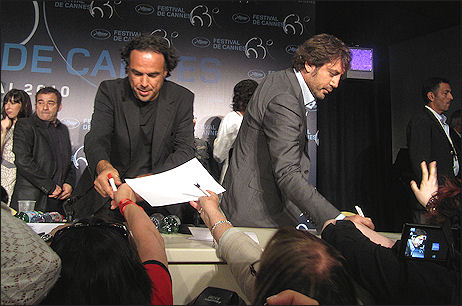
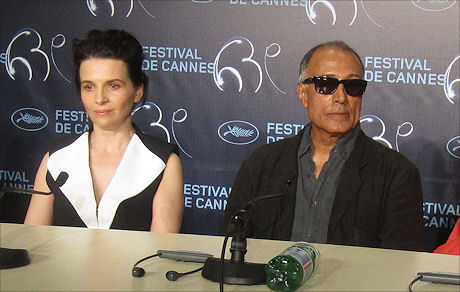
(l.) Juliette Binoche, star of Copie Conforme (i.e., Certified Copy) and (r.) director-writer Abbas Kiarostami at this afternoon’s press conference.

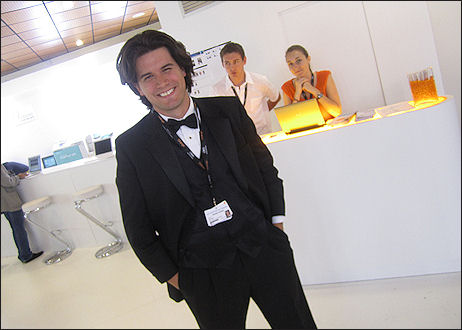
USA Today‘s Anthony Breznican prior to attending last night’s gala screening of Biutiful.

Tuesday, 5.18, 1:48 pm.

Indiewire Trying to Bully Biutiful Fans?

I began feeling more and more angry yesterday afternoon and evening as it became increasingly evident that a significant percentage of effete critics (i.e., not necessarily a majority) had come down negatively upon Alejandro Gonzalez Inarritu‘s Biutiful, an immensely sad and highly poetic little film that needs all the intelligent support it can get. And yet certain dweeb types have, it seems, gotten together and decided to diminish it.

Last night the Indiewire team sent out an e-mail stating that the two critical favorites so far are Mike Leigh‘s Another Year (which I’ve managed not to see — sorry) and Charles Ferguson‘s Inside Job (which I admire greatly), and in so doing obviously declared in blunt, Western Union-style fashion that Biutiful was not a favorite.

I interpreted this as an effort to intimidate the Cannes community into thinking that their hip film connoisseur status will be threatened if they put Biutiful at the top of their lists. The Indiewire guys e-polled a bunch of critics a few hours earlier, and had sized things up and concluded that relatively few critics had gotten behind Biutiful, or perhaps were on the fence about it or insufficiently ardent or whatever. However you want to slice it flatly declaring that a film as rich and strong as Biutiful is not critically favored on the very day that it has screened is basically an attempt by elite know-it-alls who live in a cloistered realm to prod or goad others into getting with the anti-Biutiful program.

I despise this kind of Stalinoid bullying. I despise it because I know that Biutiful is a landmark film, and that it’s easily one of the strongest I’ve seen in Cannes this year, and that people who go around tut-tutting and pooh-poohing it for the usual reasons that they flog Inarritu (i.e., his films are emotional wave experiences that are overly tricky, calculated or overly strategized, or are simply too much of a stacked deck and generally not believable) are, in my mind, coming from a kind of stifled and constipated place.

What Is Allowed & Not Allowed

Last night I was called a “tragedy” and “pig-ignorant” and “sad” and “lame” and so on by Glenn Kenny and a small team of like-minded thugs for having dissed Abbas Kiarostami‘s Copie Conforme (a.k.a., Certified Copy). In their eyes I was guilty of two offenses. The primary was having said that while I appreciated the purity of mood and technique and mise en scene in Kiarostami’s latest, I found it to be essentially an entombed and lifeless exercise. The secondary was in having used terms that weren’t properly referenced or fully considered enough, or were deemed too hot-dog plain.

What Kenny and others on this thread meant is that there is a Code of Film Dweeb Thought & Behavior, and one of the boldfaced proclamations (found on page 39) states that respected directors from Middle Eastern nations who make highly refined “art for art’s sake” films must always be spoken of in hushed reverent terms and cannot be faulted for the sin of lifelessness, particularly during important cultural gatherings like the Cannes Film Festival.

If you defy this edict and talk about how cinema feels and plays in plain terms — the terms by which most people perceive and absorb movies — Film Dweebs will go Defcon 5 and use whatever withering retorts and diminishments they can think of. Same thing if you dare to speak bluntly and disapprovingly of Douglas Sirk, another Dweeb God.

Film Dweebs are invested in a culture that obviously flourishes online (obviously a great thing) and which holds roll calls at the main film festivals, which act as a kind of professional and cultural life raft, but it is an insular culture protected by a moat and attack dogs (i.e., uglies like Filmbrain) and thick castle walls, and that dreaded substance referred to in some quarters as “everyday hotdog-eating reality” is not permitted inside.

I fell deeply in love with Nuri Bilge Ceylan‘s Three Monkeys here a couple of years ago. That was okay with the Dweebs, of course, and I certainly wasn’t savagely attacked for this because, cutting to the chase, Ceylan belongs to the same elite fraternity as Kiarostami.

But the basic rule stands — i.e., Cannes is a major mecca for Dweebs because it not only focuses worldwide attention upon their passions and whimsies but is one of the few occasions or platforms from which they can really strut their stuff, toot their horns, beat their chests and go nuts for pure-exercise films like Copie Confirme.

One should never argue about religion or politics, it is commonly said, because they’re highly sensitive issues — tethered to primal, deeply cherished beliefs and extra-sensitive emotional nerve endings. You will always get into arguments that you regret, and speak more heatedly and hurtfully than you intended.

The ugliest brawls on this site have come from the words of ardent fanatics and true believers, and what are Film Dweebs if not an amalgam of politics (i.e., looking to fortify and sustain their ranks as long as members have demonstrated sufficient loyalty to Film Dweeb favorites and concepts) and religion and a kind of aesthetic fanaticism? It explains why these discussions are so rank with contempt and disdain and flying spittle.

Kenny can call me a tragedy if he wants. But I despise his despising and general lack of civility when such matters arise. It is genuinely unattractive.

I’ve said before that I’ve been onto Glenn and his cloistered kind for a long time, in part due to having suffered under Dweeb rule and their monk dictums, which is to say there was a period during my early struggling days in journalism when I had to grovel at their feet and speak very carefully in their presence in order to survive. I obviously relate to and feel more aligned in many if not most respects to Dweebs now than I do to the vulgarians at the other end of the scale, but calling a spade a spade as far as the Dweeb agenda is concerned feels awfully satisfying on this end.

Dweebie Conforme

Abbas Kiarostami‘s Copie Conforme (a.k.a., Certified Copy) is what most hot-dog-eating humans on the planet earth would call a “dead movie.” You know…a movie with lofty pretensions and perhaps an echo or two of Yasujiro Ozu that nonetheless lacks a discernible pulse because the director-writer has crawled so far up his own ass that he doesn’t know the difference between real sunlight and imaginings of same?

However, if you’re a member in good standing of Film Dweeb Nation, a presumably human but possibly alien culture which tends to favor and in some cases worship the imaginations of sunlight found in anal cavities, you’ll stroll into the Orange press cafe just after the screening of Copie Conforme, like a certain British journalist did 20 or 25 minutes ago, and go “oh, I loved it!” I looked at this guy incredulously and said, “Hold up, let me get this straight. You didn’t like the Inarritu [i.e., Biutiful] but you liked Copie Conforme?”

During such moments you have to step back, take a breath and just go “okaaaay.” Or, as James Rocchi has been known to say, “What do I know?”

Certified Copy is a two-character endless dialogue movie set in and around San Gimignano, Italy — one of the worst places in the world, incidentally, because of the busloads of horribly-dressed Middle-American tourists that flood this city during tourist season.

The characters are James (William Shimell), a self-centered, snooty-fuck writer with carefully cut gray hair who has a little free time after discussing his new book before a small book-store group, and an attractive French-speaking woman (Juliette Binoche) with a 12 year-old, self-absorbed, pain-in-the-ass son who needs to be taken out behind the woodshed, have his pants and underwear pulled down and whipped with a leather strap.

James and whatsername meet and decide they half-like each other, and about 30 or 35 minutes later decide to start pretending they’re husband and wife. The game gradually becomes darker and darker, and before you know it you’re not entirely convinced they weren’t playing a game to begin with. But the idea — one created by dweebs, aimed at dweebs and certain to be endlessly discussed by dweebs — has something to do with determining the natures of games vs. reality, originality vs. forgeries, truth vs. imagination and so on.

I didn’t hate every minute of it. It is informed by a certain purity of mood and technique and mise en scene — always the mark of exceptional high-end filmmaking. I was half-engaged at first, but common sense disengaged me within 45 or 50 minutes. And yet I stuck it out to the end. I stood, I sat, I leaned against a wooden panel. And people were booing as the end credits appeared.

Mission Statement

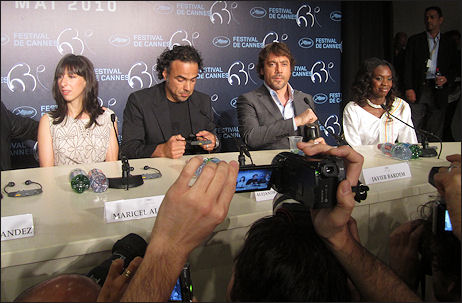
This clip from this morning’s Biutiful press conference is visually underwhelming, to say the least, but it offers a good explanation from Javier Bardem and Alejandro Gonzalez Inarritu about what the film is, what they were after and so on. Toward the end of my taping a young festival guy came over and began nudging and whispering that I shouldn’t tape during the conference. Sure thing.

Tamara Drewe Stinks

My reaction to Stephen FrearsTamara Drewe, which screened this afternoon at the Salle Bunuel, was immediate and unambiguous — I hated it. It’s one of those satires of a form (i.e., romantic fiction) that doubles back and has it both ways by satirizing and playing it “straight,” or straight enough so that romantic fiction fans can themselves double-track by enjoying the cliches at face-value while having a good laugh or snicker. Everybody wins…except people like me.


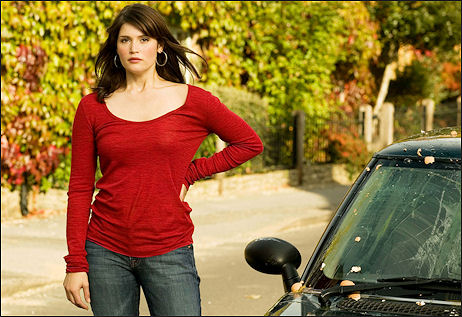
Gemma Arterton in Stephen Frears’ Tamara Drewe.

Boiled down, Tamara Drewe is (a) a comedy by a hip director that’s aimed (whether its backers admit it or not) at intellectually-challenged women of whatever age who read fashion and gossip magazines and older chump-level couples, and (b) a glossy calling-card movie by a director who’s getting on and would like the producers of crap movies to know that he can do “obvious” and “unsubtle” as well as the next guy.

It’s important to absorb Tamara Drewe in the right “insincere” context. It’s first and foremost an adaptation of Posy Simmondsweekly comic-strip serial of the same name, which itself is a modernized, “insincere” adaptation of Thomas Hardy‘s “Far From The Madding Crowd.” (Simmonds’ complete work appeared in hardcover in 2007.)

Hardy’s novel was about three fellows vying for the affections of the beautiful Bathsheba Everdene (played by Julie Christie in John Schlesinger’s 1967 film) — a brawny, whiskered man-of-the-soil type (Alan Bates), an older gentleman of property (Peter Finch), and a dashing mustachioed heartbreaker (Terence Stamp). A lot of horseshit happens, but she winds up with Farmer John at the end.

Frears has the astonishingly empty and generally worthless Gemma Arterton (soon to appear in Prince of Persia) playing Tamara Drewe, an updated Everdene who stirs the hearts and loins of three fellows when she arrives at a writers’ retreat in an English country village. (The film was shot in, around or near Dorset.) Tamara is a newspaper columnist who comes from the area, when she was mildly homely due to an enormous honker. Then she got a nose job, making herself into quite the beauty and yaddah yaddah.

The Bates role is played by Luke Evans, the Finch role by Roger Allam, and the Stamp role by Dominic Cooper.

All I could think as I watched Tamara Drewe was “what a piece of empty unfunny synthetic crap this is.” The fact that it’s satirizing other works that are genuinely, sincerely and wholeheartedly crappy as opposed to being ironically crappy is of no interest to me. I only know that I was in pain.

Frears is generally regarded as a first-rate director who lacks a particular visual or stylistic signature, and who goes where the material takes him. But I found it appalling nonetheless that the director of Bloody Kids, The Hit, High Fidelity, The Queen, Dirty Pretty Things, The Grifters, My Beautiful Laundrette, Dangerous Liasons and Prick Up Your Ears could make a film as icky and over-scored and postcard-vapid as Tamara Drewe, even with such values being rendered “in quotes.”

Move It

The digital loading rates are slow as usual in the Orange cafe (my video was converted to mp4, but You Tube won’t even appear) and now I have to get myself to the 1 pm screening of Stephen FrearsTamara Drewe, which starts in 23 minutes.


At the start of this morning’s Biutiful press conference — 5.17, 11:19 am.

5.17, 11:59 am.

Biutiful, Sadness, Humanity

Alejandro Gonzalez Inarritu‘s Biutiful, which ended about fifteen minutes ago, is a sad, deeply touching hard-knocks, lower-depths drama in the tradition (or along the lines, even) of Roberto Rosselini‘s Open City or Vittorio DeSica‘s The Bicycle Thief. How’s that for high praise out of the gate?

Set among the poor and deprived in Barcelona, it’s about love and caring and continuity and carrying on among those who have it toughest, and dealing with guilt and tradition and the approaching of death and all the rest of the stuff that we all carry on our backs.

Every actor is exactly right and spot-on in this film, but Javier Bardem gives a truly magnificent performance in the title role of an illegal migrant labor and street-vendor manager-facilitator. He looks right now like the most likely winner of the festival’s Best Actor award just as Biutiful itself seems well-positioned right now to take the Palme D’Or.

It starts out brilliantly, and then slips into a longish character-introducing, character-building, filling-in-the-details phase that goes on for a 90 minutes or so, and then — bit by bit, and then in increasing increments — it starts to emotionally kick in. And that’s when I knew it was delivering something special.

I have to stop writing because the press conference is just starting.

This Is It

Alejandro Gonzalez Inarritu‘s Biutiful will screen in 22 minutes and I haven’t left the apartment yet. Some believe that the Barcelona-set drama with Javier Bardem is the last best hope of the festival for a serious home run.

Happens Just Once

My eldest son Jett graduated last weekend from Syracuse University with a major in journalism. The photos arrived this morning. I regret not having been there.

Collapse

After my Ellen Barkin encounter I went to Lucy Walker‘s Countdown to Zero, a doc about the proliferation of armed nuclear devices, but didn’t see it due to the flu-like thing that’s been taking hold within. I promptly went under. Sharon Waxman will confirm this as she was sitting right beside me.


Will you look at that slightly stooped-over posture? Like a mailman at the end of the day. An ex-girlfriend told me a few weeks bacjk to sit up straight and stand up straight. Now I get what she meant. There’s nothing cool or soulful in slouching or stooping. Stand hard and tall like a Marine, or stand not at all.

Being too shagged to write and needing a late afternoon time-filler, I went to a second showing of Charles Ferguson‘s Inside Job, and it was no less crisp or brilliant or urgent for that. I was allowed to sit in an elite reserved row, five or six seats down from Sony Classics co-honchos Michael Barker and Tom Bernard. And then Oliver Stone arrived at the last minute and sat right next to me.

I was in that same depleted mode, of course, but I didn’t nod off — a credit to the quality of the film, I suppose.

I tried to write a bit more and failed. And then I bought some groceries, and stumbled back to the apartment. I flopped down on the couch and promptly went out. I woke up shivering at 2 am — no blanket, lying there in my clothes, shoes still on — and grabbed the blanket, which is heavy and slightly itchy, and went back out.

Barkin

For me, Ellen Barkin, the star of Cam Archer‘s fairly dreadful Shit Year, is movie-star material. Which is why I sat in the front row with my camera and my computer and my touch of a fever at the American Pavillion’s panel area and waited to see her, even though she kept everyone waiting for nearly 40 minutes.


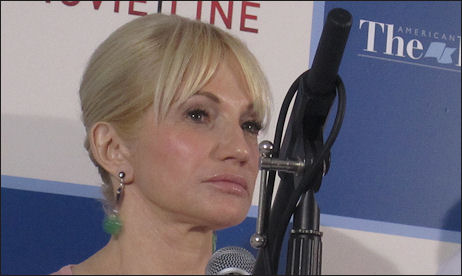
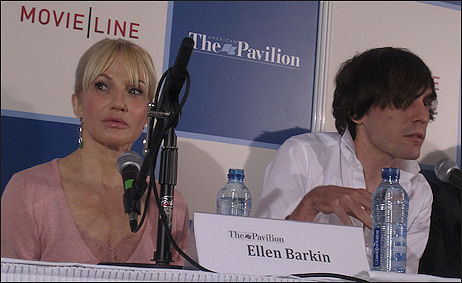
Ellen Barkin during this afternoon’s American Pavillion panel discussion of Shit Year, which was considerably delayed by Barkin’s tardiness.

Barkin, Shit Year director Cam Archer — 5.16, 12:55 pm.