Whirl

Last night I caught my second viewing of John Curran‘s Stone (Overture, 10.8), and it played just as well as before. And then came the Peggy Siegal after-party at a corporate, high-ceilinged space on 41st Street near Fifth Ave. Curran and Ed Norton were milling around. The usual assortment of filmmakers, distributors, agents, actors, friends and journalists. Really excellent food — chicken, rissotto, vegetable salad, etc.

I wrote last August that the Stone trailer “makes it seem like a more-or-less conventional crime melodrama. In the midst of evaluating an apparently psychopathic convict (Norton) regarding an upcoming parole hearing, a retirement-age prison counselor (Robert De Niro) succumbs to sexual favors offered by the prisoner’s scheming wife (Milla Jovovich). We all know where this is likely to go. Exposure, revenge, moral ruin, chaos.

“Guess what? It goes somewhere else entirely. And I mean into a realm that, for me, is not far from the one that Robert Bresson mined in the ’50s and ’60s and early ’70s.”

Stay With Let Me In

I apologize for suggesting during last weekend’s “Oscar Poker” podcast that Matt ReevesLet Me In is all but finished as a potential awards contender because it fizzled at the box-office. It’s not. It’s one of the finest films of the year and one the most touching and thematically rich vampire films ever, and just because the popcorn crowd didn’t rush out to see it last weekend shouldn’t mean all that much.

I certainly shouldn’t have succumbed to the conventional wisdom, and anyone else who erred as I did needs to apologize also. It was wrong of me. It was an abdication of what columns like mine are supposed to do, which is to say over and over “most of the time the crowd has no taste, box-office performance is over-prized, and if a film is really and truly high-end then it’s really and truly high-end, and attention must be paid.”

Every so often the best and the brightest (or those who imagine themselves as such) need to step back and remind themselves that there’s a lot more more to movies than the Preakness betting-window mentality, and that we all need to step back and consider the greater scheme, and if we don’t do this we’re all just a bunch of monkeys in a cage.

In the ’60s or ’70s Let Me In could have potentially hung in there and sought to establish a box-office footing. If a 30 year-old Warren Beatty had produced Let Me In he’d be banging right now on the door of Ryan Kavanaugh (the current owner of Overture) and demanding that the film be re-released with a different marketing campaign. Now, as we all know, it’s a game of sudden death or the opposite, and more often the former.

I don’t dispute that that the Academy members have probably forgotten about Let Me In — they primarily reward films that make them cry and/or make money — but don’t forget that a war film that made a small amount of theatrical change won the Best Picture Oscar last year, so a precedent has been set. It’s certainly the responsibility of critics groups to respect and salute the year’s best films regardless of how much money they’ve made, and this should definitely be one of those times.

"No Rats"

I first saw the extended director’s cut of The Exorcist a few years ago on DVD, and again last week at the Museum of Modern Art. I still prefer the original theatrical cut. Tighter, subtler, a little more concise. It was this version that I popped into the player yesterday when the new Exorcist Bluray arrived. My favorite bit in the whole film is that eerie whoosh-slingshot sound coming from the attic. The scariest stuff is always about suggestion.

Hanks, Drugs, Dogs

Wells: That’s cool about Tom Hanks talking to you guys about starring in Sleeping Dogs. Can you tell me non-attrib who or what Hanks will play? He’s…what, some kind of law enforcement guy? Can you give me the rundown?

Sleeping Dogs guy: I can’t right now, but when I can share I’ll get back to you.

Wells: Not even a generic boilerplate description? Does he play a good guy or a bad guy?

Sleeping Dogs guy: I’m sorry, but you know how this goes. I just can’t say anything.

Wells: I’m going to assume he’s not playing a drug kingpin with a Latin accent and a twirly moustache. I’m going to assume that he plays ‘Tom Hanks,’ just like he does in every other film.

Sleeping Dogs guy: You can assume what you want, but I’m not going to say what you want me to say.

Wells: “Go ahead, try and make me say ‘Niagara Falls!’

Sleeping Dogs guy: “Niagara Falls! Slooooowly I crept, step by step, inch by inch…”

Wells: Who came up with the title Sleeping Dogs?

Sleeping Dogs guy: Why, whadaya mean?

Wells: Nothing. I mean, I like the title. I do. It’s a little bit better than Triple Frontier. Well, somewhat. I’m just remembering a story from the late ’70s about Karel Reicz‘s Who’ll Stop The Rain

Sleeping Dogs guy: Yeah?

Wells: Which was originally called Dog Soldiers, based on the Robert Stone novel, and the reason they changed the title, I read, is that they did a marketing survey and women, they found out, don’t like titles with the word “dog” in it. No dogs. Dog, death. I guess…whatever, they think the word suggests something smelly and male and drooling with saliva.

Sleeping Dogs guy: But this is an expression, obviously. A saying that everyone knows the meaning of — “Let sleeping dogs lie.”

Wells: All right, cool with me, whatever. I’m just saying you can’t mess with women when it comes to movie marketing. If they don’t want to see something, you can’t stop them.

Avoidance

Yesterday Alison Willmore posted a smart, incisive reply to feminist Social Network haters on IFC.com. The film “doesn’t present a world in which women are ‘all gold-diggers, drunken floozies and that ‘bitch’ who got away,” she wrote. “It presents one in which [the] main characters do everything possible to meet girls except actually go out and meet them.

“That ridiculous party that’s juxtaposed with Mark’s assembling of Facemash.com isn’t meant to be a feasible depiction of what life in the final clubs is like — the members order in kegs of beer and kegs of ladies. It stands for everything Mark thinks he’s missing out on, the debaucherous good time the elite are surely having while he sits at home stewing in his own self-loathing. What would he even do if he was invited? He’d just sit in the corner with his laptop.

Mark Zuckerberg, or at least the Mark Zuckerberg of the movie, embodied by Jesse Eisenberg, finds the seeds of his company in the type of obscurely vengeful thought we’ve all found consolation in at one time or another — ‘You’ll be sorry when I’m famous/dead/beautiful/successful/rich!” What’s tragic about Zuckerberg is that even as he builds the company that will become a part of the lives of half a billion people, that will make him the world’s youngest billionaire, he’s still just a closed-off workaholic who has trouble relating to people, and his ex isn’t going to come crawling back because of his achievements.

“We don’t see women around much in general in the film because our main characters have no idea how to meet or pursue or talk to them. The smart, grounded girl the film starts out with — Rooney Mara‘s Erica Albright — walks out on the asshole she’s been dating after he simultaneously ignores and talks down to her. It’s an affirming moment, but we don’t go with her, because it’s the asshole that The Social Network is about.”

Essential

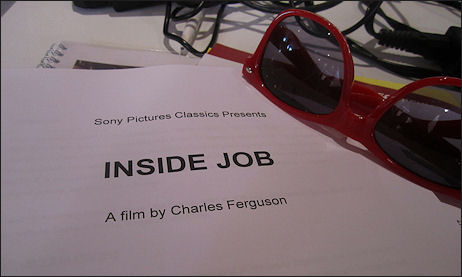
In his 10.6 review of Charles Ferguson‘s Inside Job (Sony Classics, 10.8), Marshall Fine says this brilliant, diamond-hard doc “should be required viewing for all citizens. Instead, it’s destined to be one of those movies that critics rave about and people who already know this material go to see. But it should be shown in every college and high school, in all the economics, civics or social studies classes in America.”

In my review from the Cannes Film Festival, I said that “every Average Joe and tea-bagger needs to see this film at least twice and take notes each time. (Or at least read the press notes.) Will they? Of course not. Inside Job will only play to the educated liberal urbans — the only social class that’s even half-inclined to spend ticket money on documentaries.

“The American public was — hello? — robbed blind and is still being made to suffer by an arrogant den of thieves, and the enormity of their power-corridor hustle is almost too vast and labrynthian to comprehend. But Ferguson’s doc makes it more comprehensible than in any presentation I’ve seen thus far.

Inside Job “delivers a clear, razor-sharp portrait of a gang of blue-chip ogres and world-class motherfuckers (Summers, Paulson, Greenspan, Geithner, etc.), starting with their initial unleashing during the Reagan-era deregulating and moving through a litany of Bush 41, Clinton and Bush 43 sign-offs, conflict-of-interest corruptions, revolving-door deals and mutually beneficial handjobs.

“Too many billions were available, they all got greedy and created games and schemes in order to line their pockets, and here we are. And Barack Obama hasn’t done jack about restraining this culture since taking office.”

Fine agrees and reviews the basics: “If the financial crisis of 2008 has shown anything, it’s that deregulation — a free-market idea championed by Republicans and Democrats alike — has exactly the opposite effect of what is promised.

“Ultimately, it also proves the primitively atavistic nature of human beings: that altruism is an unnatural societal construct and that self-interest is the natural impulse of the human animal. Take away the rules and, rather than benefiting everyone, it benefits only those in the position to exercise power.

“It’s like the long-refuted notion of trickle-down economics: Given the opportunity to keep more of their money instead of paying taxes, corporations and businessmen don’t use that money to create jobs and send more money downward to those in the lower-income brackets. No, they follow human nature and hoard as much for themselves as possible.”

She Can Wait

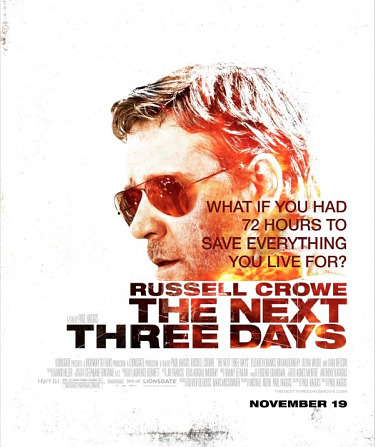
A time-pressure element has obviously been built into Paul Haggis‘s The Next Three Days, but this remake of Pour Elle is primarily about a husband (Russell Crowe) busting his wife (Elizabeth Banks), wrongly convicted of murder, out of jail. So what’s the hurry? She’s not about to be executed like Grace Kelly in Dial M for Murder. She’s in stir so what difference does it make if you bust her out this weekend or three weeks from now or whatever?

I’m saying that I smell the scent of un-grounded artificial tension built into the story if the breakout has to happen with 72 hours. Take it easy, be careful, don’t rush, knock back some brewskis, go to the football game on Sunday, etc. A jail break is not easy. My favorite was when Robert Redford and pals busted out their pal Greenberg in Peter YatesThe Hot Rock ; my runner-up is the organized jailbreak in John Huston ‘s The Macintosh Man, when they air-lifted Paul Newman over the wall with a crane and a net.

Son of Aronofsky Paycheck

Darren Aronofsky has as much right to grab a creative paycheck gig as Chris Nolan or anyone else on that level. He’s one of the very few helmers who can take an over-and-done-with superhero franchise like Wolverine — Jesus! — and make it work. He can bestow integrity. But at the same time there’s something odious about corporate Hollywood responding to the artistry of Aronofsky’s Black Swan by saying, “Wow, great flick…would you take a shot at reviving a ruined pop-trash superhero franchise if we pay you enough?”

I said roughly the same thing on 9.29 when it was being reported that Aronofsky was in discussions with Chris Nolan about directing the Superman reboot.

Better Days

Tim Gunn‘s message about how “it gets better” for anguished gay, lesbian, transgender or conflicted youth applies to any kid who feels suppressed and despairing. I was one of the most miserable kids on the planet in my mid teens (constant criticism and belitting, powerless, alcoholic household) but it got better for me. I also love Gunn, a renowned fashion critic/personality, for having said “the Kardashians have an absence of taste and I don’t think that that should be perpetuated.”

Ditherer, Salad-Tosser, "Benign God"

In a 10.5 Slate piece about the screwy-monkey working habits of Tree of Life helmer Terrence Malick (which must be the sixth or or seventh article in journalistic history to be titled “Absence of Malick”), Jessica Winters notes that “genius filmmakers are allowed to improvise, request supernatural feats from their staff, waste time and money, and generally behave in an inscrutable manner befitting their ineffable gifts.”

Malick, however, is a species unto himself. Here’s a portion of the piece, which mainly focuses on the making of Malick’s The Thin Red Line:

“It seems to me that Terry does so much of his work in the editing room,” explains production designer Jack Fisk on the Thin Red Line Bluray commentary. But there, too, Malick works in mysterious ways. According to one of film’s three editors, Billy Weber, Malick saw a full version of the film exactly once: a five-hour work print assembled during the 18-month-long post-production process, and screened for him under some duress. (‘We forced him to watch,’ Weber says in an interview.)

“Otherwise, Malick edited by watching one reel at a time, with the sound off, while listening to a Green Day CD. If he missed any dialogue, it stayed in; if he didn’t, it would likely be supplanted by music or voiceover. ‘I don’t think he was capable of seeing the movie as a whole during the process,’ co-editor Leslie Jones says evenly. ‘…That was a big adjustment.’

“It’s an adjustment for viewers, too, especially for that fervent cult of fans who have psychoanalyzed, memorized, and immersed themselves in The Thin Red Line over the years. (Among the men in my family, Nick Nolte‘s volatile Col. Tall is as eminently quotable as Jeff Lebowski.) It’s startling to find out that this same obsession-worthy film is not one that its director could find cause to watch in full or to edit with the sound on.

“Still, Malick doesn’t fit into our established category for cinema’s pure artists, who tend to fall somewhere on the control-freak spectrum — think of David Fincher asking for 100 takes of a scene or Martin Scorsese knotting the gangsters’ ties himself on the set of GoodFellas. Malick seems to be a different animal: unavailable, cryptic, indecisive, evasive, there-but-not-there. (His self-effacement may extend beyond a simple aversion to interviews.) To judge from the admiring but bemused conversations with his cast and crew, Malick is less like a conductor and more like a muse, perhaps, or an elusive father figure, or a benign god in whom an apostle can have faith but nothing so presumptuous as understanding.

“What emerges isn’t a group of people striving to fulfill an artist’s vision, but rather striving to figure out what that vision might be.”