Rewriting Vaughn's Statement

Vince Vaughn‘s 10.14 statement about the “gay electric cars” joke in that now-reedited trailer for Ron Howard‘s The Dilemma was a little too grim and butt-plugged. We wanted to hear that guy in The Wedding Crashers do a free-associating riff and lay it down in a kind of motor-mouth style. Instead Vaughn sounded constipated. He was saying what his people told him to say rather than what he really thinks.

“Let me add my voice of support to the people outraged by the bullying and persecution of people for their differences, whatever those differences may be,” Vaughn’s statement reads. “Comedy and joking about our differences breaks tension and brings us together. Drawing dividing lines over what we can and cannot joke about does exactly that — it divides us. Most importantly, where does it stop?”

Here’s what Vaughn should have said: “If you want to write funny and make people laugh, you have to speak in common everyday terms. Trust me, I know what I’m talking about…okay? And as much as I agree with the need to condemn hate speech in all its forms, beefy guys who slurp beers in Chicago bars during happy hour understood and laughed (or at least snickered) at that line. And those beefy guys are okay people in my book. Decent, bill-paying, fair-minded schlubby types who don’t want any kind of hate in their lives or in their heads.

“The line I spoke simply meant that electric cars aren’t studly or swaggery enough in a Clint Eastwood sort of way — that’s all. The line wasn’t putting down gay people or implying anything negative. It simply meant that the thinking and the symbolism behind electric cars them is a little bit guilty and constricted and regimented in a p.c. kind of way, however necessary and eco-friendly those cars happen to be, and that Steve McQueen would never drive one.

“That’s all it was. Just a joke that average people who are totally down with Anderson Cooper and are not homophobes happened to get. The Thought Police don’t like to hear this, but funny is what people laugh at.

“The other day Jeffrey Wells took some heat for saying there are two definitions of gay. The first simply means being homosexual, and the second means a cross between p.c. overdosing and lacking a certain guy-ness — a kind of sloppy apartment, softball-adept, baseball-hat wearing, hot-dog-eating, Jack Lord in Hawaii Five-O quality. The second definition of ‘gay’, Wells said, is reflective of a certain gelatinous, salad-eating metrosexual thing — a ‘watch your language and be respectful of others and watch your attitude’ attitude. We all know what he was talking about even if if some of you say that you don’t. Leave that shit outside when you’re talking to me…okay? No offense.

“Some said no to Wells. They said there is only one definition of gay and splitting the definitions is denigrating gays all the same. Okay, maybe so. We’re not assholes and we don’t want to imply or pass along harmful things so maybe we’ll just cut the fucking line out of the film. But there’s something just a teeny bit Soviet about what I’ve been hearing.

“Can I be honest? Can I just say it? Fuck it — LexG said it better than I can: ‘Going green is gay, energy-efficient vehicles are gay, and sandals are incredibly gay. And saying that isn’t on par with dragging Brandon Teena into a cornfield, and does not even remotely in any microscopic way contribute to actual homophobia or hate speech.’ But we’ll probably lose the line anyway because we don’t want to be seen as dicks, and I’m sure we can all rest easy that because a two-second snippet has been cut from the trailer and — this is Ron and Brian’s call — the film itself.”
Ixnay on Colored Girls

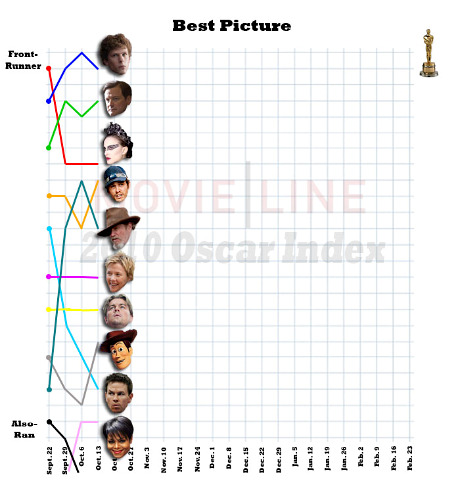
Yesterday Movieline‘s Stu Van Airsdale posted a Best Picture Oscar chart. The leading ten, he says, are (starting from the top) The Social Network, The King’s Speech, Black Swan,127 Hours, True Grit, The Kids Are All Right, Inception, Toy Story 3, The Fighter and For Colored Girls.

Look — I thought I explained a while back that Tyler Perry is too mediocre a filmmaker for anyone to even imagine that he might get lucky with For Colored Girls on the strength of it being based on a respected mid ’70s B’way play. He’s a niche director who’s made a lot of money, but his movies make people like me groan. The odds of For Colored Girls turning out even half-decently are not very high. People need to stop dreaming about this film.

And enough with putting FCG on these lists because Perry is the only African-American director in the pack. If FCG becomes a miracle turnaround, great. But no counting the eggs before they’re hatched, and no quotas.

Once the general community comes to its senses about Perry’s film, they need to rally around Blue Valentine. Really, truly. The Best Picture roster needs at least one super-passionate, go-for-broke love story. Plus Blue Valentine fills the slot for the too-cool-for-school John Cassevetes “little movie” category.

Other Alternates: Secretariat is too square and conservative, and it won’t be making enough money to elbow its way in. Mike Leigh‘s Another Year could easily make the grade. The Way Back hasn’t been seen by those who couldn’t afford Telluride. Made in Dagenham is a relatively decent, well-acted film about women getting the wages they deserve in a 1968 Ford auto plant, but don’t get your hopes up.

Credit Where Due

Why would Brooks Barnes run a recent N.Y. Times story about HBO’s forthcoming Phil Spector biopic with Al Pacino without mentioning the obvious inspiration? I’m speaking, of course, about Vikram Jayanti‘s The Agony and the Ecstasy of Phil Spector, which opened at Manhattan’s Film Forum last June and received lots of publicity and praise during a brief run.

Pacino and screenwriter David Mamet and producer Barry Levinson can say they just decided to make a movie about Spector out of the blue because they know all about his murder case and love his music and so on, but how many people are going to believe them? Spector has been in the slammer for over a year (since May 2009) and had been more or less forgotten until Jayanti’s doc put him back into the conversation three months ago.

The decent thing would have been for Pacino/Mamet/Levinson to give a nod to Jayanti in the article and also toss him a fee for providing the inspiration. Barnes, at least, should have asked the questions or mentioned the doc or something.

Creeper

Next Wednesday I finally get to see Andrew Jarecki‘s All Good Things, a bad-marriage-leads-to-murder drama “inspired” by the history of rich-guy Robert Durst (Ryan Gosling) and the probably-foul-play-related disappearance of his wife Kathie (Kirsten Dunst) in 1982. My interest is based solely on my admiration for Jarecki’s Capturing The Friedmans, the 2004 doc that was also about creepy weird stuff inside the home of a New York-area family.

All Good Things was originally skedded to open via the Weinstein Co. in the summer of ’09. It didn’t happen and the film changed hands. Magnolia will open it in Manhattan on 12.3.10 “with national expansion to follow.”

Will. Not. Emote.

Under some protest I saw The Girl Who Kicked The Hornet’s Nest at last weekend’s Hamptons Film festival, and the same thought I had while watching The Girl With The Dragon Tattoo returned. Noomi Rapace‘s shark-eye performance as Lisbeth Salander is a bit of a drag. It’s the easiest thing in the world to be impassive and show no emotion, and that’s all she does in both films. She gets all frozen and still and blank-faced, and holds onto this like a gila monster.

I’m mentioning this because a 10.14 Entertainment Weekly/Popwatch piece by Keith Staskiewicz mentions that Rapace has made the Hollywood rounds and is reportedly close to signing onto The Last Voyage of Demeter, a Dracula flick, on top of already-bagged roles in Sherlock Holmes 2 and Mission: Impossible 4. I get the part about attracting female audiences because of the Girl movies, but there’s absolutely nothing happening inside or behind her eyes. She’s a punk mannequin poseur.

Tough It Out

As I wrote in a 9.30 piece called “Betty Ann Brockovich“, Tony Goldwyn‘s Conviction (Fox Searchlight, 10.15) is on the rote and humdrum side. It’s one of those come-from-behind stories about a working class woman (Hilary Swank) with a fairly demanding life who achieves the seemingly impossible task of….zzzzzzz. Sorry. Where I was I?

I love how Marshall Fine tries to turn it all around and give Conviction points for being plain and unpretentious and using “straightforward storytelling.”

“There’s no equivocation here — you know who you’re supposed to be rooting for right from the beginning. And the movie tells the story from start to finish, without pausing to show off the director’s stylistic chops at the expense of the film. Linear plots – what a concept!

“Yet there currently is an arm of film criticism that disdains exactly that: movies that tell a story from start to finish, about characters who are human, identifiable and even (perhaps especially) likable. You can throw a stone at any press screening in Manhattan (or any of a number of urban centers) and hit more than one critic for whom that description is their idea of a movie that is stodgy, old-fashioned and not worth their time.”

Fine goes too far, however, when he calls Conviction “an old-fashioned underdog drama in the best sense of the term, the kind of crowd-pleaser that The Blind Side was last year.” It may be the same “kind” of film, but it isn’t as involving or well assembled or top-flighty as The Blind Side — not by a damn sight. Fine then concludes by saying Conviction “could have Oscar potential.” Oh, yeah?

Another MPAA Smothering

It was revealed last weekend that Derek Cianfrance‘s Blue Valentine, which I warmed to after catching a slightly shortened version at the Hamptons Film Festival, had been hit with an NC-17 rating. This morning the pic’s distributor Harvey Weinstein (i.e., Weinstein Co. co-honcho) said in a statement that “we are taking every possible step to contest the MPAA’s decision…we hope they will see that our appeal is reasonable, and the film, which is an honest and personal portrait of a relationship, would be significantly harmed by such a rating.”


Ryan Gosling, Michelle Williams in Derek Cianfrance’s Blue Valentine.

The NC-17 rating was given, I presume, because of a couple of simulated sex scenes — one between Michelle Williams and Ryan Gosling when they’re married, and another between herself and a boyfriend she knew before hooking up with Gosling. Neither is all that provocative. They don’t make you gasp or go, “Wow…pushing the limits here!” They’re just scenes showing people pretending to do the usual-usual…big deal. They’re somewhere between medium and hard R.

There’s also an almost-abortion scene — not graphic but very real-deal in a clinically procedural sense. It shows Williams starting to submit to an abortion procedure with a doctor starting to actually terminate the pregnancy, and then changes her mind and puts a stop to it. This scene may not have been a factor in the ratings board handing out the NC-17, but if it was it’s a very weird and creepy call. Abortion procedures are a fact of modern life, and here’s a scene in which a woman can’t face going through with one, which is obviously a nod to the rightie-conservative pro-life view.

Astrology

I’m a double Scorpio with Libra rising, and because of this I’ve been looked at askance all of my adult life. Mostly by women I’ve known or run into at parties. I’ve also been reading astrological analyses of Scorpios all my life, and it is their opinion, boiled down, that Scorpios are killers — just evil conniving rage-hounds with big stingers.

I wouldn’t want to go anywhere near a Scorpio based on these descriptions. And yet I’ve known Scorpios all my life and have come to like or enjoy or admire or care for quite a few of them. They’re good, worthy, fascinating people, and are never boring or at least are interesting mixed bags. They’re certainly not emotional terrorists looking to shove knives into people and eat their organs for breakfast and then howl from high rooftops.

Astrological authors really have it in big-time for Scorpios. They condemn me and my kind without mercy. So I decided eons ago that the people who write these truly ugly condemnations of Scorpios (“unscrupulous terrorist, morbid jealousy, total arrogance, sadistic and aggressive brutality”) are deranged, and to throw out the whole astrological analysis thing and just trust my own instincts and feelings.

I know what the Scorpio drill is. It partly means a person with a tendency to lash out when feeling weak and vulnerable and threatened. There’s a current of truth to this. I’m not a day at the beach when I’m being cornered and attacked. But I’m not a zoo animal either. I have thoughts and insights and observational powers and experience and determinations that have come from decades of living. And I know what “Taurus” and “Virgo” and “Libra” and “Gemini” and “Aquarius” mean, and it’s mostly just sloppy crap shorthand that sometimes echoes in little ways and sometimes has nothing to do with anything.

To hear it from the astrology crowd each and every person born under the Scorpio sign is a problem. Millions of people across the globe walking around with arrogant and sadistic terrorist personalities, ready to pounce on their victims and rip them to shreds and chew their ears off because of when they were born? It’s material from a cheap horror film.

I’ve gotten to know and and have worked with exceptionally bright and accomplished people all my professional life — the best people in the top fields — and no one of any brain size or developed intelligence buys into astrology as anything more than a burp diversion while buying groceries. It’s the truth. We’re all astrology dilletantes, but no one who’s been around and knows what goes is any kind of real follower.

The ones who do subscribe to astrology tend to be (no way around this) women for the most part, and women in particular who haven’t had a thorough education. I’m sorry if this sounds dismissive, but astrology is for people who read Tarot cards and go to seances and read supermarket tabloids. It attracts people of limited perception and intelligence.

Agreed

Olivier Assayas‘s Carlos (IFC Films, 10.15) is “five and a half hours of border-hopping, bombings, botched attacks, a brutal but bungled hijacking, and many, many short scenes in which bearded men and beautiful, impassive women sit in small rooms and strategize how best to advance the Palestinian cause and defeat the imperialist capitalist world order.

“You might opt to see Assayas’s condensed [150-minute] version [but] I say go for the whole shebang. Shot by shot, scene by scene, it’s a fluid and enthralling piece of work. I wasn’t bored for a millisecond.” — from a review by New York‘s David Edelstein.

Let It Go

There’s nothing to be gained from another Chris Nolan Batman film, and that goes double when it comes to Tom Hardy (Bronson) playing the villain. Because Hardy’s schtick (i.e., intense shaved-head machismo) is just too obvious and big-foot primitive to steal the cool-villain crown from Heath Ledger‘s Joker. And even if Hardy does pull something off it’ll still be the same old superhero vs. super-villain crap. In the realm of fresh-water storytelling and magical potions of imagination, a reboot of a big fat corporate franchise is like toxic waste in the water table. What is Nolan thinking? Does he want to move forward and upward or slide back into the trough?