Coverage

Yesterday afternoon The Hollywood Reporter‘s Jay Fernandez quoted an amsuing excerpt from Peter Bart‘s “Infamous Players: A Tale of Movies, the Mob, (and Sex)” (Weinstein, 5.3.11). It concerns the fabled Julie Christie-Donald Sutherland sex scene from Nicolas Roeg‘s Don’t Look Now (’73), and whether or not the couple actually “did it” during filming.

According to Fernandez, who’s read galleys of the book, Bart unequivocally says “they were fucking on-camera.”

The following exchange happened between Bart and Roeg on the Venice set as this scene was being shot. Bart: “Nic, don’t they expect you to say cut?'” Roeg: “I just want to be sure I have the coverage.” Bart: “His dick is moving in and out of her. That’s beyond coverage.”

HE Lite

I have surely heard the cries of HE readers, complaining of slow loading. I myself have felt the anguish of the drip-drip-drip. So today we cut down the number of postings on the front page — formerly 50, now 30. And we’re going to be more vigilant about accepting flash ads, which can also slow things down.

"The Material Isn't There"

Variety‘s Andrew Stewart reported earlier today that Sony “many finally be conjuring up its long-gestating Harry Houdini project” with Francis Lawrence (Water for Elephants) directing and Jimmy Miller producing — and that’s fine. But I’ll bet serious money that neither Lawrence nor Miller have thought about what would make a good movie about the legendary escape artist (and what would make a bad one) as much I have. Seriously.

In the late ’80s and early ’90s the late Stuart Byron and I had a small business called re:visions that sold analyses of stalled or otherwise troubled film projects. 22 years ago we co-researched and co-wrote an exhaustive 36-page analysis about why Rastar Prods. (the Columbia-based filmmaking company run by the legendary Ray Stark) had repeatedly tried and failed to get its own Houdini movie before the cameras in the ’70s and ’80s, despite having commissioned scripts from the highly skilled James Bridges, Carol Sobieski and William Goodhart.

Our opinion, in a nutshell, was basically “forget it.” We delivered our opinion on page 4, as follows:

“We began our immersion into the Houdini material under the hope that we’d strike oil, some structural flaw or hidden theme that everyone had missed, and thus resurrect the [Houdini] project as it was originally conceived. But after slogging through three Houdini biographies, two-and-a-half stage treatments done for Ray Stark, all of the scripts (some Rastar-owned, some not) and treatments, and various research materials assembled in the Rastar riles through the years, we came to a conclusion which surprised us — certainly one for which we were unprepared.

“The material isn’t there.

“It is not the fault of James Bridges, Carol Sobieski or William Goodhart that none could write a producible script. Harry Houdini may have had a fascinating career. His stage act may have been the biggest knockout of his day. And he may have had, on some deeply repressed level, strong inner conflicts that render him a subject for psychological discourse.

“But he did not lead an interesting life. Indeed, of all the major celebrities of the 20th Century, it could be argued that Harrry Houdini led the dullest and most uneventful off-stage existence. Houdini may have led a life that, to him, was incandescent, but reading about requires great amounts of coffee and fortitude. The dramatic dullness is unrelenting. We wished that once, just once, Harry Houdini had failed in some performance and been publicly humiliated. Or that he’s suffered some crisis of confidence. But it never happened.

“Houdini’s is an example, in fact, of the sort of life in which, dramatically speaking, nothing happens.

“He never fell in love with a woman other than his wife (this no adulterous conflicts or guilt, leading to some cinematic flashpoint). He did not have to leave his country and become an exile. He had no serious rivals or feuds (except for the wars of rhetoric between himself and the spiritualists, fought with terminology and metaphor of an obscure, hard-to-grasp nature). His career never stalled due to some interruptus, like having to fight in World War I, or suffering injury or serous illness, or becoming an alcoholic or dope addict.”

And so on and so on. None of this will stop Lawrence and Miller from making something up that is wholly fictional and CG-flamboyant, but the whole reason for focusing on Harry Houdini is the metaphor of escape, and the fact many of his escapes were done in “real” environments and not as a showbiz presentation.

Aahh, forget it. It’s a different world, a different set of rules. Lawrence and Miller are going to do whatever the hell they want, but they may as well invent something out of whole cloth instead of trying extract something true and historical.

Dinosaur D-Day

I don’t think there’s anything terribly thrilling in the official announcement that Terrence Malick‘s The Tree of Life will have its world premiere at Cannes 2011. The big news would have been if Fox Searchlight, the film’s distributor, had decided not to show it there. But we all knew this was coming, just as we know that if Malick could have figured a way to delay showing Tree another year, he would have done so.

Things have changed since The Tree of Life was a no-show at Cannes 2010, and I’m telling you that this Sean Penn-and-Brad Pitt darn-my-dad family dysfunction flick is no longer enough to truly quicken the pulse of the Cannes cognoscenti. In terms of showing a film by a major American auteur and/or some sort of prestige-level director, Cannes 2011 needs something else to make itself vibrant and whole.

Because Tree, I fear, is going to deflate when it finally screens. Too much time in post-production always indicates convolution and a lack of clarity — let’s face it — and it often means double-trouble when the film in question is based on a decades-old idea and a dust-covered script that a director has been waiting half his life to put before cameras.

No, we need something else from this country to play Cannes. As George Clooney said to Tilda Swinton in the finale of Michael Clayton, “I want more.” Something bolder and out of the blue — ballsier, more exciting, cooler, more flamboyant, etc. Because Malick, gifted fellow that he is, has fiddle-faddled for too long. I’m sorry, but that’s how it smells now. And I’m saying this as someone who would dearly love to be proved wrong, if warranted. But I know in my heart and in my insect-antennae vibrations that this film is going to be trouble.

And They Said "Okay"

A couple of hours ago on KCRW I heard a quote from Jeanine Basinger stating that the late Elizabeth Taylor launched the era of the superstar salary by hardballing it with 20th Century Fox executives during initial Cleopatra negotiations by saying, “If you want me, you’ll have to pay me a million dollars.” As I heard it the million dollar demand was actually meant in jest. She didn’t want to do effing Cleopatra and figured, “Okay, this’ll get rid of them — ask or some ridiculous amount.”

Read more

He's Da Lovely

The new King of Kings Bluray (Warner Home Video, 3.29) arrived yesterday. I’ve said before that it’s not the spiritual content of this so-so 1961 Biblical canvas flick (which I can take or leave) as much as (a) the lusciously detailed Super Technirama 70 photography, which looks mouth-watering on the Bluray, (b) Miklos Rosza‘s legendary score and (c) Jeffrey Hunter‘s performance as Jesus of Nazareth, which seems wooden and posed at first but gradually deepens and sinks in during the second half.

The best journey-of-Christ movie is Martin Scorsese‘s The Last Temptation of Christ followed by Pier Paolo Pasolini‘s The Gospel According to St. Matthew. But in an odd way King of Kings has a special vibe about it due to Hunter’s Nazarene, who is at once Hollywood-fake and yet captivating and soothing. That handsome face, that nut-brown hippie hair, those light blue eyes, and that red-and-white outfit that he wears during the Sermon on the Mount scene.

I might as well just spit it out: there’s a vaguely erotic appeal to Hunter’s Christ. All the King of Kings characters look at him with half-goofy, half-awestruck expressions, but it’s hard not to presume or imagine that they’re also taken by his physical beauty. (Even Ron Randell‘s Roman Centurion seems to regard him in this light.) There’s no question during the watching of King of Kings that Hunter’s Christ is far and away the best looking….okay, I’ll say it…the hottest guy in the film. If I were a gay Judean and he wasn’t the Son of God…

Two or three years ago I mentioned a sartorial similarity between Hunter’s Jesus and Rebel Without a Cause‘s James Dean with both wearing bright red tunics on top of white T-shirts in climactic scenes. One assumes this was at the urging of Nicholas Ray, the director of both films. Let’s not forget that Ray, according to one or two Dean biographies, had some kind of sexual affair with Dean during the making of Rebel. So it’s at least possible that he injected a subtle erotic undercurrent into King of Kings….maybe.

Technical sidenote: Super Technirama 70 provided 70mm release prints, but not from a 70mm (or 65mm) negative. It used a horizontally-run, 8-perf film almost identical to VistaVision, but with an anamorphic squeeze during the photography so that both 35mmm anamorphic and 70mm prints can be made from the negative.

Misgivings

Except for Netflix, these Google Ads that went up today are horrific. I’ve never had ads on this site that looked so ugly and low-rent and angled at the Walmart crowd. HE happens to be in an in-between period between film-campaign ads, and I was persuaded to allow the Google Adsense ads to run because it’s money and it couldn’t hurt. But look at them! They do hurt!

Liz Is Dead

I once saw Elizabeth Taylor in the flesh. She was standing about ten or twelve feet away in a dense crowd of guys at an after-party at the Roxy, the popular Manhattan roller disco on West 18th, sometime in ’79 or ’80. I managed a glimpse or two of her eyes, and was slightly surprised to discover that they really were as beautiful as I’d been told. I was mesmerized. I think I actually said out loud, “Wow.”


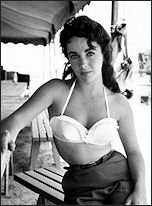
Elizabeth Taylor in either a Cat On a Hot Tin Roof or Butterfield 8 publicity still.

I’d been looking at Taylor in film after film all my life, of course, but those real-life peepers had an extra-glistening, pools-of-passion, send-your-hormones-to-the-moon quality that I’d never quite gotten from a live female before. And they actually did seem to be violet colored, as legend had it.

And now she’s gone at age 79. Everyone and everything fades and recedes and moves on to the next dimension and/or state of being — no exceptions. The once-legendary Taylor, who hit her career and erotic hottitude peak between ’51 (A Place in The Sun) and ’60 (Butterfield 8), has left the earth. Death will happen one day to Chloe Moretz, to Angelina Jolie, to Johnny Depp, to Justin Timberlake, to myself, to Tom O’Neil, to Scott Feinberg, to my two cats….it’s as natural as breathing. But no one likes to think about that, and when somebody like La Liz passes away, it’s like everyone is collectively taking a big solemn gulp and saying, “Uhhm…oh, wow, yeah…of course.”

And the natural urge is to celebrate the highlights. But I can never quite bring myself to do that. Not 100%, I mean.

I’d heard early on that Elizabeth Taylor wasn’t the brightest bulb on the planet. I’d heard a story about her being at a pool party and asking someone what the calendar date was, and that person suggesting that she check the newspaper lying on a table nearby, and Liz doing so and saying the paper was no help because it was from the day before…or words to that effect.

But I heard and read a lot more about her as time went on, and I became persuaded that she was tough and real and super-loyal to her friends…although I never understood why she befriended the freak known as Michael Jackson. I had read once that she saved Montgomery Clift‘s life just after his 5.12.56 car crash by extracting a dislodged tooth that had been stuck in his wind pipe. By all accounts she was a good person to know and share time on the planet with, and also that she was feisty and steady and reliable and no fool. And she liked to drink and have fun and laugh through it all….hah!

I think, in short, that she might have been a somewhat better person than she was an actress. I’m not dismissing her very good ’50s performances in A Place In The Sun, The Last Time I Saw Paris, Giant, Cat on a Hot Tin Roof, Suddenly Last Summer and Butterfield 8. But she was really quite atrocious — certainly miscast — in the miserable Cleopatra, and with the exception of her brilliant, possibly all-time best performance in Mike NicholsWho’s Afraid of Virginia Woolf, she stopped getting the good roles after that and just wasn’t a very interesting presence in the ’60s and ’70s. She was pretty much out of the game by the early 80s.

Her golden time was the 1950s, period, and she was at her hottest back then also. She started to put on weight after Butterfield 8 (i.e., after she hit her early 30s), and the hard truth is that she looked vaguely plump in Cleopatra, and that roundish, slightly boozy and besotted look never went away after that. I’m sorry but that’s how it pretty much was. But those eyes of hers were givers of rapture and splendor.

Taylor lived a hell of a life, and stories will be told and re-told about her over the next two or three days that will refresh feelings of affection and respect and nostalgia, etc. She knew and jousted and clinked glasses with all the best people of her time, and sometimes loved and/or went to bed with men of great style and accomplishment and character and pizazz. (Except for Larry Fortensky.) It’s become more-or-less accepted doctrine that Richard Burton was the love of her life.

Does GenX or GenY know or care about Taylor? Probably not very much.

Honestly? I was looking around this morning for that SNL clip from ’78 or ’79 when John Belushi dressed up as Fat Liz eating fried chicken (and being interviewed by Bill Murray), and then pretending to choke on a chicken bone — that was hilarious.

My only other first-hand connection with La Liz has been my numerous sleepovers at the Nicky Hilton-Elizabeth Taylor house on Route 102 in Georgetown, Connecticut, as the guest of cartoonist Chance Browne. It’s a small cottage where Hilton and Taylor stayed for a period in 1950 during their brief rocky marrriage before she sued for divorce (she complained of spousal abuse) — local legend says Hilton threw Taylor out a window during one of their drunken fights.

In 2.12.11 posting called “Miss Tits”, I wrote that “what life’s natural process does to all of us in the end, even the luckiest and most beautiful and most magnificently endowed, is fairly horrific. I presume it’s understood that it was the great love of Elizabeth Taylor‘s life, Richard Burton, who came up with the above nickname during the shooting of Cleopatra.”