Dogs Peek-Out

A guy I know caught a research screening of Rod Lurie‘s Straw Dogs remake the night before last at the Rave Cinemas (Howard Hughes center) and forwarded a highly positive review save for one complaint that seems premature because there’s time to do some finessing, etc.. Where’s the online trailer that was supposed to be up today?
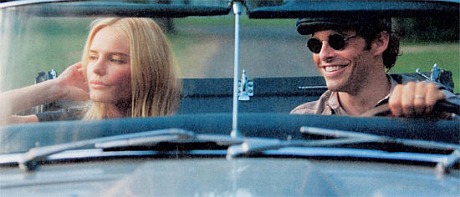

Kate Bosworth, James Marsden.

“Firstly, Lurie has assembled a dynamite cast: James Marsden, Kate Bosworth, Alexander Skarsgard, James Woods and even Walton Goggins (who is absolute nitro-glycerin in FX’s Justified) has a small role. The fact that Lurie was able to attract this cast speaks volumes for his reputation. Is this an award-worthy film? No. Is it a good time at the movies? Yes. Could it be a great time at the movies? Hell yes. But in order to get there I need to wade into spoiler territory. [Deleted.]

“A Hollywood screenwriter (Marsden) and his wife (Bosworth) are moving into a home in his wife’s small rural hometown so he can write his new script, Stalingrad, in peace and tranquility. She had a small role in a TV show he once wrote but we get the impression she’s washed up now (she’s one of the many Straw Dogs in the film, a.k.a people who peaked to early but are now hollow and easily knocked-around and broken).

“Marsden is fantastic in the film. In fact, he’s never been better. He exhudes kindness and decency. He plays the soft city boy with a heart.

“The happy couple settle into their countryside mansion in the middle of a very isolated forest. In town, they run into Bosworth’s old flame (Skarsgard). Skarsgard is everything that Marsden is not — tall, rugged, manly and dangerous. The quintessential bad boy that all girls are attracted to in their teens but eventually grow out of… or do they?

“There are two themes running through the film. The first (and I’m not too sure I agree with this) is that a man can only be a man if he resorts to violence in order to defend his wife. Lurie straddles a dangerous line in the film by presenting us with a wife who is a provoker.

“Marsden kindly hires Bosworth’s ex-boyfriend to fix the roof of the barn… and then Bosworth proceeds to jog around the forest in skimpy clothing (no bra, barefoot). She then complains to her husband that her former flame and his crew of roofers are eye-raping her. Marsden ever so kindly (and he could’ve been an ass but wasn’t) suggests that maybe she should consider wearing a bra next time. Bosworth is obfuscated by this suggestion. So what does she do? Goes upstairs, opens the bedroom window and proceeds to strip in front of the Skarsgard and his crew. It’s an ambivalent, tough scene that says a lot about feminism, power struggles in couples and highlights that actresses (in real life and on film) are a loopy bunch.

“Therein lies the second theme of the film: Do women want the stable, dependable good-guy or do they have deep subconscious yearnings for a bad boy?

“So far the film is great. Fun set-up and as a writer myself, it’s fun to see Marsden create his writing workspace — chalkboard with scenes and notes in a lovely dream office, etc. Marsden is once again great in the film, despite his thankless role — the pussy-fied husband who must grow a brass-coated set of testicles by the end of the film so his Southern Wife can finally respect him (I’m serious)… and he eventually does, in a realistic, believable fashion to boot.

[Deleted comment about a scene our correspondent doesn’t like & wants cut out, etc.]

“The ending is gangbusters. Violent and very un-Lurie-like. Marsden rises to the occasion and all the plot strands come together. Woods is great as a drunken high-school football coach who doesn’t want his teenage daughter flirting with the local developmentally delayed man (Dominic Purcell).

“Yes, there is a fairly graphic rape. Yes, Bosworth is ambivalent in the scene. Does she fight off Skarsgard as hard as she could during the rape? Nope. Does she kinda like it? Sure seemed like that to me (which will surely infuriate the feminists out there). There’s also an incredibly satisfying final kill that involves a bear-trap.

Straw Dogs is a good movie that wants to be great…[excised comment]!”
Payback

Nobody has been slower to post the Horrible Bosses trailer. I have many good excuses — well, one big one — but I’m definitely the caboose.

Dry, Spare, Full Of Itself

Julia Leigh‘s Sleeping Beauty, which just finished showing at the Debussy, is a highly refined, carefully poised erotic mood piece with oodles and oodles of milky nudity. It’s definitely a LexG movie, and I’ll tell you right now I’m kinda sorry I just wrote that. I only know that all through it I was saying, “This thing is candy for guys like LexG…a bag of Halloween candy. But that’s not what you’re supposed to think.”

Emily Browning‘s Lucy is a student who does this and that to make ends meet — high-end prostitution mostly, but she also holds down jobs at a copy shop and a bar/restaurant. And she goes to classes in-between. The film is more or less about Lucy being lost or zoned out in this oddly meandering, downswirl life. She’s not unhappy as much as numb.

I felt numb watching it. It’s obvious that Leigh knows how to deliver those Cannes Film Festival-tailored, high-end cinematic chops in a kind of…I don’t know, a late-Buneulian or Peter Greenaway sort of way. The movie is a class act but most of the time you’re trying to figure out what’s going on exactly. Stop allowing the violations, you’re telling Lucy all through it. But mostly you’re saying to Leigh, “Can this movie get off its arse and do something, please?”

Three or four times I raised my hands in exasperation, hoping that the screen or Leigh or Lucy or whomever/whatever would feel my plight and respond.

I was tempted to use the term “erotic horseshit” in the headline but that’s not really fair. You’d have to call Sleeping Beauty some kind of lost-in-space movie but — but! — it’s very nicely done for whatever that may be worth. Leigh and Browning definitely make you feel the angst and the agony of being used and stuck and flirting with drifting doom. This is a woman without a plan or a dream or anything, really, except for a kind of suppressed revulsion at the stuff she does.

The film does hold your interest because you’re constantly sensing that something is going to happen. And it does, but that “something” is the fact that Sleeping Beauty ends. And that is something.

And with her brave and memorable performance Browning has certainly balanced out the demerits she got for playing Babydoll in Zack Snyder‘s thoroughly contemptible Sucker Punch. Aaron Hillis just tweeted that the film could be called Fucker Punch — good one. The film subjects you to the sight of three old naked guys getting all sick and pervy with Browning, and that, I can tell you, gets very old. Oh, no…here comes another geezer. Please don’t take your clothes off…oh, Jesus, he’s undressing…God. Please don’t show me another withered hairy dick.

But the best moment in the film comes when one of the old guys (I’ll eventually get the actor’s name) delivers a soliloquy about the agony of aging and withering and the falling apart of bones.

At least the film ends with a scream. Maybe Lucy has finally had enough, you’re thinking. Some in the audience shared that resolve, I suspect. I’m not sorry I saw Sleeping Beauty — I’m a better man for it, I think. But I’m not exactly delighted either. Leigh, a novelist, can certainly compose and frame and abbreviate and…well, direct in what anyone would call a highly oblique, dry-as-a-bone manner.

Light Paris Embrace

There’s no fair-minded way to put down Woody Allen‘s Midnight in Paris, which I’m calling a relatively minor piece that works very well by way of charm and humor. The key phrase, of course, is “works very well.” When a film does this then words like “minor” or “trifle” go out the window because a film that knows what it’s doing is by definition substantial and not minor. It may not be the startling world-class masterpiece you’re looking to see, okay, but a success is a success.

You can complain like Indiewire‘s Eric Kohn, but you’ll sound like a guy who doesn’t know when to leave well enough alone. He remarked that while Allen’s film is “generally satisfying” and “casually likable,” it delivers “a slight entertaining touch,” using a “magical hook” — i.e., time travel — in “mostly a conventional way” that is “flimsily conceived” with the back-to-the-20s gimmick gradually “growing tiresome.”

And yet Midnight in Paris “does justice to the universe without taking it in any new directions,” he says, and that’s as good as you’re going to get these days from the 75 year-old Allen.

All you can hope for from a filmmaker who’s been around as long as Allen and has made as many films as he has is agreeable reinvention and refinement. All auteurs make the same film over and over again. Whatever idea Allen comes up with at this stage of the game is probably one he first devised 20 or 30 or 40 years ago. It’s very rare for an artist to capture anything that feels like fresh lightning in a bottle. And any film that delivers a basic truism that everyone can agree with — i.e., nostalgia is a trap, a form of denial — is one that can’t help but resonate. And that’s what you have here.

Here’s a nicely written interview-review by Scott Foundas in the L.A. Weekly.

Paris Is Perfect

The advance buzz was correct: Woody Allen‘s Midnight in Paris is a goodie. I don’t think it’s possible to discuss it without using the terms “thinking man’s fantasy film” or “time-trip movie” or “a down-the-rabbit-hole excursion” so I’ll just say it’s his most charming and engaging film in this vein since The Purple Rose of Cairo…how’s that? And certainly his overall best since Match Point.

On one level it’s almost a trifle except that it’s thoughtful and reality-based (whatever that term may be worth in this context) and very funny…although in a way that requires the viewer to be at least glancingly familiar with the world of Paris in the 1920s and 1880s and ’90s (“la Belle Epoque”). In other words, you need to be at least semi-educated. As we all know that leaves out a significant chunk of 2011 moviegoers so we’ll see how it plays.

Life is always vaguely unsatisfying because it always has been and always will be vaguely unsatisfying to those caught up in the striving and sufffering and the hurly-burly (or in other words everyone, including those with heroin habits.) But Midnight in Paris satisfies very nicely. It is time well spent, and a time-trip worth taking. [Posted from iPhone while waiting for the Paris press conference to begin.]