Intuition, Compassion, Heart

Alexander Payne‘s The Descendants won’t open until 11.18, but the word’s been running strong since Telluride/Toronto, and I think it’s time to settle into a chat about Judy Greer‘s brief but poignant performance as Julie, the wife of a Hawaiian realtor (Matthew Lillard) whose slight relationship to George Clooney‘s Matt King hinges on a relationship her husband has had with Clooney’s wife. She’s only in three scenes, but the final one really gets you and delivers — quietly, almost surprisingly — one of the big emotional moments.


Judy Greer at Le Pain Quotidien — Friday, 10.14, 1:45 pm.

And it hits you later on that it’s not the amount of screen time that counts, but what you do with it and how well you score. And it’s not just about craft but what the audience remembers and feels about your character. (Which is what great acting is finally about, I suppose.) Greer’s Julie has a certain warmth and maturity that settles in. Sensitivity, perception, backbone…the qualities of a good woman. And she sells all this in just…what, ten or twelve minutes? Quality, not quantity.

Everyone knows that George Clooney has a Best Actor nomination locked down and that 19 year-old Shailene Woodley will get lots of recognition for delivering a breakout ingenue performance, but I think Greer is a completely credible contender for Best Supporting Actress. Really. She doesn’t deliver a Beatrice Straight-in-Network performance that just rocks the movie in a single blazing scene, and yet she does kind of do that in a softer, kinder, quirkier way.

In a 9.18 N.Y. Times piece about standout character performances, Manohla Dargis and A.O. Scott praised Greer’s Descendants turn. “Best known for kooky-friend roles in romantic comedies, Greer makes a strong, poignant impression in three scenes opposite George Clooney. [She’s] playing a fairly tangential character: the wife of the man Mr. Clooney’s wife had an affair with. But whether clueless, bewildered or tearful, Greer shifts the film’s center of gravity and alters its emotional chemistry.”

Greer is currently in Manhattan with the Descendants gang (Payne, Clooney, Woodley, etc.) for Sunday night’s New York Film Festival screening at Alice Tully Hall. She’ll be making the rounds all through the season, I expect.


Greer in The Descendants.

Greer and I sat down yesterday at West Hollywood’s Le Pain Quotidien. It was a bit noisy but I recorded about 60% of our chat. I turned it off at one point because I wanted to say something off the record, and then I forgot to turn it on again. Partly, I suppose, because I was having such a nice relaxing time with her. Greer is my idea of a great conversationalist. She knows everything, hears everything, doesn’t put anything on. Her pores are wide open.

Val Kilmer was sitting a couple of tables away with his daughter, and he was nice enough to come over and say hi at one point, and when Judy and I left we were told that he’d picked up our check. Thanks, hombre.

Greer is known as a spunky light comedian, of course, so The Descendants is a big score in that it reminds everyone that she’s got a lot more in her quiver than just pluck and charm and a way with comedy, and it catapults her into that special realm that all contributors to an Oscar-worthy film reside in during Oscar season.

Greer does a lot of television but I don’t watch episodics. Her next significant feature role is in Mark and Jay Duplass‘s Jeff Who Lives at Home, which I missed at Toronto. She projected her usual spritzy, spirited energy in Love and Other Drugs, but that movie was killed by Josh Gad so nobody talks about it.

Greer’s other significant scores have included M. Night Shyamalan‘s The Village (’04), Cameron Crowe‘s Elizabethtown (’05), Thomas McCarthy‘s The Station Agent, and Spike Jonze‘s Adaptation (’02 — i.e., the waitress whom Nic Cage‘s schlumpy screenwriter has a big thing for).


I Miss Being Happy

This is one of the saddest lonely-guy endings ever. It gets me every time. But I always felt that director Bill Forsyth didn’t quite mix the sound at just the right levels for the final shot of the village. The framing should have been a little tighter on the red phone booth, and the ring-ring should have been a bit louder with Mark Knopfler‘s music turned down just a tad. If you’re not listening carefully (or watching on your 1998 TV with the sound too low) the ring-ring is almost inaudible.

David Bordwell wrote the following three years ago:

“The original cut ended with Peter Reigert‘s Mac returning to his Houston apartment and staring out at the dark urban landscape — beautiful in its own way, but very different from the majesty of the Scottish shore,. There the original film ended, but the Warners executives, although liking the film, wanted a more upbeat ending. Couldn’t the hero go back to Scotland and find happiness, you know, like in Brigadoon? They even offered money for a reshoot to provide a happy wrapup.

“Forsyth didn’t want that, of course, but he had less than a day to find an ending.

“The movie makes a running gag of the red phone booth through which Mac communicates with Houston. Forsyth remembered that he had a tail-end of a long shot of the town, with the booth standing out sharply. He had just enough footage for a fairly lengthy shot. So he decided to end the film with that image, and he simply added the sound of the phone ringing.

“With this ending, the audience gets to be smart and hopeful. We realize that our displaced local hero is phoning the town he loves, and perhaps he will announce his return. This final grace note provides a lilt that the grim ending would not. Sometimes, you want to thank the suits — not for their bloody-mindedness, but for the occasions when their formulaic demands give the filmmaker a chance to rediscover fresh and felicitous possibilities in the material.”

Big Year Collapse

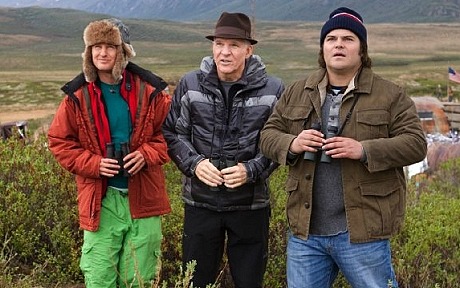
I was so underwhelmed by David Frankel‘s The BigYear (20th Century Fox, now playing) that I forgot to review it. Howard Franklin‘s script about three bird-watching devotees (Steve Martin, Owen Wilson, Jack Black) tries to create an interest in who will catch sight of (or take pictures of, or simply hear) the most birds in a given year. But bird-watching tallies require no proof so anyone can fake a sighting or two. It’s an honor-system competition so who could care? How could such a passive pastime possibly be seen as a “race”?

I hated Frankel’s attempts to inject all kinds of artificial punch-up action. (To think that the director of The Devil Wears Prada might have actually directed Moneyball!). And watching Martin, Wilson and Black doing what they can to keep the energy levels up is like watching three hamsters running inside those cylindrical cages. I didn’t give a damn about any of it.

The general public didn’t either, to go by Deadline‘s Saturday morning report. It shows that The Big Year has come in eighth place with an estimated $3 million weekend haul. It cost $41 million to make before Canadian tax credits, according to a 10.13 “Company Town” article.

“What’s The Rumpus?”

I saw Joel and Ethan Coen‘s Miller’s Crossing 21 years ago, once. And that was it. No seconds because I was soothed as opposed to aroused. I had a good time and enjoyed the hell out of Barry Sonnenfeld‘s cinematography and Gabriel Byrne, Marcia Gay Harden, Albert Finney and John Turturro‘s performances, but it didn’t blow me away. I had it ranked just below Barton Fink and just above Raising Arizona.

I saw it again on Bluray this morning and everything changed. Now it’s a near-masterpiece. Now I plan to watch it every year or so for the rest of my life.

From the Wiki page: “The film alludes to Barton Fink in two ways. Firstly, a prominent newspaper article with the headline ‘Seven Dead in Hotel Fire,’ refers to a fire at the end of that film. And secondly, by naming the apartment building Tom lives in ‘the Barton Arms’.

“The city in which the film takes place is unidentified, but was shot in New Orleans as the Coen Brothers were attracted to its look. Ethan Coen commented in an interview, “There are whole neighborhoods here of nothing but 1929 architecture. New Orleans is sort of a depressed city; it hasn’t been gentrified. There’s a lot of architecture that hasn’t been touched, store-front windows that haven’t been replaced in the last sixty years.”

Miller’s Crossing was a box-office failure at the time, making slightly more than $5 million, out of its $10 to $14 million budget. However, it has made a great deal of revenue in video and DVD sales.

“Film critic David Thomson calls the film ‘a superb, languid fantasia on the theme of the gangster film that repays endless viewing.'”

Ridiculous

From a 10.14 story by N.Y. Times reporter Marc Santora: “The average rental price for a Manhattan apartment in September was $3,331, according to data compiled for The New York Times by Citi Habitats. Last year at the same time it was $3,131, and in 2009 it was $3,013.

“In the past year the increase has been especially sharp. In TriBeCa, for example, a one-bedroom in a doorman building averages $4,635, compared with $3,937 last September, and a similar apartment in Harlem is now $2,398, up from $1,786 last year, Citi Habitats found.

“The average rent for a two-bedroom in a nondoorman building is now $4,137, up from $3,560 last September, according to the MNS survey. In doorman buildings, the average rent for a two-bedroom is $5,857, compared with $5,321 a year ago.”

I pay $850 for a reasonably okay place in a great neighborhood that smells of healthy lawn plants and flowers and moist grass at night. The street is tidy and rubble-free and lined with beautiful trees, and the general atmosphere is beyond quiet — it’s serene. Lots of dogs and cats, and no kids to speak of. Manhattan can go eff itself.