Two Non-Altercations

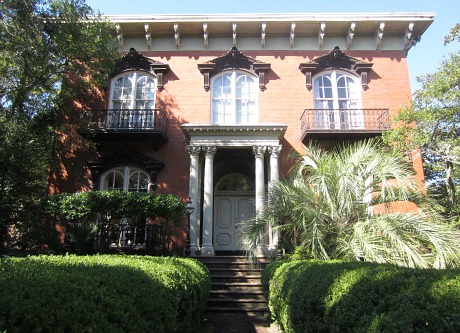
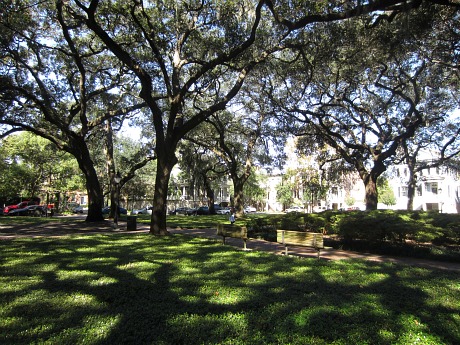
I almost had words with a driver of a dark sedan during this morning’s bike ride through Savannah’s historic district. “Almost” is actually overstating it. I could have had words with this guy if I had a little less self-control.

I was stopping to take a picture on a small cobblestoned street, and a friend pulled her bike over to the opposite side. Along comes asshole in his dark sedan, and he doesn’t like that she’s taking up 18 to 24 inches of space in the right lane. He stops and waits for her to walk the bike entirely out his way before he proceeds. Except she doesn’t, meaning he’ll have to veer ever so lightly into the left lane to pass her. There was plenty of room, trust me.

So he starts in with the expressions. He scrunches his face up to express his contempt for her bike-riding skills. Then he does one of those head-wagging, “tsk-tsk” loud-exhale expressions that says “my God, this woman is beyond pathetic…the people I have to put up with…Jesus!,” etc.

The next “almost” happened in a touristy area near Congress Street. I raised my camera to take a picture of a couple of Clydesdale horses. A woman who was about to walk in front of my viewing path went “oh” and stopped and waited. She was being polite, of course, but I’ve said before that waiting for someone to snap a photo is a mark of middle-class cluelessness about photography. A good photographer has to roll with what happens, and sometimes you can get a better shot if somebody or something is half-obscuring what you’re shooting. You never know, and you’re better off not knowing. I never stop and wait for a picture to be taken…ever.

In any case, I said “thanks…it’s okay…it’s cool” to the woman. But I didn’t say it the right way. She took umbrage and asked if I had an attitude problem. I was just trying to get out of there but just to mess with her head I said “uh, yeah, I guess I do.” She stopped in her tracks. “What’s your problem?” People like you, I wanted to say. People who don’t understand that one of the tenets of mediocre photography is refusing to accept the natural unruliness of life and to just go with what happens when you’re shooting and stop trying to control everything. But instead I said “it’s cool, doesn’t matter” and turned away.
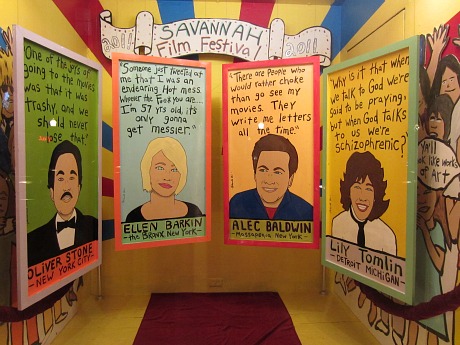
Boxy Rebellion

At 5 pm (95 minutes from now) Alec Baldwin and James Toback will be leading a post-screening discussion of Barry Lyndon (’75) at Savannah’s Lucas Theatre. The Stanley Kubrick film began showing around 2 pm. I waited in the green room before it began to do a chat with Toback (which I’d been told I was scheduled to do), but he wound up doing a longish TV interview and I was shunted aside. I didn’t care that much. I took a nap in an easy chair instead.

I went upstairs to see how Barry Lyndon looked, and was amazed and very pleased to see it projected at an aspect ratio that almost looked like 1.37 to 1 but was definitely boxier than 1.66 to 1. If any 16 x 9 or 1.85 crop fascists had been there they would have been furious. “Chop those tops and bottoms off!,” their mantra would go. “What’s with all the headroom? This is an outrage! Who’s the projectionist?”

The foot-lambert levels were insufficient, of course — it looked like 8 or 9 foot lamberts, definitely on the dark side — and the focus was hazy. This is what your typical theatrical projection of classic films is mostly like these days, for the most part. What you see is nowhere near as sharp and well-lighted and good-looking as the Bluray. Cheers all the same to the projectionist for staging a mini-rebellion and showing this classic film even a tad boxier than Kubrick himself intended.

Second Time Around

I have to be honest and report that I felt under-nourished and bored during my second viewing of Michel HazanaviciusThe Artist, which opened the Savannah Film Festival last night. I felt mostly pleased and charmed when I saw it in Cannes five and a half months ago, but it’s too cloying and simplistic — too much of a peanut- gallery pleaser — to stand up to a second viewing.

Last May I called The Artist “a winning ‘success’ and at the same time a half-and-halfer — a film that delivers beautifully but also leaves you wanting in certain ways. It’s basically a very well-done curio — an experiment in reviving a bygone era and mood by way of silent-film expression.

“Is it a full-bodied motion picture with its own voice and voltage — a film that stands on its own? Not quite. But it’s a highly diverting, sometimes stirring thing to sit through, and the overall HE verdict is a thumbs-up.

“If you’re any kind of film buff it’ll work for you and then some, but I’m not so sure about the under-45 set. Monochrome plus no dialogue are obviously stoppers for the majority of filmgoers out there. Let’s face it — The Artist would have seemed like a quaint exercise if it had been made 35 or 40 years ago by Peter Bogdanovich.

“My basic impression is that The Artist is a very well-done curio — an experiment in reviving a bygone era and mood by way of silent-film expression.

“Is it a full-bodied motion picture with its own voice and voltage — a film that stands on its own? Not quite. But it’s a highly diverting, sometimes stirring thing to sit through, and the overall HE verdict is a thumbs-up.

The Artist has been very carefully assembled, but chops-wise it’s not strictly a revisiting of silent-film era language. It visually plays like a kind of ersatz silent film — technically correct in some respects but with a 2011 sensibility in other ways. It has a jaunty, sometimes jokey tone in the beginning, and then it gradually shifts into drama and then melodrama. But it tries hard and does enough things right that the overall residue is one of satisfaction and ‘a job well done.’

“Shot in Los Angeles, the story of this French-financed production recalls the plots of Singin’ In The Rain and A Star Is Born with a little Sunset Boulevard thrown in.

“It takes place in Hollywood between 1927 and 1931 and focuses on George Valentin (Jean Dujardin) a Douglas Fairbanks-y silent film star who stubbornly refuses to adapt to the advent of motion-picture sound, and Peppy Miller (Berenice Bejo), a Janet Gaynor-like or young Joan Crawford-y actress whose career takes off with sound.

“Hazanavicius uses an entire passage of Bernard Herrmann‘s Vertigo score in the final act, when Valentin is at his lowest ebb.

“It’s interesting that Dujardin strongly resembles Fredric March, star of King Vidor‘s A Star Is Born (1937).

John Goodman plays a studio chief, James Cromwell plays Valentin’s chauffeur, and Penelope Ann Miller plays Valentin’s unsatisfied wife.”

Incidentally: The Artist showed at the SCAD Trustees’ theatre (216 E. Broughton Street, a block away from the Marshall House). It’s been ten years since I last attended the Savannah Film Festival, and I’d forgotten that the screen is way too small for the size and length of this fairly sizable theatre. We’ve all become accustomed to a certain largeness in proportion to a viewing space, especially with the advent of super-sized flat screens. If you’re sitting in the rear of the SCAD theatre the screen looks like your father’s 27″ television. It’s not good enough. The festival fathers need to upgrade.

Rummies

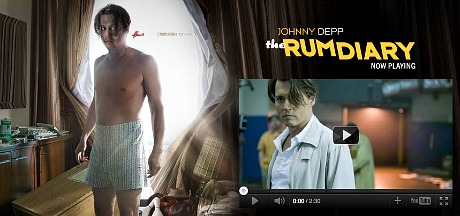
Low-key offbeat mood movies like The Rum Diary have always been tough sells, even if they’re relatively assured and “well made” as far as that goes. The odds are that half the critics are going to take a dump on them because they aren’t dramatic or wacko or plotty enough. But dry, rambling, mild-mannered half-comedies are okay in my book, and I was surprised to discover earlier this week that this long-delayed Bruce Robinson-Johnny Depp film is far from a burn.

Either you let it in or you don’t. It is what it is, and it ain’t half bad.

“No, wait…that’s not what we want!,” says the public. “We want madness, cojones or some kind of extremity. We want deep-river emotion or major nutso insanity or…whatever, something weird or new or jaw-dropping or pants-dropping.” Well, Rum Diary isn’t that. Which is why it’ll be gone from theatres fairly quickly.

If you’ve followed the tortured history of this film, shot in early ’09 and then found wanting by distributors and set out on a path of unloved loneliness, you would naturally expect it to play like some kind of calamity. That’s what I was mostly expecting. And when it turned out to be what it is, I felt mildly pleased. It’s an in-and-outer, mostly an inner, and reasonably adult and thoughtful and measured. It works according to its own modest design.

I for one am sick of the rules of doper or absurdist or extreme-misfortune-happening-to-idiots formulas, and I felt mildly amused and half-charmed by this dry, no-big-deal thing. I loved that it kept its laid-back cool and didn’t force a comedic agenda into the folds of its slight narrative. And the fact that the story, set in 1960 Puerto Rico, feels like it’s actually happening in 1960 and not a 2011 version of same.

Everyone knows the gist of the Hunter S. Thompson book by now. Depp’s Paul Kemp is Thompson as soft clay, uncertain of mission, a pre-60s guy in the sense that the ’60s began with the Kennedy assassination, pre-Hells Angels book, pre-Fear and Loathing, pre-Woody Creek, pre-almost everything.

Rum Diary is basically a Hunter S. Thompson origin saga — i.e., how the late gonzo writer came to find his soul and his voice at the beginning of his career.

Kemp arrives in San Juan to work for a failing daily newspaper, and becomes chummy with the paper’s boozy, slightly fungusy photographer (Michael Rispoli) and some kind of slimy, greasy newsroom oddball (Giovanni Ribisi) who hangs around and drinks. He meets Puerto Rico’s greedy capitalist cabal (led by Aaron Eckhart‘s “Sanderson’) and stupidly falls then falls in love with Chenault, Sanderson’s hottie-blondie girlfriend (Amber Heard).

What happens? Sanderson hires Kemp to write some kind of real-estate brochure that will presumably generate investor interest, but Kemp barely types a word before falling in love with Chenault, which naturally leads to eventual conflict with his employer. This and that happens (a lot of beautiful Puerto Rican scenery) including too much drinking, the watching of one of the Kennedy-Nixon debate on a TV belonging to a neighbor, and the taking of some kind of hallucinogen via eyedrops. But the basic offshoot is that Kemp realizes he despises slick opportunistic hustlers like Sanderson and will henceforth devote his life to giving them as little comfort and as much anguish as possible.

It goes without saying that it’s a pleasure to see Depp not wearing mascara or a pirate hat and being somewhat naturalistic, and at the same time inhabiting the same Hunter Thompson he played in Terry Gillliam‘s Fear and Loathing in Las Vegas (an unfulfilling film that was nowhere near as good as the book) only this time with hair.

I should have written this two or three or four days ago (I saw Rum Diary last Tuesday night) but it wouldn’t come.