Scene Stealers

Amy Berg and Peter Jackson‘s West of Memphis has its first Sundance press screening tomorrow morning at 8:30 am. There’s been friction and contention, of course, between Berg-Jackson and Joe Berlinger-Bruce Sinofsky, makers of three docs about the Memphis 3 including the short-listed Paradise Lost 3: Purgatory. And it’s worth recalling a fact contained in Jason Guerrasio‘s 1.19 Indiewire article, which is that Berg-Jackson drew first blood.

“In 2009, Jackson called on Berg to begin work on a documentary that would reveal…new findings and hopefully exonerate the WM3 (Jackson is a producer on the film). Friction between Berg and Berlinger/Sinofsky built after Pam Hobbs, ex-wife of murder suspect Terry Hobbs, signed an agreement with Berg making her unable to be interviewed for any other film.

“Unable to work out an agreement with Jackson and Berg, Berlinger/Sinofsky felt they had to protect their film and decided to make a similar agreement with some of their subjects, blocking Berg from talking to them.

“Documentary filmmaker AJ Schnack points out this is hardly the first time two documentaries have been made on the same subject, but understands the mixed feelings to why West of Memphis was made.

“‘It’s certainly fair for filmmakers to tackle subjects that have been covered before,’ Schnack says. ‘As far as I can tell, Nick Broomfield holds no grudge that I made a film about Kurt Cobain,” referring to his film Kurt Cobain: About A Son and Broomfield’s Kurt & Courtney. ‘I’m pretty sure that both of us assume that other films will be made about him in the future.’

“‘What makes this case so unusual is that the West Memphis Three story is intrinsically linked to Joe and Bruce’s films. Damien may have been put to death if not for the light that HBO shined on the case and Peter Jackson is on record as saying that he became interested in the case because he saw the first Paradise Lost.'”
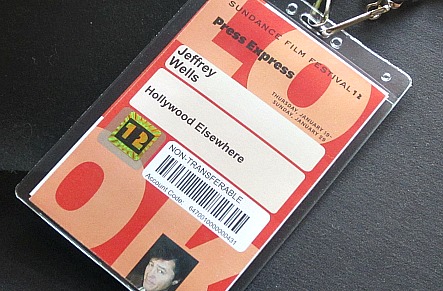

Construction Standards

I’ve written about this before, but anyone staying in a middle- or lower-cost Park City condo is always reminded how second- and third-rate the construction materials are. Plugs fit too loosely in the wall outlets and sometimes fall out. The shower controls are a pain in the ass (i.e., turn the plastic knob to the right or left and nothing happens). The sheetrock walls feel a tiny bit flimsy. A general cheap-ass (i.e, “it doesn’t have to that good, people won’t notice or complain,” etc.) aesthetic. I don’t really care as long as the heater works.

Goodbye, Mr. Putz

FiveThirtyEight’s Nate Silver has reported that Newt Gingrich probably won’t benefit much from Rick Perry‘s endorsement. Mitt Romney is locked in like The Artist. Nobody is really elated by him and everyone has a beef or two, but no matter how badly things go perception-wise from now through summer he’s still going to be the Republican nominee.

Throwback?

Ry Russo Young‘s Nobody Walks (Eccles on Sunday, 12:15 pm) is about a 23 year-old New York artist (Olivia Thirlby) crashing with a Silver Lake family (John Krasinski, Olivia Thirlby, Rosemarie DeWitt, Justin Kirk, India Ennenga) and stirring the sexual pot all around. The script is by Russo-Young and Lena Dunham (Tiny Furniture), which indicates a tone of middle-class lethargy.

I haven’t the first clue what the plot is, but it would be fascinating and daring if Thirlby’s character is more centered and powerful than anyone else, and winds up seducing all four family members. The template for this sort of thing is Pier Paolo Pasolini‘s Teorema (’68) in which Terrence Stamp, staying with a wealthy Milanese family, was the stirrer-upper. Stamp did everyone except the family dog. Teorema‘s theme had something to do with spiritual satori and/or transformation.

Little Brit

I took a shared shuttle into Park City from Salt Lake City airport last night. Myself and two women, two guys. Steady rain in SLC became moderately heavy snow once we got into the Wasatch mountains. We dropped the women off in Kimball Junction (five miles from Park City) and then one of the guys near the main Park City ski resort. The last guy had to get dropped off on Lowell Avenue, a small, hilly street with a view of the city.

The driver, an older guy with no GPS, was cruising along looking for the number, which was 190 or something like that. “We’re gettin’ there,” he said as we nudged along with the snowstorm coming down like Jack London. “Is that…? What is that…178?…looked like 178…gotta be right up there…184…where’s 190? Somewhere. This must be it here.”

The driver got out and started checking doors and mailboxes. I GPS’ed the address on my iPhone and the red and blue dots were converged. We were there, all right, even if the number wasn’t immediately visible. I turned to the guy, who was sitting in his seat, and said “190 Lowell…that’s the address?” Yeah, he said, “but I don’t wanna be standing here all alone with my bags if we can’t find it.”

I said nothing, but I was thinking to myself what a little candy-ass this guy was. First, he doesn’t try to find the condo number himself — he waits for the driver to do it while he sits safe and warm inside the van. Second, there was no logical indication that we weren’t right on top of 190 Lowell — the map, the GPS and the driver’s experience said we were there. But this little guy, a Brit, wouldn’t budge until the driver had found “190” painted or mounted on something. What would Jeremiah Johnson say? Where was this guy’s spirit of adventure of discovery? Real men get out of the van and find the number themselves.

All Quiet, Serene

The morning after a snowfall is always peaceful, especially around 7 or 7:30 am. Nothing doing today during daylight. Two…make that four or five screenings tonight. Poking around the Park City Marriott right now. Filing, taking snaps, social stuff.

Read more

Bottom of Dark Barrel

N.Y. Times reporter Brooks Barnes has reviewed the Sundance 2012 offerings and concluded (as I did before posting a summary on 12.29) that many of the narratives (including those contained in the docs) are about meandering, vaguely gloomy dysfunctional situations of one kind or another….the Tiny Furniture syndrome writ small, medium, large and extra-large.

“Many [Sundance] movies, about 25, look at 30-somethings whose lives have come apart for one reason or another — divorce, drugs, depression — and who are trying to get back on track,” Barnes reports. “At least eight fall squarely into the category of ‘America is broken.’ Four films gaze intensely at corporate greed [and] at least 14 selections look at moral decay.”

“I see a lot of movies in this year’s festival that aren’t made to be crowd pleasers but are instead made to say something about the moment,” Tom Bernard, the co-president of Sony Pictures Classics and a longtime festival attendee, tells Barnes.

In other words, we’re back in a Park City realm summed up by that immortal Victoria Wisdom line, “Sundance spelled backwards spells depression.”

Four years ago MSN’s James Rocchi said the following: “People mock ‘Sundance films,’ or joke that ‘Sundance’ spelled backwards is ‘massive depression. The reality of the matter is that if mainstream film offers us escape, independent cinema offers a necessary escape from escapism. Movie characters don’t seem to worry about paying the bills; most moviegoers do.”

I have some errands to attend to before catching my 4:30 flight to Salt Lake City so that’s all until I hit the airport, and maybe not until I hit Park City.

Clouds Smell of Gasoline

A restored version of William Wellman‘s silent, Oscar-winning Wings (1927) was screened last night at the Academy. Free copies of the new Wings Bluray were handed out. A friend says the black-and-white film had some color tinting, but the overall film was not, he reports, sepia-toned, as DVD Beaver’s screen captures plainly indicate. The audience clapped when 25 year-old Gary Cooper did his one scene cameo as Cadet White.


Gary Cooper in William Wellman’s Wings (1927).

Nazi Werewolves

Seth Grahame-Smith‘s historical mashup genre meets Troma attitude and expertise in Garrett Brawith‘s FDR: American Badass — ostensibly a feature looking for a distributor but you never know. It could just be a glorified trailer. Clearly funded with a debit card, this is going to make Timur Bekmambetov‘s Abraham Lincoln: Vampire Killer (20th Century Fox, 6.22, budgeted at $70 million) look masterful, and Roger Michell‘s Hyde Park on Hudson…forget it.

There’s probably not much difference, tonally-speaking, between Barry Bostwick‘s Franklin Delano Roosevelt and Brad Pitt‘s Lt. Aldo Raine in Inglourious Basterds. Flagrant caricature can work for a trailer, but it’s always hard to take over 90 or 100 minutes if every character in the film is doing this. Ludicrous material has to be played straight or you’re dead. Look at John Landis‘s Schlock, a gorilla-on-the-loose comedy that’s clever and amusing because Landis (who directed and starred) did everything he could to not “announce” that he was spoofing. He directed the actors like they were in something written by Hecht and MacArthur.

The costars are Lin Shaye (Bob’s younger sister), Bruce McGill, Ray Wise (“Shut the fuck up, Einstein!”), Kevin Sorbo and William Mapother.

After My Own Heart

It’s entirely fair to say that Peter Schade, vp Universal Studios Technical Services, gets the Hollywood Elsewhere viewpoint on film grain. “Now that we’re scanning off the original negative at very, very high resolution and creating very high resolution digital images,” Schade says, “it does…make grain more apparent.” Wow…somebody who knows the realm finally repeats what I’ve been saying for years!

“Film grain is one of the things that makes film look like it does,” Schade continues. “We certain don’t want grain to be nonexistent and make everything look flat, but where it causes an objectionable or distracting aspect of enjoying the film, we do want to manage it.”