Aniston’s Boobs & Matters of Character

TheWrap‘s Tim Kenneally reported a couple of hours ago that Wanderlust star Jennifer Aniston recently persuaded director David Wain and/or producers Judd Apatow, Ken Marino and Paul Rudd to digitally and editorially cover her naked breasts in a comedic topless scene, despite the precise point of the scene being that Aniston’s character bares her breasts in front of a local TV news crew.
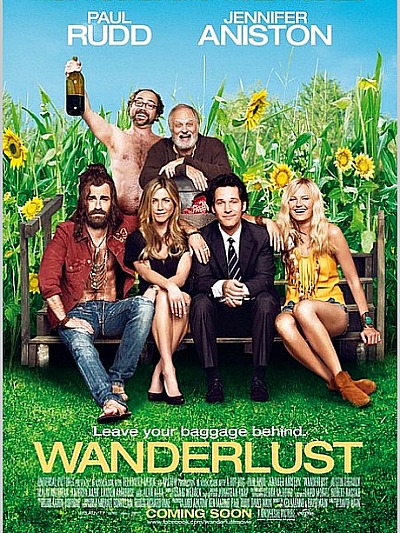

Notice Theroux’s arm across Aniston’s shoulder. Implied statement: “I’m not only playing a charismatic Mel Lyman-ish hippie clan leader who seduces Aniston’s married character, but I’m also her boyfriend in real life, which means that her naked boobs are for my private pleasure alone…is that understood?”

Kenneally writes that Aniston “pleaded for an alternate version due to her blossoming relationship” with Wanderlust costar Justin Theroux, whom she met during filming and with whom she’s now living.

I have three things to say about this.

One, there’s nothing lamer than an actress saying she wants to water down a scene for a reason that has nothing to do with the integrity of the film. If you change a scene you do it for one reason and one reason only — i.e., to make the scene better on its own terms, and to make sure that the scene more successfully serves the picture as a whole. Only lame-o’s, non-artists and other people with pedestrian mentalities futz around with a scene for personal, non-artistic reasons. The conclusion, no offense, is that the shoe fits, and Aniston is wearing it.

Two, the story makes Theroux sound woefully insecure. Aniston wanted her boobs not shown in the film (and they have been covered up and cut around — I saw Wanderlust last night) because, in Kenneally’s view, she “decided it just wouldn’t be right to share her naked breasts with anyone except her new beau.” In other words Aniston was persuaded that Theroux would feel better about his live-in lady being modest or extra-devotional, or would feel less threatened or insecure or whatever. In other words, Theroux, to his possibly eternal discredit, may have complained and/or pressured her to make the change. If so (and even if he didn’t), what a unstable little wuss! Theroux is threatened by his girlfriend’s boobs being flashed in a totally non-erotic way in a big-studio comedy? What would Pablo Picasso or Ernest Hemingway have said if they were in Theroux’s position? This is the end of Justin Theroux as an actor who can play men of consequence in films. There’s only one way to regard him henceforth — as a wee man, a whiner, a guy who frets.

Three, Wain has demonstrated to the industry that he’s a director with no balls whatsoever. He’s a pushover, and can henceforth be depended upon to give on each and every artistic argument that arises during the making of any film he directs in the future. He has shown his colors, and is now regarded worldwide (or at least industry-wide) as a candy-ass. Ditto producers Apatow, Marino and Judd. They’d all rather comfort and indulge and pet their lead actress than make the film right…or not right. To them the concept of mellow relationships is all.

It would have been one thing if Wain had decided to cut the scene from the film entirely because Aniston’s sudden attack of modesty would make the scene seem ungenuine or half-assed or glossed-over. That I would understand. But agreeing to keep the scene while resorting to editing and digital cover-ups of Aniston’s boobs shows what kind of guy Wain is — a go-alonger, a guy who folds.

Update: Read how the lame-os at E! Online (and more particularly reporter Bruna Nessif) are covering this.

“Genial Cosmopolitanism” = Andromeda Strain

I don’t begrudge The Artist its probable win,” says N.Y. Times critc A.O. Scott in a 2.17 chit-chat piece with Manohla Dargis. “It’s a charming, likable movie — a movie in love with movies and its own charm and also full of the genial cosmopolitanism that the Academy tends to like.

“It and The King’s Speech, different though they are, may define what an Oscar movie is today: well made, emotionally accessible and distributed, as you note, by the Weinstein Company. People who see them mostly like them. But the movies people love — both the idiosyncratic, ambitious movies that spark passions and start arguments and the hugely popular, hugely expensive genre movies that are Hollywood’s global cash crop — have become marginal. Which could be why the Oscars seem so small these days.”

Oscar Breakup Awards

In a 2.16 Atlantic piece called “The Most Insane, Illogical Award Choices in Oscar History,” Jason Bailey does a good job of explaining the Oscar break-up syndrome. It’s in a portion of the article that laments the Best Picture crowning of Crash in early 2006. The riff follows, but what Oscar moments persuaded HE readers to emotionally disengage or walk away?

I’ve gone through countless breakup moments over the last three or four decades. Except I’ve never signed the divorce papers. Instead I hang around like a pathetic henpecked husband, taking the abuse. Well, not really as I’m doing pretty well with HE but you know what I mean. I’ve been burned and disappointed so many times that I’m numb.

I think my first “what the fuck?” moment goes all the way back to early ’69, when the Best Picture nominees for 1968 were announced and I realized they’d left out 2001: A Space Odyssey, Bullitt and Rosemary’s Baby. The Best Picture nominees were Oliver!, Funny Girl, The Lion In Winter, Rachel, Rachel and Romeo and Juliet. The Lion in Winter is a sturdy film, but who watches the other four these days? No one. All but forgotten.

“Every true film lover can pinpoint the moment when they broke up with the Oscars,” Bailey writes, “when the Academy made a choice so illogical, so upsetting, and so numb-skulled as to blow their credibility forevermore. When you’re young, the Oscars are a big deal, the movie geek equivalent of the Super Bowl; then they blow it, and while you may watch in the years that follow, it’s never with the same enthusiasm or gusto.

“For some, that moment came in 1971, when The French Connection beat out A Clockwork Orange and The Last Picture Show; for some, it was Gandhi‘s 1982 win over E.T., Tootsie and The Verdict; for others, it was Shakespeare in Love beating Saving Private Ryan and The Thin Red Line in 1998.

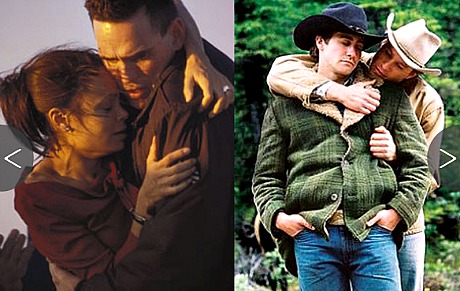
“But this writer made it all the way to age 30 before giving up on Oscar, when the biggest award of the night went to Paul Haggis‘ pedantic, contrived, and utterly artless Crash. In going with this simple-minded ‘racism is bad’ tale, Oscar voters passed over Ang Lee‘s revisionist cowboy love story Brokeback Mountain, Bennett Miller‘s masterful biopic Capote, George Clooney‘s enthralling Murrow vs. McCarthy tale Good Night and Good Luck, and Steven Spielberg‘s difficult but rewarding Munich.

“It’s not just that the less-deserving nominee won; at the 78th Academy Awards, the worst nominee (by leaps and bounds) won. Me and Oscar still hang out every once and while, but we haven’t been the same since.”

Titanic 3D Is A “Defacement,” Says Ebert

Paramount publicity will screen Titanic 3D for critics, but not until a week or so before the 4.4 opening (i.e., late March). How, then, did Roger Ebert see it three days ago and (surprise!) trashing it in a just-posted review? Titanic fans in major cities were invited via Facebook to attend special showings last Tuesday, 2.14, and Ebert somehow finagled his way into a Chicago showing.

Ebert didn’t trash James Cameron‘s 1997 film, which he’s long admired. He’s trashed Cameron’s 3D conversion process, which he says (a) adds little or nothing to the film, (b) diminishes the light levels “as much as 20%” and (c) isn’t even used in certain scenes. This comes as a surprise as word on the street, driven by those excerpts shown to press weeks ago, is that Titanic 3D is a couple of cuts above any 2D-to-3D conversion thus far. Maybe not!

“Titanic was not shot for 3D, and just as you cannot gild a pig, you cannot make 2D into 3D,” Ebert writes, “What you can do, and he tries to do it well, is find certain scenes that you can present as having planes of focus in foreground, middle and distance.

“So what? Did you miss any dimensions the first time you saw Titanic? No matter how long Cameron took to do it, no matter how much he spent, this is retrofitted 2D. Case closed.

“But not quite. There’s more to it than that. 3D causes a noticeable loss in the brightness coming from the screen. Some say as much as 20 percent. If you saw an ordinary film dimmed that much, you might complain to the management. Here you’re supposed to be grateful you had the opportunity to pay a surcharge for this defacement.

“If you’re alert to it, you’ll notice that many shots and sequences in this version are not in 3D at all, but remain in 2D. If you take off your glasses, they’ll pop off the screen with dramatically improved brightness.

“I know why the film is in 3D. It’s to justify the extra charge. That’s a shabby way to treat a masterpiece.”

Wait…”if you saw an ordinary film dimmed [by 20%], you might complain to the management”? Has Ebert ever sat with a paying audience when something has clearly gone wrong with the projection or sound? I’ll tell you what they do when this happens. They sit there like sheep. It always falls to someone like me to get up and complain.

Ebert is often given carte blanche treatment by the studios, so it seemed possible that Paramount might have eased him into its Chicago Valentine’s Day screening. So I double-checked with a few calls, and boy, did I get the cordial run-around! From the office of Kyle Bonnici to Michael Agulnek to Paramount field publicity’s Alicia Wyld to marketing exec Colleen Yacka and back to Katie Martin Kelly in Los Angeles. Nobody knew anything, but they were happy to push me onto another person. Whatever.

Update: Certain press people were invited to the LA Valentine’s Day screening in Burbank. MCN’s David Poland posted a review himself last night. I’ve been lied to by certain persons in the Paramount publicity chain, in addition to being kept off the invite list, despite three or four pleas to be invited to any Titanic 3D press screenings that come along. Much appreciated, Michelle Alt and Katie Martin Kelley. Anything I can do in return.

Friends of War

By tweeting “uh-oh, I liked it,” Rope of Silicon‘s Brad Brevet is acknowledging that he’s committing a form of cultural heresy by writing a half-supportive review of This Means War, which seems to be 2012’s most despised film thus far.

Brevet is not alone. Others who haven’t slammed and have even winked at McG’s action comedy include Entertainment Weekly‘s Lisa Schwarzbaum, Hitfix‘s Drew McWeeny, Detroit News critic Tom Long, Jam! Movies’ Liz Braun, Alonso Duralde and MediaMikes’ Michael A Smith. Even N.Y. Times critic Manohla Dargis gave it half a pass, calling it “perfectly acceptable [if] watched on the back of an airline seat or at home while you’re doing housework.”