Corbijn Portrait

Klaartje QuirijnsAnton Corbijn Inside Out, a portrait of the famed photographer and director of Control, The American and the forthcoming A Most Wanted Man, will have two market screenings in Cannes — at the Arcades 1 on Thursday, 5.17, at 3:30 pm, and at the Arcades 2 on Monday, 5.21, at 2 pm.

A Most Wanted Man, based on a 2009 John Le Carre novel, will costar Phillip Seymour Hoffman and Rachel McAdams.

My 8.31.10 review of The American. The best party of it stole from Richard Eder’s review of Rancho Deluxe, to wit: “The American is handsome, meditative, elegiac and languid. It’s so coolly artful it is barely alive. First-rate ingredients and a finesse in assembling them do not quite make either a movie or a cake. At some point it is necessary to light the oven.”

My second favorite portion of the 8.31.10 review: “There’s a moment at the very end when George Clooney‘s grim, somber-to-a-fault performance — monotonous and guarded to the point of nothingness, shut and bolted down — suddenly opens up. It’s when he asks the local prostitute to leave with him. For the first time in the film, he smiles. He relaxes and basks in the glow of feeling.

“There’s a little patch of woods by a river that Clooney visits three times. Once to test his rifle, once for a picnic and a swim in the river, and then in the final scene. One too many, perhaps. But his final drive to this spot is almost — almost, I say — on the level of Jean Servais‘ final drive back into Paris in Rififi. For the second and final time in the film Clooney shows something other than steel and grimness.

The American is worth seeing for this scene alone, and for the final shot when a butterfly flutters off and the camera pans up.”
Respect The Man

If someone was to tell me I’ll never be able to watch a movie about a fat kid protagonist, I would think “that’s a strange restriction” and “why would anyone care if I see another fat kid movie or not?” But honestly? I wouldn’t be unhappy about it. Sorry but that’s my position. There’s almost no difference between being obese and being a heroin addict. That aside, I support what Matthew Lillard is trying to do. As a gumption-y thing.

Shrewd Hanks Move

Two days ago N.Y. Times “Arts Beat” guy Patrick Healy reported that Tom Hankswill make his Broadway debut next year as Mike McAlary, the Daily News columnist in Nora Ephron‘s Lucky Guy. The Pulitzer Prize-winning tabloid reporter died in 1998 of colon cancer at the age of 41. Says a director-screenwriter friend: “A smart aging star move whose box office clout has been fading. This will help him.”

Downey at Clooney’s

HE Reader: “I was just wondering if you saw the articles about the Obama fundraiser that George Clooney hosted at his house? And that Robert Downey, Jr. was one of the attendees? Wondering what you think about that since you’ve labeled him a Republican or closet Republican.”

My Reply: “I haven’t labelled anyone as anything. I’ve just pointed out what others have said and what seems fairly evident, given Downey’s own statements.

“All Downey being at the Clooney fundraiser suggests is that he isn’t walking around with a Republican stick up his ass, and is more of a comme ci comme ca type at the end of the day. Downey can be Downey and still be an amiable get-around, schmooze-around, socially ambitious fellow. He’s been a very smart Hollywood player all his life (except during the druggie days) so how could he have a problem with the company of liberals at a very cool party, particularly one attended by Barack Obama? Please.”

I repeat what he told N.Y. Times reporter David Carr in 2009: “I have a really interesting political point of view, and it’s not always something I say too loud at dinner tables here, but you can’t go from a $2,000-a-night suite at La Mirage to a penitentiary and really understand it and come out a liberal. You can’t. I wouldn’t wish that experience on anyone else, but it was very, very, very educational for me and has informed my proclivities and politics ever since.”

And I repeat what a first-rate source whom I’ve known for over 25 years shared last December about Downey:

“His values are pure Republican values. He’s a serious materialist. He loves the great clothes, the beautiful house, the cool cars. He’s a ‘protect the rich’ guy. Why should the rich have to pay for this or that? The people who have it should keep it, and the people who don’t have it shouldn’t complain. And the one he looks up to the most and has been his philosophical guide is Mel Gibson. The Gibson thing is key. Mel Gibson over the years, and who he is and that way of looking at the world.”

“As Roger Friedman reported in 2003, Downey was able to return to movies only after Gibson, who’d been a close friend to Downey since they starred together in Air America (’90), paid Downey’s insurance bond for his appearance in The Singing Detective (’03).

“Downey has looked up to Gibson as an older brother and authority figure and mentor for a long time…Mel said this, Mel said that…all through the ’90s and the aughts. They shared [the late] Ed Limato as an agent. I ask you, how can you be that close to Mel Gibson for 20 years and not share some of his values? Of all the people Downey was close to Mel was by far the most politically inclined and vocal…he was a kind of guru.

“So they’ve been close all through the last 20 years despite Air America having been a failure, both commercially and critically. Usually people sort of run away from people with whom they’ve made a bomb with, but not here.”

Studio Babelsberg Drop-By

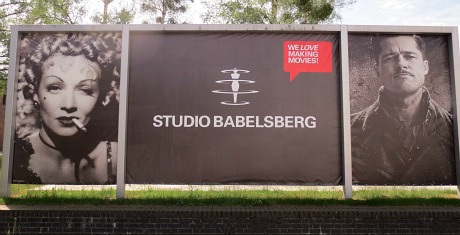
Late this morning I spent about 90 minutes touring Studio Babelsberg, the oldest large-scale studio complex in the world which last February celebrated its 100th anniversary. I was hoping to see some remnants of Cloud Atlas (Warner Bros., October), the Wachowskis-meet-Tom Tykwer epic that shot here last year, but alas, all the sets have been struck. But it was great to just roam around and take in all the history and the detail and the endless knick-knacks and eye candy for the soul.

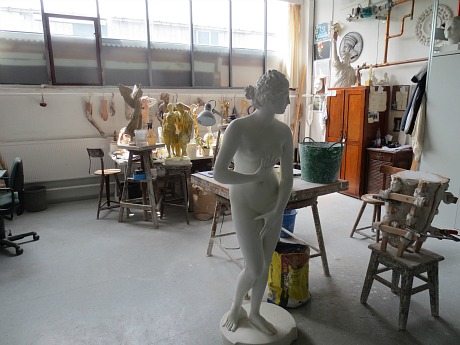
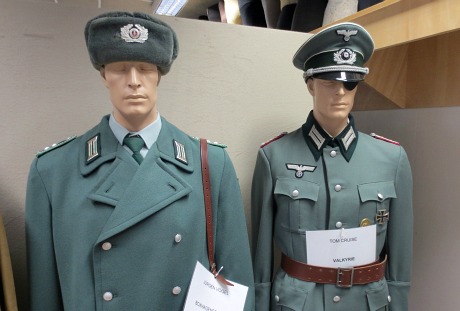
Studio Babelsberg is an all-in-one super-factory for filmmaking — sound stages big, medium and small, a sprawling carpentry shop, a superb prop museum and costume warehouse. You could spend hours and hours inspecting everything.

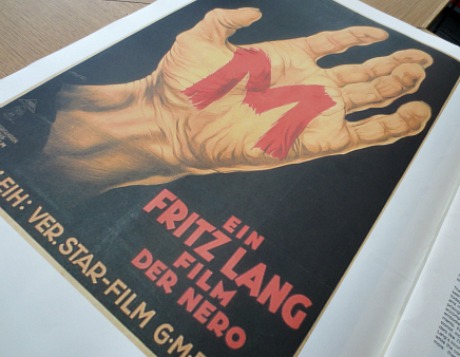
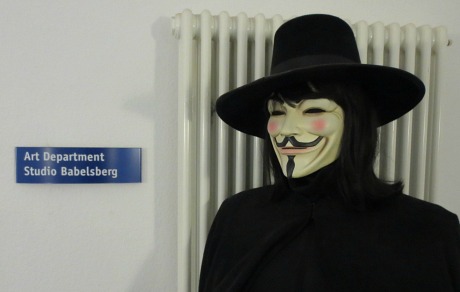
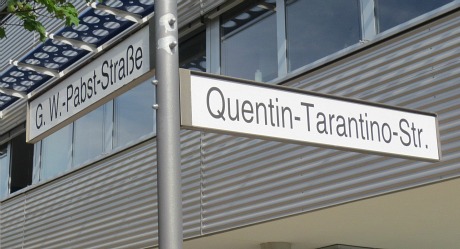
For a guy like myself, a fan of German cinema since I was a kid, this was like coming home and visiting a grand cathedral at the same instant. Studio Babelsberg is where Fritz Lang‘s Metropolis, Josef Von Sternberg‘s The Blue Angel and Robert Wiene‘s The Cabinet of Dr. Caligari were shot. Ditto significant portions of Roman Polanski‘s The Pianist and The Ghost Writer, Quentin Tarantino‘s Inglourious Basterds, the Wachowski’s V for Vendetta, Brian DePalma‘s Passion (i.e., “DePalma Lesbo Action”)and Roland Emmerich‘s Anonymous, among many others.

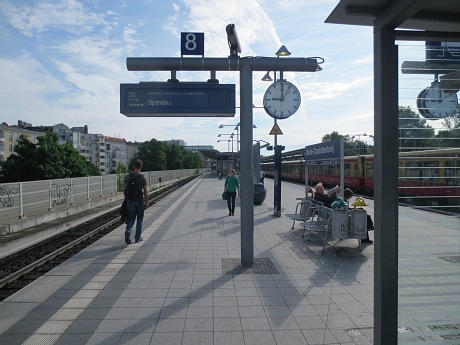
It’s located in Potsdam, the leafy university town about 35 minutes southwest of Berlin by train. It helped that this was the first really warm and fragrant day since I arrived in Berlin seven days ago.

Many thanks to corporate communications chief Eike Wolf, who gave me the tour and introduced me around. He also invited me to a Studio Babelsberg gathering in Cannes at the Grand Hotel in eight or nine days.

I would have stuck around for lunch but only one guy takes orders at the studio cafeteria — one guy! — and the line is endless, and most of the dishes include piles of french fries.

Update: “It’s great you made a point of going out to Babelsberg,” a critic friend has just written. “I was there in 1990 before the studio had its latest modernization. Just wonder if your guide pointed out that the striking moderne buildings put up in the late ’20s and early ’30s were designed by none other than Albert Speer.”


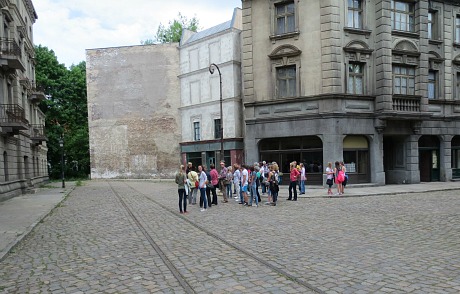
European street set where the Warsaw ghetto portions of The Pianist were shot.

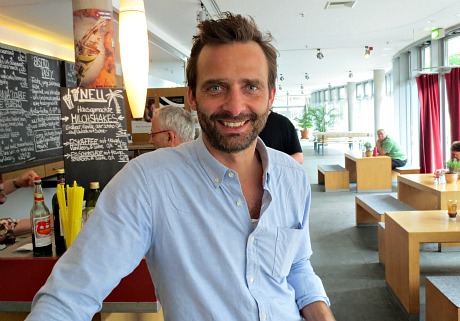
Eike Wolf, head of corporate communication for Studio Babelsberg AF — Friday,

I misheard Eike Wolf when he said that one of Hugh Grant’s roles in Cloud Atlas is that of a “woman” — I thought he said “Roman.”


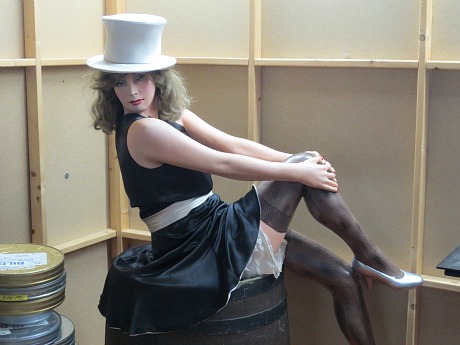
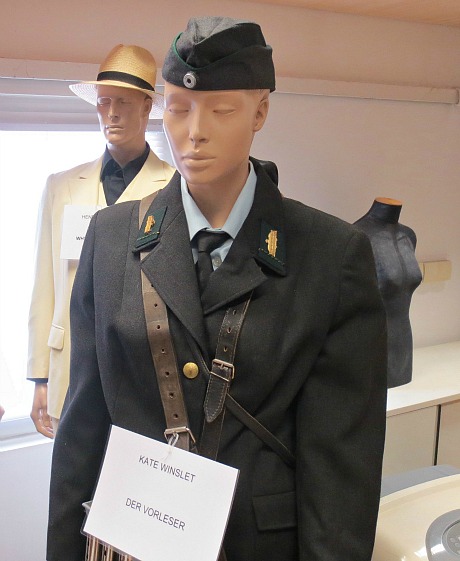
The train conductor’s uniform worn by Kate Winslet in The Reader.