Ernest Borgnine

There’s no question that the great Ernest Borgnine, who died today at age 95, peaked in the mid ’50s. His Oscar-winning role as Marty the homely butcher in Marty (’55), was the pinnacle, closely followed by the sadistic Fatso Judson (“I’m gonna cut this wop’s heart out…anybody steps in I give it to ’em first!”) in From Here to Eternity (’53).
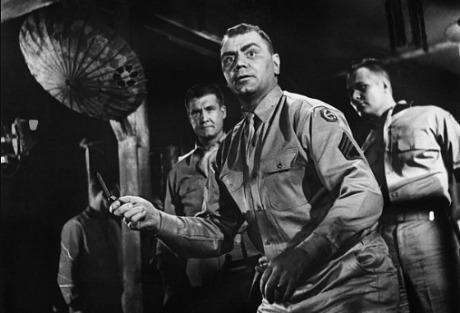

Ernest Borgnine at Fatso Judson in Fred Zinneman’s From Here To Eternity (’53)

Borgnine also cashed in with McHales’s Navy, the TV series that ran four years (’62 to ’66), and two or three years later he got lucky with the best western role of his career — Dutch Engstrom in The Wild Bunch (’69). “Lucky” is the sense that Sam Peckinpah cast him, I mean — not in the delivery of the character, which was all about skill and finesse.

Borgnine’s third-best ’50s role was Ragnar in The Vikings (’58), particularly the scene in which he jumps into the wolf pit with a sword in hand (“Odaaahhhnn!”). Followed by his villains in Bad Day at Black Rock, Johnny Guitar and (yes) Demetrius and the Gladiators. He was also half-decent as Lucius, a Roman tribune/whip-cracker/something-or-other in Barabbas.

He was also pretty…make that very good in Robert Aldrich‘s The Flight of the Phoenix (’65) and The Dirty Dozen (’67), and he was direct and vulgar as a Hollywood something-or-other in The Oscar. I forget what kind of Hollywood guy he played in Aldrich’s The Legend of Lylah Clare (’68), but he was oppressively grotesque in that also. Not Borgnine’s fault — the film was painful to sit through, and horribly written — because he gave it all he had. He always did. But Borgnine was best when he was told to hold back.

He was also good as a brutal train conudctor with a nightstick in Aldrich’s Emperor of the North Pole (’73)

The Poseidon Adventure (’72), The Black Hole (’79), When Time Ran Out (’80), Escape From New York (’81)…words fail.

And let’s not forget Airwolf, the early-to-mid ’80s TV series in which he costarred with Jan Michael Vincent and Alex Cord. Actually, I had forgotten Airwolf — it took a friend to remind me.

Borgnine made a ton of crap, of course, but he kept working, kept on plugging, kept on being Borgnine. We should all live so long, or enjoy lives as memorable, interesting, joyful, etc.

Here’s a rememberance by The Hollywood Reporter‘s Scott Feinberg.
Saved

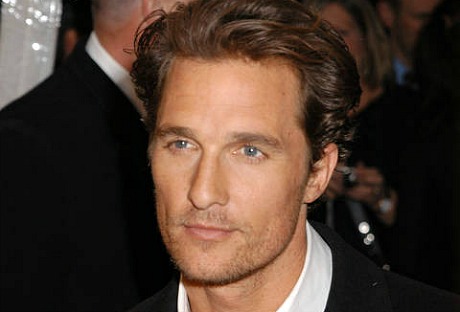
N.Y. Times guy Dennis Lim has written what amounts to an officially sanctioned acknowledgement that Matthew McConaughey has turned a significant career corner, and that he’s been doing the right thing over the last two years with intriguing, flavorful performances in Magic Mike, Mud, The Paperboy, Killer Joe, Bernie and The Lincoln Lawyer.


Matthew McConaughey

I’ve been feeling this way about McConaughey for over a year now. Sometime in 2009 or ’10 he must have told his agent, “I know I went along with these shitty romcoms before but it has to stop…you’re fucking killing me, man…will you get me out of this?…enough of the quarter-inch-deep, pretty-boy Kate Hudson flicks…that way lies death.”

My first acknowledgement that McConaughey had changed course was in a 5.3.11 review of The Lincoln Lawyer, to wit: “For nearly 20 years McConaughey has under-achieved. The few good films he’s been in have been mostly ensembles (Dazed and Confused, U-571, We Are Marshall, Tropic Thunder) while many of his top-billed or costarring vehicles have been romantic dogshit, especially over the last decade. Now comes The Lincoln Lawyer, the first completely decent, above-average film McConaughey has carried all on his own. By his standards that’s close to a triumph.”

I should now state that I no longer regard McConaughey as a Beelzebub-like figure, which is how I described him in a 4.21.09 piece called “The Devil Probably.” And that I no longer think of him as “King of the Empties,” which is how I put it on 7.16.06. He’s wised up, done the work, redeemed himself…no more condemnation.

Submission

I’ve been ducking The Amazing Spider-Man for four days now, and now it’s Sunday and time to suck it in and buy a ticket. I so don’t want to do this. I’m so against paying to see a reboot of a spent franchise. That’s the “wrong attitude”, of course. A critic friend told me a while back that director Marc Webb (500 Days of Summer) has tapped into something here. I doubt that, given what some of the Rotten Tomatoes naysayers have written. Either way I’m stuck — I can’t not go.

Red House

I was on the scooter yesterday afternoon, buzzing along Mulholland and in and out the canyons and trails and cul de sacs between Beverly Glen to Laurel Canyon. And I guess I was thinking about the two 2012 Roman Polanski docs — Laurent Bouzereau and Andrew Braunsberg‘s Roman Polanski: A Film Memoir (which I reviewed in Cannes) and Marina Zenovich‘s Roman Polanski: Odd Man Out, which will play the fall festival circuit — because I found myself hanging a subconscious right onto Cielo Drive off Benedict Canyon south, and up to an area that used to be known as 10050 Cielo Drive.


The original Robert Byrd-designed home, apparently taken sometime in the late ’60s or early ’70s.

Jeff Franklin’s “Villa Bella,” was built in ’94 or thereabouts on the same lot after the Byrd home was torn down.

This was the site of Robert Byrd‘s now-demolished California ranch-styled home where Polanski’s late ex, Sharon Tate, and four others — Abigail Folger, Steven Parent, Voiytek Frykowski and Jay Sebring — were murdered by the Manson family on August 9, 1969. I knew that Trent Reznor lived there for two or three years in the early ’90s, and that the place had been torn down in ’94 and that a nouveau-riche Moorish-Mediterranean monstrosity called “Villa Bella” was built in its place by producer Jeff Franklin (Full House). The original street number was also erased — the address is now 10066 Cielo Drive.

I stood on the other side of the canyon and told myself that anyone who would trash the original single-storied structure, which had a nice homey vibe with a pool and a guest house and was painted red with white trim with huge trees on the grounds, and then cut down the trees and build a ghastly Uday Hussein-style Euro-mansion, must be a real animal. I can understand how a new owner might want to flush out the murder vibes by building a new place, but the Franklin mansion is an even worse nightmare — a monument to tastelessness and a metaphor for the mongrelization of architectural standards in Los Angeles and across the USA. You’d have to be truly coarse and clueless to build this place and be delighted with it. If and when I ever run into Franklin I think I’ll tell him that.

A certain percentage of those reading this article will go, “Wait, what’s wrong with the Franklin place? It looks like a nice McMansion — big and palatial with over-sized rooms and great wifi…probably has a home theatre and maybe a workout room and a pool and room for three or four SUVs in the garage…what’s not to like?

Choke On It

I’ve never been much for epic mano e mano conflicts between devotional good and malevolent evil. They’ve always seemed like stories for simpletons who don’t know from parking meters. So when I hear Chris Nolan describe The Dark Knight Rises as “a very elemental conflict between good and evil,” I immediately mutter to myself, “Jesus…give it a rest, for God’s sake.”

Good vs. evil is an ancient crock — a bullshit fable that epic poems and dime novels and comic books and superhero movies have been selling since forever and ever. Obviously there’s a basic emotional need to see these tedious tales told time and again and again. I realize I’m in the minority for being sick to death of them, but every time I hear people cheer a superhero, I think to myself “you fucking saps.”

Evil clearly abounds in the U.S. financial and political realms (Boehner, Cantor, Rove, Koch brothers, Tea Party idiocy, rightwing talk radio, Goldman Sachs, “banksters”) while internationally we’ve had Al Qeada, the Taliban executing female adulterers, Pol Pot and the killing fields, Adolf Hitler and the Final Solution, etc. But there are never any formidable polar opposites looking to stop or defeat them, no real-life Bruce Waynes or Supermans or Peter Parkers. There are only flawed and/or compromised alternatives (Obama, Warren, the progressive community) who are less selfish and less craven and nobler in their stated goals.

Bane is just a designated hitter — a cyborg built to enhance corporate earnings. He’s just a musclebound, gurgly-voiced S & M gay icon who’s essentially a tribute to George Miller and Kjell Nilsson‘s “Lord Humungus…the Ayatollah Rock-and-Rolla.” Now there was a baddie to believe in. Because thirty years ago, he felt semi-novel — a relatively new idea borrowed from gay leather culture.