Bowling Scenes Are “Statistically Unwise”

To hear it from N.Y. Times reporter Brooks Barnes, Vinny Bruzzese‘s Worldwide Motion Picture Group is either a proponent of the increasingly synthetic and cheese-whizzy nature of mainstream movies, or an outgrowth of this. Either way Bruzzese sounds to me like a slick and opportunistic type who would have gotten along just fine with Christopher Moltisanti while he was looking to refine and sell Cleaver.
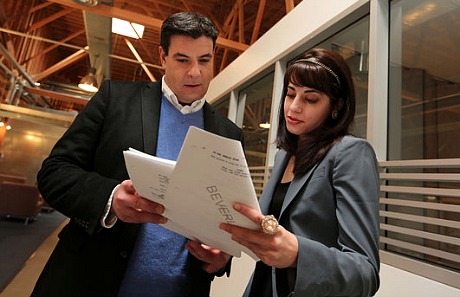

Worldwide Motion Picture Group honcho Vinny Bruzzese conferring with Miriam Brin, WMPG’s head of script analysis.

Bruzzese is apparently less of a calculating, self-created fiend than an inevitable manifestation of a development and production community that has less and less of a clue with each passing year. Either way he’s basically selling feelings of safety by advising production execs to favor cookie-cutter banality. Irving Thalberg would have taken one look and had the “gravelly-voiced” Vinny thrown right off the lot.

“For as much as $20,000 per script, Mr. Bruzzese and a team of analysts compare the story structure and genre of a draft script with those of released movies, looking for clues to box-office success.” WMPG “also digs into an extensive database of focus group results for similar films and surveys 1,500 potential moviegoers. What do you like? What should be changed?

“’Demons in horror movies can target people or be summoned,’ Mr. Bruzzese said. ‘If it’s a targeting demon, you are likely to have much higher opening-weekend sales than if it’s summoned. So get rid of that Ouija Board scene.’

“Bowling scenes tend to pop up in films that fizzle, Mr. Bruzzese, 39, continued. Therefore it is statistically unwise to include one in your script. ‘A cursed superhero never sells as well as a guardian superhero,” one like Superman who acts as a protector, he added.

“His recommendations, delivered in a 20- to 30-page report, might range from minor tightening to substantial rewrites: more people would relate to this character if she had a sympathetic sidekick, for instance.

“Script ‘doctors,” as Hollywood refers to writing consultants, have long worked quietly on movie assembly lines. But many top screenwriters — the kind who attain exalted status in the industry, even if they remain largely unknown to the multiplex masses — reject Mr. Bruzzese’s statistical intrusion into their craft.

“’This is my worst nightmare,’ said Ol Parker, a writer whose film credits include The Best Exotic Marigold Hotel. ‘It’s the enemy of creativity, nothing more than an attempt to mimic that which has worked before. It can only result in an increasingly bland homogenization, a pell-mell rush for the middle of the road.”

“Mr. Parker drew a breath. ‘Look, I’d take a suggestion from my grandmother if I thought it would improve a film I was writing,’ he said. ‘But this feels like the studio would listen to my grandmother before me, and that is terrifying.’”
Mostly Thumbs Down on Gatsby

The first Great Gatsby reviews began breaking a couple of hours ago, and the consensus so far is that no one except for The Hollywood Reporter‘s somewhat approving Todd McCarthy is feeling especially charmed or elevated. Most of the critics published so far are generally unenthusiastic about the excesses of Baz Luhrmann‘s 3D, CG-ified adaptation of F. Scott Fitzgerald‘s novel.

Declaring that “it don’t mean a thing if it ain’t got that bling,” Variety‘s Scott Foundas says that Gatsby is “like the Macy’s Thanksgiving Day Parade as staged by Liberace. Indeed, it comes as little surprise that the Aussie auteur behind the gaudy, more-is-more spectacles Moulin Rouge and Australia has delivered a Gatsby less in the spirit of F. Scott Fitzgerald’s novel than in that of its eponymous antihero — a man who believes bejeweled excess will help him win the heart of the one thing his money can’t buy.”

The Great Gatsby uses the unbridled excess of the Roaring Twenties as an excuse to unleash the unbridled excess of 21st century digital effects, but we’re left with nothing but roar,” writes TheWrap‘s Alonso Duralde. “Baz Luhrmann sucks the life out of Fitzgerald’s immortal novel and replaces it with empty filigree and overbearing style.”

“As is inevitable with the Australian showman who’s never met a scene he didn’t think could be improved by more music, costumes, extras and camera tricks, this enormous production begins by being over-the-top and moves on from there,” writes THR‘s McCarthy. “But given the immoderate lifestyle of the title character, this approach is not exactly inappropriate, even if it is at sharp odds with the refined nature of the author’s prose.

“Although the dramatic challenges posed by the character of narrator Nick Carraway remain problematic, the cast is first-rate, the ambiance and story provide a measure of intoxication and, most importantly, the core thematic concerns pertaining to the American dream, self-reinvention and love lost, regained and lost again are tenaciously addressed.”

“To accuse Luhrmann of overkill is a bit like faulting a leopard for his spots,” Foundas adds. “Love it or hate it, take it or leave it, this is unmistakably his Gatsby through and through, and as with all such carte-blanche extravaganzas (increasingly rare in this cautious Hollywood age), it exudes an undeniable fascination — at least for a while.

“In the notes for his unfinished final novel, The Last Tycoon, Fitzgerald famously wrote, ‘action is character,’ but for Luhrmann action is production design, hairstyling, Prada gowns and sweeping, swirling, CGI-enhanced camera movements that offer more bird’s-eye views of Long Island (actually the Fox Studios in Sydney) than The Hobbit did of Middle-earth. Arguably, the movie reaches its orgiastic peak 30 minutes in, with the first full reveal of Gatsby himself (Leonardo DiCaprio), accompanied by an explosion of fireworks and the eruption of Gershwin on the soundtrack. Where, really, can one go from there?”

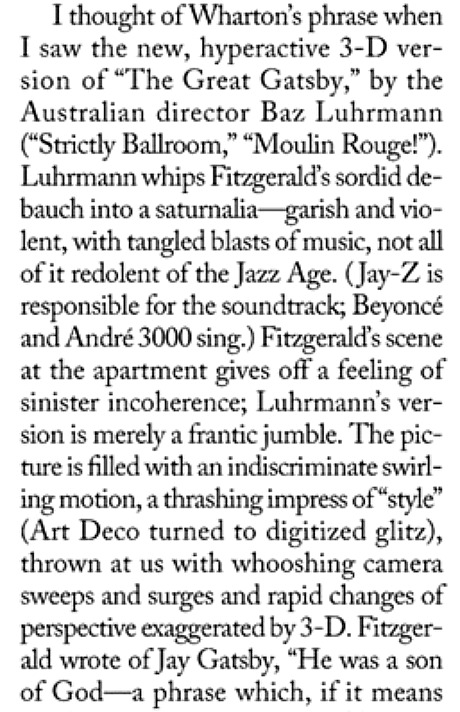
Here’s a chunk of David Denby’s review in The New Yorker:

Mr. Cranky With Class, Insight, Feeling

In my book the best film critics aren’t just about smarts or perception or passion — they’re about gourmet personalities. Like any good friend or acquaintance or FM talk-show host, they’re people you enjoy for their attitudinal “brand” as well as their thinking-cap riffs, for their persistent attitudes and moody asides and occasional derisions. A particular flavor, a burn-through quality. As James Wolcott wrote in 2006 about legendary critic Dwight McDonald, “His verdicts would mean nothing to us now if he hadn’t invested them with a humming force of personality and humor that opened up daylight wherever his mind gusted.”

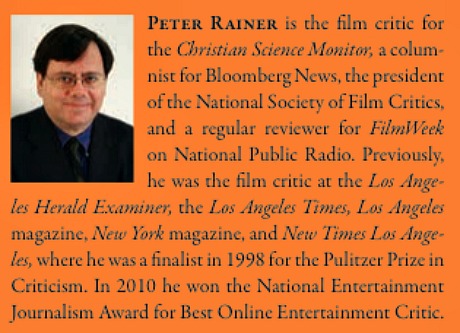
Peter Rainer has earned his stripes in this regard. A pantheon critic who’s been around since the ’70s and understands The Whole Equation and Knows Whereof He Speaks, Rainer is an erudite, smart-assy guy whose succinct and creamy prose has, over the last thirty-odd years of filings for the L.A. Herald Examiner, the L.A. Times, New York magazine and the Christian Science Monitor, conveyed a personality as distinct and recognizable as Jerry Lewis or Zach Galifianakis or Leo Durocher‘s.

Distilled to essence, Rainer is, in my mind at least, Mr. Cranky with smarts and class and cultivation. I don’t read Rainer for any F.X. Feeney-like exuberance and generosity of spirit — I read him for the ascerbic wit and the snoot.

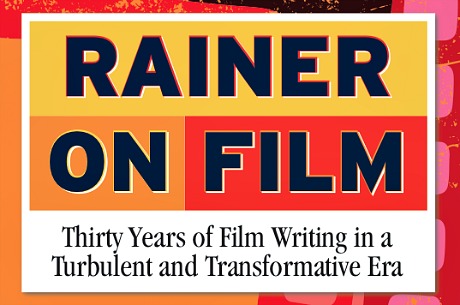
Early this morning, being unable to sleep, I began reading Rainer’s new review and essay compilation book, “Rainer on Film: Thirty Years of Film Writing in a Turbulent and Transformative Era” (Santa Monica Press, 5.15). It’s a good, rich, reflective read — a tangy if judiciously spotty journey through the last three-plus decades of film-savoring. Each essay took me back to this or that distinctive film as it seemed at first blush. I nodded, remembered, laughed, chuckled, smirked, pondered, time-tripped…all that stuff.

In Rainer’s words: “This book should not be mistaken for a comprehensive survey. The vagaries of the profession do not allow for that. It covers three decades of reviews and essays written during an especially turbulent and transformative film era, drawn from my years at big-city papers, city magazines and monthlies, alternative weeklies, and national newspapers.

“With the exception of a few trims and minor restorations, the reviews remain the same as when they were written. In a number of instances, especially in my writings over the years on Richard Pryor, Stanley Kubrick, Sylvester Stallone, Eddie Murphy and film noir, I have retained a few repetitions, which seemed preferable to messing with the original constructs. Here and there I have added postscripts, but I have resisted the fetish, not to mention the impossibility, of bringing things ‘up to date.’ These pieces are best approached as snapshots in time, captured in the heat of the moment.”

Rainer’s book is good Hollywood Elsewhere food. I plan on dining out on the various chapters over the next week and a half or so. I’m especially planning on running a counter-punch piece on Rainer’s dismissive review of Alan Parker‘s Evita.

A former chairman of the National Society of Film Critics and a finalist for the Pulitzer Prize in Criticism in 1998, Rainer arguably deserves to be ranked alongside Pauline Kael, Andrew Sarris, Andre Bazin, David Denby, Otis Ferguson, Manny Farber, David Thomson, Anthony Lane, A.O. Scott and the afore-mentioned McDonald. I’ve only read about 25% of it, but “Rainer on Film” is worth the price and then some.