
“You Know It When You See It”

An essay by A.O. Scott called “The Big Picture Strikes Back,” appearing in the 12.1 Sunday N.Y. Times Magazine, discusses evidence of “directorial presence” in the not-entirely-corporatized art form known as movies, and in so doing praises J.C. Chandor‘s All Is Lost, Alfonso Cuaron‘s Gravity and Richard Linklater‘s Before Midnight.

Near the end of the piece Scott mentions “the audacity of Gravity, with its big budget, big movie stars and huge box office, and the even greater boldness of All Is Lost, which blithely ignores some of the most basic axioms of moviemaking. The cast consists of one person, who utters a few dozen words and whose story is told with virtually no exposition. We don’t know his name, his profession, his back story or anything else. Nothing has been done to make him relatable or representative or universal, even as he becomes all of those things.
Read more

Repeat For Emphasis

Many were surprised this morning when Asghar Farhadi‘s The Past wasn’t included among the five announced Spirit Award nominees — Blue is the Warmest Color, Gloria, The Great Beauty, The Hunt, A Touch of Sin — for Best International Film. Hitfix‘s Greg Ellwood noted that The Past “isn’t as beloved as [Farhadi’s] A Separation, granted, but the exclusion of The Past is puzzling. Farhadi won the Spirit Award in this category for A Separation in 2012. The Past has had strong reviews since Cannes and it’s certainly better than The Hunt or The Great Beauty. Odd to say the least.” If you ask me The Past is way, way more believable and on-target. More enticingly textured and satisfyingly adult than The Hunt. More emotionally precise, delicate, affecting. The Past performances alone tower over those in The Hunt.”

Oldboy Spoiler Gusher

This review contains massive third-act spoilers: I was fairly to moderately pleased with much of Spike Lee‘s Oldboy (FilmDistrict, 11.27), which I saw a couple of weeks ago. It seemed to me a vigorous, well-disciplined, good-enough remake of Park Chan-wook‘s audacious, same-titled original. I realize that I’m expected to hate or at least disapprove of Lee’s version and ask why did he remake it and that no one can touch the original, etc. But it’s not half-bad, really. Josh Brolin shoulders the lead role of Joe Doucett (a nod to original character Oh Dae-su, played by Choi Min-sik) with a fittingly grim, terse, low-key attitude. And the extended warehouse fight sequence (which lasts four or five minutes) is grippingly staged, I thought. And thank God Lee doesn’t go in for tongue-severing, which struck me as completely needless in Chan-wook’s original.

My problem with Lee’s Oldboy is all about the rewriting of the big “surprise” ending, which of course isn’t a surprise to tens of thousands as it’s basically the same used in the ’03 film, which every fan of extreme Asian action cinema is totally up on. I’m nonetheless declaring for the second time that what follows blows the big third-act reveal all to hell.

Read more

Drop Zone

In this Inside Llewyn Davis clip, John Goodman‘s drug-addled character declares that the Brooklyn Bridge is the most traditional New York City-area place to commit suicide from, and that anyone jumping instead from the George Washington Bridge is some kind of confused loser. He means that the Brooklyn Bridge has acquired more notoriety as a suicide spot, most likely due to Steve Brodie having jumped off the bridge 127 years ago (7.30.86) and lived. A site called Dark Destinations claims that the Brooklyn Bridge “has more suicides than any of the other bridges in the city, including the George Washington and Verrazano-Narrows, which are actually much higher from the water.” But the GW bridge is no slouch. It averages about six deaths a year. 18 people died from GW jumps in 2012, 13 in 2010 and 10 in ’04. There’s also that story told by William Holden‘s Max Schumacher character in Network, the one about him oversleeping and throwing on his raincoat and jumping into a cab and saying “Take me to the middle of the George Washington Bridge!’ and the cabbie turning around and pleading, “Don’t do it, buddy…you’re young, you have your whole life ahead of you.” I don’t know about 1961 (i.e., when Inside Llewyn Davis takes place), but by today’s standards the GW and Brooklyn bridges are fairly evenly matched.

video platformvideo managementvideo solutionsvideo player

Spirit Noms Cover Most Of The Bases

Congrats to 12 Years a Slave, Nebraska and All Is Lost for landing seven, six and four Spirit Award nominations, respectively. Congrats to Nebraska‘s Bruce Dern for landing a Best Actor nom, which obviously adds a measure of heat to his Best Actor Oscar campaign. Congrats also to Inside Llewyn Davis and Frances Ha for landing Best Feature noms, and to Davis‘s Oscar Isaac for his Best Male Lead nomination. Ditto to Best International Film nominee Blue is the Warmest Color, which I’m presuming will take the cake.

A Best Cinematography nomination went to Inside Llewyn Davis‘s Bruno Delbonnel — good for that and all artfully desaturated color schemes. It seems curious that the black-and-white cinematography from both Nebraska‘s Phedon Papamichael and Frances Ha‘s Sam Levy were overlooked.

Somehow or some way Richard Linklater‘s Before Midnight, which snagged a Best Screenplay nom and a Best Actress nom for Julie Delpy, should have been nominated for Best Feature.

Spirit Awards rules forbid nominations for non-American films except in the Best International Film category, otherwise Blue‘s Adele Exarchopoulos would surely be among the Best Female lead nominees.

Read more

Osage County Gathering

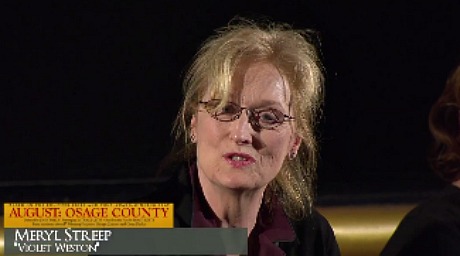
Last night’s August: Osage County cast discussion included an interesting comment from playwright/screenwriter Tracy Letts about Meryl Streep‘s Violet Weston character, an abrasive, drug-addled matriarch who is based on his real-life maternal grandmother. Since the 2007 stage debut of Letts’ Pulitzer Prize-winning drama, Violet has been routinely referred to as one of the most caustic and abrasive female characters ever depicted, but Letts said last night that she’s actually a toned-down version of the Real McCoy. When he first showed August: Osage County to his novelist mom Billie Letts, she told Letts that “you’ve been very kind to my mother.”

Read more