As Star Wars Prepares To Take Flight…

In early June director J.J. Abrams will begin shooting the much-awaited Star Wars sequel, otherwise known as Episode VII, at London’s Pinewood studios. The cast will probably include Adam Driver as the chief villain, and possibly Benedict Cumberbatch and Gary Oldman in good-guy roles. Let’s not speculate about Harrison Ford, Mark Hamill and Carrie Fisher delivering quickie cameos. I really wish they wouldn’t, to be honest. Leave it there and move on.

I don’t know anything except that shooting will begin about 10 weeks hence. That’s a fact. So here’s a thought for Abrams if he’s reading this (and I’m told he peruses HE from time to time):

Remember what George Lucas said to one of his colleagues on The Empire Strikes Back when director Irvin Kershner was taking a lot of time to light the sets with a bit more character and uptick the performances and add layers to this and that? Lucas, concerned about budget, said “It doesn’t have to be that good.”

Your movie, Mr. Abrams, does “have to be that good.” You have to aspire to the level of Irvin Kershner and The Empire Strikes Back . It has to be 100% committed to blowing the Lucas prequels out of the water and out of people’s memories for good, and kicking Richard Marquand‘s ass from here to kingdom come.

Read more

Better Agniezka Holland Than Michael Bay

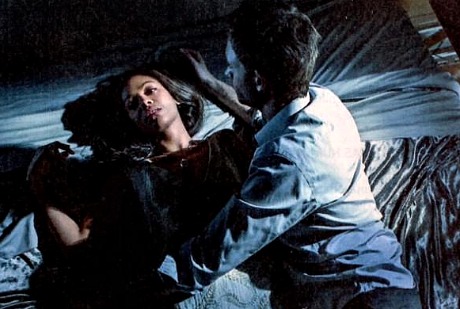
The world will not have to cope with a Michael Bay-produced remake of Rosemary’s Baby, which was being threatened four of five years ago. Instead there’s a four-hour miniseries now being shot in Paris by the respected Agniezka Holland. I’m presuming she’ll apply the same kind of restraint that Roman Polanski used in the original 1968 Paramount film. Zoe Saldana is playing Rosemary Woodhouse (i.e., the Mia Farrow role). Carole Bouquet and Jason Isaacs are playing Margaux and Roman Castevet (the Ruth Gordon and Sidney Blackmer roles in the ’68 film). When the original Ira Levin book was published in March 1967 there was a sense that the old traditions were falling by the wayside and that Cecil B. DeMille‘s demanding, disapproving, deep-voiced God was losing His grip or had perhaps even died (as a famous 1965 Time magazine cover asked). But that was 47 years ago and this is now. Who is the target audience for this NBC miniseries? Uncultured pudgebods who are too lazy or stupid or inert to stream Polanski’s original? There’s nothing the least bit alienating or “dated” about that film. It’s perfect. It totally works by 2014 standards. But they’re remaking it anyway.


Zoe Saldana as Rosemary Woodhouse, Patrick J. Adams (a dull-looking actor) as Guy Woodhouse in Agniezka Holland’s Rosemary’s Baby miniseries.

Attitude, Auburn Hair, Struggling

Until last night I’d never laid eyes on a decent-quality color photograph of young Katharine Hepburn. This shot from John Ford‘s Mary of Scotland (’36) was taken when Hepburn was 29. It appears to be genuine color (i.e., not tinted monochrome). Mary of Scotland happened in the middle of Hepburn’s “box-office poison” period, when she starred in several failures and couldn’t catch a break. Alice Adams (’35) was the only hit she had during this streak. Even Sylvia Scarlet (’35) was a bust. Even Holiday and Bringing Up Baby (both in ’38) underperformed. Hepburn finally got back on the rails with The Philadelphia Story (’40).


Katharine Hepburn in John Ford’s Mary of Scotland. Her freckles were airbrushed or makeup-based out. Word around the campfire is that Hepburn and Ford locked loins during production but you’d have to ask Ford biographer Joseph McBride about that and I’m not sure he’d know. Did John Ford ever have sex with anyone, ever? He drank and scowled and swore and smoked like a fiend, but sex? Some people aren’t cut out for it.

Sasha/Jeff Projections

Awards Daily‘s Sasha Stone and I have posted a list of Most Anticipated 2014 Films. Here’s hers — mine’s sitting in the all-new Oscar Balloon. I had some issues with some of her choices to we kicked it around a day or two ago. We both received our Cannes 2014 press credential approvals early this morning so we started the day off in a good mood. We’re both a little confused about whether or not Christopher Walken does any dancing or not in Clint Eastwood‘s Jersey Boys (he definitely doesn’t sing) but I’ve since been told that the Broadway jukebox musical, which I’ve never paid the slightest attention to, is quite well written in terms of character and story turns so maybe there’s hope. Nobody knows much at this stage, but that didn’t stop us

Kohn on SXSW 2014

I took several days to finally speak to Indiewire critic Eric Kohn about his South by Southwest experience (mostly due to my unstable schedule), but we finally did it yesterday morning. Kohn, a sage, first-rate critic, didn’t much care for Jon Favreau‘s Chef or Fort Tilden, the SXSW Grand Jury Award-winner about Brooklyn hipster types. He tends to like outliers — films that Joe and Jane Popcorn wouldn’t pay to see with a knife at their back — or at least the kind of films that you can only see at special festivals when you’re attending special festivals. Nor is he repelled, as I am, by films about weird, anti-social types who hate themselves or hate their jobs (or both) and who can’t eat spaghetti and meatballs without spilling it all over the white bathrobe they happen to be wearing. Yesterday I collected links to all of Kohn’s favorites but now I can’t find them, and I’m not going to listen to the interview and write them down all over again.

Friends of Varinia: The Return

18 months ago I posted an odd little riff called “Friends of Varinia,” the most unique observation ever written about Stanley Kubrick‘s Spartacus (and the 1951 Howard Fast novel it was based upon). I’m presuming that a portion of today’s readers missed it or are new arrivals or only know about the downmarket, 300-resembling Spartacus: Blood and Sand TV series, so here’s a re-visit:

“Nobody and I mean nobody in the history of film criticism has mentioned what I’m about to bring up. It’s about a hidden aspect of Spartacus, although it’s really a question for Howard Fast, who wrote the original 1951 “Spartacus” novel. But Mr. Fast is long gone so let’s just kick it around. It’s about sex and territoriality and rage that would have been unstoppable.

Read more

Woe to Budapest In The Sticks

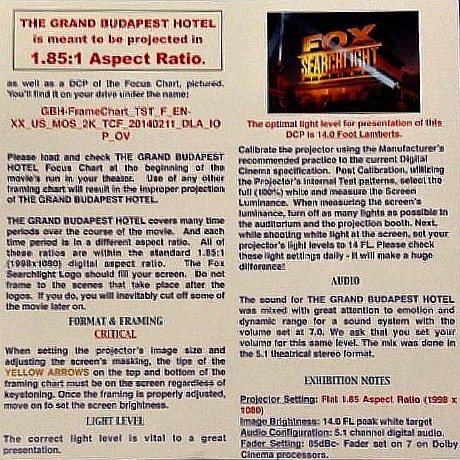
Fox Searchlight’s projection instructions for Wes Anderson‘s The Grand Budapest Hotel, sent to theatre owners before the film opened last week, were reported yesterday on Reddit and by Variety‘s Maane Khatchatourian. Among the criteria is a request that the film be projected at 14 foot lamberts — the ideal SMPTE screen-light standard that you’ll see at high-end screening rooms and top-tier film festivals, and at the better commercial venues like Hollywood’s Arclight plex. But rotsa ruck seeing that level of light projected in most commercial cinemas. Full Aperture SystemsJames Bond, a respected projection consultant based in Chicago, says that the average screen light levels in a majority of commercial cinemas are in the range of eight to ten foot lamberts, or only a bit more than half the foot lamberts requested by Fox Searchlight. That’s because today’s movie plexes have no professional projectionists (i.e., they’re entirely automated) and, Bond says, because exhibition-chain accountants “always go with the cheapest projection bulbs they can find….it’s a pity but it’s true.” The best bulbs, Bond says, are manufactured by Osram, a German company, and Ushio, a division of the parent company that owns Christie Projectors, which are among the best in the world.