Can The Wrong Actor Ruin Your Movie?

Whenever filmgoers are presented with a romantic couple consisting of a famous actress and a less-well-known boyfriend, they immediately become protective of the actress by assessing and deciding if the boyfriend is (a) a good guy and worth staying with or (b) an egoistic, untrustworthy, not-hot-enough dick who needs to be jettisoned at the first opportunity. 60 seconds after being introduced to Adam Levine in John Carney‘s Begin Again (formerly Can A Song Save Your Life?), in which he plays Keira Knightley‘s famous musician boyfriend, I knew he was toast. I just knew. Not good-looking enough, for one thing. I also hated Levine’s dress sense and his fake serenity and slightly detectable air of entitlement. (He’s the lead vocalist for Maroon 5 and a rich entrepeneur who’s marketed his own fragrance and menswear collection.) I also felt a tiny bit alienated from Knightley for being with Levine in the first place. How come I could see through this asshole right away and she couldn’t? I began to feel repelled by images of Knightley (or anyone for that matter) having sex with Levine. I honestly wanted to see him get hit by a bus or die in a plane crash, or at the very least get beaten up in a fight. Levine is rat poison.


Will you look at those beady little pig eyes and stubbly face and oddly shaped nose? I’m sorry but Adam Levine’s performance in Begin Again ignited extraordinary negativity and repulsion.


Read more

“Old Testament on Acid”

If you’re a true Christian (or a true mystic or spiritualist) you have some idea of how inspiration works. It’s never announced or spelled out, for one thing. It comes in soft little pings or a very faint tapping on the door. Or sometimes as a visual metaphor. An image you might understand the instant it appears…or not. This is how God talks to Russell Crowe in Noah, and it’s one of the trippiest little moments I’ve ever experienced in a mainstream film. This is (or at least should be) the value of Noah for those Christians who aren’t ignorant, climate-change-denying, Republican-supporting assholes. It’s genuinely mystical at times, and when it’s not that it’s at least imaginative or audacious or somewhat nutty. Most movies go in the other direction — they try to numb you out with tropes you’ve seen a million times. But Darren Aronofsky was not asleep at the wheel when he cowrote and directed this puppy. If you don’t appreciate Noah‘s general verve and occasional nuttiness then I don’t know what to say to you. Go rent Pompeii or something.

Read more

Most Off-Target Post in HE History?

I actually posted the following just after seeing Mr. and Mrs. Smith in June 2005, or nearly nine years ago. The opening paragraph contains a wildly off-the-mark call. It’s such an embarassing wrongo that I felt obliged to re-post it today. The review of the film is still valid, of course.


Brad Pitt, Angelina Jolie in Mr. and Mrs. Smith

“Romances between immensely attractive, super-successful movie stars don’t last for all kinds of reasons. I won’t go into all the usual factors but one thing that really throws a monkeywrench into these relationships is when their children — i.e., the movies they make together — turn out badly. The Brad Pitt + Angelina Jolie alliance is toast. I don’t actually know if they’re ‘with’ each other and it’s none of my damn business anyway, but they’re in Mr. and Mrs. Smith together and if my observation has any validity they’re doomed as a couple because their child is a rank embarrassment…a thoughtless, pointlessly prettified, emotionally neutered Mongolian idiot.

Read more

Not Interested, Forget It

Felicity Jones is a skilled and respected actress, but I didn’t find her especially attractive in Drake Doremus‘s Like Crazy. She’s supposed to be this object of mad erotic desire for costar Anton Yelchin, but I was frowning and going “I really don’t get this.” Not a hint of erotic arousal or intrigue or anything. Then I saw Jones in Ralph FiennesThe Invisible Woman, portraying the real-life Nelly Ternan, the young mistress of Fiennes’ Charles Dickens, and again I was perplexed. Jones was more attractive than Joanna Scanlan, who played Dickens’ fat, older wife, but I couldn’t fathom why Dickens, a huge literary celebrity and a man of considerable wealth and power in mid-1800s London, would choose a woman who looks like Jones, of all the attractive women in London at the time, to be the extra-marital love of his life.

Now we have Doremus’s Breathe In opening on 3.28 and I’m not sure I even want to see it because of Jones. You have to want to see someone before you can admire their acting talent. Why do audiences decide they like some actors and actresses and not others? It’s a queer mystical process but some have it and some don’t. I don’t mean to be cruel but Jones is just not schwing material and I’d rather not go there…no offense. Fair warning: if Jones is in a major role, I’m either going to delay seeing the film and/or find some way to not like it when I do. Or…you know, like it less than I would if Jones wasn’t in it. I’m sorry but that’s my decision.

Read more

Simple Equation

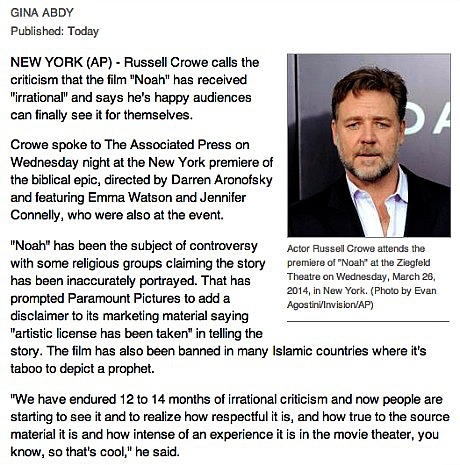
In an AP story posted today (3.27), reporter Gina Abdy has sought to ignite controversy by suggesting that Noah star Russell Crowe was out of line when he described Christian nutter objections to the unseen Noah as “irrational.” Of course such objections are irrational — how else to describe believers in a made-up myth objecting to a film that weaves in alternate myths in a re-telling of same? On top of which…hello?…Christianity itself is irrational. There couldn’t be a Christian faith (or any belief in any deity or after-life) without a basic investment in irrationality.

“Terminator Stiffened Into Tin Man”

“In writer-director David Ayer’s End of Watch, there wasn’t a moment that didn’t feel lived-in and true. The same cannot be said of Ayer’s Sabotage, a gruesome and frequently preposterous B-grade actioner about an elite team of DEA agents who run afoul of a ruthless Mexican cartel — and each other. That the team’s battle-scarred leader is played by Arnold Schwarzenegger, in the best and most substantial of his post-Governator comeback roles, gives a mild kick to this otherwise strained attempt at a latter-day “Wild Bunch” or “Treasure of the Sierra Madre” updated to the mean streets of metro Atlanta. Likely to repel even some of the hard-R action crowd with its intentionally scuzzy milieu and lack of a rooting interest, this $35 million Open Road release will be hard-pressed to top End of Watch‘s $41 million domestic haul.” — from Scott Foundas‘s 3.27 Variety review.

Read more

Latest Emmerich Disaster Pic, Sans Emmerich

Roland Emmerich owns Into The Storm (Warner Bros., 8..14) even if he has nothing to do with it. Hard-drive disaster movies have been stamped with his DNA. Storm will probably be mediocre in the acting, thematic and and screenwriting departments, but I have to admit the impressive VFX have me hooked. The director is Stephen Quayle, a Charlie Nobody if I ever heard of one. Director of Final Destination 5, second-unit director on Avatar and Titanic…strictly a jizz-whizz journeyman. But hats off the visual effects team.

Skanky, Pre-Corporate Manhattan of ’60s, ’70s and ’80s

An assortment of clips from New York-centric films of the ’60s, ’70s and ’80s might suggest a portrait of grime, grit and squalor — a city that used to scare the shit out of tourists who dared to venture out of the Times Square area. But Jonathan Hertzberg‘s “Dirty Old New York” is not that. It’s mainly a portrait of old analog Manhattan — a world of dicey-looking black guys with big Afros, gas guzzlers, dial pay phones, trash on those John Lindsay-Abe Beame streets, turntables, tube television sets, a co-residing Dustin Hoffman and Mia Farrow, 3/4″ video tapes, VCRs, etc. A nice time-trip thing, but I wouldn’t call it “dirty.”

Strong Girl Impression

“20th Century Fox showed an extended clip of David Fincher‘s Gone Girl this morning [at Cinemacon in Las Vegas]. Can’t wait for this one. It looks really great. The usual atmosphere we’ve come to expect from Fincher is there. I was most impressed by the footage we saw of Ben Affleck‘s performance. I think it’s safe to say that working with Fincher kicked up his game a couple of notches, based on what was on display. ” — an email just received from Boxoffice.com’s Phil Contrino.


Gone Girl director David Fincher, star Ben Affleck during filming.

Best LexG-Level Action Flick Piece In…Years?

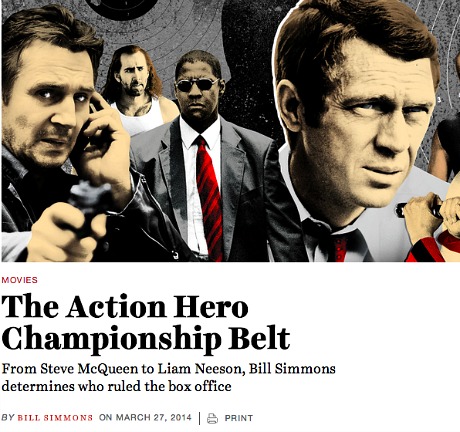
Every other year Grantland‘s Bill Simmons, whose metier will always be sports-writing, bangs out a piece about movies. Almost (I say “almost”) every time he does this he slams a ground-rule double or a triple — he always tags it pretty hard. I love Simmons’ voice. He’s Grantland‘s all-guy antidote to the studiously passionate know-it-allism of Mark Harris. His latest effort, posted today (i.e., 3.27), is called “The Action Hero Championship Belt,” a chapter-by-chapter review of the peak moments of greatest action stars of the last 45 years (starting with Steve McQueen in 1968’s Bullitt), is a major kick and possibly the best Simmons movie piece ever written. But since he’s only tapped out…what, seven or eight movie articles in his entire life this praise is obviously modified if not faint.

Simmons, of course, is a grade-A, brand-name columnist and cultural seer, but my first reaction was that this sort of regular-guy-dealing-straight-cards and dispensing-with-any-semblance-of-pretentious-bullshit style of movie-writing is owned these days, in my mind at least, by LexG. Simmons is a veteran pro, of course — more skilled and seasoned than Lex and in no apparent way saddled or distracted by alcoholism or hookers — but he’s such a dilletante-ish dabbler that this particular voice is primarily owned by that tortured and lamenting voice of Agonized Horndog, Underpaid Caption-Inserter and Chinese Wizard Imprisonment. I’m serious.

Read more

Basic YA Formula

Hollywood’s four biggest YA franchise properties of the last few years are, of course, The Hunger Games, Fifty Shades of Grey, Divergent and the over-and-done-with Twilight. All are trilogies in book and (presumably in the case of Divergent and Fifty Shades) movie form. Their authors, respectively, are Suzanne Collins, EL James, Veronica Roth and Stephenie Meyer. What do these women have in common? Not age — Collins and James are 51, Meyer is 40, Roth is 25. Their trilogies are, of course, romantic fantasies (dystopian, urban, fantastical) about young women who possess or command great power. The guys in these novels are, of course, intensely devoted to and in love with the heroines — The Hunger GamesKatniss Everdeen, Fifty ShadesAnastasia Steele, Divergent‘s Beatrice Prior and Twilight‘s Bella Swan. What else do the authors have in common? A German exhibition guy I was speaking to at Cinemacon said they’re all kind of…uhm, plus-sized. But that’s not apparently true in the case of Collins and Roth. They’re not Angelina Jolie but c’mon…writers are never as attractive as movie stars. This is partly, I’m sure, what led them to write these books. All fiction writers are creators of alternate worlds that they very much prefer to the real one.


(l.) Fifty Shades of Grey trilogy author EL James (a.k.a. Erica Leonard); (r.) Hunger Games trilogy author Suzanne Collins.


(l.) Twilight series author Stephanie Meyer; (r.) Divergent trilogy author Veronica Roth.