Alphabet City Confidential

Shari-Springer Berman and Robert Pucini‘s Ten Thousand Saints, a coming-of-age drama set in late ’80s Manhattan, is another Sundance film I missed last January. It has a 67% Rotten Tomatoes rating, which suggests an issue or two. JoBlo’s Chris Bumbray: “While the fact that Ethan Hawke [plays] an absentee father will likely draw comparisons to Boyhood, in reality this is more like a John Hughes movie than anything else, right down to the finely curated ’80s soundtrack and frequent lapses into heavy melodrama. The latter is not a criticism — I happen to like melodrama.”

Bumbray says it’s “set in Alphabet City right on the cusp of its gentrification”…bullshit. No way was Alphabet City about to be gentrified in 1987, which is the year that Eleanor Henderson’s book takes place. I roamed around Alphabet City a lot during the ’90s and even then it didn’t seem to be gentrifying very much. Maybe a tiny bit. When did the neighborhood really start to go bucks up? Try the early aughts. And it wasn’t really, really gentrified until 2010 or thereabouts. The ’80s were a fairly scuzzy time in Alphabet City. I used to scrape the scuzz off the soles of my boots so don’t tell me.

Come And Get Your Money

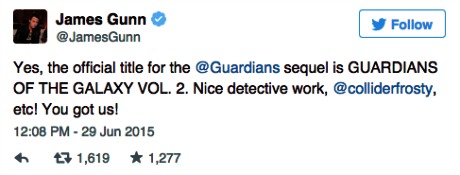
Earlier this month I asked a rhetorical question about the James Bond franchise. What would we lose as a community or a culture if a final, irrevocable pledge was made by producers Michael Wilson and Barbara Broccoli to never make another 007 film again, to just walk away and leave it forever? Allow me to ask the same question about the Guardians of the Galaxy franchise. Suppose that director James Gunn and star Chris Pratt and all the producers suddenly said, “We don’t really need the money, and the audience doesn’t need another Guardians movie…admit it. The first Guardians was fine. Where is it written that we’re obliged to fuck things up with a sequel? Even if we made a half-decent film, who would really care at the end of the day? The crowd would pay to see it, eat their popcorn, have a good time, quietly fart a few times in their seats and go home. Can we be honest? We don’t have a single half-decent idea for the sequel yet. Not one. But we’re making it anyway because we all want second homes.”

Read more

The Old Crowd

The other day a friend mentioned a pending high-school reunion. Okay, fine, I wanted to say, but if you were fundamentally unhappy and occasionally miserable in high school (as many of us were, and as I definitely was), you’ll need to stash that history in your locker and keep it there until the reunion is over.

Reunions tend to remind a lot of us what a regimented environment and cultural concentration camp high school was. Most of us only realize this after we’ve found our footing as adults. I was lost but now I’m free, or certainly a lot freer.

My high-school years didn’t feel “miserable” in an unmistakable, lemme-outta-here sense; the unhappiness I lived with seeped into my system in a hundred subtle ways. I wasn’t anti-social but I didn’t party and run around all that much until my senior year, and once that phase kicked in I became a madman. The truth is that on a certain level I was a kind of functioning alcoholic (no serious behavioral problems but a few serpents under the surface) from my late teens until I quit the hard stuff in the mid ’90s. The real healing didn’t begin until I went sober three years ago, or so I tell myself.

Before I socially flowered I watched a shitload of TV and listened to a lot of music and lived in my head. I was a secret genius who could potentially be persuaded to join the crowd, but no one ever asked. I know that my father’s alcoholism felt and smelled like mustard gas in our home, especially during dinner hour, and that my self-esteem was in the basement. I mostly felt apart, diminished and unworthy when it came to women. In school I didn’t do sports or join clubs or do anything extra-curricular except for detention.

My life didn’t really kick into gear until my mid 20s when the journalism started, and even that was agony until I became a half-decent writer and had learned the ropes and gotten to know people, etc.

Everyone has a look of excitement and anticipation in their eye after they’ve graduated high school and are about to start college. The great adventure! When I attended my 25th celebration most of my ex-classmates had either surrendered that gleam or put it into a bureau drawer somewhere. To me they looked sedate, staid, settled. All except for a small fraternity, which I estimated to be maybe 5% of the crowd. X-factor types with a semblance of life in their veins. Looking for action, adventure, the next discovery.

Sinclair Lewis said the following to his high-school class at a reunion in the ’20s: “When we were young most of you didn’t give a shit about me, and now that we’re older I don’t give a shit about you.”

That’s obviously not a very nice thing to say. While I would never go there, I understand the urge.

HE Meerkat Feed Around The Corner

Hollywood Elsewhere’s long-nurtured dream of live video feeds is finally at hand. Last Friday morning re/code’s Kurt Wagner reported that Meerkat, the livestreaming video app that broke out during South By Southwest last March, is now allowing users to embed their livestreams directly onto their websites. The option “may provide publishers with a little more incentive to stream more often,” Wagner speculated, “or use Meerkat over Twitter’s rival service Periscope, which doesn’t have an embed option.”

My first wish piece along these lines was posted in March 2012. I posted another one last March, stating that “there surely must be some way to adapt Meerkat’s or Periscope’s skill sets to generate Hollywood Elsewhere video from my iPhone at the touch of a button and have it appear on the site…live events happening at the Cannes Film Festival, say, or during a sojourn in Rome, Paris or Prague or wherever.”

Read more

Get Those Guys

Last Thursday Memphis Mayor A.C. Wharton called for the removal of the grave of respected Confederate general Nathan Bedford Forrest from a Memphis city park, along with an attached memorial. The reason is that Forrest was a one-time Ku Klux Klan Grand Dragon and slave trader. I understand and support Wharton’s view but with two qualifications. One, Forrest was a ruthless but quite brilliant general. He seems like a villain by today’s criteria but by the standards of his time and culture he was regarded as a heroic and formidable figure. And two, once you start removing monuments of renowned 19th Century figures who supported slavery or owned slaves, you’re on a slippery slope. As we all know, George Washington, Thomas Jefferson and ten other U.S. Presidents owned slaves. Where do you draw the line? I’m presuming that Wharton would say that anyone with a public statue who belonged to the KKK is fair game. I can’t argue with that.