Sure Doesn’t Feel Like 18 Years Ago

I was working at People when Diana, the former Princess of Wales, started seeing Dodi Fayed in July 1997. Two or three of us were asked to search around, make some calls and prepare a file on the guy. Within three or four hours I’d learned that Fayed was an irresponsible playboy, didn’t pay his bills on occasion, lacked vision and maturity and basically wasn’t a man. And yet Diana overlooked this or didn’t want to know. And that’s why she died.

In short she essentially orchestrated her demise due to choosing a profligate immature asshole for a boyfriend. Fayed was just foolish and insecure enough, jet-setting around with his father’s millions and looking to play the protective stud by saving Diana from the paparazzi, to put her in harm’s way.
Read more

Sudekis Moving Past Twerps? Great…But The After-Vibe Lingers

After playing nothing but sardonic twerps, sexual hounds and domestic dolts for the last six or seven years in Hall Pass, A Good Old Fashioned Orgy, Horrible Bosses, The Campaign, Drinking Buddies, We’re the Millers and Horrible Bosses 2, Jason Sudekis has suddenly turned over a new leaf and shifted into “heartthrob territory” in Sleeping With Other People (IFC Films, 9.11).

That’s the basic notion, at least, contained in yesterday’s 8.30 N.Y. Times profile of Sudekis by Kathryn Shattuck.

I’ve seen and had a pretty good time with Sleeping With Other People. There’s no question that Sudekis does a fine job of playing his best-written character yet — a smart, sensitive 30something sex-addict named Jake. A guy who seems relatively mature and balanced and open to the moment, and who knows how to treat a lady with kindness and tact. And who definitely knows what to do with his fingers.

I muttered to myself right away, “Okay, for once Sudekis is playing a guy who’s not only tolerable but somebody I can identify with.”

Read more

Satan Laughing With Delight

I don’t care if this video is a year old. I watched this about 15 times last weekend and I can’t get it out of my head. Look at that poor little girl’s expression when this godawful harridan takes the ball from her. And then the pixie-cut thief celebrates her triumph! Has she been flown to Syria and handed over to ISIS yet? Has anyone ever confronted her on the street and accused her of being one the worst people to walk the planet ever? I’ll bet even Heinrich Himmler never did this to a kid.

Tarantino Kinda Busted By Leydon Over Numerous Similarities Between Hateful Eight and 55 Year-Old “Rebel” Episode

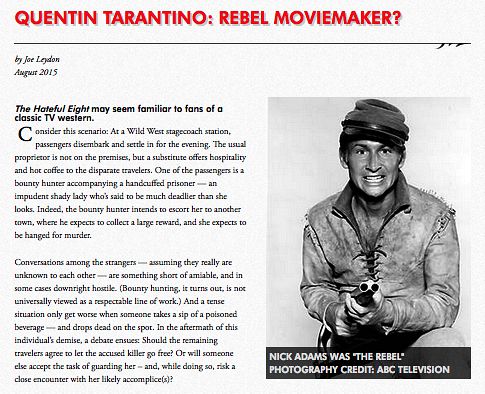
In a just-posted Cowboys & Indians piece called “Quentin Tarantino: Rebel Filmmaker?”, Variety critic Joe Leydon has noted several similarities between the basic plot bones of Tarantino’s The Hateful Eight (Weinstein Co., 12.25) and an episode from the Nick Adams western series The Rebel (’59 to ’61) called “Fair Game.” The episode, written by Richard Newman, premiered on 3.27.60 as one of 33 Rebel episodes directed by Irvin (The Empire Strikes Back) Kershner.

I’ve read a draft of the Hateful Eight script and to go by Leydon’s synopsis of “Fair Game”, there are quite a few plot points shared by the two. If you’re willing to supply your credit card information (which I’m not — fuck these guys) “Fair Game” is watchable right here.

Leydon is quick to say that he’s “not accusing Quentin Tarantino of plagiarism.” He notes that everybody stole from everybody else back in the old TV days, and that Tarantino has already admitted to Deadline‘s Michael Fleming that he drew inspiration for The Hateful Eight “from such fondly remembered series as Bonanza and The Virginian.” QT to Fleming: “What if I did a movie starring no heroes, no Michael Landons? Just a bunch of nefarious guys in a room, all telling backstories that may or may not be true. Trap those guys together in a room with a blizzard outside, give them guns, and see what happens.”

Read more

Basic Dramatic Fulfillment

In an 18 year-old Paris Review piece inexplicably linked to by Movie City News, David Mamet explains “the trick of dramaturgy” as follows: “The main question in drama…is always what does the protagonist want. That’s what drama is. It comes down to that. It’s not about theme, it’s not about ideas, it’s not about setting, but what the protagonist wants. What gives rise to the drama, what is the precipitating event, and how, at the end of the play, do we see that event culminated? Do we see the protagonist’s wishes fulfilled or absolutely frustrated? That’s the structure of drama. You break it down into three acts.”

And that’s fine, but I’ve long believed that the most affecting kind of drama (or comedy even) is one in which the main protagonist wants something and then somewhere during Act Two discovers that he/she actually wants something else. Something that is less a thing of mood or sexuality or a longing for wealth or advancement and more of a tender, deeper, more emotional longing. A personal growth move, falling in love, doing the right moral thing. A character who stays with the same desire all the way through a play or a film is not, in my view, an interesting one. We don’t want to see the protagonist’s wishes “fulfilled or absolutely frustrated,” as Mamet says. We want to see those wishes evolve and thereby reveal something unexpected.

Read more

“Who Are You?”

“I have found a disease that no one has ever seen.” In Peter Landesman‘s Concussion (Columbia, 12.25), Will Smith plays Dr. Bennet Omalu, the Nigerian-Born, real-life forensic pathologist who 13 years ago discovered chronic traumatic encephalopathy or CTE — a then-new disease affecting football players. When he revealed his findings the NFL naturally did everything they could to discredit him. What else were they going to do?

You can sense right away that Smith’s Nigerian accent feels right, and this alone may put him into the Best Actor conversation. Because it feels like “acting,” and a lot of folks eat that shit up.

As things now stand Concussion is one of five award-season contenders due to open on 12.25 — this plus The Revenant, Snowden, Joy and The Hateful Eight. That’s a lot of Christmas Day competition. The only semi-uplifting film in the bunch is Joy. I’m guessing that at least one of others will blink and move their date to early December or perhaps even late November.

Read more

What Is 2015’s Best-Known Signature Line?

“I drink your milkshake.” “If it ain’t, it’ll do till the mess gets here.” “Fame has a fifteen minute half-life — infamy lasts a little longer.” “Show me the money.” “I have had it with these motherfucking snakes on this motherfucking plane!” “Nobody’s perfect.” “Made it, ma — top of the world!”

I’ve been racking my brain and the only stand-out line from a 2015 film that I can think of is “Baskin Robbins always finds out.” From Ant-Man, of course. A catchy meme is never just catchy — it needs to spread out and take root out when you think about it for 10 or 12 seconds. And when you let the Baskin-Robbins line percolate you realize it’s just another way of saying (a) everything comes out in the wash, (b) there are no secrets in 2015, (c) a possibly benevolent Big Brother is listening 24/7, and (d) Edward Snowden accomplished too little and acted too late, etc.

I’m presuming there are other signature lines from films released during the first two-thirds of 2015. Please submit for consideration.

First Surfacing of the “Honest Trailers” Aesthetic

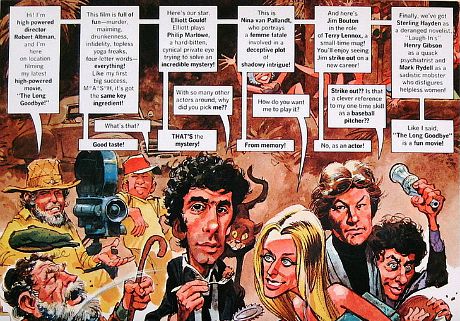
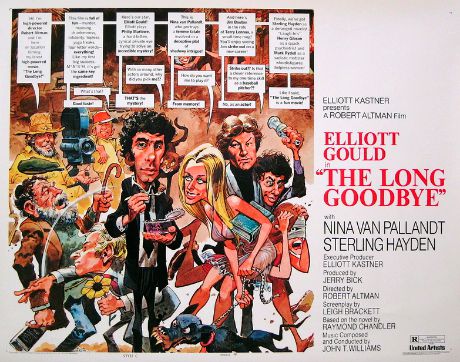
It occurred to me this morning that Jack Davis‘s legendary Long Goodbye poster (which was drawn, of course, in the Mad magazine illustrator’s trademark style — big heads, spindly legs, big feet) was an early print version of the playfully critical style of Honest Trailers. Except the dialogue balloons in Davis’s poster aren’t that playful — they’re bluntly critical by suggesting that The Long Goodbye is a coarse, somewhat tasteless film with a less than stellar lead (i.e., Elliott Gould) and a cast of curious eccentrics, two of which are portrayed by Hollywood interlopers (Nina van Pallandt, Jim Bouton). It was almost a warning to the none-too-hip crowd of 1973 that they might want to see something else. I’ve always worshipped the Davis poster but a smart one-sheet always appeals to the dolts along with the hipsters. What other theatre-lobby posters have suggested to Average Joes that they might not want to patronize this or that film?

Read more