Up In The Air

2015 was obviously a crazy year and very closely competitive, and of course it’s not over until Oscar night — Sunday, 2.28. If one thing is clear it’s that the so-called “experts” don’t know jack about the Best Picture race. They were totally taken by surprise by The Revenant‘s Golden Globe triumph; ditto Alejandro G. Inarritu‘s Best Director win. And only…what, two know-it-alls (Sasha Stone, Glenn Whipp) predicted that The Big Short would win the PGA’s Daryl F. Zanuck award?
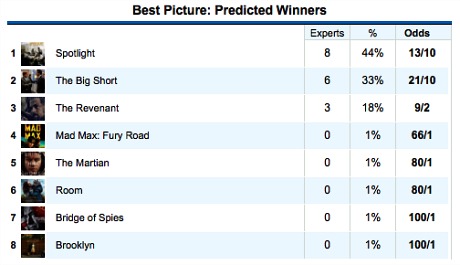
If you ask me there’s only advocacy and determined advocates/detractors like myself. I didn’t care what the odds said last year; I was a committed Birdman guy no matter what. To me there’s only (a) “here’s what I want to win,” (b) “here’s what my latest insect antennae vibrations are telling me” and (c) “screw the odds and to some extent the guilds.”

And yet I’m comforted by the fact that the Gold Derby gang, thought to be sensitive to at least some of the currents out there, is still favoring Spotlight, HE’s personal favorite, to win the Best Picture Oscar. I realize that everyone is holding their water until the 1.30 SAG awards, and then, I guess, the 2.6 DGA awards. Plus I realize that final Academy voting doesn’t begin until 2.12.16 and then closes on 2.23.16. Things can shift around between now and then. Nothing is chiselled in stone except Leo.

But if The Big Short wins the SAG ensemble award, it’s fucking over.

Read more

Right Kind of Subtlety From Spotlight Editor Tom McArdle

Spotlight is not flashy but is fairly dazzling in its efficiency. That’s what I’ve loved about Tom McCarthy‘s film from the start. Clean, true and always on-point. Tom McArdle‘s cutting doesn’t call attention to itself, but every transition is smooth and fleet as a fox. Not for nothing has McArdle, a longtime collaborator of McCarthy’s, been nominated for an editing Oscar. I ran into McArdle at a party the weekend before Sundance, and a day or two later we did a q & a:


Spotlight editor and longtime Tom McCarthy collaborator Tom McArdle

HE: You and McCarthy go back…what, 12 or 15 years? What’s the history?

McArdle: In 2002, my agent sent me Tom McCarthy’s Station Agent script. It was really good. Very thoughtful and funny. I’m L.A.-based but I travelled to New York to meet with McCarthy. We talked about the script and other films that might have a similar feel. I brought up that I was a fan of Local Hero (’83) and that it felt somewhat comparable in tone to The Station Agent. Tom also liked Local Hero a lot, so that was a good thing. We got along well. The Station Agent was a quick edit — 13 1/2 weeks total, due to the Sundance schedule and the budget. We followed The Station Agent with The Visitor in 2006, and then Win Win in 2010.

HE: I for one would love to see a longer version of Spotlight. Was there a longer cut that you personally liked but had to be trimmed down for the usual reasons?

McArdle: We cut out about 18 minutes total from the film. The final version that you see is also my favorite version of the film.

HE: There must have been some scenes that you or McCarthy loved but which didn’t strictly serve the narrative. What were those scenes?

McArdle: We cut out five scenes plus some other shots here and there. We cut out a scene of Robby (Michael Keaton) and his wife after golf where she mentions that the church is important to the community. We dropped a scene with Marty (Liev Schrieber) and the publisher Gilman (Michael Countryman) where Gilman asks to be kept in the loop about the church story. We also dropped a scene of Marty and Ben (John Slattery) talking about getting back on the case after 9/11. We dropped a scene between Mike (Mark Ruffalo) and the receptionist for the judge where Mike gets frustrated that the judge is not around. We also dropped a scene of Mike getting the morning newspapers and ignoring a phone call from his estranged wife.

Read more

Smart Guys Know When To Dump Stock

“It is a critical phenomenon I call ‘buying stock’. Critics and viewers consciously or unconsciously purchase shares in an artist’s work. 10,000 shares of Tarantino, 50,000 shares of Star Wars, etc. Once a viewer has purchased stock in an artist he/she becomes committed to that stock valuation.

“I first noticed this when Peter Bogdonavich purchased a massive holding in Howard Hawks and was then thrust into the awkward position of defending Man’s Favorite Sport. I’ve watched as cinephiles have purchased stock in DePalma, Carpenter, the Coen Bros. to the point that they are no longer objectively assessing the work but instead defending their investment.

“The latest is Hou Hsiao-Hsien and the assumption by stock holders that The Assassin must be a masterpiece because he worked on it for eight years.” — Posted last night by director-writer Paul Schrader on Facebook.

I could write 50,000 words right now about the various directors I’ve invested in over the years — when I bought the stock in each director and why, and how long I held onto the stock portfolio before dumping it. We all try to justify our stock purchases, sometimes against basic reason, but on the other hand you don’t want to be too foolish. The key thing is to knowing when to dump stock.

Read more

Last Full Day in Dodge

I fly back to Los Angeles tomorrow around 1 pm so this is the last day. No rush, no worries, take your time, do a wash. I’m catching Kim Snyder‘s Newtown, a doc about recovering from the Sandy Hook massacre, at the Holiday Village at 3:15 pm. Next is Robert Cannan and Ross AdamsThe Lovers and the Despot, which Magnolia just acquired. And finally a second viewing of Nate Parker‘s The Birth of a Nation…kidding!


Taken after a dinner I had two nights ago with HE’s own Svetlana Cvetko, editor David Scott Smith. 35 minutes later we attended a Library screening of Jason Lew’s The Free World, which is easily the worst film I’ve seen at Sundance ’16. Condolences to costars Boyd Holbrook, Elizabeth Moss, Octavia Spencer.

Prior to last nights screening of Douglas McGrath’s Becoming Mike Nichols.

Read more

Suddenly Raining Nichols

Last night I attended a Sundance screening of Douglas McGrath‘s Becoming Mike Nichols (HBO, 2.22), a 72-minute chat between Nichols and Jack O’Brien that was taped late in the summer of ’14, or about three months before Nichols passed at age 83. It’s very good as far as it goes — time well spent with a guy who knew his stuff and how to tell a good story, and who knew from wisdom and smoothitude with a pinch of irony.


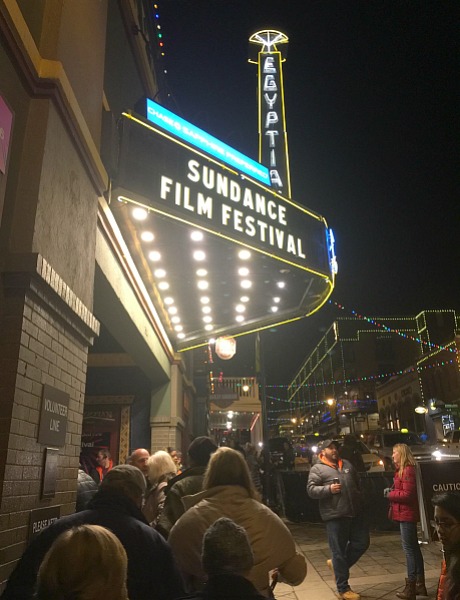
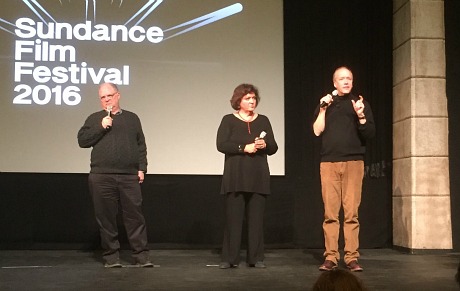
Becoming Mike Nichols director Douglas McGrath (r.) and exec producer Frank Rich (l.) following last night’s debut screening at Park City’s Egyptian theatre.

Any conversation with a gifted and loquacious fellow is probably worth your time, but Becoming Mike Nichols is about one of the greatest directors ever talking about the most vital and exciting period in his life, or between the beginning of Nichols’ comedic-improv partnership with Elaine May in the late ’50s through his directorial triumph with The Graduate in ’67.

McGrath’s rationale for keeping the doc short is sound. The “hungry and exploring and trying to make it” chapter in anyone’s life is always the most robust. Things are never quite as exciting once you’ve become a success. Then your story becomes a story about whether to risk or maintain, and because people almost always try for a lopsided mixture of the two (a hint of risk with a lot of maintenance) something always dies or slows down in the narrative.

What’s the best line in the whole piece? An observation about marriages or romantic relationships. At any given moment, Nichols tells O’Brien, a relationship is either about (a) seduction, (b) negotiating or (c) fighting. You’d think that a healthy pairing would be about more than this, but as I thought about it last night as I walked home I began to realize that Nichols was right.

Another Nichols tribute, a PBS American Masters tribute directed by May, airs tonight (1.29). McGrath’s doc, as noted, debuts on February 22nd.

Read more

Rivette Hat Tip

I know the American movie realm fairly well; less so the European one. And because I am, or can be when the mood strikes or I fall into a mood pocket, an occasional cinematic Philistine, I never got into Jacques Rivette, who died today at age 87, until La Belle Noiseuse came along in 1991. I’m not attuned or hip enough to have even seen, much less appreciated, Rivette’s The Nun (’66) and for whatever reason I was only vaguely taken with Celine and Julie Go Boating (’74) when I saw it at the Carnegie Hall Cinema in the late ’70s.

But the prospect of studying a naked Emmanuelle Beart for the better part of four hours intrigued me to no end, and so I watched La Belle Noiseuse, all 237 minutes worth, when it opened in late ’91 or early ’92 in Los Angeles. (I forget exactly where but I’m sure it was either the Royal or the Nuart.) And I’ll never regret it.

Wiki boilerplate: “[Rivette’s] films, often improvised, have brief outlines instead of scripts, long running times and loose narratives. They explore themes such as conspiracy theories, fantasy and theatricality in daily life.” Rivette on James Cameron and Titanic: “Cameron isn’t evil. He’s not an asshole like Spielberg. He wants to be the new De Mille. Unfortunately, he can’t direct his way out of a paper bag. On top of which the actress is awful, unwatchable.”