Last Full Day in Dodge

I fly back to Los Angeles tomorrow around 1 pm so this is the last day. No rush, no worries, take your time, do a wash. I’m catching Kim Snyder‘s Newtown, a doc about recovering from the Sandy Hook massacre, at the Holiday Village at 3:15 pm. Next is Robert Cannan and Ross AdamsThe Lovers and the Despot, which Magnolia just acquired. And finally a second viewing of Nate Parker‘s The Birth of a Nation…kidding!


Taken after a dinner I had two nights ago with HE’s own Svetlana Cvetko, editor David Scott Smith. 35 minutes later we attended a Library screening of Jason Lew’s The Free World, which is easily the worst film I’ve seen at Sundance ’16. Condolences to costars Boyd Holbrook, Elizabeth Moss, Octavia Spencer.

Prior to last nights screening of Douglas McGrath’s Becoming Mike Nichols.

Read more

Suddenly Raining Nichols

Last night I attended a Sundance screening of Douglas McGrath‘s Becoming Mike Nichols (HBO, 2.22), a 72-minute chat between Nichols and Jack O’Brien that was taped late in the summer of ’14, or about three months before Nichols passed at age 83. It’s very good as far as it goes — time well spent with a guy who knew his stuff and how to tell a good story, and who knew from wisdom and smoothitude with a pinch of irony.
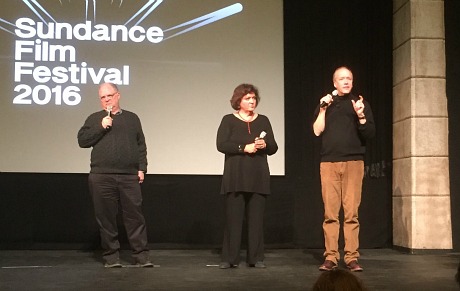

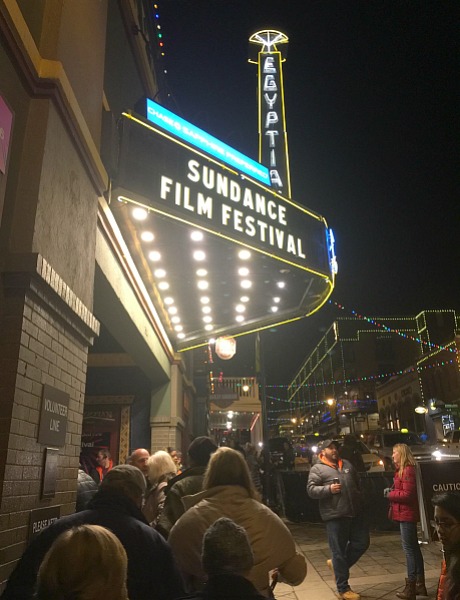
Becoming Mike Nichols director Douglas McGrath (r.) and exec producer Frank Rich (l.) following last night’s debut screening at Park City’s Egyptian theatre.

Any conversation with a gifted and loquacious fellow is probably worth your time, but Becoming Mike Nichols is about one of the greatest directors ever talking about the most vital and exciting period in his life, or between the beginning of Nichols’ comedic-improv partnership with Elaine May in the late ’50s through his directorial triumph with The Graduate in ’67.

McGrath’s rationale for keeping the doc short is sound. The “hungry and exploring and trying to make it” chapter in anyone’s life is always the most robust. Things are never quite as exciting once you’ve become a success. Then your story becomes a story about whether to risk or maintain, and because people almost always try for a lopsided mixture of the two (a hint of risk with a lot of maintenance) something always dies or slows down in the narrative.

What’s the best line in the whole piece? An observation about marriages or romantic relationships. At any given moment, Nichols tells O’Brien, a relationship is either about (a) seduction, (b) negotiating or (c) fighting. You’d think that a healthy pairing would be about more than this, but as I thought about it last night as I walked home I began to realize that Nichols was right.

Another Nichols tribute, a PBS American Masters tribute directed by May, airs tonight (1.29). McGrath’s doc, as noted, debuts on February 22nd.

Read more

Rivette Hat Tip

I know the American movie realm fairly well; less so the European one. And because I am, or can be when the mood strikes or I fall into a mood pocket, an occasional cinematic Philistine, I never got into Jacques Rivette, who died today at age 87, until La Belle Noiseuse came along in 1991. I’m not attuned or hip enough to have even seen, much less appreciated, Rivette’s The Nun (’66) and for whatever reason I was only vaguely taken with Celine and Julie Go Boating (’74) when I saw it at the Carnegie Hall Cinema in the late ’70s.

But the prospect of studying a naked Emmanuelle Beart for the better part of four hours intrigued me to no end, and so I watched La Belle Noiseuse, all 237 minutes worth, when it opened in late ’91 or early ’92 in Los Angeles. (I forget exactly where but I’m sure it was either the Royal or the Nuart.) And I’ll never regret it.

Wiki boilerplate: “[Rivette’s] films, often improvised, have brief outlines instead of scripts, long running times and loose narratives. They explore themes such as conspiracy theories, fantasy and theatricality in daily life.” Rivette on James Cameron and Titanic: “Cameron isn’t evil. He’s not an asshole like Spielberg. He wants to be the new De Mille. Unfortunately, he can’t direct his way out of a paper bag. On top of which the actress is awful, unwatchable.”

“Never Audacious or Revelatory”

In the view of BBC.com’s Owen Gleiberman, Nate Parker‘s The Birth of a Nation is “scrupulous and honorable, with moments of scalding power. But it’s also just good enough to make me wish it had been better. To present a drama of slavery not so long after 12 Years a Slave, the most searing and artful movie ever made on the subject, is to scale a very high bar. Parker proves a competent filmmaker, but in a slightly flat, middle-of-the-road way that’s halfway between Edward Zwick and Ron Howard.

“If the film were as good as Zwick’s 1989 Glory, I’d have no complaints…but it isn’t. It features a musical score that’s atrocious in its bland sentimentality, and there’s something a little too cautiously retrograde about the whole thing. It’s like a rerun of Roots with more blood.

“In one of the most unforgettable scenes in 12 years a Slave, Lupita Nyong’o’s character is being whipped, and the camera fixes on her face (the way it always does in scenes like this) until it suddenly spins around to show us the leather tearing at her flesh; at that moment, the film slices through ‘movie reality’ to reveal a far more agonizing truth.

Read more

Bit By Bit, The Truth Emerges

“Although Nate Parker has called The Birth of a Nation ‘a black Braveheart,’ his rough-hewn directorial debut is less a traditional awards movie than Ava DuVernay‘s Selma from 2014, or even the Philadelphia-shot Creed from last year. The movie’s substantial power is lessened by significant lapses in judgment — the glowing figures who appear to Turner in religious visions tilt perilously close to kitsch — and the movie’s failure to delineate characters beyond Turner and his white owner (The Social Network‘s Armie Hammer) lessens its dramatic scope.

“But when Parker fills the screen with the faces of young slaves, framed so tightly that their 19th-century clothing drops out of sight, you’re no longer watching a period piece or dead history, but looking at the faces of young black men in 2016, demanding their humanity be fully recognized. It’s far from a perfect film, but it fills an aching need in society and the movie industry both, and should find a substantial audience waiting for it in the fall.” — from “Six Sundance Movies To Pay Attention To,” a Philly.com piece by Sam Adams.

Kathryn Bigelow To Direct Detroit Riots Film? Hey, Wait A Minute…She’s White! Have We Learned Nothing?

Kathryn Bigelow will direct and produce a Detroit Riots project, set in 1967, which they’re now calling an “untitled true-crime drama.” She and longtime collaborator Mark Boal are pooling forces with Annapurna’s Megan Ellison and Matthew Budman. Boal has penned the original screenplay. Pic is set to begin principal photography this summer. Boal has been researching and working on the project, which explores “systemic racism in urban Detroit”, for more than a year. Pic is expected to open in 2017 — the 50th anniversary of the riots.

From Joe Leydon: “The #OscarsSoWhite crowd will start complaining that a black director wasn’t hired for this project in 5…4…3…” Then again she’s a woman so maybe it all kinda balances out. (No?) 

Oliver Stone would have been a natural for this project 15 or 20 years ago.  But today Stone or any similar-type director (heyday in the ’80s and ’90s) would have two strikes against them — (a) white and (b) old-farty, tied to the past, etc.

The Anxiety of the One-Eyed Jacks Aspect-Ratio Decision Makers

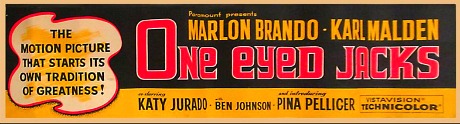
About 10 days ago I spoke to a Universal source about the progress of the forthcoming One-Eyed Jacks Bluray, a joint restoration between Universal Home Video and the Film Foundation that I’m assuming will street sometime in the spring or summer. (Work began last July.) The big question is what aspect ratio will they decide upon — 1.85:1, 1.78:1 or 1.66:1? I’m presuming that my personal preference of 1.66 will be passed over in favor of 1.78, which I can live with. It breaks my heart but I can take it. As long as they don’t whack it down to the dreaded 1.85:1.

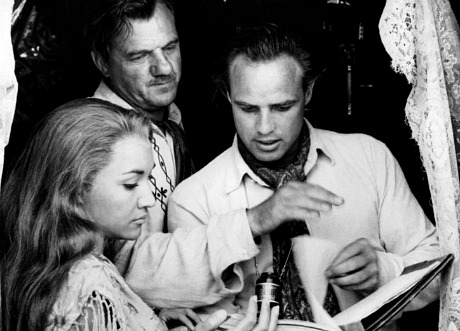
I’m told that when work began on Marlon Brando‘s sole directorial effort it was scanned at the full VistaVision aperture, or 1.5:1. Universal was waiting for input from Martin Scorsese and Steven Spielberg, who were both in the process of reviewing the restoration (or about to review it), when I reached out.

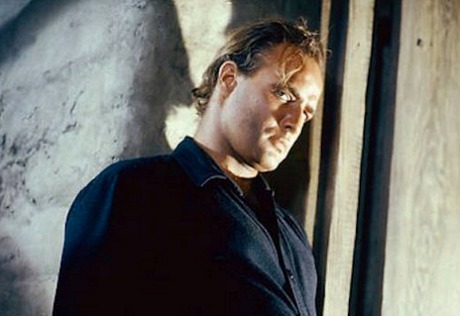
Some weeks ago Austin Wilkin, a Brando estate representative who had been asked by Universal for an aspect-ratio preference, sought my opinion. I said it should be 1.66 if the sides aren’t sliced off. Why throw away all that beautiful VistaVision footage on the tops and bottoms of the frames?

We all know One-Eyed Jacks was primarily projected at 1.85 but that dp Jack Lang‘s compositions were made with an understanding that the full aperture would be 1.5:1, that 1.66 was very much in play at the time (the aperture plates were certainly present and being used in theatre booths all over) and that the boxy TV aspect ratio had to be considered. My guess, as noted, is that Universal and The Film Foundation are going to go for a 1.78:1 as this fits 16 x 9 high-def screens, and it at least allows for a bit more height than 1.85.

I was also told that some kind of limited theatrical exhibition will occur prior to or concurrent with with the release of the Bluray.

Read more

Swigging P.C. Kool-Aid

If you want to hear the pure, unfettered voices of the politically-correct cominterm regarding Hollywood racism, listen to Vanity Fair “Little Gold Men” podcasters Katey Rich and particularly Mike Hogan as they discuss same. Their view is that assessments of movies by the usual standards (excellence of acting, screenwriting, direction, editing, cinematography) need to be modified or eased up on in order to show a little generosity toward filmmakers of color. This is a socially compassionate “Little Red Book” approach to cinematic assessment, pure and simple. On the other hand VF‘s Richard Lawson, calling from Park City, tells the truth when he notes that Nate Parker‘s The Birth of A Nation is “not great art”, although it has caught the fervor of the moment. (You can almost hear Hogan audibly deflate when Lawson says this.) Lawson mentions the undisputed greatness of Kenneth Lonergan‘s Manchester-By-The-Sea — a surprising admission given the all-white cast.

Angry Academy Birds

My Sundance activities have interfered with a timely awareness of some interesting reactions to the recently revised Academy rules that are basically about taking the vote away from older white members, or more precisely those who haven’t been “active” within the last decade, and increasing the membership roster among African Americans, Latinos and somewhat younger people. For the last four days The Hollywood Reporter has posted several reactions to this change, and a clear majority of the posts have been intensely negative.

Four reactions were posted yesterday (1.27) — three negatives written by actress Rutanya Alda, short film and feature animation committee member Nancy Beiman and visual-effects guy John Van Vliet, and a stand-alone positive from The Color Purple costar Margaret Avery.

Four previous essays were posted on 1.25 — three negatives from director’s branch member Stephen Verona, public relations branch member Mark Reina and writers branch member Stephen Geller; the only 1.25 positive was written by directors branch member Rod Lurie. Another negative response, written by documentary branch member Milton Justice, was posted on 1.24.

Six negatives and two positives obviously argues with an assertion from the Academy that responses to the membership and voting rules have been largely positive/favorable. Hollywood Reporter columnist Scott Feinberg tells me that the essays were only partly solicited (some members got in touch on their own), and that the identities of the authors were carefully vetted.

Read more

Dickensian Moral Fable Reduced To Family-Friendly Barry Sonenfeld Wank In The Vein Of Look Who’s Talking? Pics

Nine Lives, a French-produced comedy about a shitheel billionaire (Kevin Spacey) trapped in the body of cat, could have been a comedic cross between Charles Dickens‘ “A Christmas Carol” and Franz Kafka‘s “The Metamorphosis” — a moral-redemption tale flavored with sharp, socially-resonant humor. Instead, to go by this Europa Corp. trailer, it’s been made into a coarse, low-rent Barry Sonnenfeld family comedy in the vein of those Look Who’s Talking? comedies. The Eurocorp production costars Christopher Walken, Jennifer Garner, Talitha Bateman, Mark Consuelos and Robbie Amell. Christophe Lambert and Luc Besson are listed as producers. Pic was going to open in April but was bumped to August 5th.

The Heat Is Gone

There was less of a pulse prior to yesterday’s 6 pm screening of Meera Menon‘s Equity than I’d felt during Sundance Film Festival screenings over the previous five days. “Everyone goes home on Tuesday,” an entertainment attorney explained. The buyers, she meant, plus much of the talent plus the party/entourage crowd. “Really? I thought they all went home on Wednesday,” I said, “but whatever.” Today things are barely percolating. You can definitely feel the absence of juice. But a downshifted festival has its advantages — more seats, less crowded buses, more of a devoted cineaste atmosphere.


Park City Marriott — Wednesday, 1.27, 11:20 am.

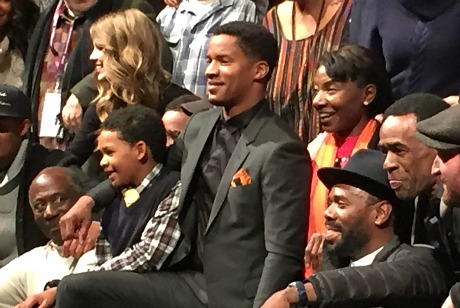
Nate Parker and The Birth of a Nation team on Eccles stage following Monday evening’s premiere screening.

Bedroom in HE’s 1-bedroom abode at Park City Regency.

Jim director Brian Oakes (far right) with (l. to r.) John Foley, Diane Foley (parents), French journalist who shared cell with James Foley (can’t pinpoint his name), former Syrian-coverage colleague of Foley’s (her name could be Manu Brabo or Clare Gillis…you tell me). Pic taken following Monday afternoon’s screening at Library.

Read more

Due Respect But Later

Sundance reactions to Louis Black and Karen Bernstein’s Richard Linklater: Dream is Destiny have been entirely favorable. The Hollywood Reporter‘s John DeFore called the doc “one of the most enriching and enjoyable about a filmmaker in recent memory.” Well and good, but when a publicist friend asked yesterday if I’d seen it I responded candidly. Linklater is definitely one of my favorite artists in this business, I said, but why is it worth my time during this super-busy festival to watch a kiss-ass portrait of the guy? I don’t need a sum-up tribute piece and neither, I would think, does Linklater. He’s nowhere near the end of his career — he’s in the thick of it and going great guns. I’ll watch it on cable when it pops a couple of months hence.